

11 Cool Ford Concept Cars That Never Made It To Production
Ford has been pleasing both enthusiasts and regular buyers for decades. Yes, it had some huge flops over the years, but how can you not respect an automaker that gave us legends like the Mustang, GT40, F-150, and Focus RS? Or successful people movers like the Fiesta, Focus, and Escape?
Well, Ford's history would've been even more fascinating if the Blue Oval had greenlighted some its coolest concepts. In this alternate reality, mid-engine sports cars would've replaced pony cars as the enthusiast's vehicles of choice and we would've used nuclear power, not oil, to move around. Heck, Ford was even working on a quad-turbo hypercar designed to steal the top-speed crown in the 1990s.
So these are some of the coolest Ford concepts that never reached dealerships. Some were only pipe dreams, but most were fully working prototypes that seemed destined to rewrite Ford's history. They came from an era when Ford was fearless and had the "us vs. the world" mentality baked into every wild plan.
1958 Ford Nucleon
Range is the biggest hurdle EVs face toward market dominance, with most models offering around 300 miles between charges. Gas cars are better, but you still need to stop for gas every 403 miles on average (per 2021 data from the U.S. Department of Energy). But wouldn't it be cool if you could forget about refueling for 5,000 miles?
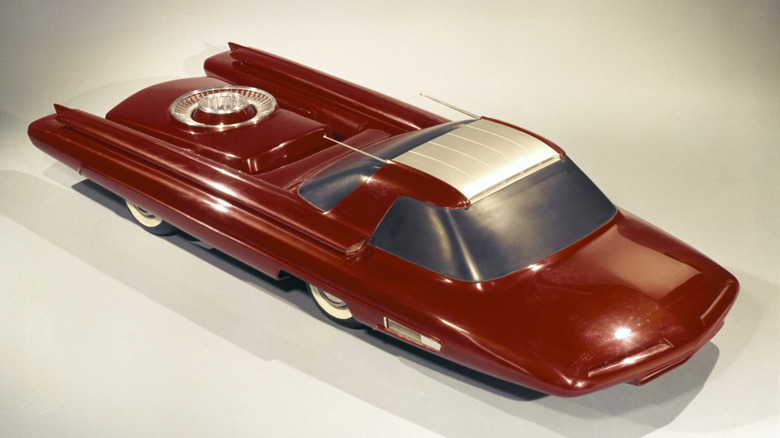
That was pretty much the idea behind the 1958 Ford Nucleon concept. Of course, it achieved this using nuclear energy, meaning it had to have a reactor inside. And in order to place a nuclear reactor in a passenger car, you need it to be relatively big — the Nucleon was envisioned as being 16.7 feet long and 6.5 feet wide. However, its ridiculously short 5.8-foot wheelbase gives the Nucleon a surreal appearance. The body also looks like it came out of "The Jetsons," but that's just how futurism looked during the 1950s.
The funny thing is that Ford never actually built a full-sized car — all it showed to the public was a 3/8-scale model. The Nucleon's replaceable nuclear power package was supposed to be available in different sizes, which naturally would have had an impact on range but also horsepower. But nuclear reactors as automotive power trains weren't — and still aren't — feasible, so even if Ford wanted to build it, the Nucleon could never go into production.
1961 Ford Gyron
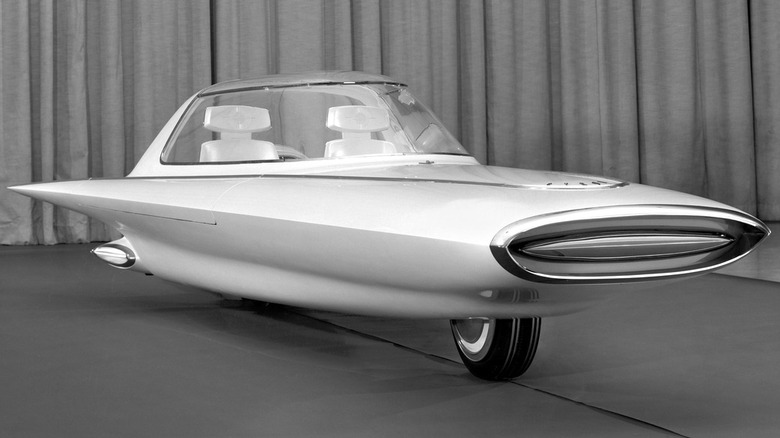
The Nucleon seems like a wild idea, but wait until you hear about the Gyron concept that debuted at the 1961 Detroit Auto Show. This car had training wheels. No, seriously — they even looked like kids' bike training wheels, only the Gyron concept used them so it didn't tip over while standing still and getting up to speed. When the Gyron reached a sufficient velocity, a set of gyroscopes kept the car upright, and, like in an aircraft, the training wheels retracted into the body. That's so very cool, and so is the retro-futuristic spaceship design.
But why would Ford go to such great lengths with the Gyron? Was it just a proof of concept? The answer is: aerodynamics. A long, narrow body with only two wheels cuts through the air more efficiently, meaning you can go faster with less fuel. (The Aptera EV three-wheeler follows a similar premise, minus the gyroscopes.) To further enhance efficiency, Ford also used lighter fiberglass body panels. Inside, the Gyron seated two people and even had a mobile phone.
Before you search for a video where the Gyron moves on two wheels using its gyroscopes, note that Ford never built a functional prototype. Implementing complex gyroscopes in a show car was deemed expensive and unnecessary, thus it needed those funny training wheels. With a top speed of 5 mph, the Gyron didn't have enough oomph to use them, anyway. It also didn't have much luck — the concept car was destroyed by fire in 1962, though two early, non-functioning prototypes survived.
1962 Ford Mustang I
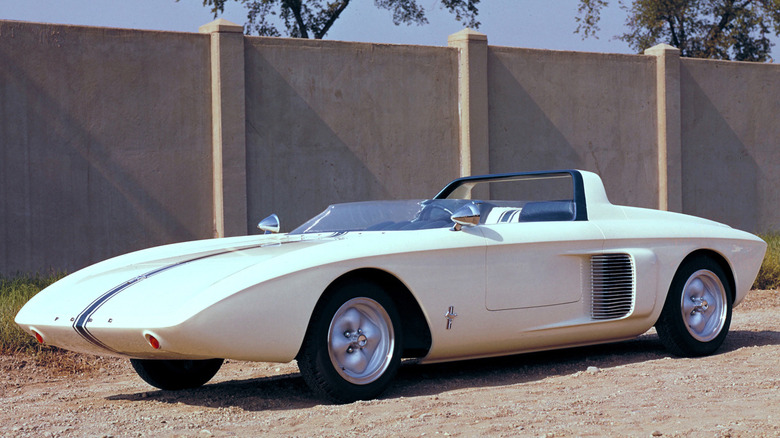
Imagine an alternate reality where the Mustang — and, by extension, pretty much any other pony car — has a mid-engine layout. That's exactly how Ford envisioned its most famous nameplate with the forgotten 1962 Mustang I concept. A wedge-shaped mid-engine roadster, the Mustang I was more akin to a European sports car than an American pony car. Heck, it was even equipped with a 1.5-liter V4, aka half-V8, engine because of its compact footprint. Better still, it was designed for economy cars and certainly not a performance motor.
But don't make the mistake of thinking the Mustang I was slow. It was a performance car, through and through, featuring an advanced space-frame chassis and aluminum body panels, which brought its weight down to only 1,543 pounds , with some sources claiming it was as low as 1,148 pounds! So although the engine produced only 100 gross horsepower (a bench-tested figure that didn't account for parasitic losses from accessories) the Mustang I reached 115 mph.
The light mid-engine platform also helped it in the corners. Famously, Ford presented the Mustang I at the United States Grand Prix in Watkins Glen, New York, where star F1 driver Dan Gurney pulled off a publicity stunt by pushing it on the track, reaching times close to those of F1 cars.
So yes, unlike with the Nucleon and Gyron, Ford had built a functional prototype of the Mustang I, now on display at the Henry Ford Museum of American Innovation in Dearborn, Michigan. But a production mid-engine sports car didn't follow, though some details from the concept lived on in the production Mustang, including the running horse emblem and side vents.
1967 Ford Mach 2
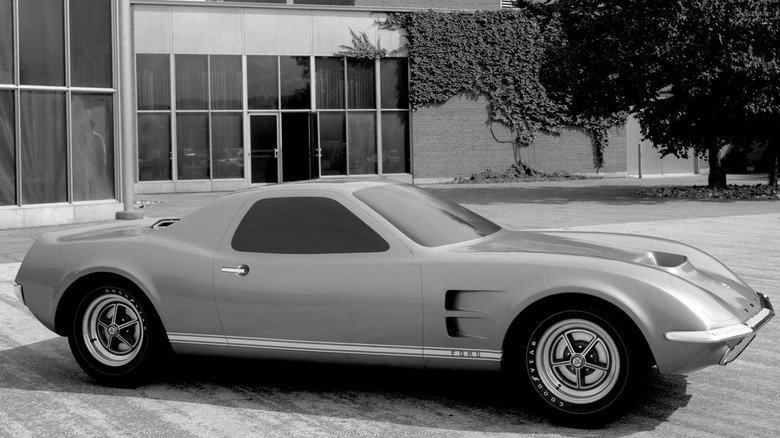
Ford's dreams of producing a small, lightweight mid-engine sports car didn't end with the Mustang I concept. In 1967, the Blue Oval presented the Mach 2 concept, designed as a direct answer to Chevrolet's Corvette. The Mach 2 was also kind of a homologation special, built to compete in the Sports Car Club of America's A-Production and FIA Group III GT. Something like a GT40, but tailored for the lower categories of racing.
The Mach 2 project started in 1966, and Ford first termed it the "Road Sports Car." It borrowed the floor pan from a Mustang Convertible because it had reinforced rocker sills to combat cowl shake. It didn't help much — low torsional rigidity was listed as an issue when the car was tested at the Dearborn Proving Grounds. The Mach 2 also shared the front independent suspension with the Mustang, but it had an independent rear suspension aimed at improving its handling.
The zesty bit, however, was the 4.7-liter Windsor V8 in the middle, which produced up to 271 hp in the Mustang and was mated to a ZF four-speed manual. Ford never published performance figures, but we reckon brisk 0-60 times, as the Mach 2 weighed only 2,644 pounds.
Ford contractor Kar-Kraft engineered and built two Mach 2 prototypes — a white and a red one. The white model has been crushed, but the whereabouts of the red prototype aren't known today. It was seen for the last time in a 1969 video taken at Kar-Kraft's premises.
1984 to 1985 Ford Maya
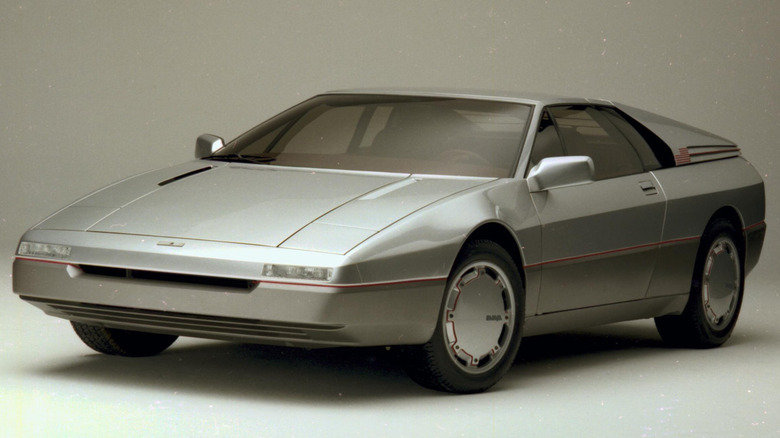
Ford's dreams of producing a mid-engine sports car didn't end with the Mach 2. In 1984, the automaker pulled the wraps of the Maya concept — a clean-looking, wedge-shaped machine penned by Italdesign and destined for production. This wasn't an ordinary concept designed to measure public reception — Ford built three working prototypes in 1984 and 1985, improving the formula with each iteration. The company planned to build 50 Maya sports cars a day, though the car never went into production.
The initial Maya concept was relatively compact at 165.6 inches long, so instead of a V8, it packed Ford's 3.0-liter V6 in the middle, producing a measly 140 hp at the time. However, Ford planned to work with Yamaha on the production engine, planning a 250-hp output. Ford never published how much the prototypes weighed, but considering the Maya rode on an all-aluminum independent suspension on both ends, it should've been relatively light. What's more, it had a low drag coefficient of only 0.28, which should've allowed a higher top speed. The Maya was also equipped with disc brakes on all wheels and a five-speed manual gearbox.
The second prototype, called the Maya II ES, had cleaner, more fluid body lines and a central air intake, but the same mechanicals. However, the third "EM" prototype might be the most interesting, as it had a twin-turbo version of the V6 that produced 300 hp. Unfortunately, it also had a slightly less appealing notchback rear end, which somewhat disrupted the body's clean lines.
1995 Ford GT90
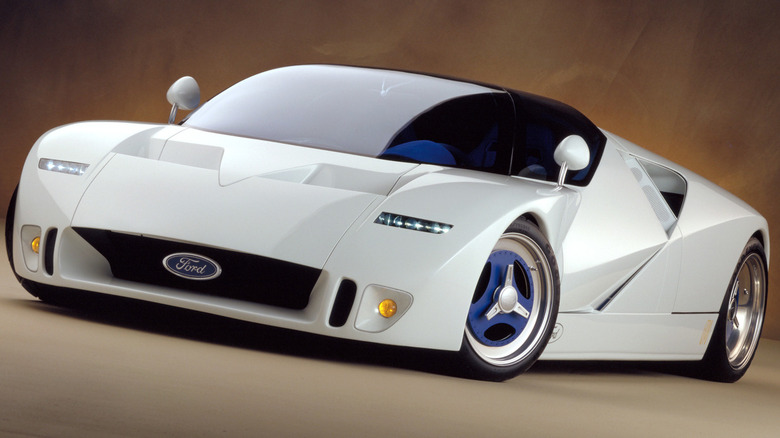
Ford had proved in the 1960s that its GT40 could beat Ferrari, with the Italian company considered the pinnacle automaker at the time. Well, at the beginning of the 1990s, McLaren stole every headline with the legendary V12-powered F1 that reached a top speed of 242.9 mph. Again Ford answered the call, this time with a mid-engine V12-powered hypercar designed to steal the top-speed crown.
Now, sure, the GT90 was only a concept, but Ford planned a limited production run of 500 cars. And had it reached production, the GT90 would've definitely unsettled McLaren, Ferrari, and Lamborghini. See, unlike its naturally aspirated V12 rivals, the GT90 packed a 5.9-liter V12 boosted with four Garrett T2 turbochargers, producing a whopping 720 hp and 660 lb-ft. Ford claimed a 0-60 sprint of just 3.1 seconds, a quarter-mile time of 10.9 seconds, and a record-breaking top speed of 253 mph.
Unfortunately, the GT90 didn't have a cooling system capable of keeping the V12 and four turbochargers at operating temperature. It was also not purely an in-house Ford creation, relying on the Jaguar XJ220 supercar for its aluminum chassis and five-speed manual gearbox.
Ford has never said why the GT90 never went into production. Maybe solving the cooling issues was deemed impossible or the project was too expensive, but the Blue Oval's wildest concept never got its shot at greatness. It's a shame, because Ford's futuristic "New Edge" design ethos looks really cool on a mid-engine hypercar.
1996 Ford IndiGo
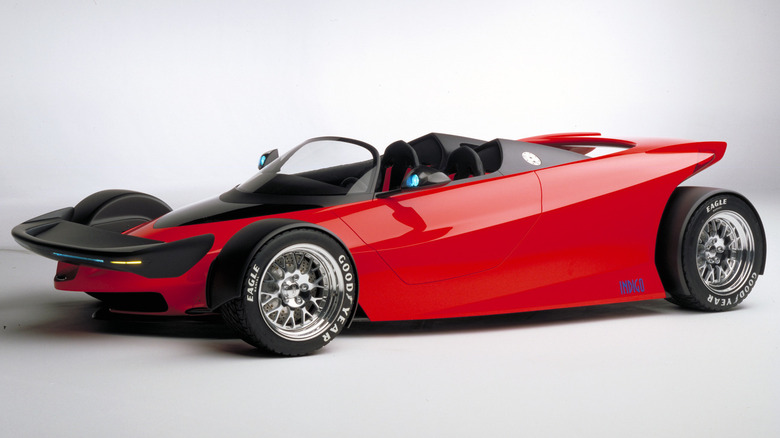
The 1996 IndiGo concept only adds to the list of Ford's endless obsession with the mid-engine configuration. Like the GT90, the IndiGo uses V12 power, but also uses an Indy Car chassis developed by Reynard Racing Cars, the team that won the 1995 CART/PPG Indy Car World Series Constructor's Championship.
In that sense, the IndiGo is more of a road-going race car, developed to showcase the advanced technologies used in Indy Car racing during the 1990s. The chassis is probably the most interesting, as it combines a carbon-fiber central tub with aluminum honeycomb composite for maximum stiffness and minimum weight. The front and rear suspension parts were made from aero-grade chrome-moly steel and attached directly to the rigid chassis and transaxle, respectively. Since the chassis was made from one piece, it provided excellent crash protection to the two passengers. The IndiGo looks cool, too, clearly borrowing inspiration from Indy Car's racing machines, but with a more streamlined, futuristic body.
The V12 engine that powered the IndiGo concept was derived from Ford's 3.0-liter Duratec V6. Basically, Ford joined two of these V6s together, but produced the new block and heads from Cosworth-sourced 356-T6 aluminum alloy to reduce weight. The resulting 6.0-liter V12 monster produced 435 hp and 405 lb-ft. That doesn't sound like a lot until you learn that the IndiGo also weighed only 2,299 pounds, so acceleration must've been exhilarating. Reynard Racing Cars also paired the engine with a six-speed sequential transaxle operated via buttons on the steering wheel.
2001 Ford Forty-Nine
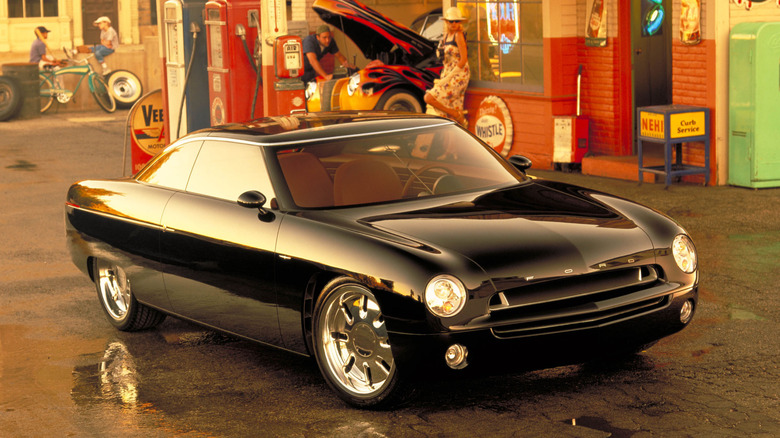
The 2001 Ford Forty-Nine concept serves as a nice breakaway from all those wild mid-engine Ford concepts. It's sleek and elegant, with retro design elements and smooth body lines that give us one of the best representations of retro-futurism. The Forty-Nine rides on polished 20-inch wheels and sits low to the ground, too, giving it а "kustom" lead sled look. The cabin tells a story of its own, combining 1950s hot rod design elements with clean, modernistic lines.
The Forty-Nine is easily one of the coolest-looking luxury coupes this millennium, and it's a shame it never reached production. And it wasn't because Ford didn't have the mechanical bits at its disposal. The Forty-Nine used Thunderbird's 3.9-liter V8 engine, which received an extensive satin black, stainless steel, and chrome makeup to match the stunning exterior. The car was built over the Ford/Jaguar DEW platform, which also underpinned the Lincoln LS sedan. In other words, it was fully functional and could've smoothly transitioned to production.
This time, however, reaching showroom floors was never the point. The Forty-Nine concept was more of a design exercise, developed to commemorate the 1949 Ford, one of Blue Oval's most important vehicles. These cars brought a brand-new design language, featuring aircraft-inspired features and an overall sleeker body, and came equipped with Ford's hot-rod favorite flathead V8. In fact, the cam covers on Forty-Nine's engine were designed to look like those on the flathead V8.
2003 Ford Visos
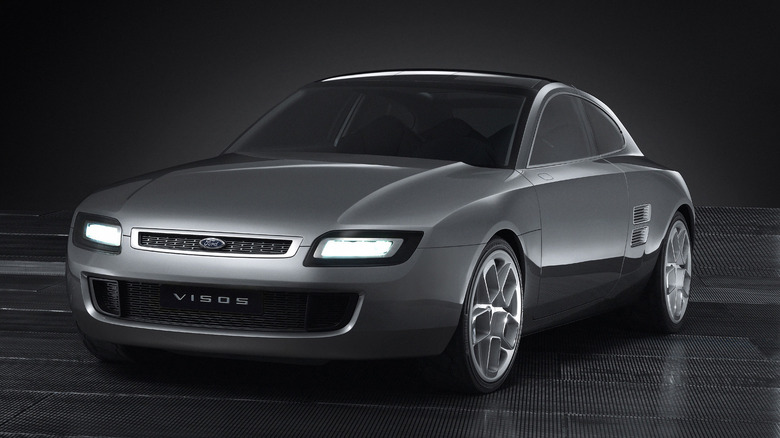
Looking at the image, you are probably wondering what's so cool about the 2003 Ford Visos concept, which Ford Europe unveiled at the 2003 Frankfurt Motor Show. Yes, it looks clean, with a design reminiscent of the original Capri, and the shooting brake rear end is a nice addition.
However, it's not what the Visos shows — it's what it hides that makes it cool. This concept is equipped with active aerodynamics, i.e., a front splitter, rear diffuser, and rear spoiler that can be activated by selecting Sport mode. Alternatively, they are automatically deployed when the Visos reaches 56 mph. The fact that Ford's exterior design manager, Chris Hamilton, and his team implemented these bits while creating a streamlined body is really impressive.
The Visos had some other interesting parts, like cameras hidden in the door panels that provided a clear view of the blind spot. Meanwhile, the cabin sported a clean, retro-inspired design, with an instrument panel that combined an analog dial with two Sony LCD panels and was attached directly to the steering wheel. It was light and airy inside, too, thanks to the T-bar roof with two glass panels.
Still, the Visos wasn't all show, no go. It was equipped with a 3.0-liter twin-turbo inline-6 that produced 345 hp and 295 lb-ft. Ford opted for a six-speed automated manual transmission, which probably wasn't the best choice, but at least the shifter followed the retro-futuristic theme and looked like a stick shift.
2004 Ford Shelby Cobra Daisy
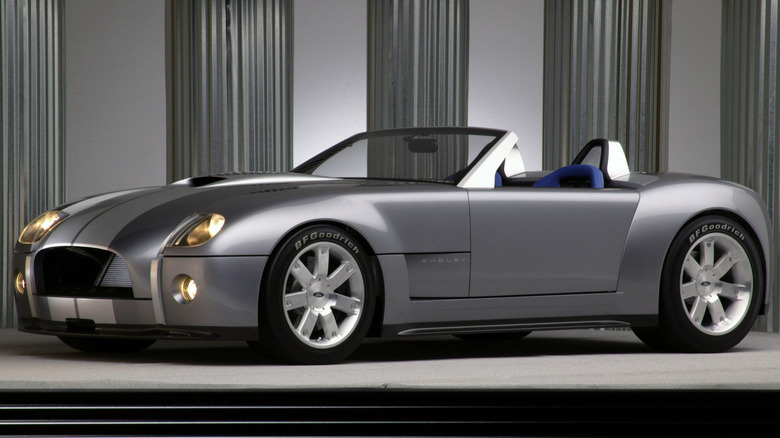
Carroll Shelby finally fulfilled his dream of a bespoke sports car with the 1999 Series 1, only to encounter an uninterested market. Fortunately, he was given another chance in 2004, teaming up with Ford on Project Daisy to reinvent the Cobra roadster for the new millennium. In the end, as with most crazy Ford concepts, financial struggles killed the 2004 Shelby Cobra concept before it could show its full potential.
It's a pity, because the concept was the ultimate Ford-Shelby reunion. What's more, the 2004 Shelby Cobra concept was a fully functional prototype equipped with all the ingredients worthy of its name. Most notably, it was built over an aluminum space frame and featured double-wall fiberglass body panels, resulting in a low weight of only 3,075 pounds. The crazy part is that the concept was powered by a high-revving 6.4-liter V10 that cranked out a whopping 605 hp and 501 lb-ft. The 5.4-liter supercharged V8 from the GT was another homage-friendly option, but it was heavier and would have raised the center of gravity.
Critically, the V10 was mated to a six-speed manual in a rear transaxle layout, resulting in a near-perfect 48/52 (front-to-back) weight distribution for more balanced handling. To add to the driving experience, the interior was stripped of a radio and air-conditioning, but it was also roomy and functional.
2004 Ford Shelby GR-1
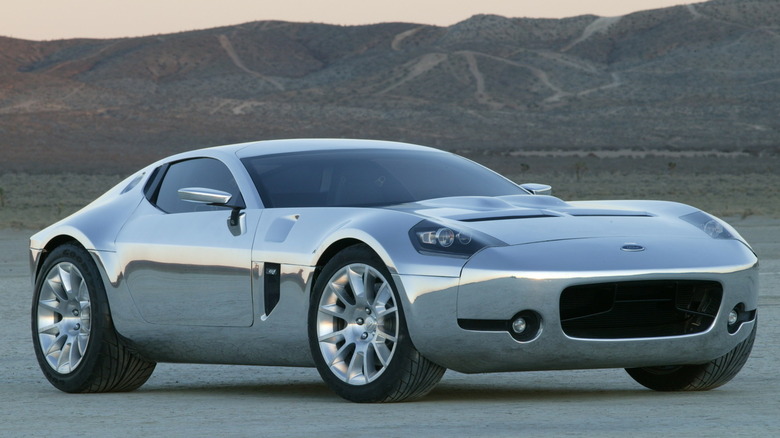
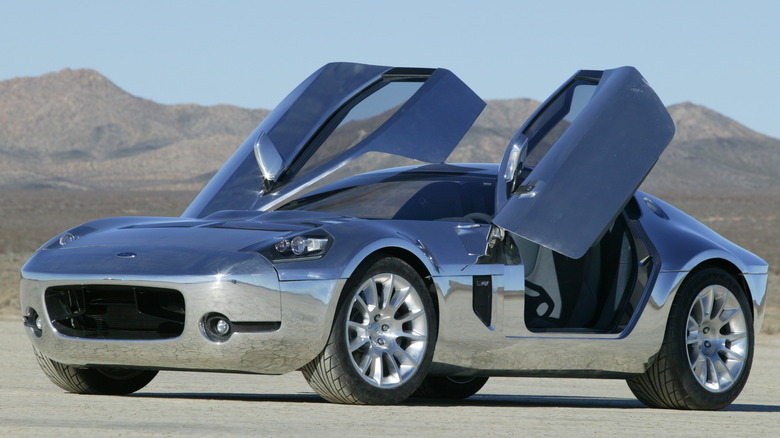
The 1964 Shelby Cobra Daytona Coupe is one of the wickedly cool cars that made Carroll Shelby a legend, but one that never got its successor. That is, until 2005, when Ford introduced the Shelby GR-1 showstopper at the North American International Auto Show, developed as an homage to the Daytona Coupe.
Penned by Ford designer George Saridakis, the GR-1 is the perfect modern interpretation of the original Daytona Coupe. Its body is textbook front-mid-engine GT proportions, even though it was based on the mid-engine platform from the Ford GT. The GR-1 looked equally dramatic with a long hood, massive grille opening and swept-back headlights up front, dramatic butterfly doors, a teardrop taper in the rear, and a mirror finish.
Still, the GR-1's real standout feature was the 6.4-liter dry-sump V10 engine from the Cobra "Daisy," which produced 597 hp. The power was sent through a six-speed manual to the rear wheels, where a limited-slip differential and massive 345-section tires ensured good traction. According to Ford, the GR-1 sprinted to 60 in 3.9 seconds and had a top speed of 190 mph. Modest figures for that much muscle, you'd think, but unsurprising considering the GR-1 concept weighed a whopping 3,900 pounds. Ford knew this, targeting a 400-pound weight cut and probably a V8 engine for the production model that never came.