

This Forgotten Mid-Engine Mustang Concept Could Be The Answer To Ford's Affordability Woes
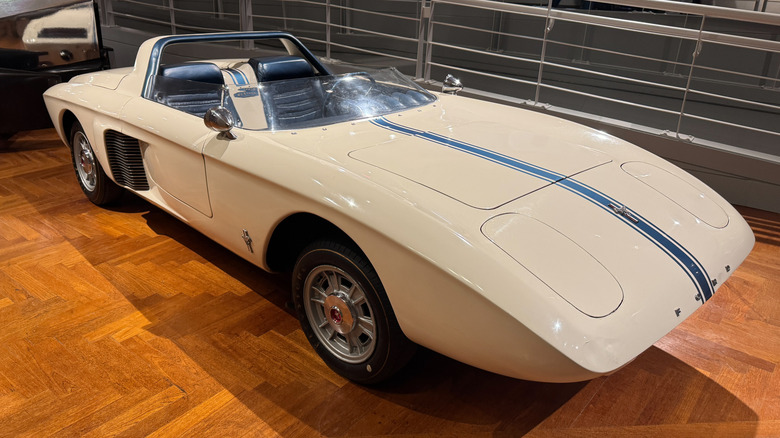
When Ford's iconic Mustang made its debut in April of 1964, it was an instant success, delivering a style-forward, performance-oriented machine for the everyman. By 1966, Ford had moved a million units, and because the Mustang shared its underpinnings with the Falcon, profit margins were high. Mustang is now, and has been for many years, a key performance model for the blue oval, with the benefit of decades of heritage and nostalgia built into it. But there is a decidedly different direction Mustang could have gone in, as the horse badge was initially attached to a compact mid-engine European-style sports car with four cylinders of fury.
With a tiny 7,500 RPM short-stroke 1,500cc V4 engine mounted behind the two-seat open-air cabin, this proto-Mustang made around 100 horsepower and weighed in at a feather-light 1,148 pounds. It's obvious that Ford never intended for this car to go into production sans roof, but this could have been a radical shift in Ford's sports car future, tying itself to the mid-engine GT40 efforts at Le Mans just a few years later.
Some period sources say the car was never intended to make production, as it was simply a marketing effort by Ford exec Lee Iacocca to influence young drivers to check out Ford. Then again, Ford ran a full-court press national marketing campaign featuring the Mustang I, including appearances at the Formula 1 United States Grand Prix at Watkins Glen and the USAC Pacific Grand Prix at Laguna Seca with the one and only Dan Gurney driving. Further, Ford loaned the prototype out to Car and Driver, Road & Track, and Sports Car Graphic to test. Presumably, Ford was gauging interest in the concept with an eye toward building something like it.
Dan Gurney's publicity tour
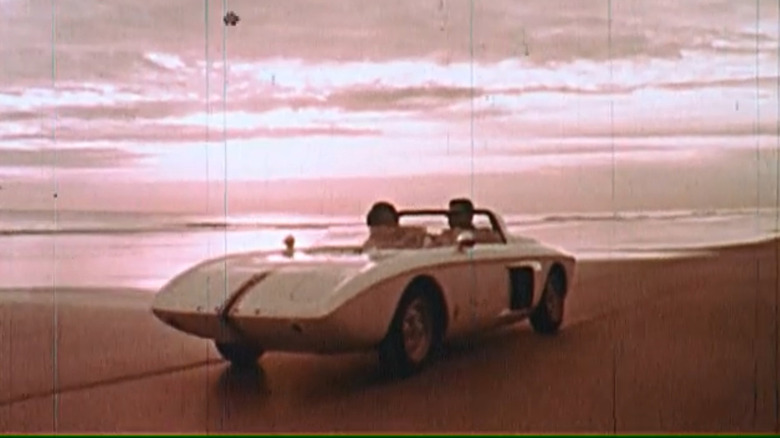
In the early 1960s, Dan Gurney was among the most famous racing drivers in the world. He would race anything with wheels and had wins in USAC, NASCAR, sports cars, and Formula 1. Gurney hadn't yet reached the pinnacle of his racing career, but in 1962 he was no longer an up-and-comer. He got the gig driving Ford's demo car because he'd proven himself behind the wheel of Ford machinery as a driver for Holman-Moody's NASCAR squad, and he'd be at both the F1 race at Watkins and the USAC sprint at Laguna Seca, so why not stuff him in the car to show people what it could do on track?
With Ford's developing "Total Performance" efforts across the 1960s, it was dead set on pushing into motorsport. By the end of the decade, the blue oval would see victories in F1, the Indianapolis 500, a run of wins at Le Mans, and more. Because the racing efforts were still spinning up from scratch, getting Gurney into this car and showing it off at motorsport events was meant to put the race-going public on notice that Ford meant business.
The potential of the Mustang I was unmatched on the market in 1962. Ford had managed to outshine even the best sports cars from Euro automakers who had already gleaned decades of experience from their own motorsport efforts. Could a racing version of the Mustang I have beaten Ferrari's 4.0-liter V12 monsters at Le Mans in 1962? Not likely, but it would have made Porsche stand up and take notice in the GT 1.6-liter class. And it would've taken Ford down an entirely different path — maybe one that led to a smaller, more affordable sports car today.
Ford should revive this idea today
Back in 1963, after testing the Mustang I Concept, Car and Driver declared that the car was a sensation:
There can be no doubt however, that this car deserves to be produced. It would in fact be a most welcome addition to the sports-car market and provide less daring manufacturers with valuable inspiration.
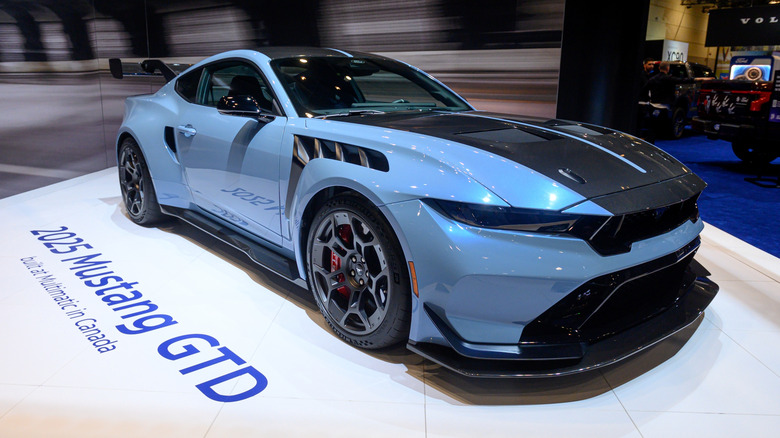
Even that praise wasn't enough to get a production line going, though. The Mustang I never made it past the concept phase, and the single prototype remains housed safely in the collection of the Henry Ford Museum in Dearborn, Michigan. Should it stay that way forever, though? The current Mustang has ballooned to an incredible 4,000-plus pound monster of a grand tourer with as much as 815 horsepower and a 200+ mile per hour top speed in GTD trim. Mustang GT's with their V8 powerplants start at over $42,000 and the new Dark Horse SC goes deep into the six figures.
Maybe, if Ford hadn't gone the 2+2 coupe-and-convertible route with the Mustang, we never would've ended up with the GTD or the ultra-pricey standard Mustangs. And, maybe, we might still have some small, affordable sports cars with a blue oval on the hood. Aside from the Mustang, Ford doesn't currently produce a single car, having moved on to a truck-and-SUV-heavy product lineup. And nowhere in that lineup is there anything on the Ford lot that would entice a young driver to get behind the wheel and have a little fun. Perhaps it's time for Ford to re-develop a modern lightweight four-cylinder mid-engine sports car with good fuel economy and a low price point to round out its performance portfolio.
The price-conscious mid-engine sports car in question doesn't doesn't need some big expensive infotainment system and lots of speakers; it doesn't really even need a center console or particularly accommodating creature comforts. Just some no-frills driving enjoyment with a sensible and small engine behind it.