

Pros And Cons Of Transaxles Vs. Standard Transmissions
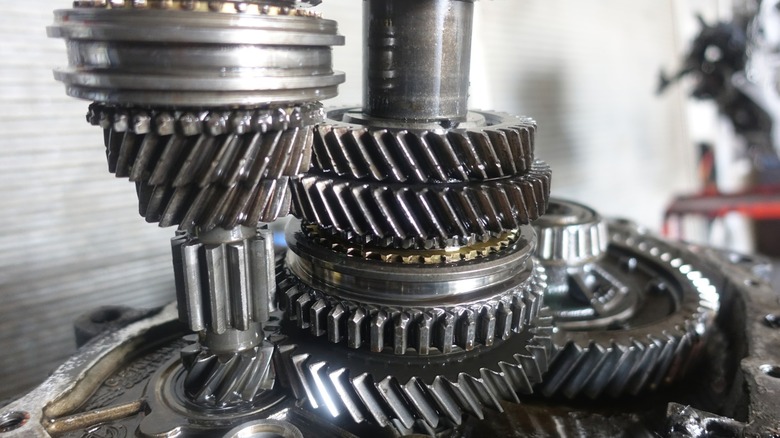
Transaxles are really common on modern cars. They are ubiquitous in front-wheel drive vehicles, and FWDs are the default for cheap cars. Some rear-wheel drive vehicles are also fitted with transaxles instead of a standard transmission.
There are pros and cons to having either setup. Transaxles are lighter and more compact, leaving more room for passengers. They are also more fuel-efficient due to their simplicity of design. On the other hand, transaxles can be harder (and therefore more expensive) have repaired. They aren't ideal for vehicles that require a lot of power, especially when towing is involved. Torque steer can sometimes be a problem as well.
Vehicles with standard transmissions, like just about all pickups, are generally much better suited for towing and other power-hungry tasks. They are easier, and thus cheaper to repair, too. Of course, if you've ever had a transmission worked on, you realize that "cheap" is a relative term here. Downsides of standard transmissions can sometimes include handling. The reason for this is that many standard transmissions live in front-engine, rear-wheel drive vehicles. The lack of weight over the drive wheels results in less traction.
What's the difference between a transaxle and a transmission?
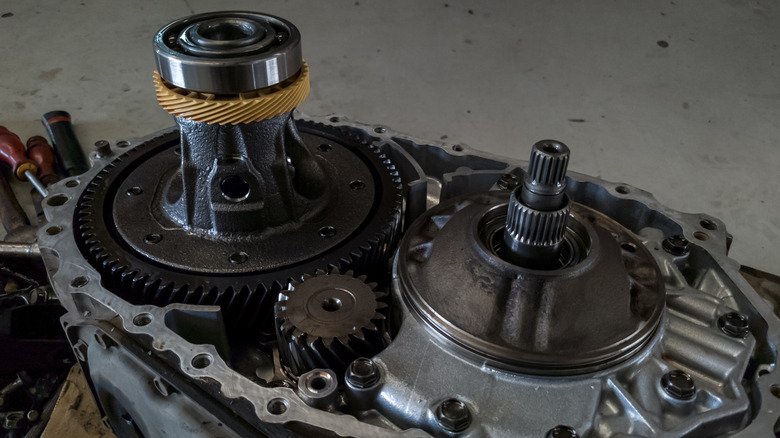
So, how do transaxles differ from standard transmissions? Transaxles put the transmission and differential together in one housing, which is integrated into the axle of the drive wheels. A standard transmission, on the other hand, is its own thing, sitting by itself, normally behind the engine. A transmission takes power from the crankshaft and sends it through the driveshaft to the differential, which distributes the power to the wheels on the drive axle. In a transaxle, power is more directly delivered to the differential, because it is in the same housing as the transmission. With a transaxle, there is no long driveshaft. A shaft comes out of each side of the transaxle to power each drive wheel.
Transmissions usually, but not always, are found in rear-wheel drive vehicles where the engine is in front, like pickup trucks and certain high-performance sedans. Transaxles most often appear in front-wheel drive, front-engine vehicles, but also some rear-wheel drive, rear engine vehicles. Basically, they often appear where engines are on the same end as the drive wheels. This places the weight above the drive wheels, offering better handling. However, some front-engine RWD vehicles like some Corvettes place the transaxle in the rear to evenly distribute weight.
Among rear-wheel drive, rear-engine vehicles with rear transaxles are vintage VW Beetles, Porsche 356 and 911 models, and DeLorean sports cars (presumably to make room for the Flux Capacitor up front).
The benefits of a transaxle
The main advantage that transaxles hold over transmissions is space, especially for front-engine, front-wheel drive vehicles. They are more compact than transmissions, which allows for a smaller engine bay. This, in turn, allows for a larger passenger compartment. Manufacturers know that more legroom sells cars. But there are several other advantages, too.
We already mentioned how the transaxle layout places the engine and transmission (in the transaxle housing) above the drive wheels, and that this placement of weight helps the car keep its traction in bad weather. But the lightweight nature of a transaxle makes the overall vehicle lighter, which makes the car more efficient, and therefore better on gas. A transaxle has a simpler layout, making the vehicle cheaper to produce. And since a transaxle doesn't have as many parts as a separate standard transmission and differential, it should, in theory, require less maintenance.
Vehicles built to house transaxles also offer better distribution of weight, which is an advantage when power is a priority. This is especially true in rear-wheel drive vehicles. Typically, if the engine is in front, the transmission is right behind it — that puts most of the weight up front. But when the transaxle is placed on the rear axle, the weight evens out.
The disadvantages of a transaxle
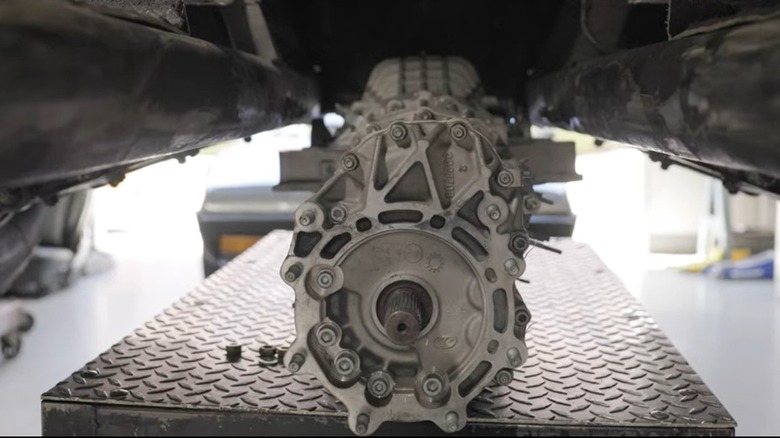
Of course, transaxles do come with their downsides. Transaxles are not typically built for a lot of power, which is why vehicles that are used for towing or high performance often have transmissions. That's not to say it's impossible for a high-powered engine to connect to a transaxle, but the small design of a transaxle makes it hard to engineer for that kind of performance.
Then there's the cost of fixing a transaxle or servicing it. A transaxle crams a lot of parts into a small space. This makes it hard to work on, increasing labor costs. In other cars, if there is a problem with the differential, a mechanic can more easily get to it, since it's separate. But with a transaxle, the mechanic has to take apart the housing just to get to the differential.
There are also mechanical problems which can be common with transaxles, like torque steer, or when the car tries to pull to one side temporarily. This is because the driveshafts coming out of the two sides of the transaxle are often of different lengths. The longer one can sometimes twist and flex, which causes torque steer. CV axles and bearings tend to wear out faster with transaxles, as well.
The benefits of a standard transmission
It turns out that good old standard transmissions do have their advantages. For one thing, it's easier to get to various parts, like the differential, since everything is separate. You don't have to take apart the transmission just to get to the differential. Keeping the differential separate makes it easier to tune, to upgrade the axle, to install limited-slip units, or to swap gear ratios. And of course, easier access generally means that a separate transmission and differential are also cheaper to have repaired.
If you prefer driving a stick, you're probably going to find yourself in a vehicle with a standard transmission. That's not to say all standard transmissions are manual, of course. But a manual transaxle is not nearly as common. There have been exceptions, like the Porsche 924, which came with a manual rear transaxle all the way back in 1976, and the new Lotus Europa, with its 5-speed manual transaxle. Tremec has made an aftermarket 6-speed manual transaxle that can be fitted to certain Corvette models.
Another advantage of standard transmissions is that they can be more easily designed for powerful vehicles, because they aren't so compact. Vehicles with separate transmissions are generally more adept at handling more power for things like towing. They are made to do the heavy lifting. They have not been made obsolete by transaxles. On the contrary, they do have their place. That's why you'll find them in trucks and sports cars.
The disadvantages of a standard transmission
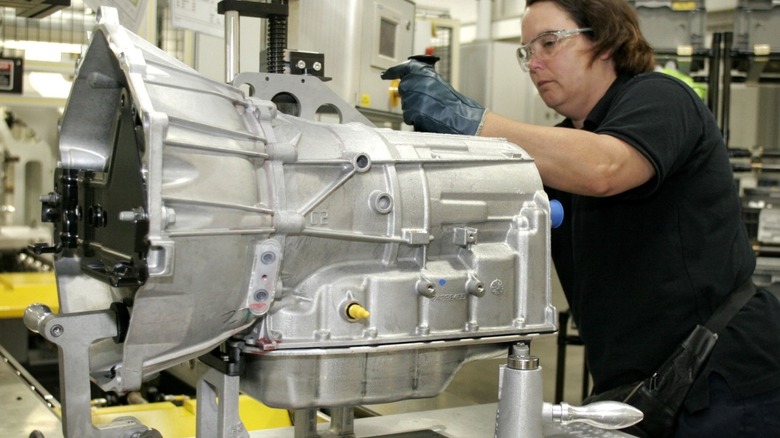
There are some pains associated with owning a vehicle with a standard transmission. For one thing, your standard transmission may need to be serviced a little more often, while some automakers often don't even list a maintenance schedule for transaxles. But check your owner's manual, whether your car has a standard transmission or transaxle. Even differential fluid needs to be changed from time to time.
Rear-wheel drive vehicles with standard transmissions typically have less room for passengers and cargo, since the transmission and driveshaft form a hump under the cockpit floor. Front-engine vehicles with standard transmissions require a larger engine bay, often resulting in a smaller cockpit. It's harder to design a car with a small wheelbase to accommodate a separate transmission and differential. These vehicles generally don't have the best gas mileage as they are heavier and less efficient than vehicles with transaxles. Handling can be an issue, too. In front-engine, rear-wheel drive vehicles with standard transmissions, the transmission is up front, behind the engine, while the drive wheels are in the rear. There isn't as much weight on the drive wheels, resulting in less traction on slippery roads.
Overall, transaxles and standard transmissions each have their uses. Transaxles are great for everyday commuter cars, due to their efficiency and compact design. If your vehicle is a workhorse, however, it's going to be one that comes with a standard transmission.