

7 Cars That Were Super Expensive In The '70s And Are Surprisingly Cheap Today
Depreciation is a curse that affects almost every car on the road. According to Kelley Blue Book, an average new car will shed around 30% of its value within the first two years alone, and then a considerable chunk more each year thereafter. As the years progress, many cars eventually become financially unviable to repair and maintain, and so they get parted out or simply scrapped. Those that do survive the banger years can wind up becoming classics. In some cases, their depreciation curve can reverse, and their prices can slowly begin to climb once again as buyers look to enjoy a touch of nostalgia. Because of this, many once undesirable cars from the 1970s are now worth a small fortune. But interestingly, for some '70s cars, the exact opposite is the case; despite being worth a fortune when they were new, they remain heavily depreciated today, and therefore might make for tempting bargains in 2026.
These are exactly the kinds of cars we're covering in this article. All of these cars still look and sound expensive, but they remain remarkably affordable — at least when it comes to their average used prices. If you're expecting big-block V8s, vivid upholstery, curious styling, and ruinous repair bills, you're not far off. We've included obvious choices such as big Chryslers and old Bentleys, but also some surprises, such as one curious star-studded Stutz and even a low-slung Maserati sports car. We've ordered these cars by how much each has dropped in value, using an inflation calculator to work out what their original prices would look like today, leaving the most dramatic ones for the end.
Ninth-generation Chrysler New Yorker Brougham
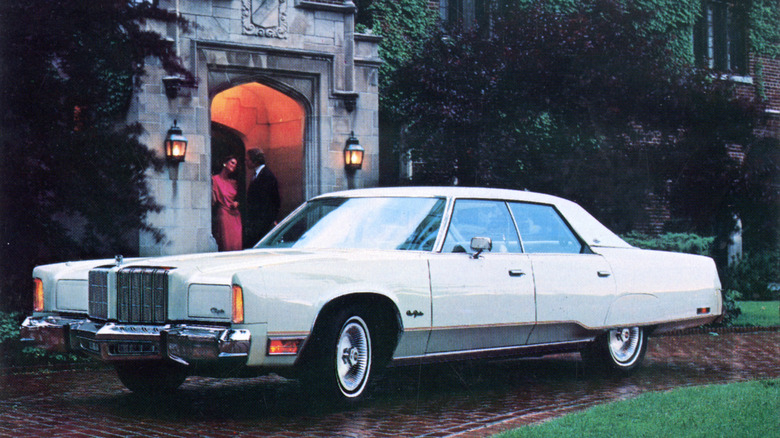
Chrysler's current line-up is a sad affair in comparison to what it was in the late 1970s, with luxurious full-size models boasting a commanding presence in showrooms up and down the country. Following on from the Imperial's discontinuation just a couple of years prior, the 231-inch long ninth-generation New Yorker enjoyed flagship status as the brand's ultimate offering. In its final and most expensive model year, the 1978 Chrysler New Yorker Brougham cost $7,831 – the equivalent of around $40,100 in today's money. That's not a monumental asking price, especially for one of the greatest land yachts ever made, equipped with a standard 400ci big-block engine, and numerous advanced features such as power seats, power locks, a radio antenna, and many more.
Time hasn't been especially kind to the gargantuan luxobarges of the late '70s, though, with many now gone from our roads for good, and residual values reflect this change in tastes. According to recent auction data collated by Classic.com, the average price paid for a ninth-gen New Yorker is just $9,230 today.
Mercedes-Benz 450 SEL 6.9
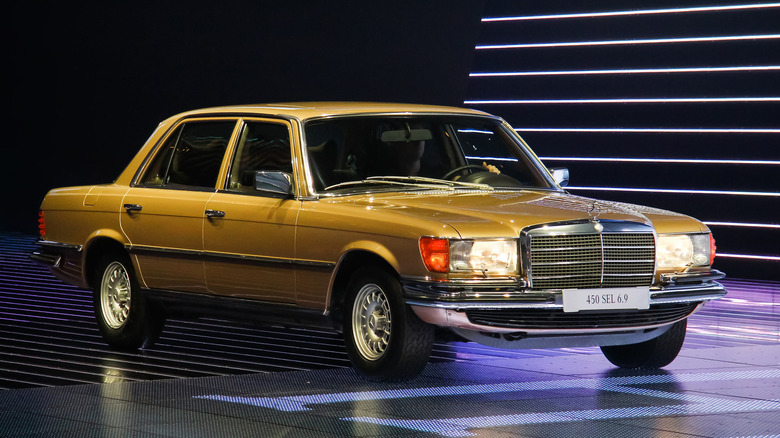
Stepping things up a bit, we arrive at the late '70s Mercedes-Benz 450 SEL 6.9. This 6.9-liter V8-powered land yacht is simply the ultimate expression of 1970s decadence — and also the grade that best demonstrates the model's steep drop in value. For example, back in '77, a 450 SEL 6.9's first buyer would have had to part with £21,995 in the UK, or around $38,491 using that year's exchange rate. To put numbers into context, that's around five New Yorker Broughams, so this big Merc definitely checks the "super expensive" box. To further drive that point home, in 1977, $38,491 was equivalent to roughly $212,100 in today's money. Interestingly, that's also roughly what one can expect to pay for a top-spec S-Class today.
However, for those after a champagne lifestyle on a lemonade budget, there is some good news. No longer is the big SEL a $200,000+ car. Instead, Hagerty estimates the values of good-condition 6.9 models in the region of $30,200 to $33,900, depending on the model year. We will gloss over the associated running and repair costs of this slow and luxurious sedan for the time being, and instead focus on the sheer value proposition the Mercedes-Benz 450 SEL offers. It's the very best '70s Merc anyone can buy, and it costs Hyundai money. That's math we can get excited about.
Bentley T2
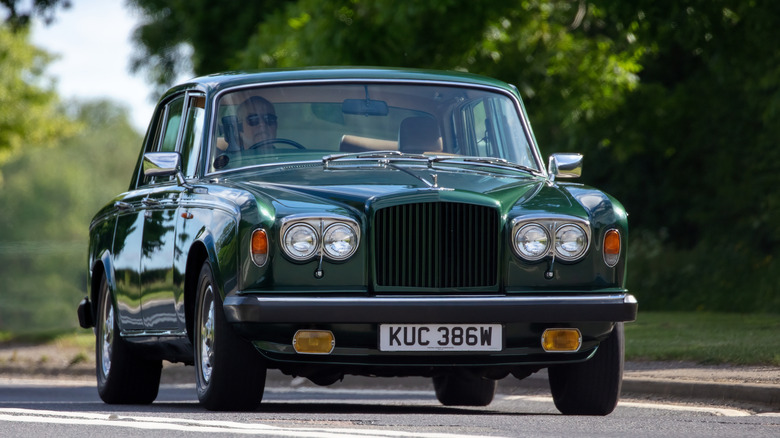
Even Bentley has a 1970s car that is surprisingly affordable today in its stylish T2 Sedan. It's the quintessential Bentley of the era, equipped with everything one might expect in a luxury car like this, including a leather cabin, plenty of quality wood veneer, an array of comfort-oriented features, and a 6.75-liter V8 engine. A delightful recipe, for sure, but apparently not one that commands the big bucks in today's market. In fact, according to Hagerty, a late-'70s T2 in good condition barely commands more than a decade-old Toyota Camry, with its current values sitting at $13,500.
However, even later, more-advanced Bentleys, such as the Mulsanne, aren't much more expensive, which likely helps keep pricing for these '70s examples comfortably low. Repair and maintenance costs are another massive factor in the T2's low values; our readers point to it as one of the cars that spell financial ruin. However, today's low valuation is decidedly different to what one of these majestic sedans would have commanded when new. When we convert the 1977 Bentley T2's domestic sticker price of £22,809 into U.S. dollars, that gives us an MSRP just shy of $40,000, which is roughly equivalent to $220,000 today.
Maserati Merak SS
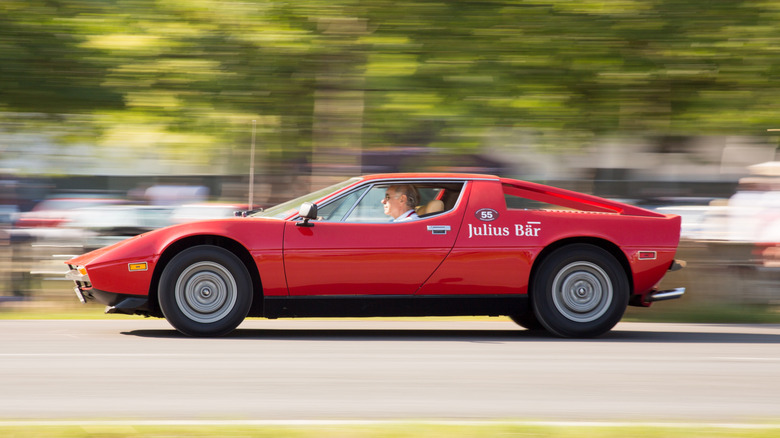
Waft-happy barges aren't the only pricey '70s models to have crashed in value, as evidenced by the super-sleek Maserati Merak -– a model that made Jalopnik readers' list of all-time favorite Italian cars. It's the SS grade under the spotlight today, which boasts a 220-horsepower 3.0-liter V6 mated to a five-speed manual transmission with rear-wheel drive and a 2+2 layout. In other words, it's a proper classic Italian sports car — you know, the type that typically costs hundreds of thousands in today's market. But while other performance coupes of the era have significantly shot up in value, the Merak has not. Instead, the little Maserati is today better described by words such as "undervalued" and "bargain," and we have the numbers to back it up.
For example, a new 1977 Merak SS sold for £12,390 in the UK, which equated to $21,683 that year. That's the equivalent of roughly $253,500 today, so it should come as some surprise to see this old Maserati changing hands for an estimated $46,000 in good condition (via Hagerty). It did everything right; mid-engine, awesome to look at, and it wore the right badge, but somehow, the Merak SS skipped out on the appreciation train so many other contemporary rivals took.
Aston Martin Lagonda S2
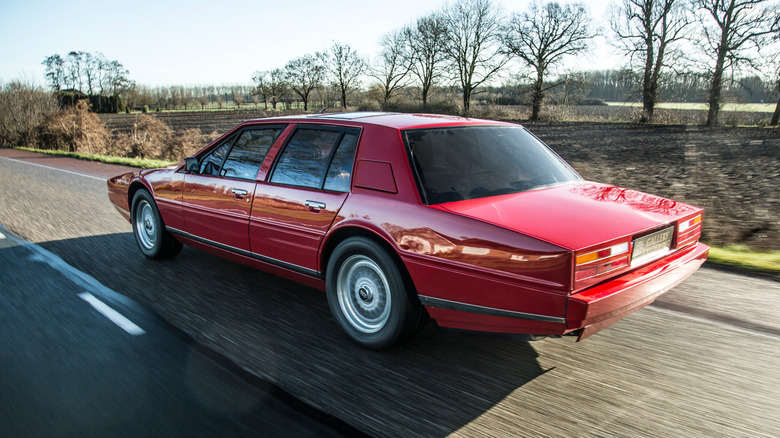
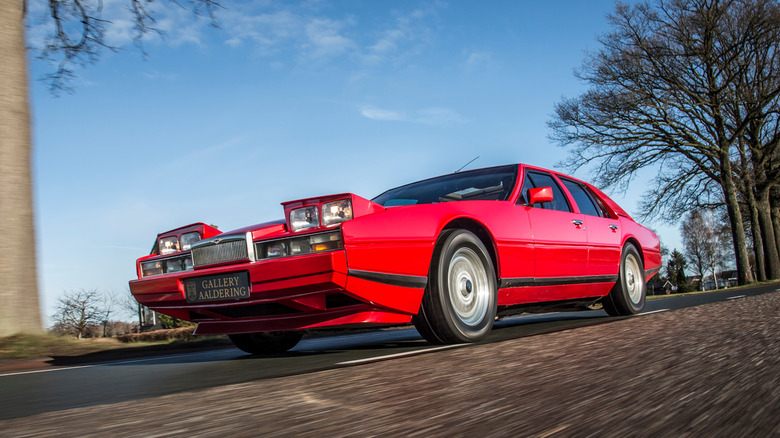
In many ways, the Aston Martin Lagonda is the poster child of cataclysmic depreciation for '70s classics, as for quite some time, these angular sedans were worth very little. It's not hard to see why: That folded-paper design is very un-Aston Martin-like, and certainly tougher to love than the soft curves of a classic DB. Still, the Lagonda sports a powerful 5.3-liter V8 designed by Tadek Marek – the revered Polish engineer also behind the DB4, DB5, and DB6's inline-six – in addition to a sumptuous leather interior, and plenty of cool gadgets to play with. In fact, the Lagonda was a true technological marvel, and as such, demand does still run fairly high for the wedge-shaped classic. Today, late-'70s Lagonda S2s in good condition easily command $50,000, according to Hagerty.
That's still a considerable sum, but it's nothing in comparison to what buying one would have cost in the '70s. These striking cars originally sold with a $79,500 sticker, and accounting for inflation, that leaves us with a mind-boggling $365,700 asking price. Curious looks, notoriously unreliable technology, and sky-high restoration costs are the main drivers behind this unparalleled depreciation.
Stutz Blackhawk
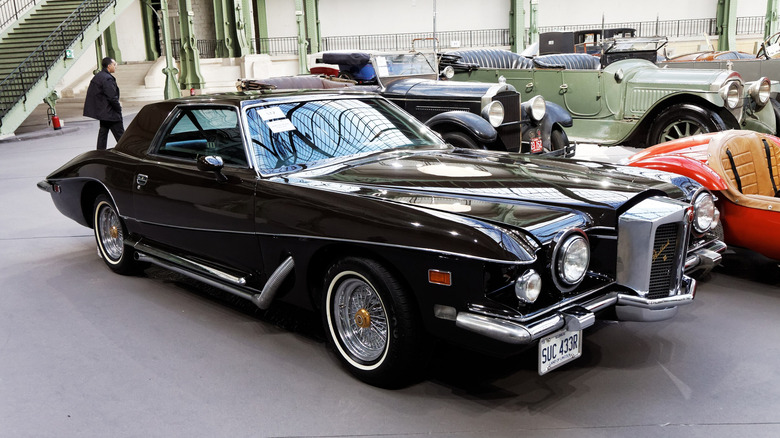
Here's a question for trivia night: what do Elvis Presley, Frank Sinatra, and the Shah of Iran all have in common? The answer, of course, is that they all drove a Stutz Blackhawk — the ultra-luxury '70s coupe that revived a historic American brand. As evidenced by the aforementioned names, it was a creation beloved by the world's rich and famous, and likely because nothing in the '70s made a statement quite so glittering as the bizarre Blackhawk. There is almost no point describing the way this thing looks — it's enough to look at it to understand its magnificence. Underpinning the Exner-penned coachwork crafted in Italy sits Pontiac's familiar Grand Prix chassis and running gear, with a 425-hp 455-cubic-inch V8 providing motivation.
Extraordinary is the only way to describe the Blackhawk's price. It was almost twice as expensive as a Ferrari Daytona at launch, and a good third pricier than a Miura even. It cost $26,500 in '71 — its first model year. By '78, the privilege of acquiring one reportedly set buyers back $74,000, which is equal to around $379,000 in today's money. This was the final car ever driven by Elvis, and so Presley impersonators will be delighted to hear this domestic slice of '70s exuberance commands right around $28,200 in 2026, according to Hagerty – a monumental drop in value over the last five decades.
Rolls-Royce Camargue
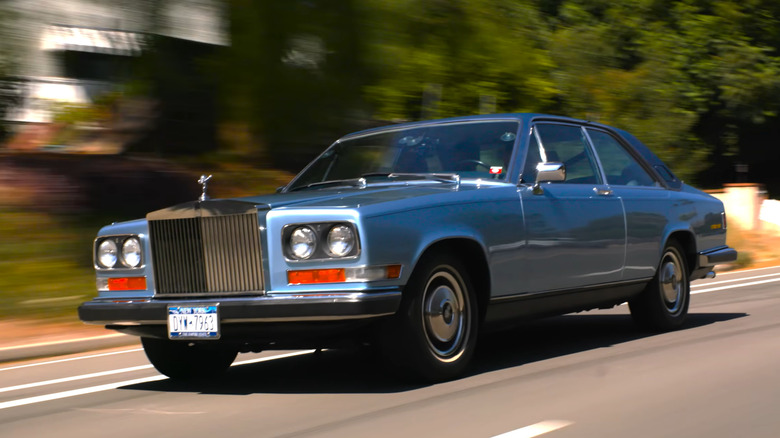
There is no denying the allure of a Rolls-Royce. The English automaker is renowned for its commitment to excellence, but that commitment doesn't always result in rock-solid residuals, as evidenced in the current values of many older models. The Camargue counts itself among such nameplates. When it debuted back in 1975, it cost buyers £29,250 — or $68,445 — which is the equivalent of $424,850 today. Now, Hagerty estimates the Camargue's value at only $33,500 in good order, with its following model years being similarly affordable.
While most Rolls-Royce models tend to toe the party line when it comes to styling, the Camargue was a little different. It still sported all the usual hallmarks of a Rolls, such as the Pantheon grille and familiar quad headlamp arrangement, but the profile itself was a little bulky and tough to love. Even by Rolls-Royce's own admission, the Camargue's aesthetics were a little divisive. This is likely why values dropped and never really recovered, as image matters to Rolls buyers. When new, the Camargue was the most expensive new car in the world, so it certainly had a fair way to fall. Its relatively ill reception likely cemented its fate, but at least enthusiasts can now net themselves what was once "the most expensive car in the world" for Toyota RAV4 money.