

9 Ways Industry Experts Are Teaching Your Local Dealer How To Get More Money Out Of You

It's no coincidence that whether you're talking about the best dealership experiences or the worst dealership experiences, there's a certain universally familiar energy to buying a car in the United States. Despite a wildly decentralized franchise model with tens of thousands of dealerships selling over $1 trillion in vehicles annually, most of us have been hearing more or less the same song and dance from our local car stores for our entire lives. Sure, there's room for regional flavor, and the waiting areas get nicer as you move upmarket, but the core sales process remains impressively consistent from state to state, brand to brand, and even generation to generation. There's nowhere you can go where a four-square sales worksheet can't sneak up on you.
It might feel like every dealership owner in America is sneaking into the same back room at the National Automobile Dealers Association to get their marching orders, but the truth is a little less cinematic. Car dealers, like every other mature business, have their own media ecosystem, training culture, and consultant class built around so-called "best practices" that are best practices for a reason. Dealer-facing publications, vendors, association magazines, finance and insurance trainers, and industry analysts spend a lot of time explaining how stores can protect gross, sell more finance-office products, improve digital retailing, retain service customers, and keep owners in the fold until the next trade-in.
We've dug into those industry publications, trade-group materials, and dealership-facing experts to see exactly what they've been telling your local dealer lately. And yeah, a whole lot of that advice ultimately boils down to how to get more money out of you.
Drive higher profit margins with finance and insurance

You'd like to think the finance office exists because cars are expensive and most people need a way to pay for them, a simple transactional convenience like tap-to-pay at the grocery store. And there's some truth to that, or at least there used to be. As car payments hit record highs, there's often more baked inside that final monthly figure than just vehicle options and extra floor mats. Finance and insurance — "F&I" in the dealership rags — can include dealer-arranged financing as well as intangible extras like maintenance contracts or extended warranties.
Taken together, the dealer's cut of such transactions can be significant, not just rivaling but often exceeding the profit they earn on the vehicles themselves. That means you'd better believe that the dealership consultant class is out there helping dealers optimize these, cough, revenue streams. The New Hampshire Automobile Dealers Association hits it right on the head as it casually refers in its dealer-facing magazine to "the F&I products you count on to drive up your margins."
So how much money are we talking? JM&A Group, which sells F&I training and dealership services, says the nationwide average for F&I profit per vehicle is around $1,700 to $1,900 and trending upward. A similar outfit, Haig Partners, put average F&I gross profit at $2,534.
One threat to this revenue stream is a better-informed consumer who does their research ahead of time and walks onto the lot with not just the car they want picked out, but their financing lined up as well. It's why dealerships are being coached to learn how to bring those financial conversations back around even after the shopper thinks they've flipped the script.
Move the finance and insurance pitch upstream

Once F&I is understood as a four-figure profit opportunity, the next problem for the dealership is obvious: What happens when some uppity customer shows up cocky and emboldened by tips to negotiate the best possible deal on a new car? Dealers know shoppers are researching online, comparing trims, picking colors, checking payments, and trying to shorten the dealership visit before anyone in a branded polo even gets a chance to say the words "vehicle service contract." So the industry advice is not to give up on the pitch, but to move the pitch upstream.
That is more or less the point of a dealer-facing F&I and Showroom piece. Articles like this acknowledge the sentiment you've probably felt before: pushing financial extras at the end of the process feels like a pushy upsell sprung on us when we thought the worst was over. This is why you might start to see information about these optional extras before you've even walked in the door as they earn a more prominent place on dealership websites.
Hidden in this is a tacit acknowledgement from dealerships: It's not necessarily in their best interest to make shopping and sales pleasant. Here's Cox Automotive, a dealership technology company: "As we make car buying convenient and even fun, we're not going to do that at the expense of the profit margins that fuel our business." Indeed.
Carvana is coming for us all
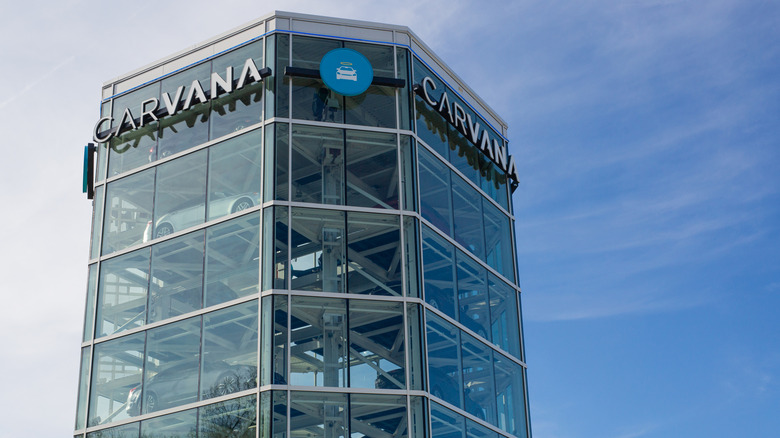
Dealers may scoff at the whole premise, but disruptors like Carvana very much live rent-free in their heads. In addition to sharing data highlighting the extent to which this new form of competition is taking a bite out of traditional dealership market share, industry pros also share what can be learned from this bold new approach to selling used cars with its glass towers dotting the landscape like defiant middle fingers aimed directly at the dealership model.
The real threat from Carvana isn't just giant glass novelty vending machines, though, it's that it has made a lot of the traditional dealership process look optional. No wandering the lot waiting to be intercepted. No starting the deal online and then doing the whole thing over again in a cubicle under fluorescent lights. No pretending the customer's hostility toward all this friction was some baffling new lifestyle trend. (Are the damn millennials killing car dealerships now?)
That doesn't mean the industry advice is to become Carvana. It means dealers are being told to absorb enough of the online-first experience to keep shoppers from wandering out of the traditional dealership funnel altogether. Digital Dealer, which provides guidance on such things, argues that Carvana doesn't win because it has the lowest prices, but because consumers respond to what the brand offers, particularly process and convenience. The site advises dealers to invest in online capabilities so that customers can complete as much as 90% of the transaction before walking in the door.
Whether that kind of compromise will win the day remains to be seen, but in the meantime it's worth noting that fears about the disruption don't seem to be overstated. Carvana's comeback has allowed its value to surge past both Ford's and GM's.
Protect margin whether the lot is full or empty

It's not unusual for there to be millions of cars sitting in dealership lots across the country at any given time, so car buyers might think things are swinging in their favor when they pull up on a lot that appears to be overflowing with inventory. Except that we no longer let little things like basic economic fundamentals or quaint notions like supply and demand tell us what things should cost.
The Car Dealership Guy pointed out this counterintuitive market behavior plainly at the end of 2025. When dealers were anxious about "volume pressure" (too many cars) they were comforted by the resilience of "pricing discipline" (overpricing the damned cars anyway). And sure, tough economic times are real, but dealers needn't fret, as "wage growth helped the buyers who are still in market handle the higher payments." Charming.
In any case, the point is that this publication, among others, is helping dealers understand how to navigate both ends of the inventory spectrum. Consider another Dealership Guy article titled with almost admirable directness, "Overstocked or undersupplied: These inventory tactics are keeping margins intact either way." In an overstocked environment, dealers may be managing aging units, uneven incentive support, and models that are not moving fast enough. In a tight-supply environment, they may be trying to protect profits because scarcity gives them less reason to negotiate. In either case, there does seem to be one option that's always on the table — lie.
The same article quotes a dealer in Denver who encourages his peers to put "sale pending" on website thumbnails that haven't had the photos added yet (you know the ones). "If most everything has a sale pending on it, it drives a lot of urgency," he shares.
Don't let a softer market turn into a cheaper deal

Every car buyer eventually becomes an amateur macroeconomist. Inventory is up? Demand is cooling? Interest rates might stop punching everyone in the throat? Great, surely this means the dealership will finally stop acting like a RAV4 Hybrid is a rent-controlled apartment in Manhattan. Unfortunately, that is not usually how dealer-facing advice talks about a softer market.
Generally, dealers are advised in the face of a softening market to be cool and maintain a disciplined approach to operations. And that's the key word: disciplined. Not generous. Not humbled. Not finally ready to throw in the all-weather mats without making you ask three times. Boston Consulting Group, which surveyed more than 200 U.S. franchised and independent dealers in March 2026, described an industry facing margin pressure, price-sensitive consumers, digital-first competition and structural changes in how people shop for cars. Its guidance was mainly operational: improve efficiency, rethink processes, and protect profitability as the easy money gets less easy.
So yes, a softer market can help shoppers when the right car sits too long or the wrong segment gets bloated. But the advice dealers are reading is not built around your victory lap. It's built around keeping the store profitable anyway. So yeah, new car prices are too high, but it doesn't appear the bottom is going to drop out. At least not as long as dealers hold the line while the consultant class screams encouragement like William Wallace in blue face paint.
Even cash buyers still get the pitch

We've said before that being a cash buyer will not get you a better price at the dealership. And honestly, even if the money works out the same, there's something to be said for being able to hold up your cash-buyer status like a vampire cross when the finance office starts peppering you with offers and add-ons. Auto Dealer Today describes cash buyers (and their equally frustrating cousins, credit-union borrowers) as customers who still need to be worked through F&I. One dealership consultant quoted compares the model to selling printers and ink: the printer is cheap, but "the ink is where it gets you." We suppose a car transaction where no one is trying to "get you" is out of the question.
Older F&I training advice makes the same point even more plainly. F&I and Showroom says the quiet part out loud, describing how "the grizzled old veterans dump the cash buyers on the new, inexperienced F&I managers, since they're not going to buy anything anyway." Notice that under this worldview, you can spend $60,000 on a new vehicle and still be scoffed at for not buying anything.
Anyway, the collective wisdom of the industry remains to keep pushing those F&I products, even for cash buyers or those with financing already lined up. So showing up with a cashier's check may save you from the loan, but it isn't going to spare you the sales pitch.
Don't leave money sitting in the service lane
A Cox Automotive article based on its 2025 Fixed Ops and Ownership Study describes service as a powerful growth engine inside the dealership and says high-performing service departments treat it as a strategic business component connected to sales, inventory, and customer lifetime value. That is the polite consultant version of the idea as they lament that dealers are leaving an all-time high amount of money "on the table," aka in your pocket.
The urgency is real because dealers are losing their grip on this revenue stream. Cox said in 2025 that dealerships had lost 12% of service visits to competitors since 2018, even as such non-car-sales revenue has become a way to offset shrinking margins.
McKinsey, when not defending itself against allegations of failing to disclose its work with foreign governments while contracting with the U.S. Department of Defense, makes the same basic consultant-class case, noting that service departments remain a meaningful opportunity to increase retention in the first years after purchase. We just think it's nice to know that the same nerds using PowerPoint to help ICE cut costs at its detention centers are also dutifully working to figure out how to coax you back to the dealership for an oil change.
Maintenance plans keep them coming back
A prepaid maintenance plan isn't just a coupon book for future oil changes. For the dealership, it's a return ticket. Sell the plan in the finance office, collect the money during the transaction, then give the customer a built-in reason to keep coming back to the service lane instead of wandering off to an independent shop.
And honestly? This feels like a fair enough arrangement for both sides so far. At least it does until you look over your dealer's shoulder and see F&I and Showroom explaining how maintenance contracts could have them bringing in "an additional million dollars or more" in a year. CBT News, meanwhile, tries to make the consumer side of the equation make sense, even pointing out Bankrate data showing that most consumers can't afford to cover a $500 emergency, as if $777 monthly car payments have nothing to do with that.
In any case, part of the calculus behind this multi-million-dollar revenue opportunity for dealerships is the out-of-pocket upsell when you come in for a covered service. So yes, the plan may be pitched as convenience. Inside the dealership, convenience has a job: get you back under the same roof, where the next recommendation can find you.
It's all about the LTV, baby

By the time you've made it through the sales floor, the finance office, and the service lane, you may reasonably believe the dealership is finished with you. That's adorable. Because in the MBA-addled business minds of industry experts, you are not merely a person who bought a car. You are a lifetime of revenue opportunity wearing shoes.
We're talking about customer lifetime value, or LTV, the long-term economic value a customer represents to a business. Cox Automotive's 2025 Fixed Ops and Ownership Study says high-performing service departments treat fixed ops as a strategic business connected to sales, inventory and, yes, customer LTV. They estimate that losing a service customer can represent more than $12,000 in potential lifetime service spend, and they frame failing to book you for that first appointment with your new car as equivalent to kissing that money goodbye. Something about putting it into a spreadsheet transforms the dynamic. It's not a relationship, it's a forecast. And your failure to participate to the fullest isn't just a personal choice, it's one that erodes their future business.
Once you understand that, the dealership's strange gravitational pull makes more sense. The service reminder, the maintenance plan, the trade-in email, the "while you're here" appraisal pitch — they are not isolated annoyances. They are touchpoints in a retention system. So at the end of the day, you may or may not still think that practices like this mean dealerships are mostly a scam, but at least you know it isn't happening by accident.