

These 1950s Semi Trucks Had More Personality Than Today's Big Rigs
Trucks are getting out of hand mechanically, with the most powerful semi engines ever built producing well over 700 horsepower. That's enough to pull three trailers and propel Australia's longest road trains. But since aerodynamics is the driving force behind the design of today's big rigs, they all look eerily similar, without any personality. American trucks usually have a long, sloping nose, while cab-over trucks overseas have vertically sliced front ends. What a lack of character.
Things were different in the 1950s, though. Then, truck manufacturers tried all sorts of cabin configurations and designs, giving us some of the most memorable semis ever made. Now, sure, some of the design decisions made were questionable and made life worse for truckers. However, there's no question that 1950s trucks ooze personality — and we'll prove it to you by showing you our eight favorite models. From weird cab-over rigs to brutish long-nose freaks, here are the coolest 1950s semi trucks.
Mack B61 (1953 to 1966)
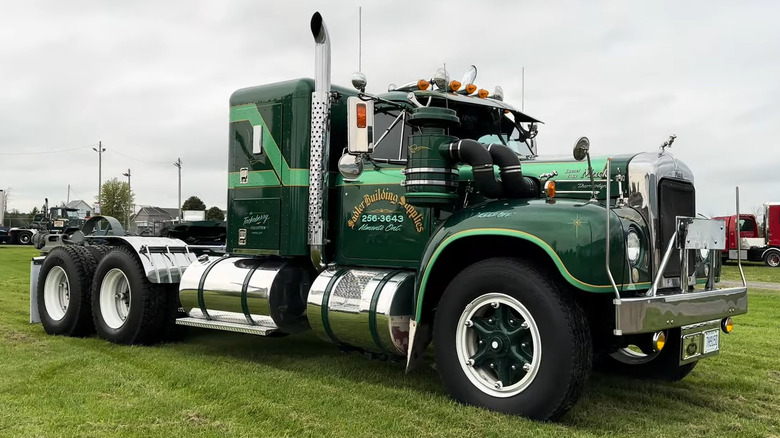
The Mack B61, launched in 1953, is a semi that oozes originality and road presence. Its massive, bulbous appearance gives it a muscular character, plus elegance few modern trucks can match. It looks like a boxer in a tuxedo, and we mean that in the best possible way. Let's also not forget about its chrome-plated Mack Bulldog hood ornament, which stands proudly over the potent engine hiding behind the massive grille.
The B61 was exclusively offered with diesel engines. Smaller B-Series trucks were also offered with gas engines with a capacity ranging between 4.8 liters (107 hp) and 11.6 liters (232 hp). However, in the B61, you had a choice between the 672-cubic-inch (11-liter) inline-6 diesel (END 673) with 187 hp to 250 hp and 500 to 701 pound-feet of torque and an 864-cubic-inch (14.16-liter) V8 diesel (END 864) with 255 hp and 639 lb-ft at 1,700 rpm.
Both engines were from the Thermodyne family, designed with long life and low maintenance in mind. So they featured Durafaced valve lifters with tungsten carbide, a fully counter-balanced crankshaft, and full-flow bypass oil filters. Because the non-turbocharged Thermodyne engines weren't particularly powerful, Mack combined them with complex non-synchromesh transmissions (up to 20 speeds) to keep them in the sweet spot.
Perhaps the B61's highlight is its cabin, which looks like an extension of the exterior design. There is literally not one plastic molecule inside, just heavy-duty metal. Behind the steering wheel, Mack opted for simple, easy-to-read gauges, with chromed rings that certainly catch the eye. Personality test: passed.
Peterbilt 281/351 Needlenose (1954 to 1976)
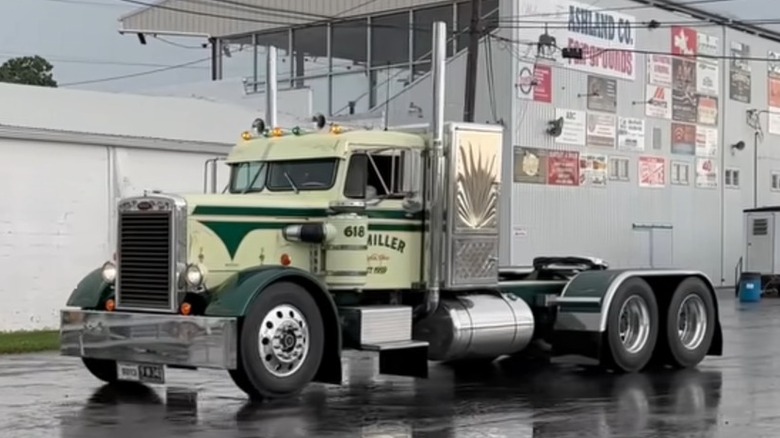
Back in 1954, Peterbilt effectively drew up the mechanical blueprint for the American semi truck with the 281 and 351 models. Their ultra-narrow hood with butterfly covers, towering radiator shell, and comparatively tiny circular headlights gave them a decidedly brawny appearance that many brands followed later.
Still, because of their narrow hoods, the Peterbilt 281 and 351 are today known as the "Needlenose" trucks. You might also know them from Steven Spielberg's scary "Duel" television movie. Spielberg cast a heavily weathered 1955 Peterbilt 281 tanker as the film's faceless mechanical antagonist. For 90 minutes, this rolling hunk of rusted iron terrorized the movie's protagonist, David Mann (Dennis Weaver), in a terrifying high-speed highway chase. Because they look so similar, Spielberg later also used a Peterbilt 351 to shoot some additional scenes for the feature-length version. The only difference was that the 281 had a single-drive rear axle, while the 351 had a dual-drive rear axle.
But how could Mann not escape a heavy, rusted truck, even though he drove a Plymouth Valiant? We won't spoil it for you, but in terms of speed, the Peterbilt 281 stood no chance. Buyers could equip the Peterbilt 281/351 with various diesel engines from Caterpillar and Cummins, with the villain truck being powered by a 262-hp Cummins engine. With a heavy trailer attached, that's far from enough to overcome the Valiant's 3.2-liter engine with 125 hp.
Freightliner WF800 & WF64 Bubblenose (1949 to 1954)
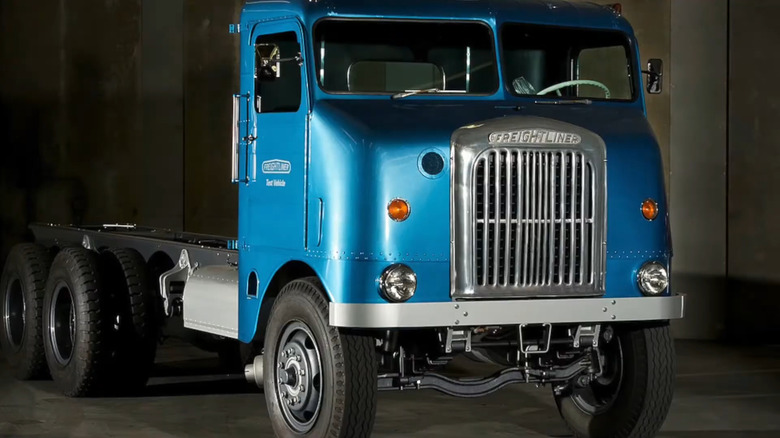
Freightliner's first semi was also one of its coolest and most innovative. Unlike its rivals from the era, the legendary truck company wanted to build a lighter, more compact model, so it used a lot of aluminum components and a cab-over-engine (COE) design. The Freightliner WF800 and WF64, initially sold through the White truck company, are incredibly compact, with a short, stubby nose that brought them the "Bubblenose" moniker.
Yes, this means there is a nose on these trucks, unlike modern COE trucks, which are completely flat on the front. Still, this gave some space for the beautifully framed chrome grille structure to shine.
Like most of their rivals, the Bubblenose trucks could be equipped with a plethora of diesel engines from Hercules, Buda, Cummins, and even Detroit Diesel two-stroke Screaming Jimmies. The last option must've been a riot to listen inside the cabin, as the driver essentially sat next to the engine. Earplugs were absolutely a necessity, but at least the DD options were potent, producing up to 318 hp in the 8V-71.
Noise wasn't the only issue drivers faced. Because of the COE configuration, the Bubblenose trucks also had a bouncy ride, and their cabins were also incredibly cramped. That didn't stop Freightliner from offering a sleeper cabin model. Known as the "Tiltin' Hilton," these trucks featured a confined sleeping area over the cabin. Suffice to say, being trucker in the 1950s and '60s wasn't a particularly nice experience.
White 3000 (1949 to 1967)
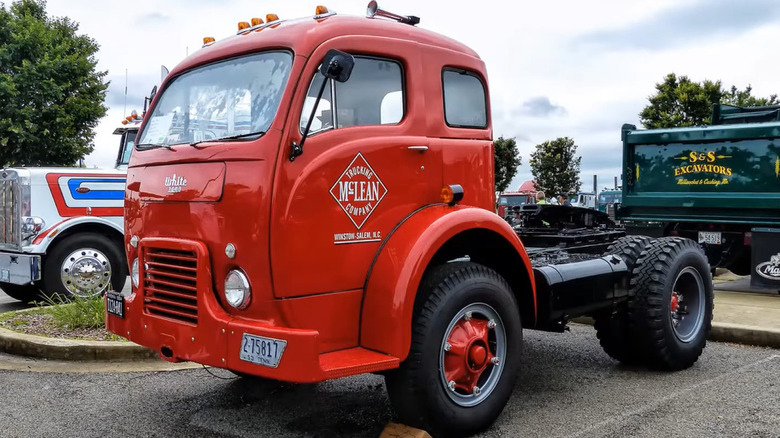
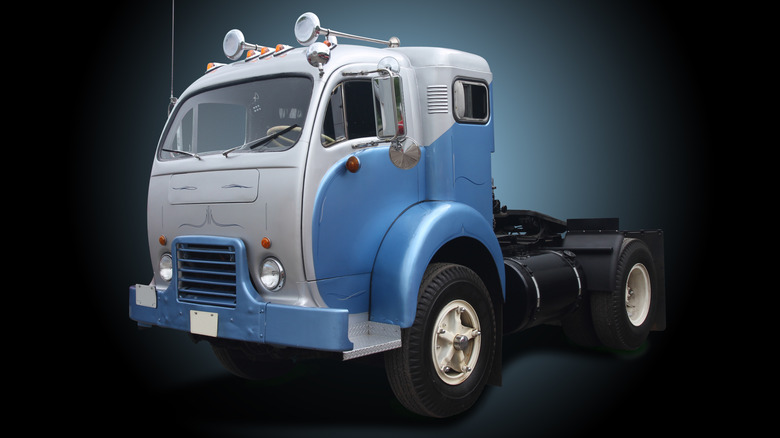
Yup, this is the same White truck company that helped Freightliner reach customers. At the time, White was the biggest truck manufacturer, and it also made some of the coolest models. Case in point, the world's first tilt cab, the White 3000. The truck's cabin could be lifted hydraulically, allowing easier maintenance and repairs than on a COE and even conventional long-nose semis.
The White 3000 is also one of the best-looking trucks of the 1950s, with a design reminiscent of a high-end Art Deco kitchen. Instead of the Peterbilt 281's villainous "Needlenose" appearance, the White 3000 boasts a smooth, streamlined, low-slung aesthetic. The tiny grille only adds to the friendly appearance.
Of course, the brand-new (at the time) cab-forward configuration helped White design such a beautiful truck, but it also helped in other areas. Because the cabin was in front of the engine, the seats were placed lower than in a regular COE truck. Even then, White had to make modifications to the design so it could accept bigger engines for cross-country trucking. A sleeper cab option was also introduced, with a bed behind the seats.
Diamond T Model 921 (1951 to 1966)
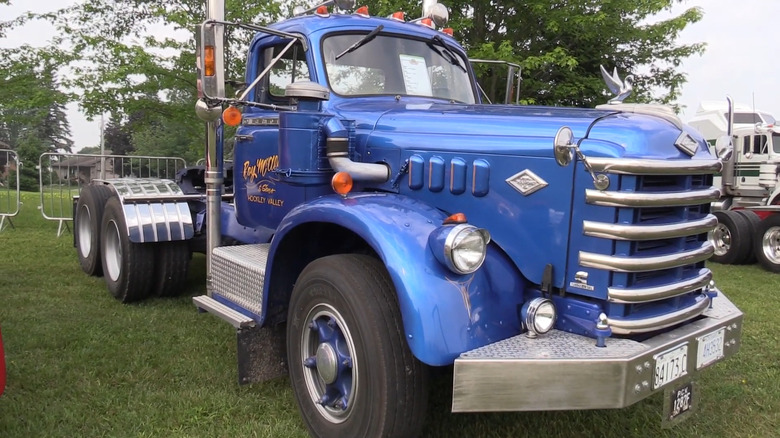
You've probably never heard about the Chicago-based Diamond T truck company, as it went defunct in 1975 as Diamond Reo. During the 1940s and 1950s, though, this manufacturer was considered the "Cadillac of Trucks," as it focused not only on getting the job done, but doing it with style.
The Diamond T Model 921 semi perfectly encapsulates that with its monolithic nose shape, proud grille from solid aluminum, and one-piece curved windshield. It looks strong, bold, and exquisite at the same time. The interior only added to the Diamond T Model 921's appeal. Instead of the spartan approach of most of its rivals, this truck featured nicely laid out dials with chrome surrounds and a greater attention to detail. Diamond T also pampered drivers with air suspension, borrowed from Peterbilt.
But Diamond didn't produce the chassis. The company bought the structural parts and power trains from other manufacturers; the Model 921, for instance, borrowed the frame and cab from different suppliers, with Diamond T then working its magic over the existing structure. Most Model T trucks were equipped with Cummins powerhouses of various capacities.
Kenworth Bullnose COE (1949 to 1958)
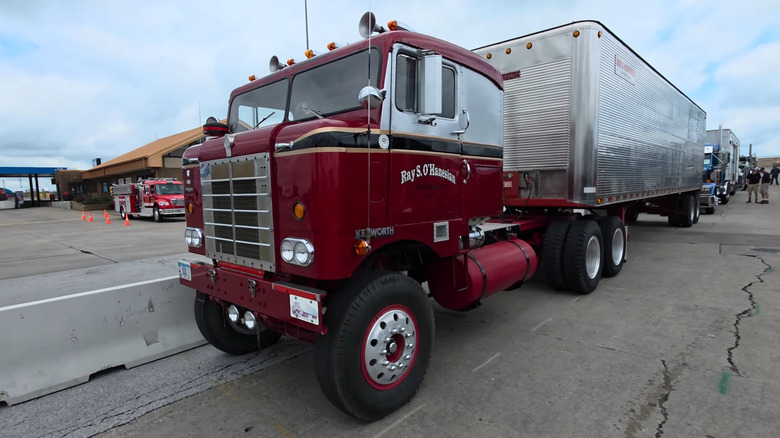
Bulldogs are one of those breeds you either love or hate. It's the same with Kenworth's 1950s "Bullnose" COE trucks, which look like a standard long-nose truck that's been smashed in the face, cartoon-style. Kenworth had to go with this design, as 1950s regulations limited the overall length of semis, so cab-over designs made more sense. But this gives these trucks a whimsical character that blends well with their almost brutalist overall appearance. The rectangular grille only intensified the truck's face, giving it a more robust appearance.
Kenworth Bullnose COE trucks were available in two-axle (model 521) and three-axle (model 523 configurations). Because of its cab-over design, the engine was tucked inside the cabin and could be accessed via a "doghouse" sandwiched between the seats. For regular maintenance, like accessing oil and coolant change, though, technicians only needed to open the tiny front hood. Kenworth used Cummins engines, which allowed Ray O'Hanesian, an owner of a Kenworth Bullnose for over 40 years, to cover over 5.2 million miles!
The Kenwhorth Bullnose trucks didn't have a tilting cab, unlike the White 3000, which would've made repairs easier. Still, Kenworth was able to cram a sleeping area behind the seats. It was a bit challenging to get to due to the engine doghouse, but it was at least there.
International Harvester R-190 (1953 to 1972)
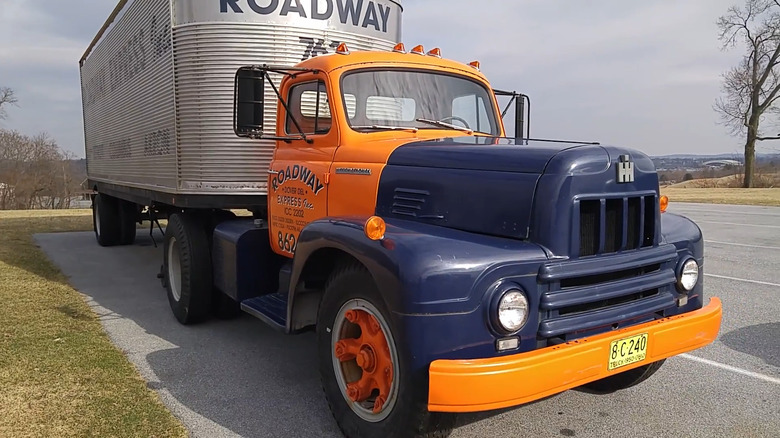
While the Kenworth Bullnose looks futuristic for the 1950s, the International Harvester R-190 looks decidedly retro. And while it didn't have as much visual fluff as its rivals from the era, its face was instantly recognizable on the road. The R-190 featured a clean, aggressive rectangular grille opening split by a thick, tapered horizontal bar, giving it a classy, refined look.
Still, it was the Red Diamond big-block inline-6 gas engines that made these trucks truly unique. Yup, unlike its opponents, International Harvester used massive gas engines in its long-haul semis. The biggest one was a 501-cubic-inch (8.2-liter) behemoth, but smaller engines were also available. Naturally, these gas engines had an unquenchable thirst for fuel, but also delivered power in a wider rpm range than their diesel counterparts.
Unfortunately, International Harvester equipped its trucks with 6-volt electrical systems initially, which wasn't enough to start the monster inline-6s after they were warmed up. Later models with 12-volt electrical systems didn't have that issue. On the flip side, International Harvester also offered AWD versions of this truck, which shouldn't come as a surprise, as the company also made off-road-ready agricultural equipment.
International Harvester Sightliner (1957 to 1964)
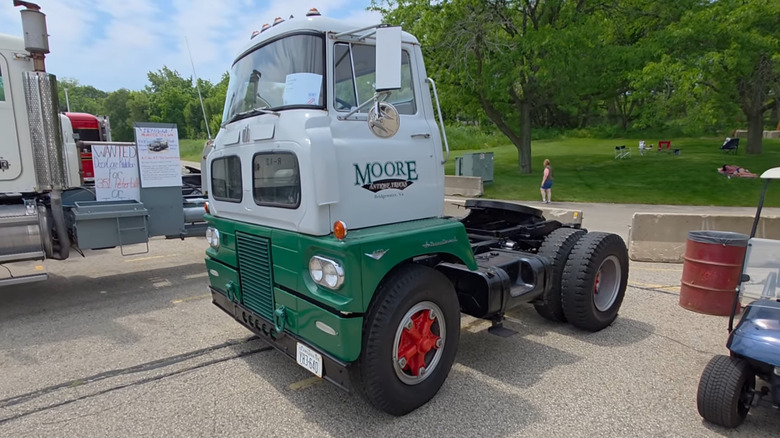
The International Harvester ACO/ACOF "Sightliner" must be one of the most unusual trucks that came out in the 1950s. Its front end looks like two stories of brick, with a pair of small windshields above them giving you a direct view of the driver's crotch, and the standard windshield on top.
The idea, of course, was to give the driver better visibility of the surrounding area in urban environments and, ultimately, increase safety. Fortunately for International Harvester, crash tests weren't a thing at the time, as these windshields offered almost no protection. Not only that, but drivers complained about the greenhouse effect, which quickly warmed up the cabin. So, many drivers covered them with cardboard. This didn't solve other issues, though. Because they were closer to the ground, they were also susceptible to shattering from road debris.
The "Sightliner" wasn't weird only when you looked at it head on. Somehow, International Harvester brought the cabin length down to 48 inches, so the ACO/ACOF trucks without the added sleeper cab look truly bizarre from the sides. The tiny interior volume only intensified the heat, and did we mention the engine sits directly below the cabin? At least the International Harvester "Sightliner" had a tilting cab, so accessing the engine for maintenance and repairs was very straightforward. It was not enough for the ACO/ACOF series to capture market share, though, and International Harvester killed it after only seven years.