

These States Allow Semi Trucks To Pull Three Trailers
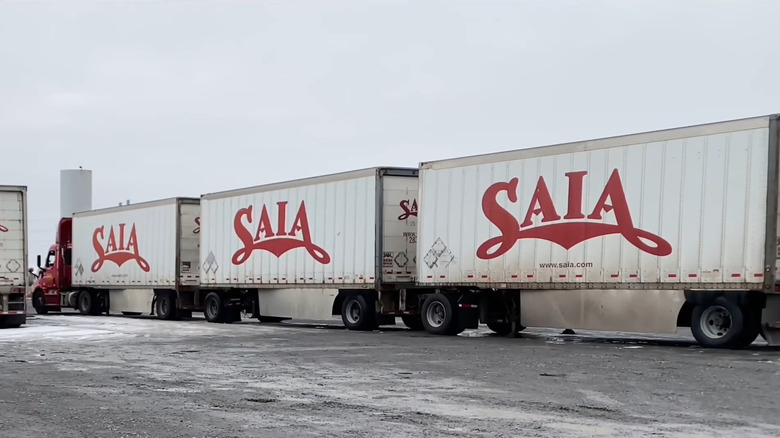
If you have ever been cruising down a desolate stretch of I-80 in Nevada and found yourself being overtaken by a vehicle the length of a Boeing 737, you just witnessed a triple trailer. These are long combination vehicles (LCVs), a spectacle in the Wild West. In case you are wondering about the longest LCV, it was a trackless, overland train meant to run on nuclear power. While most of the country thinks a single 53-foot semi container hogs a lot of the highway real estate, a handful of states out west, where the roads are longer and traffic is thinner, let truckers haul three trailers at once.
If you want to see these triple trailers in action, you'll need to be in Arizona, Colorado, Idaho, Kansas, Montana, Nebraska, Nevada, North Dakota, Oklahoma, Oregon, South Dakota, or Utah. Some states like Indiana and Ohio allow them, too, but usually only on specific turnpikes where the lanes are wide and the exits are fewer. These are more than just trucks — these are land-bound freight trains that operate under a strict set of rules.
The federal government generally limits trucks on the National Network to two trailers (doubles). However, a grandfather clause in the 1991 Intermodal Surface Transportation Efficiency Act (ISTEA) allowed states that already permitted triples to keep them. The triples are largely confined to the wide-open Western corridors or controlled-access toll roads.
Triples vs your standard big rigs
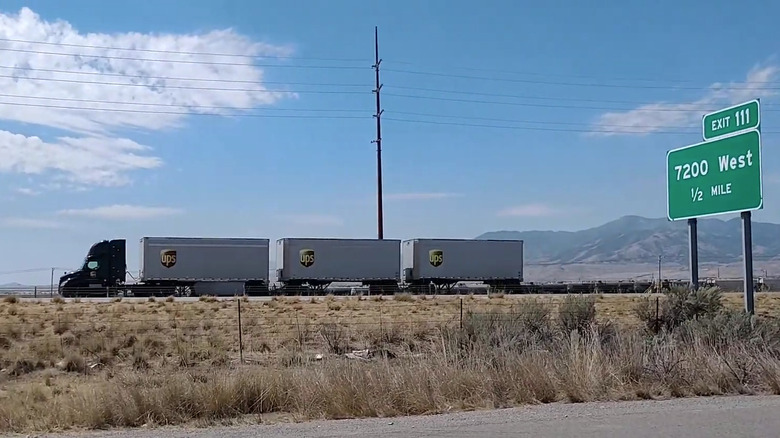
So, what exactly is a triple trailer? At its core, it is one tractor pulling three separate trailers. You do not even need the world's largest semi-trucks to pull them. However, you can't just hook three massive 53-foot trailers together — that's a 180-foot disaster waiting to happen. Instead, triple trailers typically utilize "pup" trailers, which are shorter units usually measuring around 25 to 28.5 feet each. When you factor in the trailer and the dollies –- the unpowered trailer frames with wheels used to connect one trailer to the next — a triple trailer rig can span over 100 feet in length. The mechanics of these rigs are a marvel. To get three trailers to move in unison, you need a series of converter dollies. Each dolly acts as a bridge, providing the coupling point for the next trailer's kingpin. It creates a mechanical chain that requires immense skill to navigate.
The difference between a triple and your standard 18-wheeler goes beyond length — it's the weight distribution and the snake effect. A triple rig has multiple articulation points, making it more prone to rearward amplification, where a small steering input is amplified multifold by the time it reaches the third trailer and can cause it to whip across lanes. For these reasons, many states restrict triples from places with high winds, which can cause the third trailer to rollover or drag the rig off the road.
While a standard semi's weight is usually capped at 80,000 pounds gross vehicle weight (GVW), LCVs in certain states can tip the scales at well over that or even up to 150,000 pounds with a special permit.
Why do triples exist?
It's a logical question: Why would anyone bother with the headache of managing a 100-foot rolling pendulum? The answer is efficiency and profits.
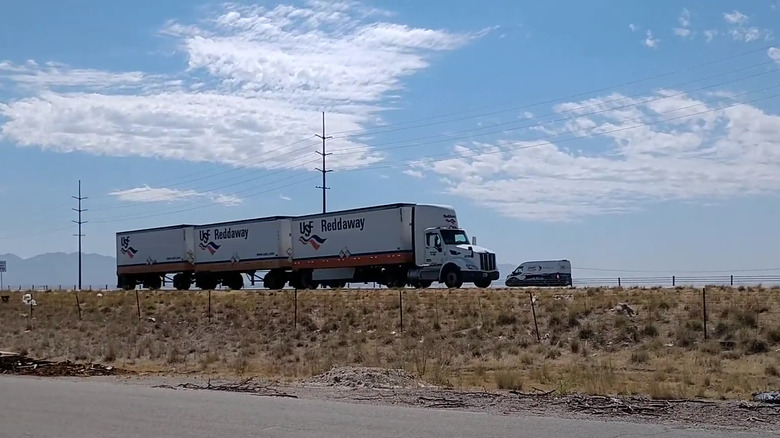
The primary benefit of triple trailers is freight density. By pulling three trailers with one engine and one driver, a trucking company can move significantly more LTL, or less-than-truckload freight. Think of packages from UPS or FedEx, which mostly have less weight than the space they occupy compared to commercial freight. Using a triple in this case means using less fuel and fewer drivers. LCVs are also one of the most fuel-efficient ways to move goods on a ton-mile basis. Well-designed semi-trucks will also help cut diesel consumption.
From a safety perspective, supporters argue that triples actually reduce the number of trucks on the road. If one triple trailer rig replaces two standard semis, that's one less engine emitting carbon and one less truck taking up space in traffic. Also, LCV drivers are usually the best of the best –- veterans with millions of miles of accident-free driving under their belts.
However, the triple remains a controversial figure. Safety advocates point to the increased braking distance and the difficulty other road users face when trying to overtake a vehicle that never seems to end. Despite this debate, when it comes to the vast empty stretches of the American West, the triple trailer is the apex predator.