

12 Of The Largest Engines Ever Built
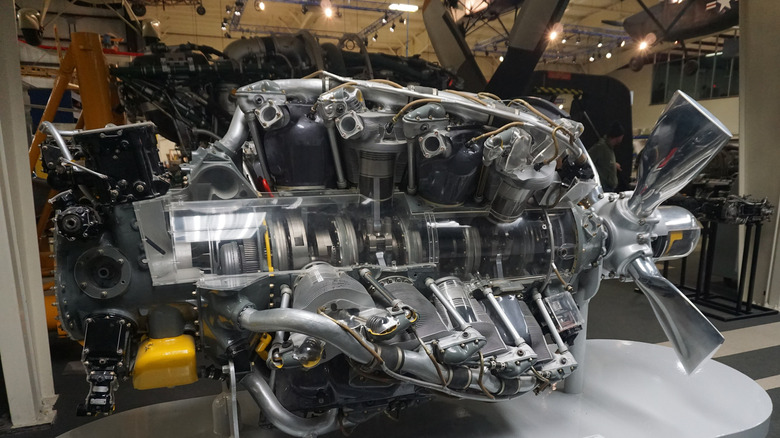
Think your V8 is big? Think again, because the engines we'll show you here are bigger than your apartment. And we are not talking about big-block engines like Bugatti's 8.0-liter W16 quad-turbo beast or the 9.9-liter Lingenfelter V8 found in the 1994 Chevy Suburban. Heck, even old semi-truck V8s are tiny in comparison to what we are about to show you.
Welcome to the world of massive reciprocating piston engines, where technicians need a staircase to change the oil and where cylinder counts reach three digits — often arranged in configurations you've never seen in a car. Of course, this translates to horsepower and torque figures that defy belief from an automotive standpoint.
These giants move the cargo ships that make the world tick. The coffee you drink and the gadget you're using to read this article were probably brought to you by one of these monsters. So, let's have a closer look at some of the largest engines ever built!
Pratt & Whitney R-4360 Wasp Major 71.5L 28-cylinder
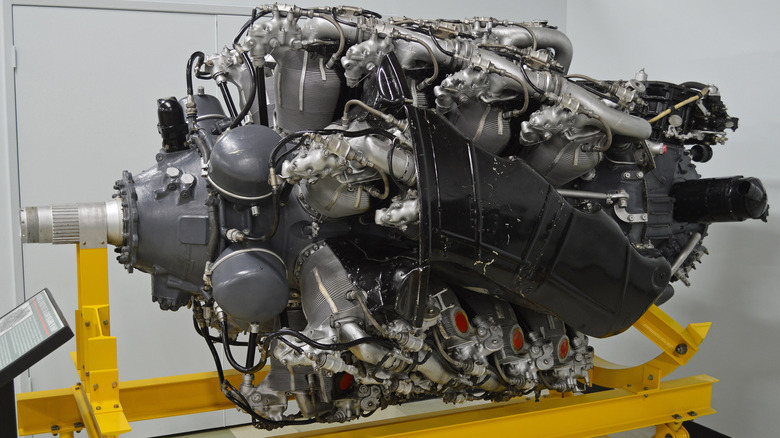
Seeing the image above, one can't help but wonder: "What am I looking at?" Indeed, the Pratt & Whitney R-4360 Wasp Major is a very complex radial four-stroke engine, with intricate geometry and many, many structural parts. Designed to power the Boeing B-50 aircraft after WWII, the R-4360 Wasp Major was the largest piston engine Pratt & Whitney ever produced, with a total capacity of 71.5 liters. It was later used in other aircraft, like the B-36 bomber, B-35 Flying Wing, and C-119 Flying Boxcar.
Yet it's the configuration that's way more interesting than the sheer capacity. Pratt & Whitney arranged the pistons in four radial rows of seven pistons each, equaling 28 pistons. Now comes the tricky part: the R-4360 Wasp Major is air-cooled. In engines with fewer pistons, this isn't an issue, but in this one? It's a nightmare. So, to ensure that cooling air could reach all rows, each row is rotated by exactly 12.857 degrees relative to the one in front. Yup, that's where the unusual helical pattern comes from. Furthermore, to achieve smooth operation, the engine fires every 25.714 degrees, meaning it completes a full firing cycle in every two revolutions (720 degrees) of the crankshaft.
With up to 3,500 hp on tap, the R-4360 Wasp Major was an outstandingly potent engine for its era. It was also massive at 97.5 inches long, 57.25 inches wide, and 66 inches deep. Still, because it was designed to be used in aircraft, it weighed just 4,130 pounds.
Cummins QSK95 95L V16
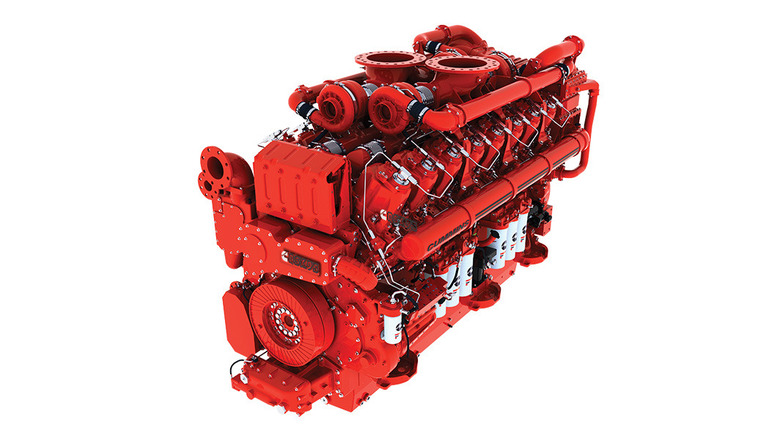
While the R-4360 Wasp Major is defined by its complex helical offset, Cummins' largest engine to date is all about simple, functional geometry. It still packs four turbochargers, but the V16 configuration is already proven in extreme-duty workflows. Yes, that same configuration is used in the Bugatti Tourbillon hybrid hypercar, though there, the V16 comes with some pros and cons that are common in automotive applications.
Besides, the two couldn't be more different when it comes to power delivery. The QSK95 is a high-speed diesel engine that operates up to 1,800 rpm. It's also built for torque, producing up to 17,802 lb-ft. Depending on the application, this 95-liter behemoth can also produce up to 5,100 hp. The QSK95 is efficient, too, thanks to the modular common rail fuel injection system.
Like most Cummins engines, this one is also built for the long term. It features forged-steel pistons with Plasma Vapor Deposition (PVD)-coated top rings, hardened cylinder bores, a deep-skirt block, and dual piston cooling nozzles per cylinder. Meanwhile, a special flywheel housing, gear housing, and oil pan-to-cylinder block ensure no oil leaks from the engine. As a result, the QSK95 can run through an astonishing 1.7 million gallons of fuel before needing an overhaul. So, unsurprisingly, the QSK95 is used in various industrial applications, including mining, marine, and rail.
Back in 2012, when the QSK95 was launched, Cummins promised an even larger 20-cylinder version called the QSK120. However, the 120-liter engine still hasn't entered production. Instead, Cummins has pushed the QSK95 power figures past the QSK120's initially planned 4,960 hp, mitigating the need for the larger engine.
Caterpillar C175-20 105.8L 20-cylinder
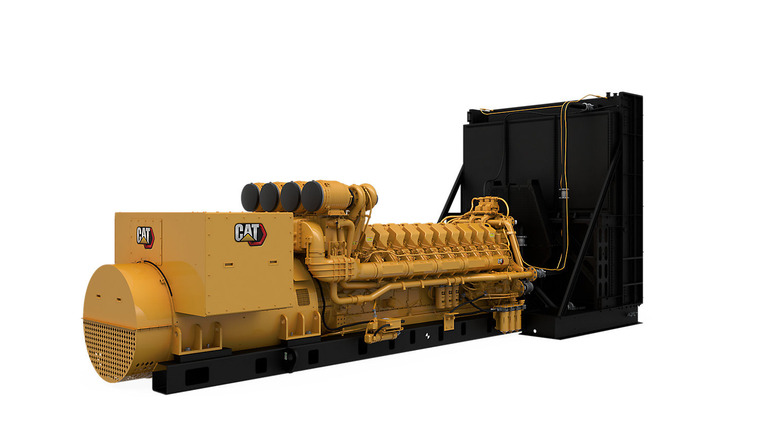
Caterpillar, one of Cummins' biggest rivals, already has a four-stroke V20 engine in its portfolio — the C175-20. A 105.8-liter colossus, Caterpillar's high-speed diesel engine was designed to power the massive Cat 797F mining truck, which has a payload capacity of a whopping 400 tons. Cat also makes a C175-20 diesel generator, which produces an astonishing 3.15 to 4 megawatts of electricity.
Like its V16 Cummins rival, the C175-20 has four parallel turbochargers, an air-to-water intercooler, and a high-pressure common rail fuel injection system. As a result, it produces 4,000 hp and 16,474 lb-ft of torque, meaning it's short on power compared to Cummins' V16. However, like most Cat engines, the C175-20 is designed for longevity; Cat says it has deployed over 3,000 units globally, which racked up more than 20 million operating hours.
Naturally, the C175-20 is massive on the outside — it has a footprint similar to a small apartment (21.8 feet long, 7.6 feet wide, 8.38 feet high) and weighs 51,588 pounds. The engine features a single cast-iron block and a single crankshaft made from forged steel. Caterpillar also designed an intricate water-cooling system. The engine also has a compact SR5 alternator.
Lycoming XR-7755 127L 36-cylinder
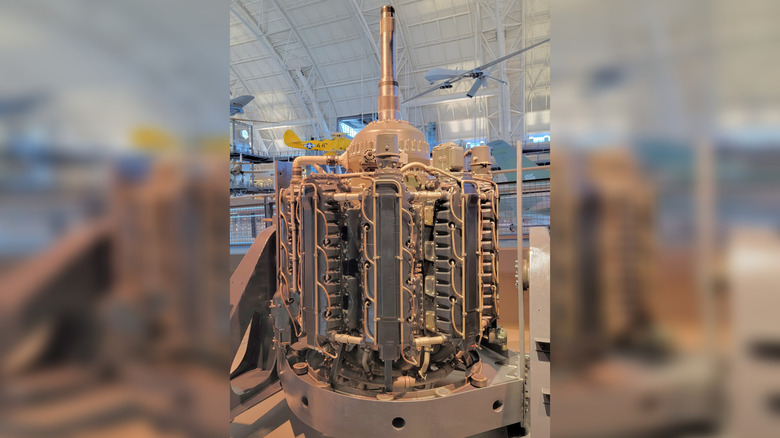
The R-4360 Wasp Major's corncob-like shape is certainly a sight to behold, but you have to give credit to Lycoming for making one of the cleanest-looking radial engines. Unveiled in 1945, the XR-7755 is one of the most advanced such engines ever produced, employing liquid cooling to solve the woes of most reciprocating radial engines of the era.
The XR-7755 was massive, too. Lycoming opted for nine banks of four cylinders, resulting in a 36-cylinder radial engine with a capacity of a whopping 127 liters. It measured 61 inches wide and 121.35 inches long, and weighed 6,130 pounds. The engine was also equipped a supercharger, which forced air through nine intake manifolds. It produced an astonishing 5,000 hp at 2,600 rpm during takeoff and powered a two-speed, dual-rotation propeller drive.
However, power was only part of the story. To maximize efficiency, the XR-7755 utilized nine overhead camshafts that moved axially, allowing the engine to switch between dual lobe profiles on the fly. That way, Lycoming could achieve maximum power during takeoff and efficient combustion while cruising. Sounds familiar? Modern variable valve timing engines work in a similar way.
Unfortunately, the Lycoming XR-7755-3 never took off. The company produced two prototypes, which were tested but never employed in an aircraft. By the time Lycoming produced these prototypes, gas turbine engines were beginning to take off.
Yakovlev/Zvezda M500 Series Radial Engines 143.6-383L
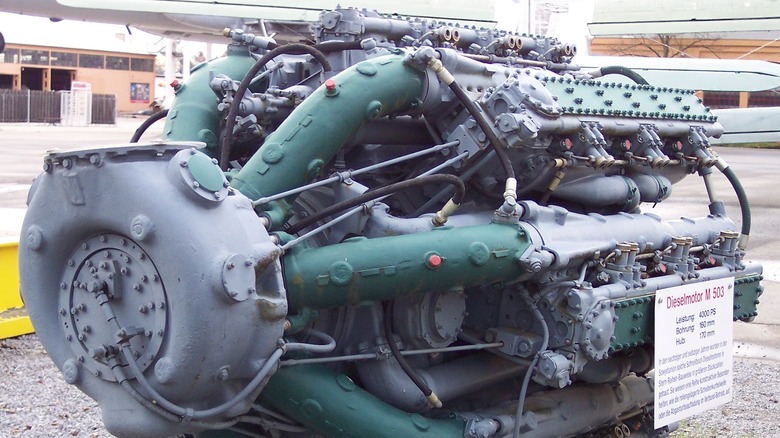
Shortly after Lycoming launched the world's biggest radial engine, the Soviets responded with the M500 diesel engine series. The first to arrive was the M501 — a 143.6-liter aircraft monster with 42 cylinders, divided into seven cylinder banks with six cylinders each. The water-cooled unit produced an astonishing 6,205 hp with a turbo-supercharger and weighed 7,500 pounds. Like with the Lycoming XR-7755-3, by the time the M501 was ready to take off, gas turbines took over and the project was scrapped.
However, this was not the end of the M500 series. Yakovlev's factory No. 174 took the design and converted it for marine use. Then, it introduced the improved M503, named Zvezda, which translates to "Star," signifying the engine's shape. The M503 borrowed the general design from the M501 and used the same turbo-supercharger. This system allowed the supercharger to be engaged by the crankshaft at lower rpm and the exhaust turbine at higher rpm. By doing this, Zvezda solved turbo lag, similar to modern twin-charged engines. The M503 produced 3,943 hp and powered the Soviet Osa-class missile boats.
For the next generation M504, Zvezda significantly increased engine capacity. The new 56-cylinder monster (seven banks of eight cylinders) had a capacity of 191.4 liters and produced 5,163 hp using an improved turbo-supercharger system. For the next-gen model, Zvezda went with a new design. The M507 was a 112-cylinder, 383-liter powerhouse formed by coupling two 56-cylinder engines together, syncing their power through a single, massive reduction gearbox. It produced a whopping 10,453 hp and weighed 37,700 pounds!
Rolls-Royce MTU 20V 8000 347.4L 20-cylinder
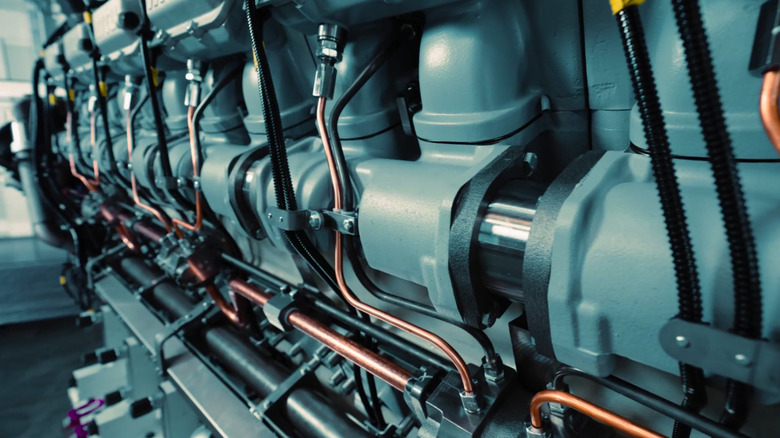
Sure, the Zvezda M507 power figures are impressive, but wait until you hear about the MTU 20V 8000 — today's heavyweight champion of high-speed marine diesel engines. This V20 diesel colossus has a capacity of 17.37 liters per cylinder, which translates into an overall capacity of 347.4 liters. However, the MTU 20V 8000 has a 48-degree angle between the cylinder banks, resulting in a more compact footprint. Of course, it's still sizeable on the outside, measuring 21.8 feet long, 6.7 feet wide, and 11 feet high.
MTU's marine powerhouse features a cast iron block, a stiff crankcase, and a single camshaft. It operates at a speed range of 380 to 1,150 rpm and produces up to 13,410 hp. It achieves this by utilizing a common rail fuel injection system and four water-cooled, sequential turbochargers. Depending on load, the engine fuel management system can also switch off one or two turbochargers to increase efficiency. The system can also deactivate cylinders to further reduce fuel consumption.
The 20V 8000 is a highly reliable unit, having received the Naval Vessel Rules certification from the American Bureau of Shipping. It also meets NATO standards for acoustics and vibration, as well as the IMO II exhaust emission standards, and is used in everything from military ships to fast, high-payload cargo ships.
MAN 18V48/60TS 1,954.8L 18-cylinder
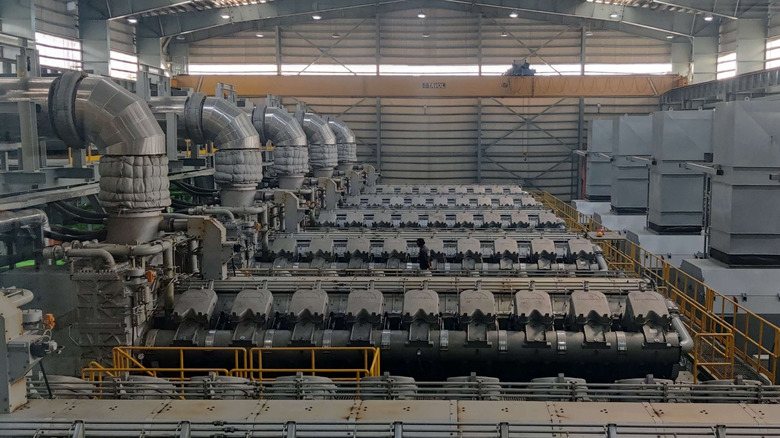
Okay, so with the MAN 18V48/60TS, we finally enter real giant territory. A true behemoth, this four-stroke V18 engine is designed for use in marine applications and for stationary power generation. Just one cylinder of MAN's monster has a capacity of 108.6 liters; multiply by 18, and you get to a whopping 1,954.8 liters!
As you'd expect, those pistons are massive, each with an 18.89-inch bore and a 23.62-inch stroke. They are so big, in fact, that the engine operates at 500 rpm (50 Hz) or 514 rpm (60 Hz). Even at that low speed, each cylinder produces up to 1,610 hp. At the same time, the 18V48/60TS is the most efficient engine in its category, with a specific fuel consumption of just 7,323 kJ/kWh. Like most big engines, the 18V48/60TS can work on a variety of fuels, including heavy fuel oils, marine diesel oil, and gas oil.
Still, the pièce de résistance feature of MAN's behemoth is the two-stage turbocharging system. It consists of low-pressure and high-pressure turbochargers, which allow efficient operation at a wider rpm range. Together with the modified camshaft, they allow the 18V48/60TS to operate under the Miller cycle. There is an additional air blower mounted below the low-pressure turbocharger, which ensures efficient operation during startup and light loads.
B&W 2000 H. C. Ørsted Power Station 2,050L 8-cylinder
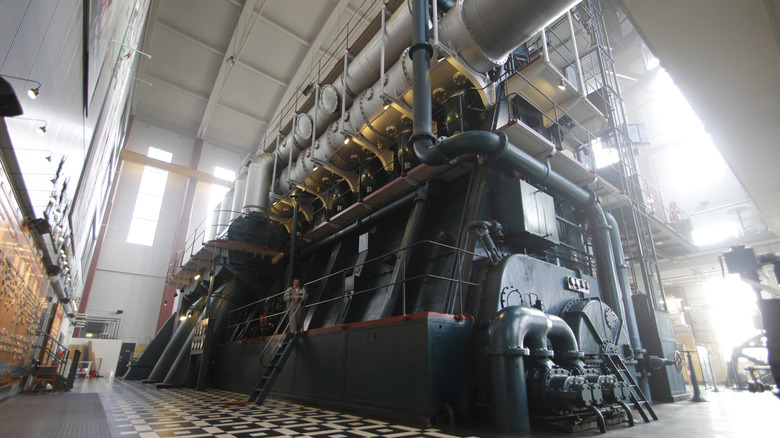
You can visit the Diesel House museum in Denmark to see some of these gigantic engines in person. However, the star of the show is the Burmeister & Wain 2000 straight-eight diesel engine, built for the HC Ørsted Power Station way back in 1932. At 80 feet long and 41 feet high, the "Copenhagen Giant" is larger than a three-story house and weighs an astonishing 2.8 million pounds. The weight of some individual parts is no less impressive — the crankshaft alone weighs 308,000 pounds.
And it's not just size — thanks to the double-acting, two-stroke design, this B&W engine produces 15 MW at just 115 rpm, or in automotive terms, over 20,000 hp! Back in the 1930s, that was enough to provide electricity for the city of Copenhagen, even during peak hours. As expected for a two-stroke engine, the B&W has four blowers that can push 63,500 cubic feet of air per minute.
The best part? The engine is still operational today. The Diesel House museum starts the B&W 2000 every first and third Sunday of the month and runs it for around 10 minutes for visitors. Because it could be started without electricity, the engine was also used as a standby power station from 1970 to 2004.
Wärtsilä 18V50DF 2,050.2L 18-cylinder
Although it has a capacity similar to the B&W 2000 (2,050 liters), the four-stroke 18V50DF V18 engine from Finnish company Wärtsilä produces up to 18.19 MW (24,400 hp) of power at 514 rpm (60 Hz). But this should surprise nobody, as it's a significantly newer engine. At 61.6 feet long, 13.4 feet wide, and 19.75 feet high, it's more compact, too. As a result, the 18V50DF can also be used in marine applications, not just power generation.
For higher efficiency, the 18V50DF also runs on the lean burn principle, i.e. the air-fuel mixture has a higher concentration of air. As a result, this V18 behemoth has an incredibly high electrical efficiency of 49.4%. The lean combustion also helps it achieve lower emissions, particularly harmful NOx gases. Like most modern engines, the 18V50DF is turbocharged and fuel injected.
However, it has two injectors — one for light fuel oil and the other for natural gas. Thanks to this arrangement, the 18V50DF can switch smoothly between the two different fuels on the fly or use a combination of both depending on the load. Heck, it will continue running even when one of the fuel supplies is interrupted, which is crucial in power generation.
Wärtsilä RT-flex96C & RTA96-C 25,573.8L 14-cylinder
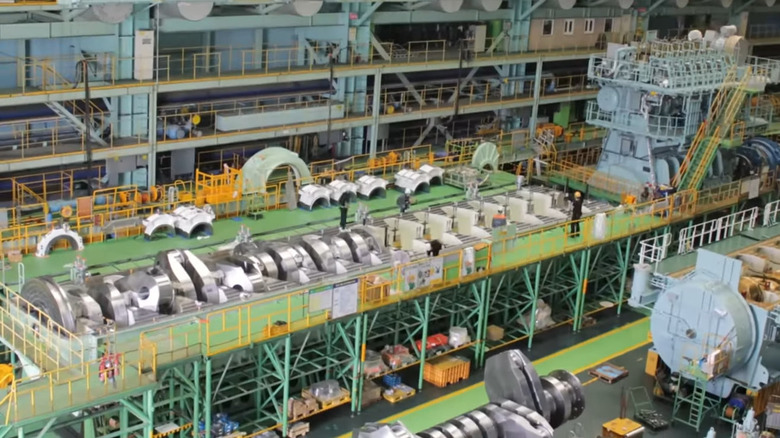
No, that's not a typo — the Wärtsilä RT-flex96C, a successor to the similarly sized RTA96-C, has an astronomical capacity of 25,573.8 liters. It's also 44.3 feet high, 87.24 feet long, and weighs over 5 million pounds. Heck, one of its pistons weighs a whopping 12,000 pounds! And the power figures are even crazier — the RT-flex96C produces 108,920 hp, which makes it the world's most powerful piston engine.
Okay, but what about torque? It's 5,608,310 lb-ft. Yes, you read that right: five million, six hundred eight thousand pound-feet of torque! To achieve that crazy torque, the RT-flex96C is a two-stroke diesel engine, with a 37.4-inch bore and a particularly long 98.42-inch stroke. Oh, and the full power and torque are available at just 102 rpm, with the engine able to idle at just 15 rpm! With so much potency at its disposal, the RT-flex96C powers the massive Emma Maersk container ships.
The RT-flex96C is also designed with efficiency in mind. It has a thermal efficiency of 51%, one of the highest for a reciprocating engine in the world. The RT-flex96C still feeds its cylinders with 1,585 gallons of fuel every hour, but that's to be expected for such a massive engine.
The Wärtsilä RT-flex96C is equipped with a common-rail system that controls the fuel injection, exhaust valve actuation, and air starting. All versions are equipped with exhaust turbochargers for air scavenging. Smaller versions of the RT-flex96C, with down to six cylinders, are also available.
MAN 11G95ME-C10.5 26,977L 11-cylinder
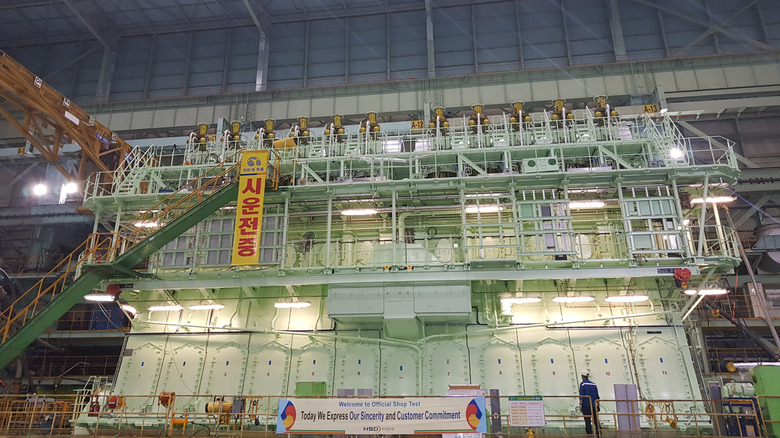
With an astonishing capacity of 26,877 liters, MAN's massive container ship engine is even bigger than its rival. What's more, that capacity is divided into 11 larger cylinders, with a 37.4-inch bore and 136.22-inch stroke. On the outside, this two-stroke colossus is 72.17 feet long and 59 feet high, or as big as a small building.
It's powerful, too. Every cylinder produces 9,213 hp, which works out to 101,340 hp. That's a slight downgrade compared to the MK9.5 predecessor, which produced north of 103,000 hp. However, MAN's focus was to improve fuel efficiency. So, the new MK10.5 platform is equipped with a new fuel-booster injection valve and top-controlled exhaust valve, which also reduces CO2 emissions.
The 11G95ME-C10.5 is a dual-fuel engine that can run on low-sulfur fuel oil and liquefied natural gas (LNG). The MAN 11G95ME-C10.5 powers the HMM Algeciras, the world's largest cargo ship. It has a capacity of 23,964 TEU (Twenty-foot Equivalent Unit) and measures a whopping 1,312 feet long and 200 feet wide.
WinGD X92-B 27,665L 12-cylinder
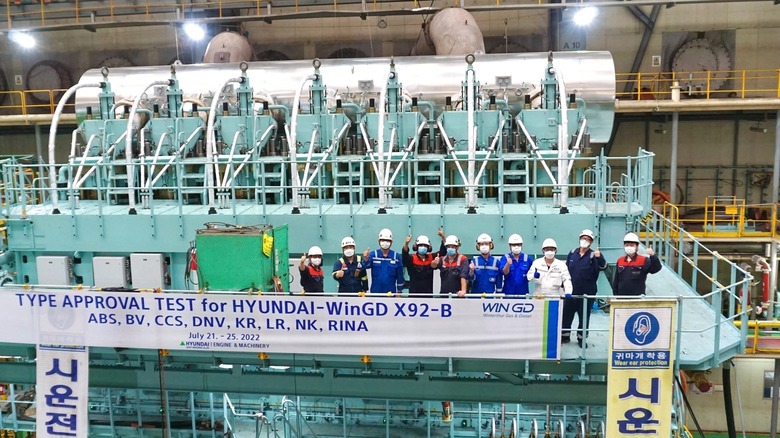
WinGD (Winterthur Gas & Diesel Ltd.), a company that was born from the Wärtsilä NSD Corporation and today operates under the China State Shipbuilding Corporation (CSSC), currently produces the largest reciprocating engine in the world in terms of operating capacity. The X92-B is a 12-cylinder unit, where each cylinder has a 36.22-inch bore and a massive 136.53-inch stroke, which equals an overall capacity of 27,665 liters. At 52.88 feet tall, it's massive on the outside, too.
Naturally, the X92-B is a very powerful engine, producing up to 103,795 hp at just 80 rpm. It can also run at 70 rpm, producing up to 90,921 hp. Like its two-stroke rivals, the X92-B was designed with efficiency in mind, so it features the company's Intelligent Combustion Control (ICC) system.
Because it's part of a modular platform, the X92-B can be delivered in six- to 12-cylinder configurations. Back in 2022, an 11-cylinder X92-B was installed in the Evergreen cargo ship, which has a world-leading capacity of 24,000 TEU.