

Think V10 Engines Are Unreliable? These Models Say Otherwise
Most engine formats have been around for a long time. The 1902 Ford 999 featured an inline four-cylinder — a really huge one, at a whopping 18.9 liters — while a Dutch company called Spyker invented the inline-six engine in 1903. France invented the V8 engine way back in 1902, although Ford is often credited with being the first manufacturer to drop a V8 into a mass-produced car with the 1932 flathead V8. And the first production car with a V12 was the 1916 Packard Twin Six, yet the first production V10 didn't arrive until the 1992 model year.
It took so long for the V10 to debut in a road-going car because of engineering challenges. V10s are essentially a pair of inline five-cylinders, which are inherently unbalanced. There are a few ways to counter this, but such methods add complexity, and more complexity in an engine means more possible points of failure. This makes V10 engines expensive and generally reserved for high-end performance models. However, the list below shows that — cost aside — V10s can be reliable despite their complex nature.
One caveat regarding our list: you may be disappointed to find some of your favorite V10 models excluded, such as the 2005-2010 BMW M5, which has well-known issues with its rod bearings and oil pumps. That's because we're focusing on models that have been proven to hold up well over the years, showing that V10s can be as reliable as they are exciting to drive.
Dodge Viper
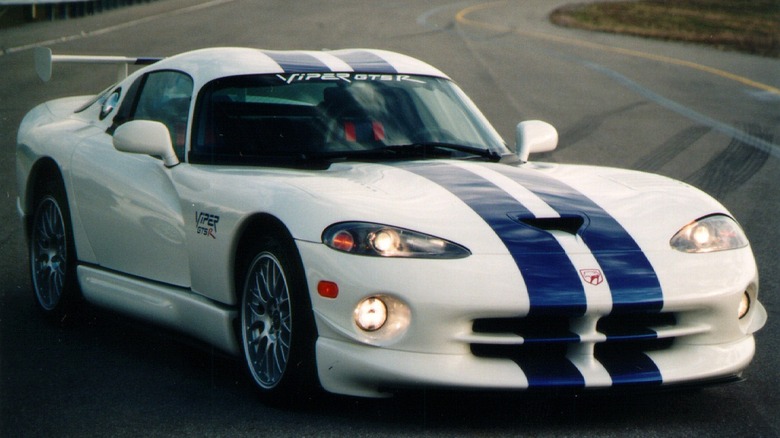
Here it is, the original of the species: the Dodge Viper, sporting the world's first production V10 in a car. The genesis of the Viper's engine lay in Dodge's truck program, which was developing a V10 for its heavy-duty Ram pickups. However, it wouldn't be fair to describe the Viper's power plant as a truck engine. Before putting it into production, Dodge handed the V10 over to Lamborghini, which was then owned by Dodge's parent company, Chrysler.
The engineers in Sant'Agata were told to see what they could do with the engine. They swapped out the iron in the block and heads for aluminum, and the resulting engine is as much a dream as any you'd find in an Italian supercar. And that's in addition to being about 160 pounds lighter than the truck motor it was born from. At $52,000, the Viper was a fraction of the price of an Italian exotic car. It produced 400 horsepower and 450 pound-feet of torque, which were truly awesome figures for its day.
For a V10, it was relatively simple, relying on sheer displacement to generate neck-snapping acceleration. Top Gear described the vintage Viper as offering "dependable reliability" with easy starts and no tendency to overheat while idling. Older first-generation models are known for piston ring failures, but this shouldn't be a concern today. Second-gen Vipers probably represent the best balance between price and reliability. The Viper improved between generations, with better handling and a larger 8.4-liter V10 that eventually produced 645 horsepower.
Dodge Ram SRT-10
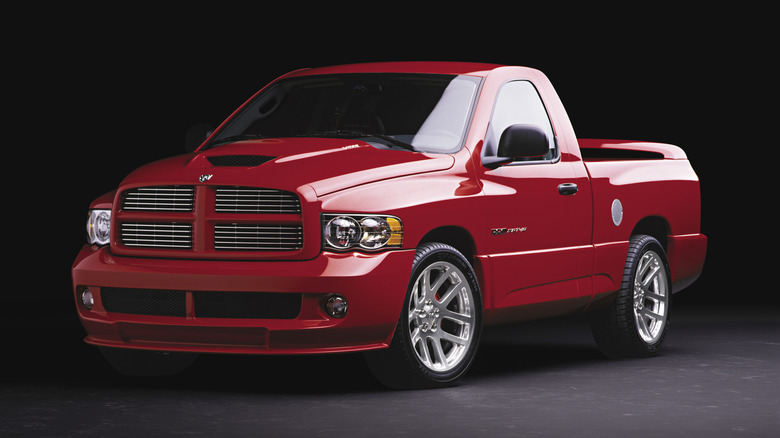
The award for the largest engine in a pickup truck goes to the 2004-2006 Dodge Ram SRT-10, sometimes called the "Viper truck." Now we should clear something up here, in case you're wondering, "Wasn't there a V10 Dodge pickup before 2004?" Yes, the iron-block Magnum V10 (the ancestor of the Viper engine) served as the top engine option in the Ram 2500 and 3500 heavy-duty pickups between 1994 and 2003. The Ram SRT-10 was based on the regular-duty Ram 1500, and its engine was the aluminum Viper engine, which displaced 8.3 liters at the time.
This extra displacement resulted in 500 horsepower and 525 pound-feet of torque, enough to move this 5,200-pound regular cab (or 5,600-pound quad-cab) pickup from 0 to 60 mph in as little as five seconds, with a 154 mph top speed. With an original sticker price starting at $45,000, it was arguably one of the greatest performance bargains of all time.
And it could haul plywood and tow a load, too! Although only the quad-cab was tow-rated, thanks to a different suspension setup in the rear. The quad-cab models were automatic-only, while the regular cab offered a choice of manual or automatic transmissions. Either way, they were dependable. As Hemmings says in its retrospective on the Ram SRT-10, "The combination of the proven Viper engine and rugged Ram chassis resulted in a sports truck that's also very reliable." That sentiment extends to owners, too, as they gave the 2005 SRT-10 4.6 stars out of five on Edmunds.
Lamborghini Gallardo
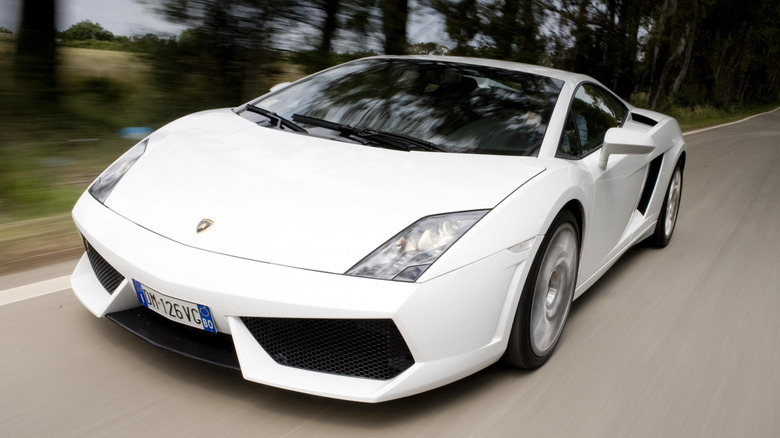
Years after helping Dodge to build the Viper's V10, Lamborghini wanted one of its own. Having been acquired by the Volkswagen group in 1998, it now had access to the corporate resources and technological expertise of VW's various divisions. As such, it turned to Audi for help with developing a motor for the mid-engine Gallardo. The result was a 5.0-liter, 500 horsepower V10 with 376 pound-feet of torque, which debuted in the 2004 model. This was a break from Lamborghini's long history of powering its supercars with V12s.
Whereas the Dodge used sheer size to create an 8.0-liter V10 with even more torque than horsepower, Lamborghini's approach used a smaller, high-revving unit that created substantially more horsepower than torque. At $165,900, it was relatively affordable for an Italian supercar, but it made no performance compromises thanks to its 500 horsepower. Plus, it came with the same satellite navigation as the Audi S8 — another benefit of corporate synergy.
For reliability, just take a look at the U.K. Ministry of Tranportation pass rate. The Gallardo has pass ratings listed for six of the model years between 2004 and 2011, ranging between 91.4% and 94.3%. By comparison, for that same time period, the Toyota RAV4 has pass ratings ranging between 78.8% and 84.1%. Both the 5.0-liter and 5.2-liter versions of the V10 have no known major issues as long as they are regularly fed a liter or so of high-quality oil — though rack-day driving will lead higher oil consumption, of course.
Audi R8 V10
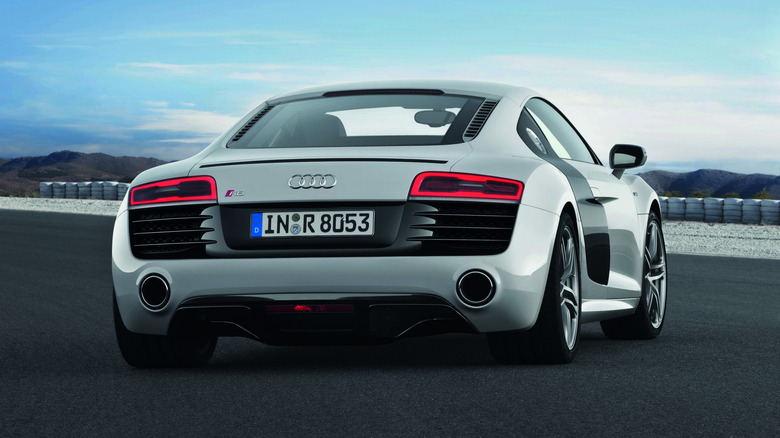
When the Audi R8 debuted for the 2007 model year, it initially offered a 4.2-liter V8. However, in 2009, the staid German company let its hair grow out just a bit and dropped a 5.2-liter V10 in its lightweight, mid-engine sports car. If those dimensions sound familiar, that's because it was a version of the V10 found in the Lamborghini Gallardo. In the R8, it generated 518 horsepower and 391 pound-feet of torque, good for a sub-four-second 0-60 time and a top speed just four ticks shy of 200 mph.
In 2011, the R8 GT featured a 552 horsepower version of the V10. When a new generation of the R8 debuted for 2016, it became a V10-only model, offering a choice of 533 horsepower in the regular R8 or 602 horses in the R8 V10 Plus model. In 2019, the base engine received a boost to 562 horsepower, although the optional higher-performance version only gained higher torque. By the 2022 model, 0-60 times had reached a neck-straining 3.2 seconds.
As an Audi, the R8 was expected to be a trouble-free, luxurious, everyday driver — and for the most part, it delivered on that promise. On CarFax, 113 owner reviews gave the R8 an average rating of five out of five stars — and that covers models from as far back as 2008. Granted, it might face some oil leaks on occasion, so owners will want to inspect the gaskets and seals regularly. Other than that, most of the problems with the R8 trace to areas other than the engine bay, so you can put plenty of faith in its V10.
Lexus LFA
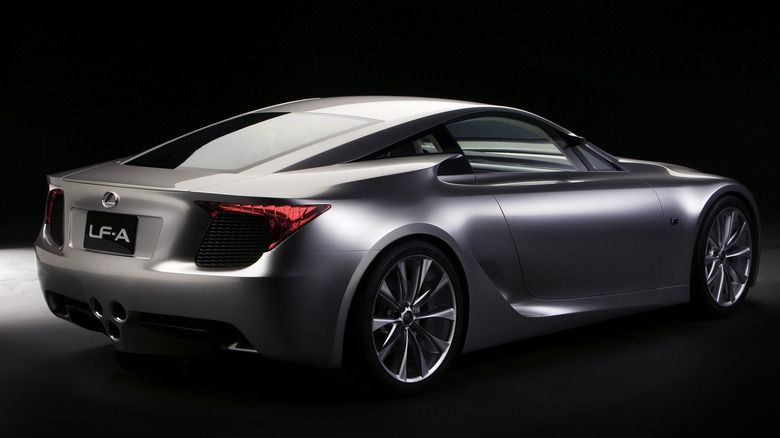
The LFA was a bit of a departure for Lexus. The company known for building your grandparents' LS400 suddenly came out with this V10-powered supercar. The result was an automobile so impressive that even Top Gear's famously jaded Jeremy Clarkson said it was "the best car I've ever driven." At a price of $375,000 and with only 500 units ever produced between 2010 and 2012, this car is a unicorn in more ways than one.
Let's start with its stunning engine. Its exhaust note is so enchanting that there's a website where you can spend three hours just listening to its roar. It sings with operatic precision all the way up to its 9,000 rpm redline, generating 552 horsepower and 354 pound-feet of torque along the way. 60 mph arrives from a standing start in only 3.6 seconds.
Regarding reliability — well, it's built by Toyota, so what do you think? It's not just that it's reliable enough that the car has only one recall in its history, and that was for its airbags. (Practically everyone has airbag recalls, anyway.) It goes beyond that, to how durable the LFA is when driven hard at the track. Autoweek once flogged an LFA at the track all day, and noted that "it required no down-time at all — no fluids checked, no brakes replaced, no tires shredded." It's no wonder that, even with high mileage, a secondhand Lexus LFA is still ridiculously expensive.
Lamborghini Huracán
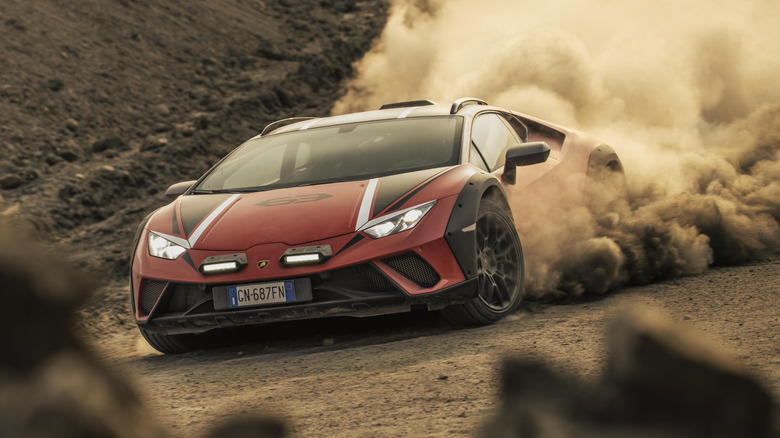
Top Gear describes the Lamborghini Huracán's V10 engine as "bulletproof." It's so close to indestructible that tuners have been able to spec it out to more than 3,000 horsepower, which Top Gear says is good for a quarter-mile speed of more than 240 mph. Yes, that's a quarter-mile speed, not a top speed. That's not too far off from the performance of Top Alcohol Funny Car dragsters, which can hit the traps at 260 MPH. Most gasoline-powered engines would turn to shrapnel under those kinds of forces.
Even in the 2023 Huracán Sterrato, the wild off-road-enabled swan song for the Huracán, the 5.2-liter V10 pumps out 602 naturally-aspirated horsepower, good for a 0-60 time of 3.4 seconds. In our review, our test driver found the Huracán Sterrato to be pure, unfiltered joy. But what makes the Lambo V10 such a reliable engine, especially by supercar standards?
Part of the answer may come from the resources of Audi. It's a part of VW Group, which bought Lamborghini in 1998, and the V10 was originally developed for the Lamborghini Gallardo under Audi's close supervision. The exchange benefited both companies, since Audi got access to the expertise of Lamborghini's engineers, and it eventually put a version of the engine in the 2009 R8 5.2.