

Stellantis Employees Complain Of 'Nose Bleeds, Migraines, Vomiting, Skin Issues, Digestive Issues' After Returning To The Office Five Days A Week
Good morning! It's Tuesday, April 28, 2026, and this is The Morning Shift, your daily roundup of the top automotive headlines from around the world, in one place. This is where you'll find the most important stories that are shaping the way Americans drive and get around.
In this morning's edition, Stellantis employees are getting sick in really bizarre ways after returning to their Michigan HQ five days a week, NHTSA says it's not worried about detaching Tesla Model Y steering wheels anymore, General Motors didn't have the best Q1 we've ever seen and Bollinger's final chapters are being written.
1st Gear: What the hell is making Stellantis employees so sick?
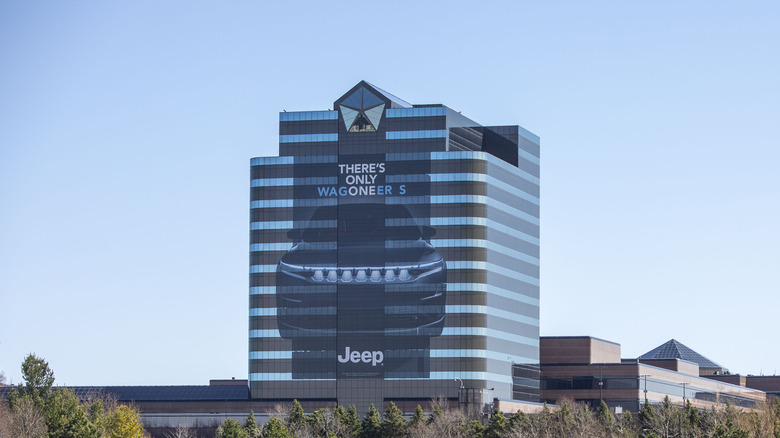
There's something very bizarre going on inside Stellantis' headquarters in Auburn Hills, Michigan, and it's not some harebrained, half-baked product this time. Instead, it's some sort of widespread, wide-ranging health concern. Apparently, Michigan health and safety regulators have inspected the expansive campus after getting reports that "dozens" of employees were suffering from various ailments after returning to the office five days a week.
Folks have complained of nose bleeds, migraines, vomiting, skin issues, digestive issues, coughing and tiredness. All of this is likely tied to, gulp, mold. Employees have also seen black dust, mice, rats, a general mustiness and several flooding incidents. Following an inspection back in February, the Michigan Occupational Safety and Health Administration didn't cite Stellantis, but it did issue a list of recommendations focused on ensuring healthy air quality and preventing mold. From The Detroit News:
"Stellantis continually prioritizes the health, safety and well‑being of our employees," a statement from spokesperson Jodi Tinson said. "As part of our standard practice, we regularly assess our workplaces to ensure they meet or exceed safety and environmental standards. Recent assessments within the office areas confirmed a safe working environment. Ongoing housekeeping enhancements and preventive maintenance are in place to support employee comfort and well‑being."
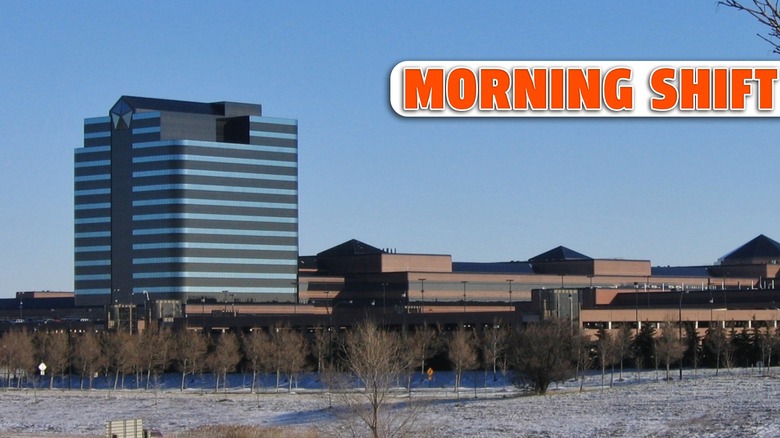
Employee reports of environmental health concerns inside the 1990s-era Stellantis headquarters building come as the white-collar workforce recently was required to return to the office five days per week.
Such MIOSHA complaints at office buildings and plants aren't altogether rare, including for Stellantis rivals GM and Ford. But the Stellantis report is notable given that it raised several health concerns about the automaker's headquarters just as the company seeks to bring more workers back to the office.
Previously, the company championed a flexible work policy allowing for a majority of time to be spent at home. But early last year, it asked workers to be in-office at least three days per week. And in January, it announced the new five-day policy that fully took effect March 30. The company explained that "bringing teams together to build stronger connections is a competitive necessity."
Stellantis told MIOSHA it had sought to prepare the building for employees' safe return by cleaning, flushing and upgrading air filtration systems. It also conducted air quality and mold testing.
From what employees in the building have said, whatever Stellantis did wasn't nearly enough, and the building is still nasty enough on the inside to make people sick just being there.
[C]ompany representatives told regulators that they began receiving complaints as soon as workers started returning a year ago, and the number of complaints "have been significant" since the five-day mandate came down. The topic came up at a recent company town hall.
The employee complaint sent to MIOSHA in February alleged that "employees continue complaining about a multitude of illnesses and strange symptoms and are being forced to work from the building every day despite their complaints and evidence showing presence of mold, and medical proof they are sick.
[...]
Stellantis previously told employees that the air quality test results were satisfactory across the facility. MIOSHA inspectors wrote that the company's testing had found "slightly elevated" mold spore counts when compared to outdoor samples, but that the results "generally were considered acceptable for indoor air quality."
Stellantis indicated to the agency that the slightly higher indoor mold spore levels might be due to the facility's indoor plants.
During February's inspection, which covered several parts of the 15-story tower, MIOSHA said they didn't find evidence of leaks or moisture "that would suggest sources of indoor mold growth may be present in the facility." Of course, the agency also noted that it doesn't have a standard or published limits for safe levels of mold exposure, and it closed the investigation earlier this month.
I really cannot say what's going on here, but clearly, there's an issue if employees are getting physically sick by being in the office. I know that no one wants to be in the office five days a week, but I sort of doubt they're going to make themselves vomit over it. Hopefully, Stellantis gets this issue taken care of, or, at the very least, the state of Michigan actually holds it responsible.
2nd Gear: Feds drop probe into detaching Model Y steering wheels
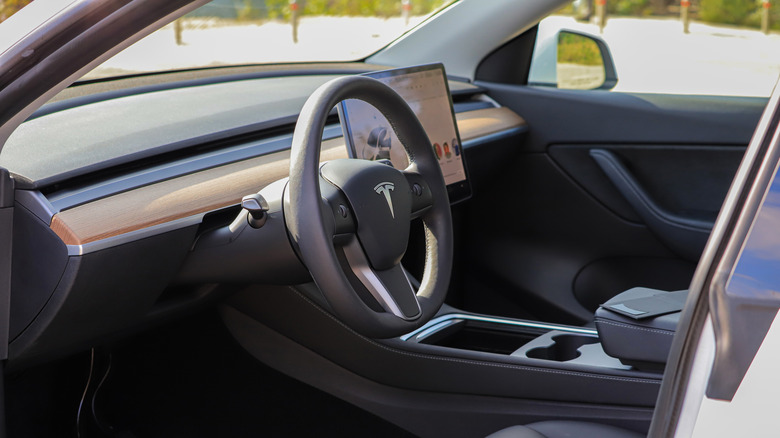
The National Highway Traffic Safety Administration is closing the books on a probe into over 120,000 2023 Tesla Model Ys after finding no issue with the automaker. It comes following a preliminary evaluation in early 2023 that was spurred by two reports of Model Y steering wheels detaching from the steering column because of a missing retaining bolt. Sounds like a big issue, no? Well, in NHTSA's eyes, the problem wasn't wide-ranging enough to warrant further action.
Both cars were said to be built in the first week of January 2023 at Tesla's plants in Austin, Texas and Fremont, California. In essence, these were isolated incidents. From Reuters:
[They] had undergone end-of-line repairs before delivery that required the steering wheel to be removed and reinstalled.
The regulator said it found no additional incidents involving the issue and said the two failures occurred within the first 400 miles of driving, indicating that any other affected vehicles would likely have already experienced a steering wheel detachment.
The agency concluded that closing the investigation does not constitute a finding that no safety-related defect exists and said it may take further action if new information emerges.
I guess whatever goofuses took the steering wheels off during those end-of-line repairs forgot to reinstall the all-important retaining bolt. I assume these are mistakes that the two individuals didn't make a second time. At the very least, I hope that's the case.
3rd Gear: GM's first quarter was all over the place
You win some, you lose some. Somehow General Motors found a way to both win and lose at the same time during 2026's first quarter. The automaker's first-quarter net income dropped 5.7% to $2.63 billion as it dealt with the usual headaches: Donald Trump's tariffs and slow EV demand.
Still, the company raised its full-year forecast on the anticipation of some tariff refunds, and its earnings before interest and taxes jumped 22% to $4.25 billion as North American profits rose 11% to $3.67 billion. However, its Q1 net revenue in North America dropped about a billion dollars to $36.4 billion. Like I said, win some, lose some. From Automotive News:
Global revenue was $43.6 billion, 0.9 percent less than a year earlier, when the company benefited from a rush in new-vehicle sales by consumers looking to get ahead of President Donald Trump's automotive tariffs that began in April 2025.
GM's performance surpassed internal expectations, CEO Mary Barra said in an April 28 letter to shareholders.
"We are clearly operating in a very dynamic environment, which isn't unusual for this industry," she said. "That's why we have had a multi-year focus to ensure we have the right products, the right team and a strong balance sheet supported by healthy cash flows to achieve our long-term goals and consistently execute our capital allocation strategy."
GM increased its 2026 outlook to account for about $500 million it expects from tariff refunds from the Trump administration after the U.S. Supreme Court ruled many of its tariffs unconstitutional in February. The company expects a total tariff bill in 2026 of $2.5 billion to $3.5 billion, down from an earlier estimate of $3 billion to $4 billion.
Although tariffs on vehicles, parts, steel and aluminum that account for the bulk of what GM and other automakers pay remain in place, companies are entitled to refunds for any illegal duties they paid. The Trump administration began accepting repayment applications April 20.
The company raised its expectations for earnings before interest and taxes by about $500 million because of the refund adjustment, projecting EBIT of $13.5 billion to $15.5 billion this year.
Still, it lowered its net income guidance to a range of $9.9 billion to $11.4 billion, compared with its previous estimate of $10.3 billion to $11.7 billion.
The General added that it was "working to right-size our battery supply chain" with its various joint venture partners and said its U.S. dealers ended the first quarter with about 516,000 vehicles in inventory. That's down 6% from the same time last year as it targets lower inventory to support "agility and low inventories."
4th Gear: Bollinger's assets to be auctioned off
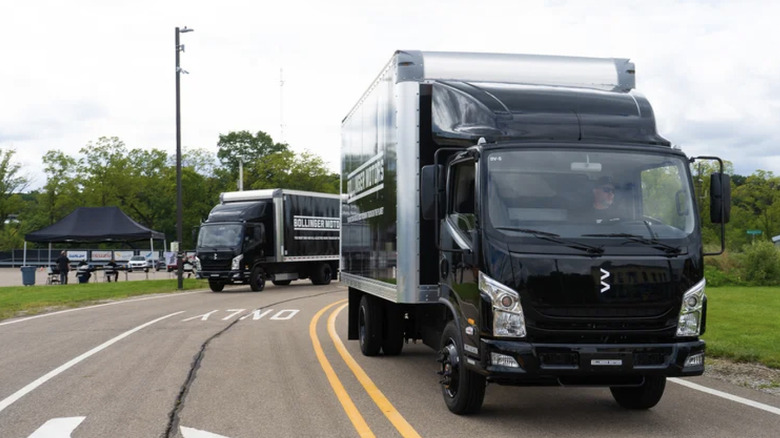
Some point soon, I'll have written about Bollinger Motors for a final time, but hopefully, today isn't that day. Though I know the end is near. Assets of the failed electric truck startup will be auctioned under court order after suppliers sued over unpaid bills. Its manufacturing equipment in Oak Park, Michigan and Tunica, Mississippi, will be sold on May 13 via a webcast auction, and there's some neat stuff in there for sure. Pick through the wreckage of some people's best-laid plans. From Automotive News:
The assets include battery-testing and -validation systems, tooling, vehicle lifts, inventory and shop equipment as well as 20 B4 trucks and additional vehicles.
The forced liquidation of a once-promising startup comes after a series of supplier complaints, including from Dana, Thyssenkrupp, Aibond, Promark Electronics Inc., Tool House, Wurth Electronics, Webb Wheel Products Inc. and others.
The company is under investigation by the Michigan Department of Labor and Economic Opportunity after dozens of complaints regarding unpaid wages or benefits. The Michigan Economic Development Corp. is also seeking to recoup about $1 million of incentive cash disbursed to the startup as part of a $3 million award announced in 2023 when the company promised to invest $44 million and create 237 jobs in the Detroit area.
Last July, Bollinger Motors merged with its parent company, Mullen Automotive, of Brea, Calif., under a new entity, Bollinger Innovations. That action consolidated operations and moved business functions from the West Coast to Detroit.
The Bollinger Motors and Bollinger Innovations websites both appeared to be defunct. Mullen's was active as of April 27, but it was unclear what operations remained at the company.
[...]
Even after the Trump administration stripped away tax credits for electric vehicles — all but destroying the business case for the B4, a Class 4 model with a nearly $160,000 price tag — Bollinger Innovations CEO David Michery was defiant, executing a series of reverse stock splits to stay NASDAQ-compliant and vowing to push forward.
Perhaps there's still some vague hope for the company at some point. Robert Bollinger, who founded the company but parted ways with Michery in a nasty split, actually purchased the intellectual property and prototypes of the B1 and B2 trucks in a deal that was approved by a judge in Ohio last month.
Who knows when this story will officially end? Bollinger sure doesn't.
Reverse: Still wild 38 years later

 History.com
It still blows my mind that Aloha 243 was able to land after being changed from a coupe into a convertible. It goes to show just how impressive airplane engineering is and how talented (and quick-thinking) the pilots on the flight deck had to be to get it down on the ground with a minimal loss of life. Seeing pictures of the plane after it landed is sort of mind-bending. It almost doesn't make sense. In any case, if you want to learn more about the incident, head over to History.com.
The Fuel Up
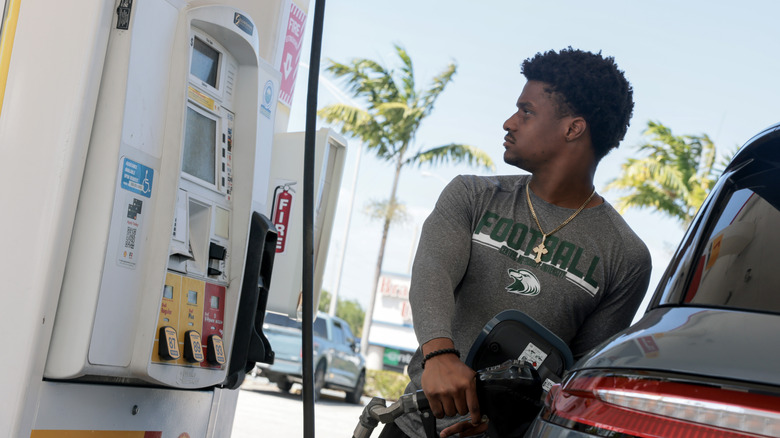
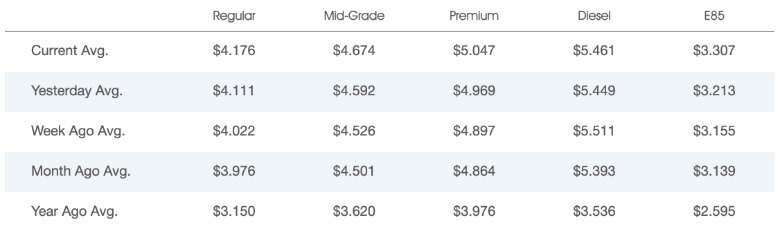
Well, friends, I've got some very bad news. We've officially cracked the $4.17 per gallon gas price record that was set back on April 9. As the Strait of Hormuz remains virtually closed and peace in the U.S. and Israel's war with Iran seems more and more unlikely, oil prices shot up overnight. At the time of publication, WTI Crude Oil futures are around $99 and Brent Crude is about $104.
All of this has caused the biggest single-day jump in gas prices we've seen since the war began, with the average price of a gallon of regular gas going up 7 cents overnight to $4.18, according to AAA.
The last time we saw prices this high was back in July of 2018, according to data from the Energy Information Administration. The average price of a gallon of gas is now up $1.20 — or about 40.3% — since the war first broke out on February 28, when it was $2.98.
Here's where national average prices stand right now, according to AAA:
 AAA
AAA
On the radio: Daryl Hall & John Oates - 'Out of Touch'
People just aren't brave enough to make music that sounds like this anymore, and that's a shame. Click play and let the soothing voices of Hall and Oates transport you back to 1984, where everybody is allowed to be out of touch because Ronald Reagan is the President.