

What To Know About (And How To Watch) NASA's Artemis II Mission To The Moon
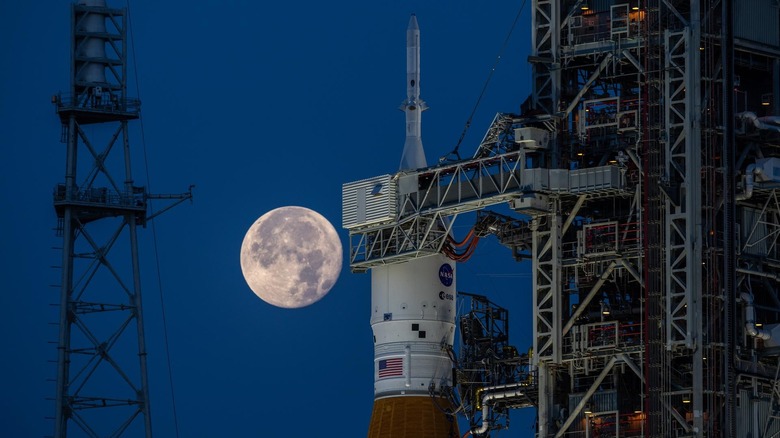
There are no guarantees in rocketry, but if all goes well, NASA's Artemis II mission ought to launch somewhere in the first week of April (this week!), which will bring human beings to the orbit of the Moon for the first time since the 1970s. This is the second part of NASA's ambitious Artemis program, which aims to return astronauts to the lunar surface in the next few years, with a not-so-secret secondary objective of beating the Chinese there. You can think of Artemis II as the twin of the Apollo VIII mission back in 1968, the flight that proved that we could send people to the Moon and back, though nobody landed. NASA is seeking to prove it still can.
Artemis II will send a crew of four astronauts on a ten-day journey, starting from NASA's Kennedy Space Center in Florida and reaching its apex nearly 4,000 miles over the surface of the far side of the Moon. While there will be some science and surveys conducted during the flight, its main purpose is just to prove that the Orion spacecraft can complete this trip successfully. If it does, that will tee up future Artemis missions that do involve landings.
If you'd like to watch the launch, unfortunately tickets to the event are already sold out. However, the Kennedy Space Center is easily observable from publicly accessible areas all around it, so bring a lawn chair and some binoculars and you should be good to go. Expect it to be crowded, although that ought to smooth out a little since nobody knows exactly when the launch will happen. If you are not yourself a Florida dweller, NASA has a running livestream of the Artemis II rocket on YouTube. You can also sign up for watch party updates straight from the space agency; many air and space museums will be hosting their own. Once the mission is underway, you can follow along using the Artemis Real-time Orbit Website (AROW).
The launch windows for the month of April will last for two hours each. The rocket is already on the platform, so provided it passes all its tests, the weather is fine, and nothing else goes wrong, NASA will start the countdown to ignition the soonest it can. Here are the potential launch windows:
- April 1: 6:24 PM EDT
- April 3: 8:00 PM EDT
- April 4: 8:53 PM EDT
- April 5: 9:40 PM EDT
- April 6: 10:36 PM EDT
- April 30: 6:06 PM EDT
The astronauts
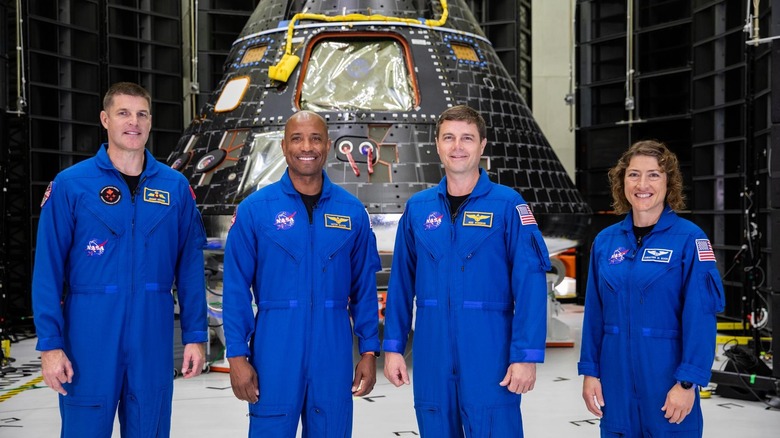
As NASA said when it announced the Artemis II astronauts back in 2023, "Among the crew are the first woman, first person of color, and first Canadian on a lunar mission." That diversity is even reflected in the name of the program: Artemis is the Greek goddess of the Moon, in contrast to Apollo, the Greek god.
Reid Wiseman serves as commander of the mission. He's already spent 165 days in space aboard the International Space Station (ISS), and he was actually NASA's chief of the Astronaut Office until just prior to his selection. One wonders if, when they asked him who should lead the Artemis II mission, he just raised his hand.
Victor Glover is the pilot of the Orion spacecraft. He was previously the pilot of SpaceX Crew-1, the very first mission to send astronauts to the ISS using the space company's Falcon 9 rocket and Dragon crew capsule. He was in space for 168 days.
Christina Koch serves as a mission specialist. She served aboard the ISS for an astonishing 328 days straight, the longest single spaceflight that any woman has ever done.
Jeremy Hansen is another mission specialist. Though he's never been to space before, he was a fighter pilot before joining the Canadian Space Agency. He has previously been a Capcom, or "capsule communicator," the person at mission control designated to speak to the astronauts in flight.
The spacecraft
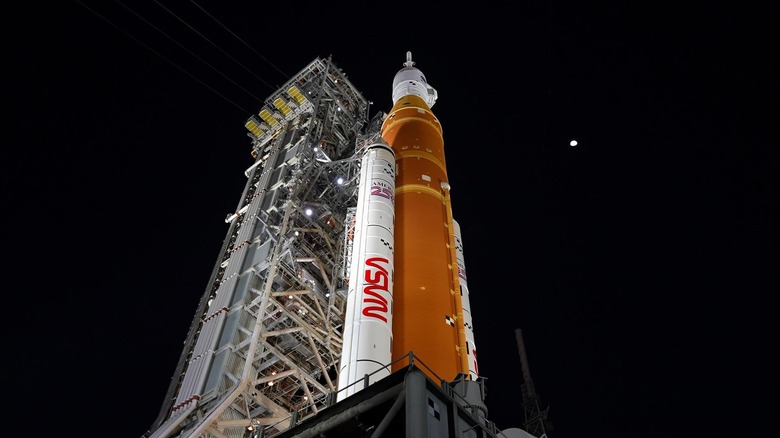
What you see waiting on the platform are really two pieces: the small Orion capsule in white atop the massive Space Launch System (SLS) rocket in orange. The SLS is a NASA initiative, primarily designed and built by Boeing, with Northrop Grumman responsible for the twin rocket boosters and L3 Harris Technologies providing the four main RS-25 thrusters. Combined, these give the 322-foot-tall SLS a maximum thrust of 8.8 million pounds, eventually reaching a top speed of 22,670 mph out in orbit. Not bad for a vehicle that weighs 6 million pounds fully fueled.
But, as these things go, that mighty rocket will mostly be thrown away once it all gets into orbit. The SLS is not a reuseable design like the Falcon 9, so once it's done its job, it crashes back into the ocean to lie there forever. While some further upgrades were slated for SLS rockets in later missions, these have since been canceled in order to standardize the spacecraft.
But it's the little Orion capsule, built by Lockheed Martin, that is the real star of the show. That's what will carry the astronauts 250,000 miles to the Moon, and then 250,000 miles back again. It's a cramped thing, mostly consisting of a small crew module for flying and a service module for everything else. Whatever room you're in right now is probably bigger.
The mission (and the program)
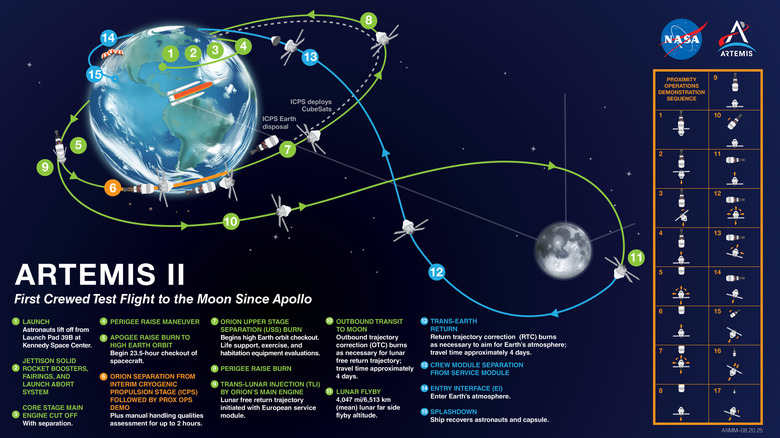
Again, the main job of Artemis II is just to go to the Moon with humans onboard and bring them back alive. Artemis I already did this sans humans back in 2022, so hopefully things will go smoothly. In the meantime, the crew of Artemis II will also be doing science! Much of this won't require any active work on their part: an array of sensors will measure their health during the voyage, teaching us about how the body handles such a journey. In addition, the astronauts have been taking geology classes, so they will do a survey of the far side of the Moon from orbit.
The Artemis II mission is, of course, part of a much larger Artemis program. The Artemis Accords are an international ruleset for the peaceful exploration of the Moon in the 21st century; in keeping with that, Artemis II will deploy small CubeSat satellites for several signatory nations into low-Earth orbit: Germany, South Korea, Saudi Arabia, and Argentina. The future of the Artemis program itself just underwent a major overhaul, which includes repurposing the Artemis III mission to be an Earth-orbit test of the lunar landing procedure, rather than an actual attempt at a landing. However, this revised plan includes launching more missions more often, eventually switching over to reuseable rockets rather than the SLS. Meanwhile, what exactly is that lunar lander? Nobody knows, since delays with SpaceX's Starship proposal eventually caused NASA to re-open the contract to other bidders (which, in practice, really only includes Jeff Bezos' Blue Origin).
The plan is to eventually build a base on the Moon, which will allow for sustained human occupation. If it happens, that will be the very first interplanetary colony, however rudimentary. NASA says that is a stepping stone to gaining the know-how to go to Mars. Really, it might just be the most historic thing our species has done since... well, landing on the Moon.