

If License Plate Reading Cameras Are Legal, Why Is California Border Patrol Hiding Them?
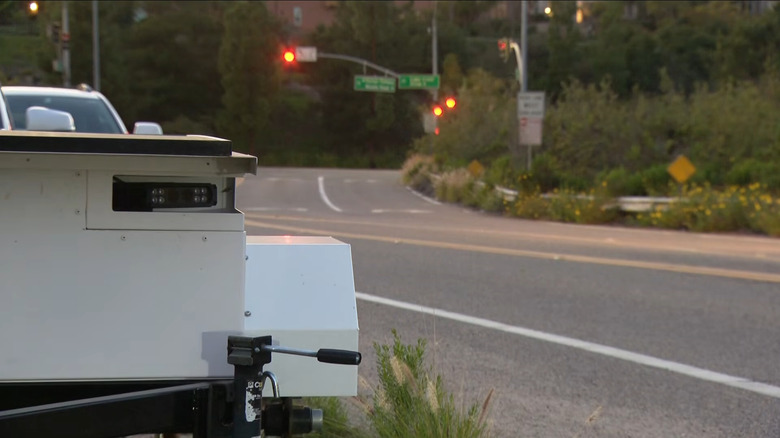
We've all gotten pretty used to traffic cameras, and we're increasingly figuring out ways to deal with the mass-surveilance license plate scanners from makers like Flock. But our esteemed government officials in border enforcement want to keep using license plate scanners, so they've taken a new tactic: Hiding scanners within otherwise innocuous objects littered on the side of southern California roads. If you drive down near the Mexicali border, that traffic cone or trailer in the shoulder may well be watching who you are and where you go.
Border Patrol started hiding license plate scanners late last year, as an Associated Press investigation revealed last November. Yet, as recently as last month, CalMatters said the scanners were still in place — places that residents and the Electronic Frontier Foundation argue don't monitor human traffickers as much as locals. If these scanners are really meant for such noble ends as stopping human trafficking, why are they so hidden from the border-area residents they're supposedly meant to protect?
Locals propose another explanation
Local residents, the people who drive these covertly monitored roads every day, told CalMatters they see another reason for such hidden surveillance: The scanners are, in fact, to track U.S. citizens who leave food at water for refugees at points near the Mexican border. Those residents argue that the Trump administration slapped humanitarian groups with felony charges years ago, and that these scanners are only the latest salvo in an ongoing war on immigration.
For my part, I doubt that Border Patrol under the Trump administration is doing anything so targeted. I think the presence of these covert scanners points to two goals: One, enriching White House donors; two, mass data intake. The Trump White House has seemed more interested in acquiring and storing data en masse than in any sort of targeted approach, and these scanners are likely another move in the same vein — taking in as much information as possible, under the assumption that some of it will be useful later on. It's an even scarier premise than the one put forth by Southern California locals, because it posts that there's no distinct rhyme or reason to the data gathering. The administration is monitoring you simply because it can.