

13 Cars You Probably Didn't Know Were Named After Real Places

Naming cars is a serious business. A good model name will resonate with buyers and help to move vehicles off dealer lots. Teams of marketers, designers, and executives pore over the possibilities, sometimes in consultation with linguists. Although this process occasionally produces duds like "Edsel," for the most part, a car's name ideally evokes a quality that it possesses — or at least one the manufacturer wants people to think it possesses. This often leads them to name cars after places.
A well-chosen geographical reference can be worth millions in marketing, at least if the car can live up to it. The rare Ferrari 365 California Spyder evokes sunny afternoons cruising the Pacific Coast Highway. The Dodge Charger Daytona's history includes getting banned by NASCAR for being too fast, so it could no longer race on the track it was named after in Daytona, Florida. But in other cases, car models bear more obscure place names; you may have a vague sense that a car is named for some spot on Earth, but the true origins of an automotive nameplate might surprise you.
Lamborghini Jarama
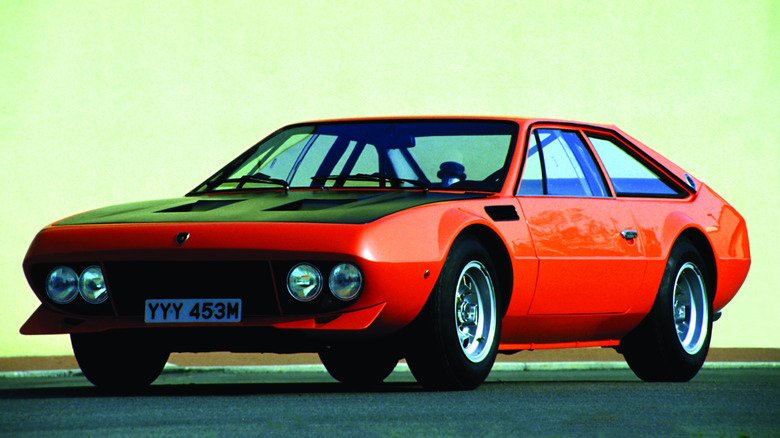
Ferruccio Lamborghini named his second production model the Miura after a breed of fighting bull, giving birth to a tradition that has survived through Lamborghini's history of corporate owners in recent decades. Many models were named directly after breeds, like the Miura, or famous individual bulls, like the Murcielago, which was named after a bull who survived an especially brutal fight. But the Jarama was named not for a particular breed of bull, but rather for a region in Spain famed for breeding fighting bulls. Jarama was also home to the Spanish Grand Prix from 1968 to 1981.
The Jarama circuit was famous for being a complicated layout and for being very hot, with temperatures frequently soaring well over 100 degrees. Perhaps this makes it a perfect namesake for a temperamental Italian supercar. The Jarama, introduced in 1970, fits that stereotype; an early example tested by "Motor" magazine lost its lighting due to an electrical fault. Nevertheless, the Jarama's quad-cam, 3.9-liter V12 cranked out 350 horsepower, and its ride quality was surprisingly good for a sports car. The Jarama was said to be Ferruccio Lamborghini's favorite model.
Ford F-150 King Ranch
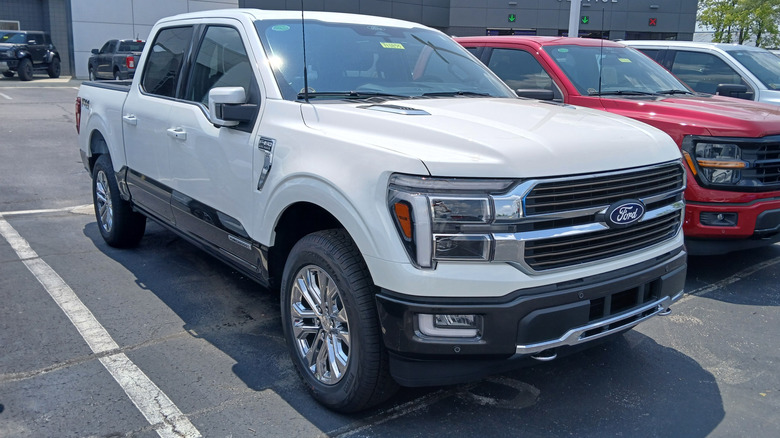
Carmakers have a long tradition of using place names to denote special trim levels of existing models, such as the Chevrolet Styleline De Luxe Bel Air, named for an upscale neighborhood in Los Angeles, or the Cadillac Eldorado Biarritz, named for a tony resort town in France. Ford got into the place name game with the Ford F-150 King Ranch, which designates one of the most premium models of its perennially best-selling pickup truck. Now, you might think the name is intended to conjure an image of the "king of the ranch," or perhaps a salad dressing if you're more sarcastically inclined.
But King Ranch is a real place. It covers 825,000 acres in Texas, sprawling over parts of six counties, making it larger than the state of Rhode Island. It grew from a cattle camp established in 1852 by Gideon Lewis and Richard King, with purchases boosting its size by tens of thousands of acres at a time. Initially, it specialized in Longhorns before breeding its own cattle called Santa Gertrudis. The ranch diversified into farming, citrus groves, pecan processing, and recreational hunting. Ford's King Ranch edition of the F-150 seeks to evoke this upscale, outdoorsy locale.
Ferrari Portofino
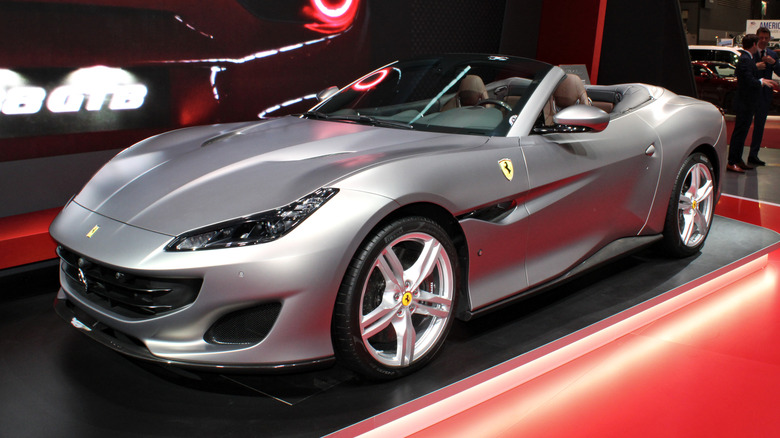
Portofino is a group of wines from a region in Italy, and a quick reaction to this Ferrari's name might conjure up pleasures that come from a bottle. But Portofino is also the name of a picturesque fishing village on the Italian coast, and it's what Ferrari had in mind when it introduced the Portofino to the world. Ferrari's website describes the car's namesake: "Portofino is renowned for its charming tourist port and, over the years, has become internationally synonymous with elegance, sportiness, and understated luxury."
It's easy to understand why Ferrari would want to associate its grand tourer with those qualities. This town on the Italian Riviera radiates charm and the glories of outdoor life in the Mediterranean sun. It offers art galleries, cafés, hiking trails, and harbor beaches where yachts are a common sight. A droptop Portofino is the perfect car to take it all in. Its rev-happy 591-hp V8 upholds the Ferrari performance tradition, and its good ride quality makes it a pleasant cruiser on the narrow streets of its namesake town.
Bentley Bentayga
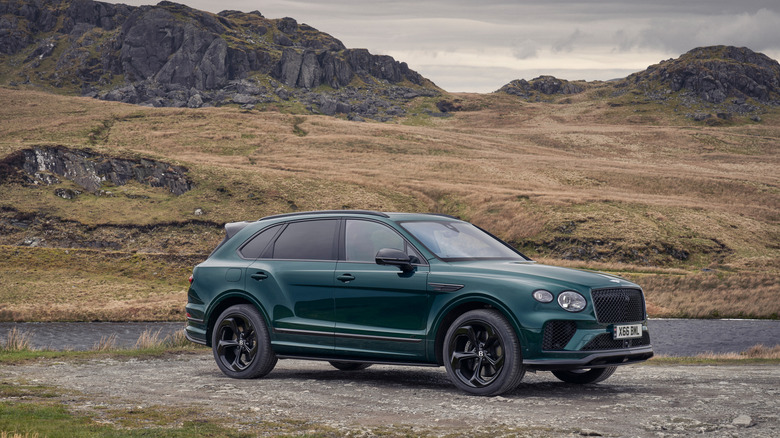
Bentley's first SUV, the Bentayga, is every bit as big and solid as you'd expect a Bentley SUV to be — all 5,668 pounds of it. Therefore, it's fitting that this huge luxury beast is named after a really big rock: the Roque Bentayga on Gran Canaria in the Canary Islands of Spain. The Roque Bentayga is a natural rock formation that culminates in three pillars towering over the surrounding landscape. This mountain was sacred to the indigenous people of Gran Canaria, and today it's part of a UNESCO World Heritage Site.
The Bentley Bentayga debuted in 2015 after the ultra-luxe carmaker consulted its existing owners to gauge what they expected of an SUV bearing the winged "B" badge on its nose. It was powered by a 6.0-liter W12 engine that could move this big ute from a standing start to 60 mph in a rather amazing 4.0 seconds. V8 and hybrid versions followed. The 2026 Bentley Bentayga Speed got a 641-hp V8 engine and a drift mode. This ain't your grandfather's Bentley!
Alfa Romeo Stelvio
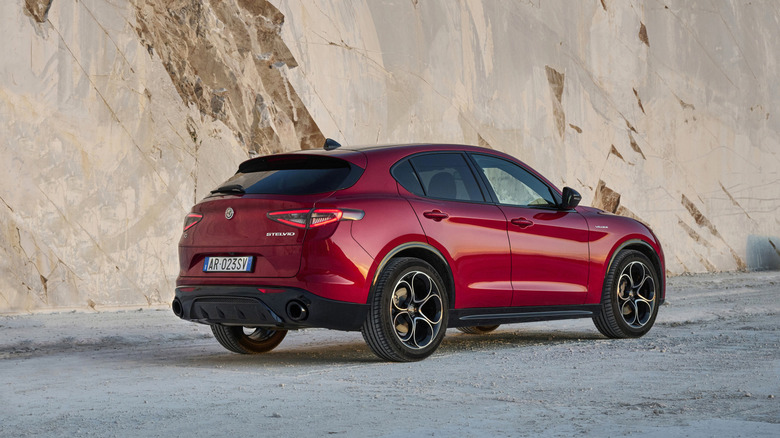
"Stelvio" sounds like a noun, perhaps something found in the kitchen, or like a person's name. It's neither of those things; the Alfa Romeo Stelvio is named for a twisty mountain pass in Italy. Alfa was apparently trying to convey the notion that its midsize SUV isn't just a suburban grocery getter, but rather a true Alfa Romeo with the handling one would expect from this brand. The Stelvio Pass, near the border between Italy and Switzerland, lies at such a high altitude in the Alps that it even gets snow in the summer.
Even when it's not snowing, the road through the pass offers a seemingly endless series of switchbacks climbing up from the valley below, presenting a challenge to both cars and drivers, one that the curvaceous Alfa was designed to handle. When the Stelvio arrived in the States for the 2018 model year, it came with a turbocharged four-cylinder that MotorTrend described as offering "effortless pace" along with a marvelously well-balanced chassis. However, the years have passed, and our reviewer found that the 2025 Alfa Romeo Stelvio "would have been really compelling seven years ago."
Nissan Murano
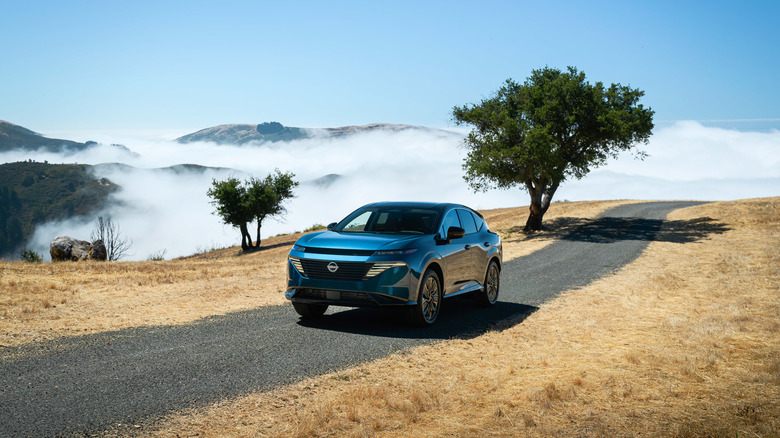
Nissan has a history of giving its vehicles abstract-sounding model names. After all, what exactly is a Sentra? And the word "maxima" is a plural of maximum, which doesn't make a huge amount of sense for a singular car. (Shades of the pluralized Mazda Millenia, which was misspelled, to boot.) So it would be easy to assume that the Murano also has an abstract name, but it's actually named for one of several islands near Venice, Italy. Murano is famed for the exquisite glassmaking skills of its artisans.
Maybe delicate crystal isn't the best thing to associate with an SUV, but Nissan probably intended to imply that skill and craft went into creating its midsize SUV. Besides, "Murano" simply sounds a bit exotic. The Murano has been a more than solid player in Nissan's lineup; since its 2003 launch, it has been one of the company's bestsellers. After a dramatic redesign to a sleek, upscale model in 2025, Nissan seemed to have messed up with the new Murano, and sales dropped in the early part of the year. Yet in a dramatic comeback, the Murano ended up doubling its sales by year's end.
GMC Acadia
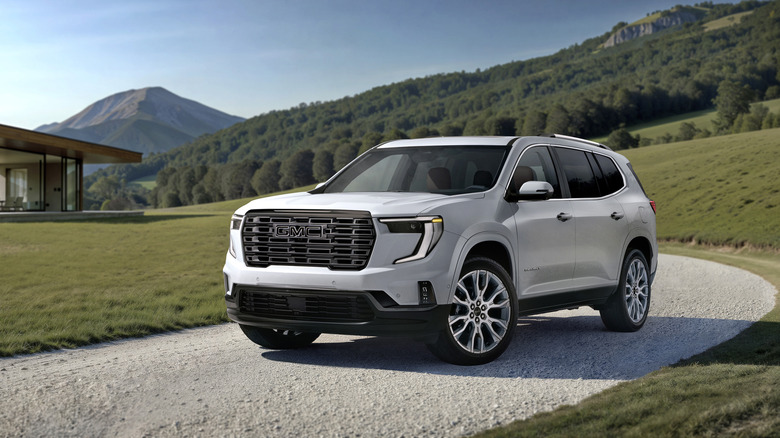
Hearing the word "Acadia" might connote mythical, dreamlike realms, like Arcadia, a woodland paradise that was the home to the Greek god Pan and several other legendary creatures. But GMC's midsize SUV is actually named for Acadia National Park in Maine, a ruggedly beautiful coastal mountain park. This 50,000-acre enclave lies where the mountains meet the sea and is famed for its hiking trails, scenic motor roads, and multiple islands. An auto road on Cadillac Mountain takes visitors to the highest overlook on the East Coast.
The GMC Acadia seeks to capture the outdoorsy aura of the rocky Maine coast. The 2026 version of GMC's midsize, three-row SUV features a 328-hp, turbocharged inline-four engine channeling its power through an eight-speed automatic transmission, with optional AWD. As a GMC model, it offers a more upscale interior and more standard features than the Chevy Traverse, which shares many of the Acadia's underpinnings. Of course, the GMC's higher window sticker reflects that difference. In keeping with GMC's trend of adding more and more words to the Acadia's name, for 2026, there's the GMC Acadia Denali Ultimate.
Bentley Mulsanne
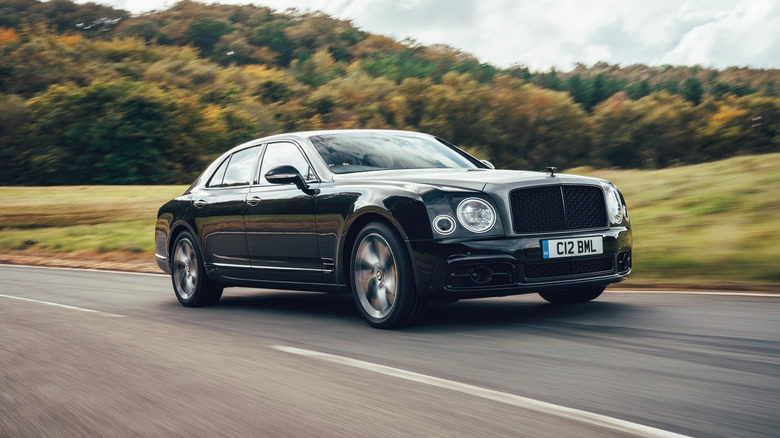
Some cars are named after very small villages, like the Ferrari Portofino, or particular roads, like the Chrysler Fifth Avenue, but the Bentley Mulsanne is named for an even more specific spot: the Mulsanne Corner at Le Mans. Actually, it's one of at least two Bentleys named after corners on this famous track — the other is the Arnage. Some may find it ironic that a 6,000-pound luxury car like the Mulsanne is named after a corner where the brakes of lightweight race cars glow with the strain of negotiating the bend.
In truth, the big Mulsanne does have something in common with the race cars at Le Mans: power, in huge quantities. Its 6.8-liter, twin-turbo V8 cranked out 530 hp in the 2020 model. If that's not impressive enough, it pumped out a positively seismic 811 foot-pounds of torque. That was enough to get this 3-ton, five-passenger behemoth from zero to 60 mph in only 5.0 seconds. That 2020 model was the last of the most recent generation, which went into production in 2011. There was also a previous model produced from 1980 through 1992.
Renault Floride
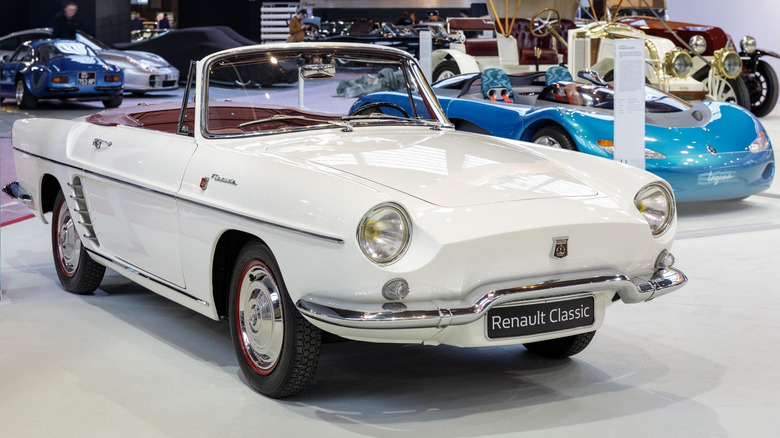
The Renault Floride's spelling might at first glance make it seem like it should be pronounced like fluoride, the neurotoxic substance that they insist on putting in toothpaste. However, the name is French, it's pronounced "floor-EED," and it means "Florida." Ironically, the Floride was sold as the Caravelle in the USA, apparently to avoid angering people from states other than Florida. Apparently, the French believed there was quite a bit of state-level chauvinism among wealthy drivers in Connecticut, New York, or California.
The Floride/Caravelle is a sweet little roadster, especially if you appreciate its odd but pretty Gallic styling. Two indented, vertical character lines converge just aft of each door, coming together into a raised ridge that juts forward like a spear all the way up to the headlights, almost like an arrow pointing to where the car is going. Bug-eyed headlights in front and small tailfins in back completed the look. This was a rear-engined car, with either a 37-hp, 845-cubic-centimeter four-cylinder or a 45-hp, 956-cc four. Production ran from 1958 through 1968.
Hyundai Palisade
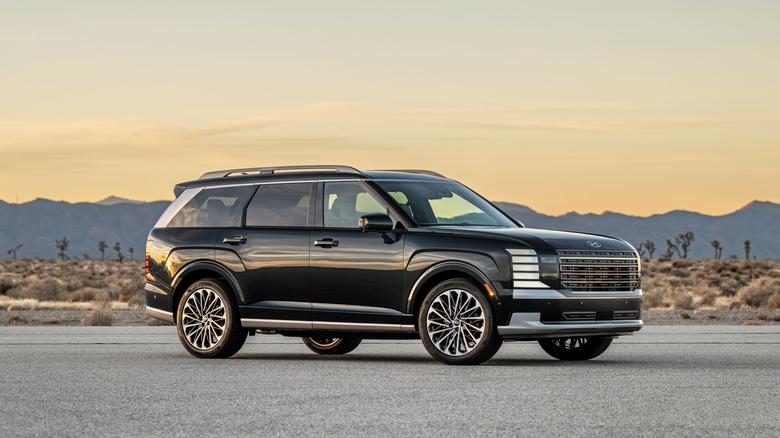
Technically, a palisade is a defensive wall made of pointed stakes or a series of towering basalt cliffs along the Hudson River. However, a Hyundai press release passive-aggressively suggested a different meaning for the name of its large SUV when it debuted for 2020: "The new SUV name references a series of coastal cliffs and might naturally be associated by many with the Pacific Palisades, an affluent and beautiful neighborhood in Southern California." Sadly, that neighborhood suffered a terrible fire in January 2025, giving the name a bittersweet association.
The Hyundai Palisade received a redesign for 2026, giving this three-row, midsize SUV a premium, bulked-up look. Powertrains include a 287-hp, 3.5-liter V6 and a 329-hp hybrid system. The interior offers a more upscale feel than many of its competitors, especially in its top trim level. Twin 12.3-inch screens reside in a curved display area focused on the driver. Our reviewer's first drive of a 2026 Hyundai Palisade concluded that it "should be a wake-up call to other automakers," due to its luxurious look and feel.
Plymouth Savoy
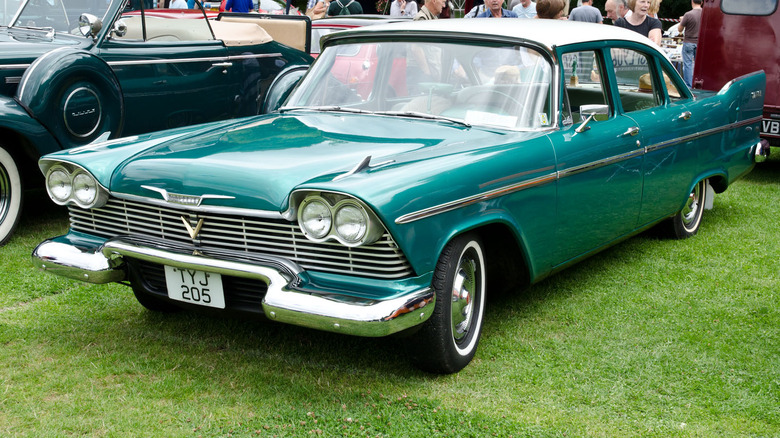
The Plymouth Savoy hit dealer lots in 1954 as its own model line, after the name "Savoy" had previously been used as a trim level on Suburban station wagons. The Savoy was a full-sized model until 1961, after which it was moved to a smaller platform for the 1962 through 1964 model years. After that, it faded into history, leaving future generations to wonder what exactly a "Savoy" is, or was. For the answer, we need to look across the sea to Olde England, and specifically to London.
The Savoy Hotel opened in London in 1889, the brainchild of Richard D'Oyly Carte. He intended his new hotel to resemble the modern hotels he had seen in America, complete with electricity (a first for any hotel in London) and elevators, which were known as "ascending rooms." D'Oyly Carte attracted celebrity chefs and superstar managers to his new hotel, and it soon became legend. Celebrities and millionaires were drawn to its luxuries and its reputation for grand parties, including some in which the central courtyard was flooded to resemble Venice, complete with gondoliers.
Jeep Wrangler Rubicon/Gladiator Rubicon
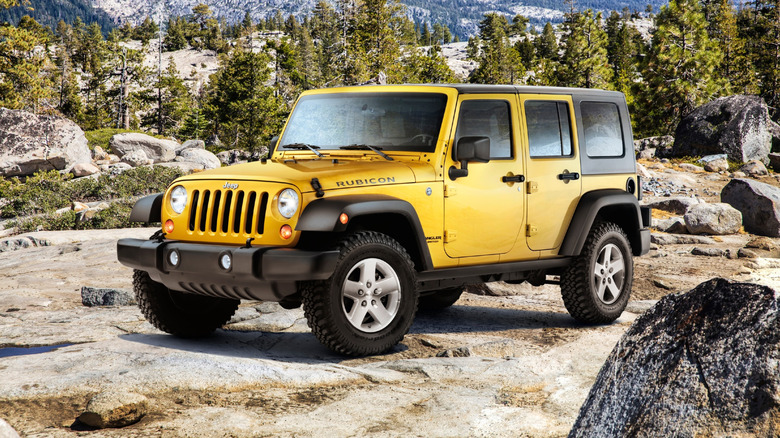
The Jeep Wrangler off-road SUV and the Jeep Gladiator pickup truck are both available in Rubicon models. In the case of the Wrangler, the Rubicon was available until quite recently with a fire-breathing 470-hp 392 Hemi V8, which is a model that Stellantis killed and brought back repeatedly. Supposedly, Stellantis and Jeep have committed to keeping the 392 Hemi in production indefinitely, but at press time, it seems to have been moved from the Rubicon to a model called the Wrangler Moab 392.
But what does "Rubicon" refer to, anyway? The most famous Rubicon in history is a river in northern Italy that marked the boundary between Italy and Gaul. When Julius Caesar crossed the Rubicon with his army, it triggered a civil war that ended with Caesar appointed as dictator of Rome. But the Jeep models take their name from a different source: the Rubicon Trail, a former stagecoach road that now serves as a rugged off-road trail connecting Georgetown, California, with Lake Tahoe, Nevada. Since 1952, Jeep enthusiasts have gathered for an annual trek on this route, and Jeep uses it to test its off-road vehicles.
Hyundai Kona
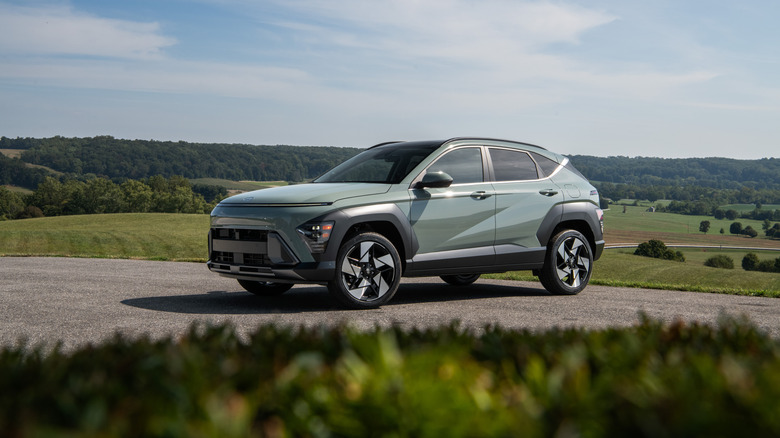
The Hyundai Kona entered the North American market in 2018 as a stylish, fun-to-drive, subcompact SUV. The name "Kona" may have been a mystery to many, who probably most strongly associated it with coffee. But the coffee and the SUV both draw their name from a place — specifically, a district of the Big Island of Hawaii. Kona runs along much of the western side of the island, offering fair winds and calm blue waters thanks to its favorable position on the leeward side of Mauna Loa, the largest active volcano on Earth.
Kona offers snorkeling, sailing, and deep-sea fishing, and visitors can take tour boats to spot dolphins, manta rays, and Hawaiian green sea turtles. Kona's famous coffee grows on the slopes of the mountains. Kona also overflows with history. It was the landing spot of Captain James Cook and the final home of Hawaii's great king, Kamehameha. Kona's reputation as an outdoor paradise inspired Hyundai to bestow the island's name on the company's "lifestyle" SUV. The 2026 Kona is also Kelley Blue Book's top-rated subcompact SUV. Its editors praised it for "stylish design and exceptional warranty coverage, tech, and practicality."