

Congress Saves NASA From Trump's Proposed Budget Cuts, Fully Funds Agency And Its Science Missions
It wasn't all that long ago that NASA looked like it was going to be absolutely gutted by massive budget cuts. However (and here's a sentence you don't hear very often), Congress acted decisively to reject the Trump administration's ambitions. In fact, it's going the other way: in 2026, NASA will have the largest budget it's had since 1998. This basically saves the science missions of the agency, which study everything from the Earth's climate to the furthest stars. And because this is the world we live in now, the new budget also mandates that this money be spent, so the administration can't just choose to not spend what it's been allocated. That sound you're hearing is a sigh of relief from the entire space community.
The specifics here, courtesy the Planetary Society, are more breathtaking than if you took your helmet off in Earth orbit. The Habitable Worlds Observatory was going to be slashed to just $3.3 million; it's now getting a full $150 million. The James Webb Space Telescope, basically the coolest camera ever, was going to be cut to just $140 million; now it's back up to $208 million. The real threat was that a huge number of programs, over 40 in all, were on the chopping block altogether. Losing all of those would have hollowed NASA out, rendering the agency a shell of what it once was.
Now, they're all back in business and fully funded, with just one exception: Mars Sample Return, the ambitious attempt to send the Perseverance rover's soil and rock samples all the way back to Earth. But this program was already bedeviled by cost overruns and a lack of a realistic plan, enough so that private companies were looking to take over from NASA. If something had to be sacrificed to the budget gods to save everything else, this is what you'd pick. Besides, the samples are still there, sitting on Mars, so we could always pick them up later. Unless of course China swoops in and grabs them first, but never mind that.
By the numbers
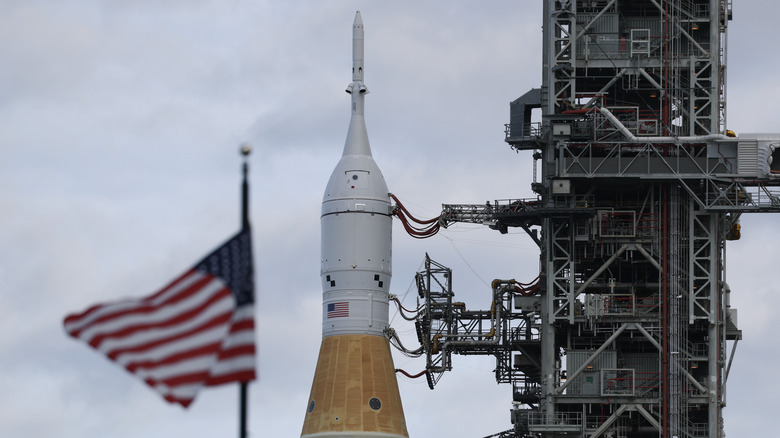
The sad story of NASA in 2025 was always a tale of two halves. On one hand, Congressional committees were advancing budget proposals that kept NASA funding intact. On the other, the Office of Management and Budget (OMB) was simply refusing to pay out legally mandated funding to the agency, effectively implementing the Trump administration's proposed budget cuts before they were ever passed. This process is called impoundment, something the OMB under President Trump has been using quite aggressively. That led to layoffs and building closures that have already hurt NASA. On yet another hand, the One Big Beautiful Bill also allocated $10 billion over the course of seven years. Confused yet?
All told, the Trump administration's proposal was to slash NASA's budget all the way down to $18.8 billion, a 24% drop and the largest one-year cut in the agency's entire history. That would have included a whopping 47% cut to science.
Fortunately, Congress just said no to all that. Through some political finagling, instead of passing an entire federal budget (something Congress is apparently not good at), this time around the legislature is passing funding in slices. NASA was folded into a so-called "minibus" (as opposed to a full omnibus) of three funding measures: Commerce-Justice-Science, Energy-Water, and Interior-Environment. The NASA portion is $24.4 billion, a cut from last of year of less than 2%. That's a big improvement, which gets improved even more once the aforementioned One Big Beautiful Bill money comes in.
That raises that total for 2026 to $27.5 billion, the most since 1998 after adjusting for inflation. Wise to the OMB's shenanigans, this budget very politely tells impoundment to pound sand by explicitly requiring this money to be spent no matter what. Despite his administration's earlier hostility to NASA, President Trump is expected to sign the minibus into law. Maybe he figured out that you can't win a space race by destroying your racing team.
The damage already done
This is all absolutely great news compared to what might have been. Of course, it's worth noting that none of this approaches what NASA's funding was in the heyday of the Apollo program. So you might view this as more of a crisis averted than a bold new direction.
But did we avert the crisis? Getting funding again is nice, but a lot of damage has already been done. Much of NASA's most experienced staff took buyouts in all the uncertainty, which combined with layoffs has dropped NASA's headcount to its lowest level since 1960. 1960! Maybe restored funding can help with rehiring, but experience like that can't be replaced overnight. Meanwhile, the buildings that were shut down probably aren't coming back.
So we're in a strange situation now where the agency has the money it needs, but not all of the people or facilities to actually use it. Not exactly the conditions we'd want if we wanted to, say, beat China to the Moon. That said, in 1960 we were also losing a space race pretty badly, and we somehow managed to figure it out then. Let's hope history repeats.