

Every Chevy Corvette Generation, Ranked By Horsepower
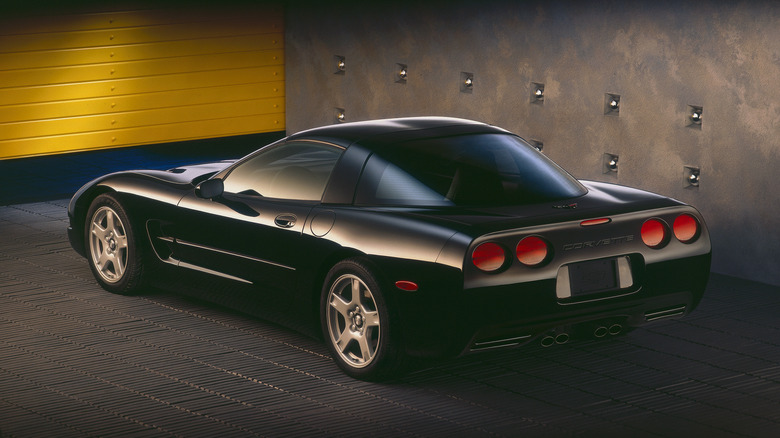
Fans of many different vehicles from the post-war era debate on which of their American sports cars was the first. Some say it was the 1952 Crosley Hotshot, others may mention the Nash-Healey, and the real nerds may even cite the Woodill Wildfire. It doesn't really matter who was the first, though, because, after 70+ years, only one retains the colloquial title of "America's Sports Car," the Chevy Corvette.
Over those 70-odd years, there have been nearly 2 million Corvettes built with dozens of different engines and body styles over eight distinct generations. So, how on Earth can you pick which one's the best? Here at Jalopnik, we always appreciate the smaller nuances of driving — steering, handling, comfort, noise, and how they all fit together — but today, we throw all of that out the window and judge each Corvette the American way: by horsepower.
However, even then, each generation of Corvette is made up of multiple trims with differing performance. To make this as straightforward as possible, each generation's ranking will be based on its trim with the most power from the factory.
C1 Corvette - max output: 360 hp
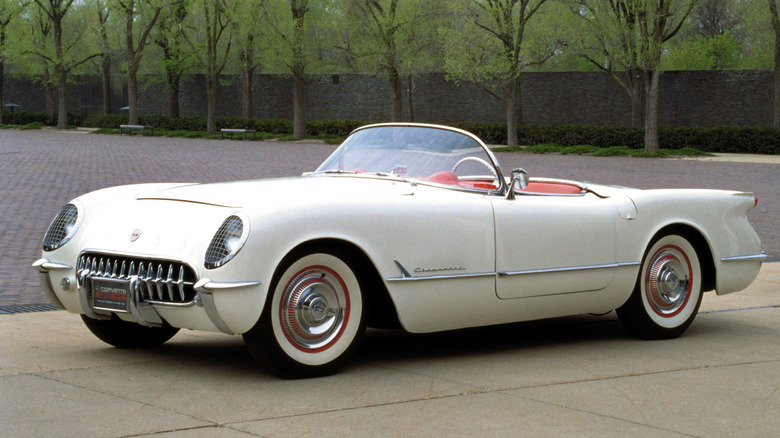
In the early 1950s, a GM task named Project Opel was Chevrolet's supposed life ring out of the murky waters of poor sales. Behind the curtain of this secret plan, interestingly, there was something that typically doesn't pull companies out of financial trouble — a sports car. It was made of lightweight (and expensive) materials like fiberglass and utilized a hopped-up engine from a family car. This was the very first Corvette.
Debuting in 1953, only 300 original Corvettes were built, and of those, just 183 were actually bought by customers, making them incredibly rare nowadays. At first, just one engine was available, the 235-cubic-inch Blue Flame straight-six. It was capable of 150 horsepower and was mated exclusively to a two-speed Powerglide automatic transmission. For 1955, Chevrolet added a hot new engine — the game-changing Turbo-Fire small-block V8. Now with 195 horsepower and an optional three-speed manual transmission, the true Corvette formula finally began to take shape.
The 1956 model year saw a base power bump with a special twin four-barrel carburetor that brought the output to 225 horses. A year later, power would once again jump, this time to 283 horsepower, thanks to the new 283 cubic-inch V8.But the true potential of the C1 wouldn't reach its peak until its final year (1962), when the new 327-cubic-inch V8 pumped out a maximum of 360 horsepower. This high-output option featured a new cylinder head design with larger ports, mechanical lifters, a performance camshaft, lightweight valves, new aluminum pistons, and a compression ratio of 11.25:1 to create this ultimate C1 machine.
C4 Corvette - max output: 405 HP
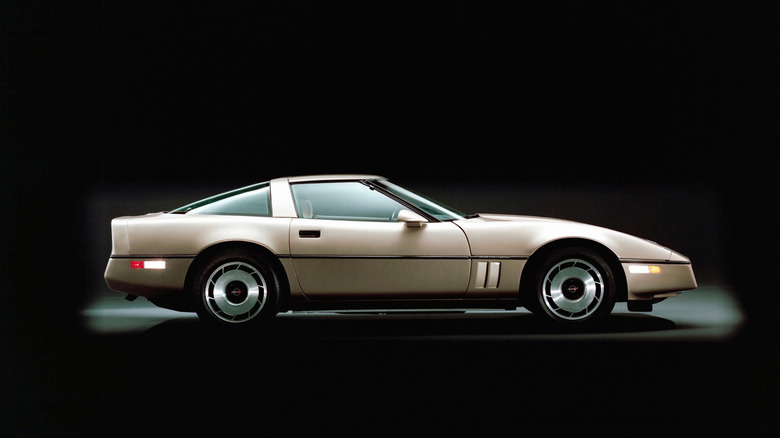
Traveling nearly 20 years and three more generations into the future, we arrive at our next rank with the C4-generation Corvette. Its design was wildly different from previous Corvettes, using a unibody construction and a clamshell front end that opened as one big piece. The suspension was reworked, using a leaf spring setup in the front instead of coil springs and a five-link suspension in the rear. The standard engine for 1984 was the 350-cubic-inch (5.7L) V8 that made 205 horsepower and 290 pound-feet of torque. Over the next several years, incremental changes like upgraded fuel injection and roller lifters would slowly increase horsepower to 240 by 1987, and up until 1989, transmission options included a four-speed automatic and four-speed manual.
For years, mounting competition in the sports car segment demanded more from the Corvette, and after some trial and error in the powertrain department, GM would eventually join forces with Lotus to design an all-aluminum, dual-overhead cam V8 (LT5) that would go in the baddest C4 ever, the ZR-1 (the Lotus Esprit almost got this engine, too). Other than its original 375-horsepower output, the true headline of this engine was its early form of variable valve timing, which utilized two different intake ports. At under 3,000 rpm, the engine only utilizes the primary intake ports, using just three valves per cylinder to breathe through. Above 3,000 rpm, the secondary ports open, and using higher lift lobes, these valves deliver a VTEC-like punch to the rev range at the top end.
The ZR-1 also featured electronically controlled suspension settings, a wider body, wider unidirectional tires, four-wheel ABS, and a six-speed ZF manual gearbox. By the end of the ZR-1's production run, output would rise to a final number of 405 horsepower.
C5 Corvette - max output: 405 HP
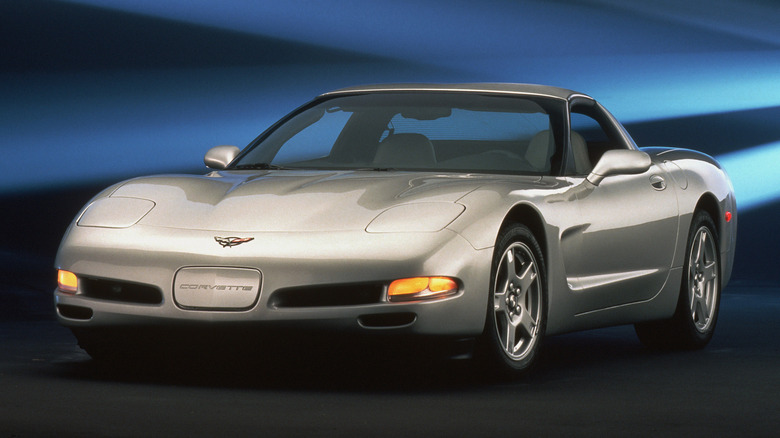
Fittingly, the approaching new millennium would bring an incredibly transformed C5 Corvette. According to the National Corvette Museum, the C5 was literally the "most changed" Corvette since its original 1953 debut. Besides being 4.5 times stiffer and about 70 pounds lighter than the previous car, the C5's slippery body work housed an engine that would change the industry forever, the LS. This all-aluminum 90-degree V8, dubbed the LS1, would make 345 horsepower and 350 pound-feet of torque from its 5.7 liters, making it the most powerful small-block ever fitted to a production Vette.
Overall, the C5 felt like a more refined version of the C4, winning MotorTrend's Car of the Year Award in 1998 and making appearances on Car and Driver's 10Best list for 1998 and 1999, as well as for the 3 consecutive years between 2002 and 2004. The year 2001, however, is what we care about most today, as Chevy ushered in the first Z06 since first appearing as an option code in 1963.
Compared to the base car, the new Z06 got additional negative camber and stiffer everything, including springs, dampers, and stabilizer bars. For power, the Corvette team delivered a true Chevrolet Performance treatment. New intake and exhaust manifolds, high-flow cylinder heads, a higher lift camshaft, and a new aluminum block made up the bulk of the changes. In this form, the LS1 transformed into what Chevy called the LS6, and at the time of release, it churned out an even 385 horsepower and 385 pound-feet of torque, but it would soon see an increase to 405 horsepower for the 2002 model year, due to an even higher lift camshaft, hollow-stem valves, and a new mass airflow sensor. Altogether, this package represented the peak of the C5 generation.
C2 Corvette - max output: 435 HP
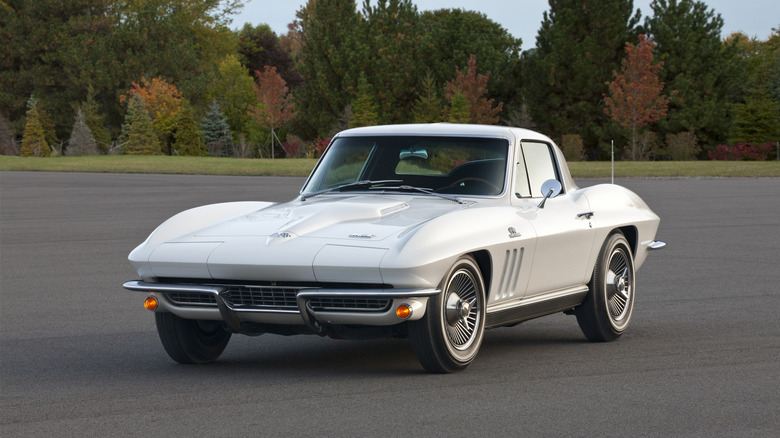
After our C4 and C5 detour, we're back on track with the C2. This Corvette easily represents the largest departure in design from one generation to the next, as it ditched the rounded bubble style of the '50s and embraced the militaristic streamlined aesthetic of the next decade. If this were a beauty pageant and we were the judges, the C2 would already have its bouquet and sash.
Instead of a brand new engine for the maiden year of the C2, Chevy opted to carry over the same range of 327-cubic-inch V8s, spanning from the base 250-horse option to the 360-horsepower trim-topper. By 1965, the Corvette received a new 350-horsepower 327 V8 (L79), as well as the new 396 big-block V8 (L78), which made its first appearance in this very Corvette at a whopping 425 horsepower. The 396 V8 option was a 1-year-only special, being replaced a year later with the massive 427-cubic-inch V8. The L71 code 427 V8, specifically, produced an official 435 horses by 1967. It achieved this number thanks to a triple two-barrel carburetor system, a performance camshaft with mechanical lifters, a higher compression ratio (11.0:1 vs the L39-code 427's 10.25:1), and bigger exhaust valves. Along with the 435 horsepower, customers enjoyed 460 pound-feet of torque and a four-speed manual transmission.
You may be wondering, "What about the L88?" And yes, we know, the L88 was an extremely rare 427 V8 option (essentially a race engine) that only 20 people ever ordered, and it was rumored to make upwards of 560 horsepower. However, its advertised output was 430 horsepower, and even though it almost certainly made more, if we're going by official numbers, the L71's 435-horse output is technically the winner.
C3 Corvette - max output: 435 HP
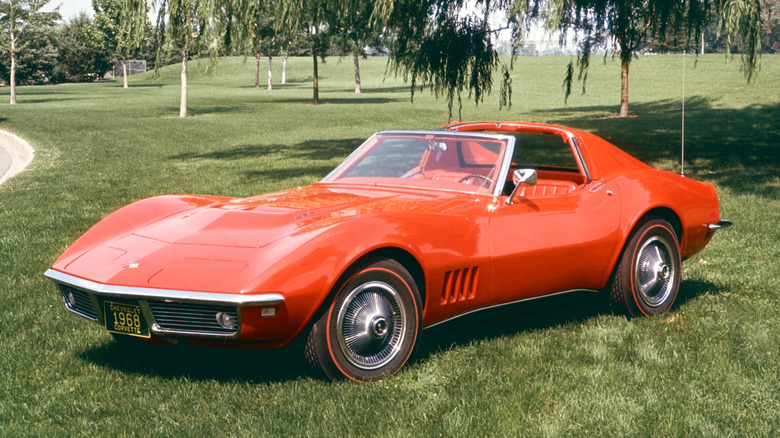
Underneath, the C3 Corvette was extremely similar to its C2 predecessor. It retained the transverse nine-spring leaf setup for the rear suspension, coil-springs up front, the four-wheel disc brake system, and most of the same powerplants. For 1968, options consisted of two different 327 V8 variants and three 427 V8 variants. In 1969, the base engine grew from 327 to 350 cubic inches, making 300 horsepower in base form. In 1970, changes were made to the big-block, increasing displacement from 427 to 454 cubic-inches. Dubbed the LS5, this Chevy big-block rat motor produced 390 horsepower and a massive 500 pound-feet of torque.
When it comes to our most powerful C3, well, it's not a 454. Instead, it's the familiar L71-code 427 V8 we first saw in the C2. Available for the 1968 and 1969 model years, the L71 made the same 435 horsepower and 460 pound-feet we already talked about, still rocking that Tri-Power carburetor setup with the upgraded camshaft and mechanical lifters. The L71 also allowed for the L89 option and a special set of aluminum cylinder heads. Interestingly, you couldn't get air conditioning with this hot engine.
Once again, the supposed 560-horsepower L88 option was offered on the early C3 Corvettes, but it was reportedly underrated and overpriced when compared to the L71, which was advertised with 5 more horsepower than the L88. We guess Chevy didn't want its customers killing themselves with a race engine. Either way, sticking to our "by the books" rubric, the L71 technically takes the cake here.
C6 Corvette - max output: 638 HP
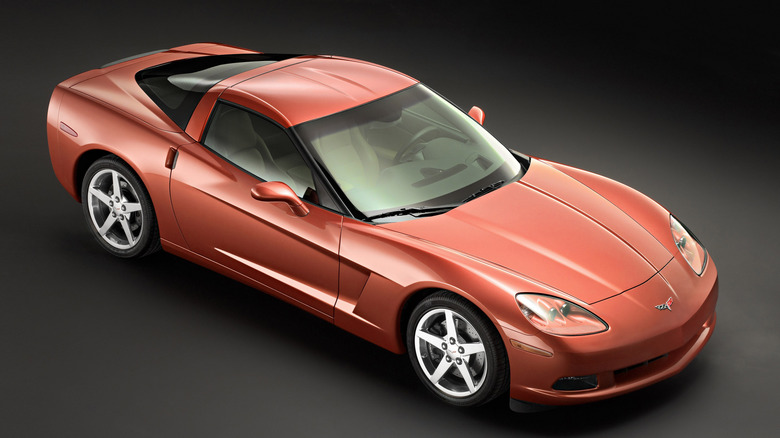
Slim and muscular, the new C6 Corvette steps onto the scene at the 2004 Detroit Auto Show and goes on sale for the 2005 model year. Despite having a wheelbase about 1 inch longer than its predecessor, the C6 was smaller overall, being both narrower and shorter in overall dimensions. Still using the tried-and-true transverse leaf spring suspension setup on the front and rear, the C6 opted for upgraded individual components — everything from the control arms to the springs and dampers were reworked.
Its base engine was essentially an enlarged LS1. The cleverly named LS2 was expanded from 5.7 to 6.0 liters, claiming an output of 400 horsepower and 400 pound-feet of torque. If that wasn't enough for you, the next step up was the race-ready Z06. Introduced in 2006, the Z06's 7.0-liter LS7 was the largest small-block GM had ever made, producing 505 horsepower and 475 pound-feet of torque.
Impressive, sure, but 3 years later, a familiar name put the Z06 in its middle-child place. The ZR-1 returned, this time with a supercharged variant of the then-current (2008 and up) base Corvette motor, the LS3. This variant, named the LS9, was hand built and aspirated via a 2.3-liter Eaton supercharger. To support the extra oomph, the LS9 received forged pistons, beefed-up bolts, and a restructured block to allow the blown LS to make 638 horsepower and 604 pound-feet. The ZR-1 was a first in several areas. Most notably, it was the first Corvette to hit the 200 mph mark (it also was capable of an 11-second quarter-mile). The trade-off? It was also the first Corvette to cost six figures or more.
C7 Corvette - max output: 755 HP
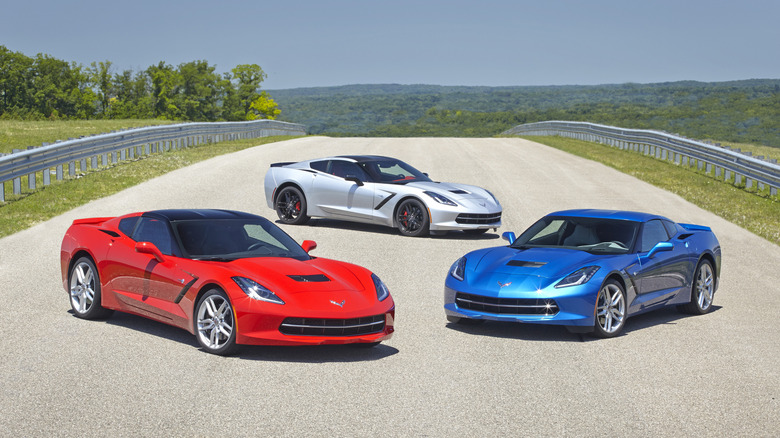
Despite the fact that GM spent basically nothing to develop the C7 Corvette, it came along as a completely new vehicle. Sharing virtually no parts with the outgoing C6, the C7 made massive strides for the Corvette's progressive legacy. Weight savings in the form of an aluminum frame, carbon fiber hood and roof, and composite body panels, coupled with improved suspension components (basic design remained the same), made sure the C7 had a chassis worth housing its all-important new powerplants.
The 6.2-liter LT-1 V8 was the first Corvette engine with direct fuel-injection, making a final tally of 450 horsepower and 450 pound-feet of torque upon its 2014 launch (460 hp and 465 pound-feet with the performance exhaust option). For the first time ever, the Corvette also received a seven-speed manual transmission as standard. Not long after we first received the C7, GM launched the Z06 (2015). It transformed the C7 into a nearly uncontrollable, but extremely capable beast, sporting a new 650-horsepower supercharged 6.2-liter V8 dubbed the LT4.
It would have been GM's scariest track weapon, but the 2019 ZR-1 argued otherwise. Downforce, mechanical grip, weight reduction, and, of course, horsepower, were all cranked up. The new supercharged 6.2-liter LT5 V8 advertised a whopping output of 755 horsepower and 715 pound-feet of torque, shooting the dressed-up Corvette to 60 mph in 2.9 seconds, through the quarter-mile in 10.7 seconds, and to a claimed top speed of 212 mph. During testing, the ZR-1 recorded 1.18 g's of grip, and through the high-speed stuff, drivers enjoyed up to 30% more downforce than that of the Z06. However, after just one model year and five U.S. track lap records, the ZR-1 would have to make way for a whole new kind of Corvette.
C8 Corvette - max output: 1,250 HP
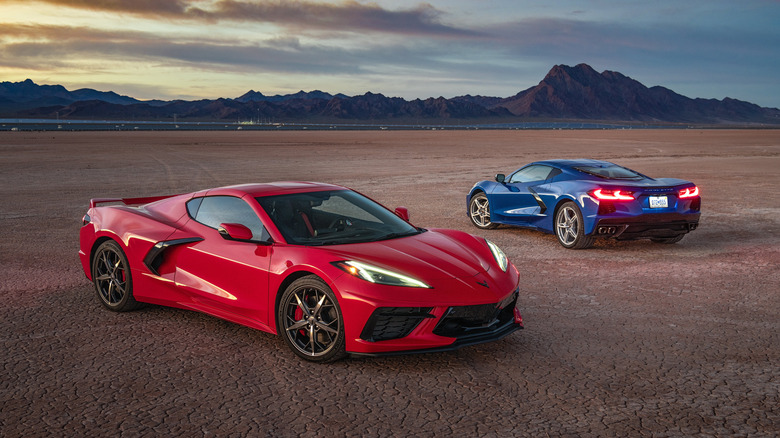
Upon release, the Corvette's base engine, a 6.2-liter cross-plane V8 (LT2), made 490 horsepower and 470 pound-feet of torque, and was paired exclusively with an eight-speed dual-clutch transmission. The next trims we would get were the Z06 and the hybrid E-Ray in 2023 and 2024, respectively, but the big boys were still yet to come. In 2025, the ZR1 arrived. Chevy took the Z06 platform and gave its engine (LT6) a pair of turbochargers, boosting the total output to quad digits. At 1,064 horses, the newly named LT7 helped the ZR1 claim the title of most powerful Corvette ever.
That title only lasted for a few months, because for 2026, Chevy has presented us with the ZR1X, which uses the ZR-1's twin-turbocharged V8 and pairs it with the E-Ray's front electric motor, creating a mighty 1,250-horsepower machine from hell. Chevy packed this demon Corvette to the brim with crazy new goodies that could only be fit for a hypercar. The ZR1X receives a special adaptive magnetic suspension, 10-piston front and 6-piston rear brake calipers, an exhaust manifold that also acts as the turbo housing to reduce lag, an aero package that makes 1,200 pounds of downforce, firmer suspension settings, and much more.
In GM's own testing (on a prepped drag strip), a ZR1X equipped only with factory options ran an 8.6-second quarter-mile and hit 60 mph in just 1.68 seconds. Not only was this run quicker than a Dodge Demon 170, but it also rivals some of the fastest street-legal cars ever built. We don't want to speak too soon, but this is, by far, the most powerful factory Corvette ever constructed. So, for the sanity of everyone involved, Chevy, let's keep it that way.