

Why Are Chevy Big Block V8's Called Rat Motors?
To discuss the rat, we must first discuss the mouse. In 1954, Ford squeaked past Chevrolet in sales by a 2% margin (1,165,942 vs. 1,143,561), a reversal of the previous year when Chevy beat Ford by 7%. Part of the reason FoMoCo got a buyer boost was its new Y-block V8 that made 139 horsepower in Fords and 161 hp in Mercuries. Chevy's Blue Flame six in the Corvette was no slouch with its 150 hp, but the future was clear. Make a V8 or get left behind.
And so, in 1955, Chevrolet's small block debuted and shouted, "Here I come to save the day!" Sales flipped and Chevy outsold Ford by 15%. That was also the year when "The Mighty Mouse Playhouse" brought Terrytoons' caped super-mouse to TV sets around the country. He was small, as mice tend to be, but he was basically Superman with large, round ears. At some point in the late '50s, someone might have watched a few episodes of Mighty Mouse beating up evildoers, then gone to the garage to work on a GM small block V8. That person may have thought, "This engine is small and strong, so why not nickname it 'Mighty Mouse?'" And bam, a nickname is born.
So, of course, when GM brought out the big block for even more displacement and power, that engine had to be called "rat" because, as any biology major will tell you, rats look like mice, only larger. Small block V8 equals "mouse," big block equals "rat." It's that simple.
But the "Mighty Mouse" origin is only a theory, though it's the one espoused by Wired and Hagerty, among others. Finding references from the era is tough, but plenty of commenters on articles and forums tell different stories.
The small block Mighty Mouse acknowledges the Hemi elephant in the room. Or does it?
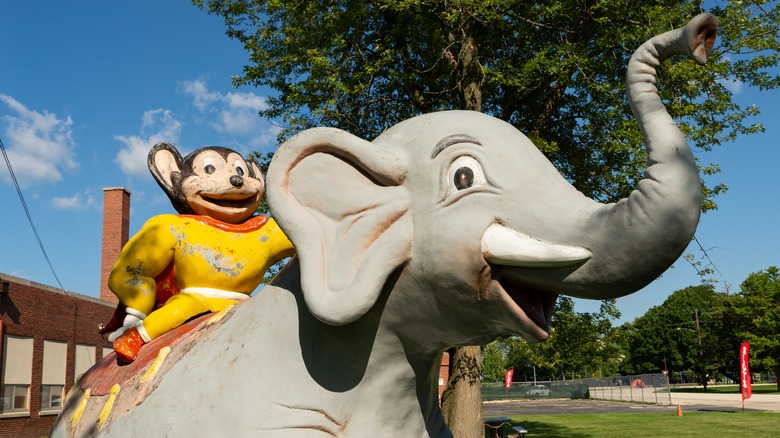
Coincidences are fun. For example, in "This is Spın̈al Tap," the band accidentally created a Stonehenge prop 18 inches tall. This was clearly a mockery of Black Sabbath's Born Again tour, which featured Stonehenge sets so large that most concert halls couldn't fit them. Except, no, that Sabbath tour happened in 1983 and the "Spın̈al Tap" gag was filmed in 1982, so it was just serendipity. Another grand coincidence? Chrysler's 426 Hemi getting the "elephant" nickname.
People online claim that the Chevrolet mouse and rat motors were meant to scare away the big, bad Hemi elephant (I wanted to portmanteau it into Hellephant, but I can't, Dodge already did that). While it might work timeline-wise to say that the Hemi got the nickname "elephant" after being beaten by cars powered by Chevy small blocks and big blocks, that's not where the name came from. The Hemi got saddled with "elephant" because it's just plain huge. That's it, that's the twist, nothing more complicated.
Plus, it would be strange for Chrysler to embrace the "elephant" nickname since that would imply that the Hemi is afraid of the competition. And elephants aren't afraid of mice, anyway. Elephants just have kind of crappy eyesight and get startled when a mouse runs by. That can also happen with a snake, a cat, or a dog, so there's nothing specifically terrifying about mice. Even "Mythbusters" had to amend the "Elephants are scared of mice" experiment after a little girl pointed out that the team used an albino mouse for the test, which would be uncommon in nature, and the odd color was probably what panicked the pachyderm.
Rats, mice, now porcupines?
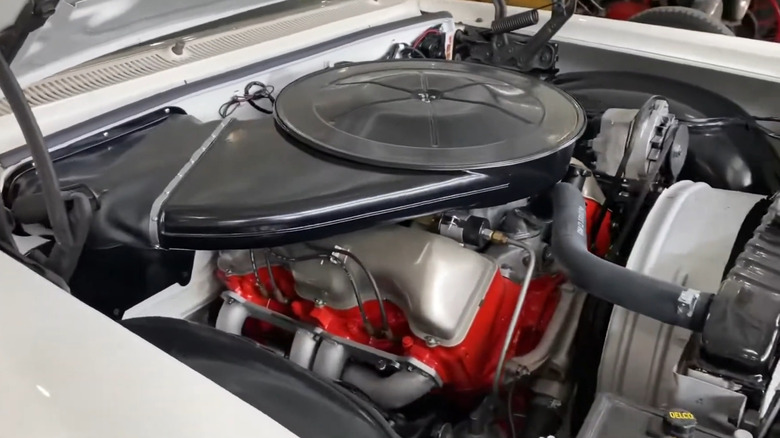
Another theory says that the big block "rat" nickname came before the small block "mouse" moniker. The Chevy "Mystery Motor" 427s had angled valves that aimed at the center of the cylinder bore, which made the valves look like porcupine quills. Porcupines are rodents, as are rats, so somewhere along the line, "rat" stuck while "porcupine" didn't. Apparently "mouse" came later in this version of the story. The problem with relying on the memories of commenters is that humans can be terrible at remembering things, hence why people across the internet thought Nelson Mandela died in jail or "The Simpsons" birthed "Jingle Bells, Batman Smells."
In an attempt to corroborate the timelines with hard historical data, I scoured the internet for period references to the "mouse" and "rat" nicknames. The earliest I found online was a Hot Rod article from 1970 about the 400 small-block titled, "Chevy's Mini-Rat." It features the sentence, "One is based on the small-block 'mouse' motor, the other on the 396 'rat' motor."
Then I turned to my collection of vintage Hot Rod, Car Craft, Road & Track, Motor Trend, and other magazines from the early '60s. In those printed materials, the oldest reference I found to the Chevy small block as a "mouse" is in the June 1967 Hot Rod, which features a story on Mickey Thompson's three-valve-per-cylinder heads for the Chevy 350. At the end of the article, author Bud Lang wrote, "So maybe this will be the year when the 'mouse' roars ... and is heard by others than just the hot rod fraternity."
So at least we can say almost certainly that the terms "rat" and "mouse" existed before 1967. But getting definitive answers on when exactly they were coined may be a wild goose chase.