

10 Iconic Cars US Presidents Drove
Presidents are often scrutinized for their political impact and rightfully so. But have you ever stopped to wonder about which vehicles our commanders in chief have piloted? We are not talking about limos fit for Oval Office duty. Instead, we're taking a closer look at 10 of the most iconic cars U.S. presidents drove on their own accord.
Now, whenever politics are involved, folks are a bit on edge. In that regard, we want to clarify that this is merely a look at the automobiles, not an interpretation of the policies or partisan viewpoints of any individual mentioned. That said, we did take a look at how each president influenced traffic laws as well as the automotive industry as a whole.
For reference, the list is presented in chronological order, starting with the earliest president to make the cut: William Howard Taft and his 1912 Baker Electric.
William Howard Taft: Baker Electric
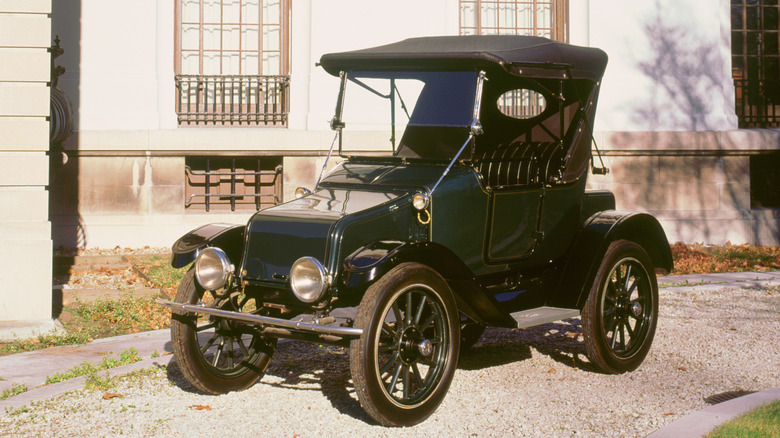
William H. Taft was in office from 1909 until 1913 and is credited with being the first president to establish a White House car fleet, replacing the estate's horse stables with garage stalls. As for his impact on the automotive realm, well, he endorsed the Good Roads Movement, which was actually spearheaded by — wait for it — bicyclists. The goal was to bridge rural communities and cities with quality, well-paved roads. Taft's affinity for the automobile had a positive impact on the movement.
When it comes to the car collection Taft brought to the White House, our standout selection goes to the 1912 Baker Electric Victoria, which was used by five different First Ladies, from Helen Taft to Grace Coolidge in 1928. No, it can't sprint to 60 miles per hour in under two seconds like a Lucid Air Sapphire, the quickest car MotorTrend has ever tested, but we think it's cool to see the prominence of an electric vehicle from over 100 years ago. It spoils the stigma against battery-powered propulsion, which is oftentimes chided as some sort of new-school tomfoolery.
To clarify, the model shown in the image above is not the vehicle that was purchased by President Taft.
Herbert Hoover: 1932 Cadillac 452-B V-16 Imperial Limousine

We did say we weren't counting limos that were driven by chauffeurs and used to transport presidents. But that wasn't the case with Herbert Hoover's 1932 Cadillac 452-B V-16 Imperial Limousine, which he bought himself. As the name suggests, the model was motivated by a 452-cubic-inch 16-cylinder engine that produced 165 horsepower. Only 49 of these machines are said to have been made, and Hoover reportedly purchased his during his last year in office. Ironically, this Great Gatsby-esque Cadi was a stark contrast to the struggles associated with the Great Depression, which began while Hoover was in office.
Fittingly, as the owner of a highly exclusive Cadillac, Hoover was influential in creating a set of uniform vehicle codes in 1930, which included acts for motor vehicle registration and anti-theft measures as well as licensing and general traffic regulation.
For those who are interested, actual photos of President Hoover's Cadi can be seen via this Bonhams auction listing. Notably, the 452-B was auctioned off for $87,750 back in 2007. That's quite a bit of coin, but as we know, nobody does land yachts like Cadillac.
Franklin D. Roosevelt: 1936 Ford Phaeton
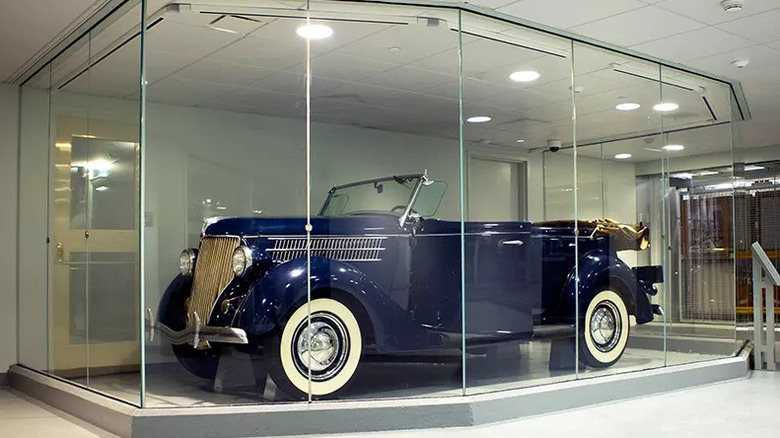
Franklin Delano Roosevelt moved into office after Herbert Hoover, and he signed the Hayden-Cartwright Act of 1934, which secured federal funding for highway development. Like Hoover, he also personally owned a 1933 Cadillac as well as a 1936 Packard. The vehicle we picked, though, is his 1936 Ford Phaeton, as he had it outfitted with hand controls since his legs had been paralyzed by polio. We felt this was particularly badass, since it flew in the face of rules put in place by the Secret Service, which prohibited presidents from driving cars themselves.
Curiously, FDR is often associated with another, rather infamous Cadillac. A myth, which has since been reportedly disproven, alleged that Al Capone's limo was confiscated and then used as the first armored presidential limo. To clarify, FDR never used a bulletproof 1928 Cadillac Series 341A Town Sedan that had been seized by the government.
Another car that FDR is accurately associated with, though, is a 1939 Lincoln V12 convertible, also known as the Sunshine Special. It is credited with being the first presidential limo that was built to specifications dictated by the Secret Service. It was then modified further after the attack at Pearl Harbor, which is when the bulletproof glass and other protective measures were installed.
Dwight Eisenhower: Rauch & Lang Electric Car
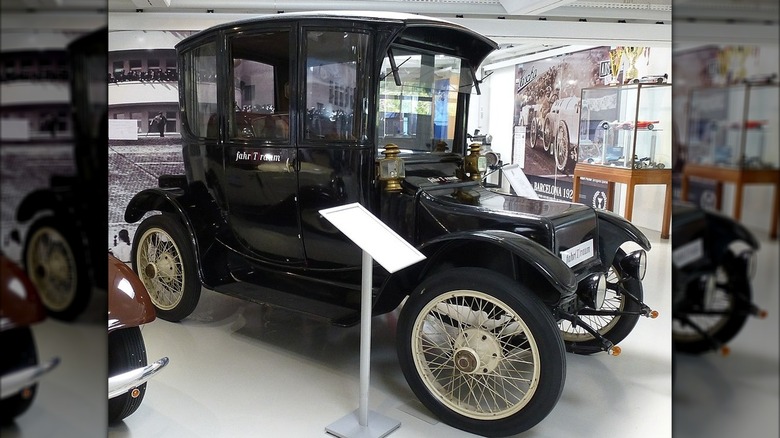
William Howard Taft wasn't the only president to own an electric car that was built in the early 20th century. Dwight D. Eisenhower, who held office from 1953 to 1961, was the indirect owner of a 1914 Rauch & Lang. We say indirect since it was actually purchased by his in-laws, John and Elivera Doud. As such, it was Ike's go-to mule when he and his wife visited her parents in Denver, Colorado.
Rauch & Lang built its first electric car in 1904, and by 1914 production was up to 1,000 units per year. At the time, there were roughly as many steam and electric cars being built as there were gasoline-powered ones. Compared to the alternatives, the electric models were typically quieter and easier to use as they didn't need to be cranked by hand in order to start, making them a popular choice for female drivers.
There's a theory that the Eisenhower administration's implementation of the Federal-Aid Highway Act of 1956 could have possibly contributed to the dominance of gas-powered vehicles over EVs. This is a bit ironic given his penchant for electrified propulsion.
Lyndon Johnson: Amphicar
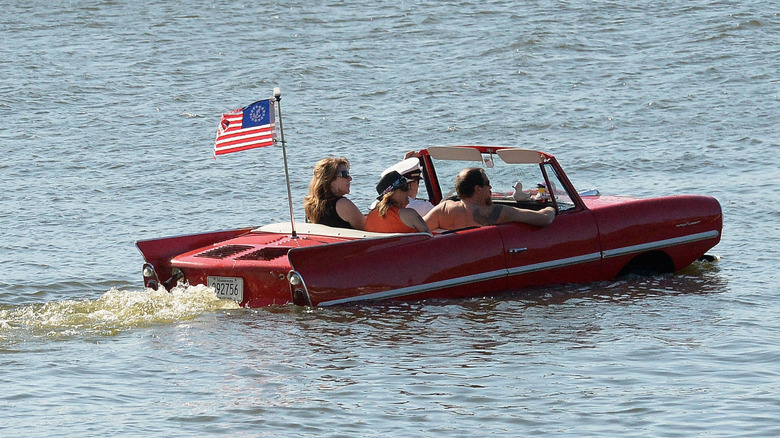
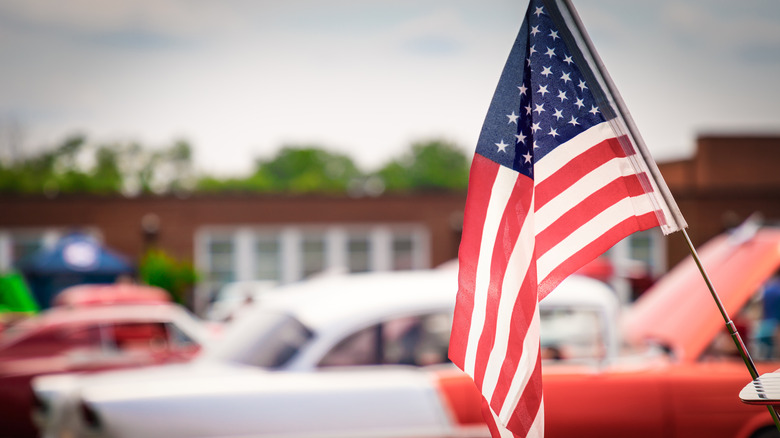
The vehicles on this list are presented in chronological order starting with the earliest president. However, if it were a ranked list, then Lyndon B. Johnson's Amphicar would definitely be a strong contender for most unique. Just so you know, the red Amphicar pictured above may have a patriotic flag waving at the back, but no, none of those folks is President Johnson. His vehicle was lagoon blue.
The rear-engined convertible was conceived and built in Germany and was designed by the same guy who gave us the Mercedes-Benz Gullwing's door, Hanns Trippel. As the name suggests, the Amphicar is an amphibious automobile that can be used on both land and water. Apparently, President Johnson used the car to prank people, including his advisor, Joseph A. Califano Jr., by pretending the brakes had failed before careening into a lake. We're not sure about sailing the seven seas in with this car, but it could make for a rather unique fishing expedition.
Speaking of safety, Johnson was the last president permitted to drive on public roads. Presidents and former presidents must now be driven around by Secret Service agents trained in evasive maneuvers. He also signed the National Traffic and Motor Vehicle Safety Act of 1966 and the Highway Safety Act of 1966. The decision to step in and place regulations on private companies was preceded by a rather fascinating series of events, including a lawsuit filed by Ralph Nader against General Motors. For all you young'uns out there who are probably unfamiliar with these matters, we encourage you to fall down that rabbit hole of American history.
Richard Nixon: Oldsmobile 98
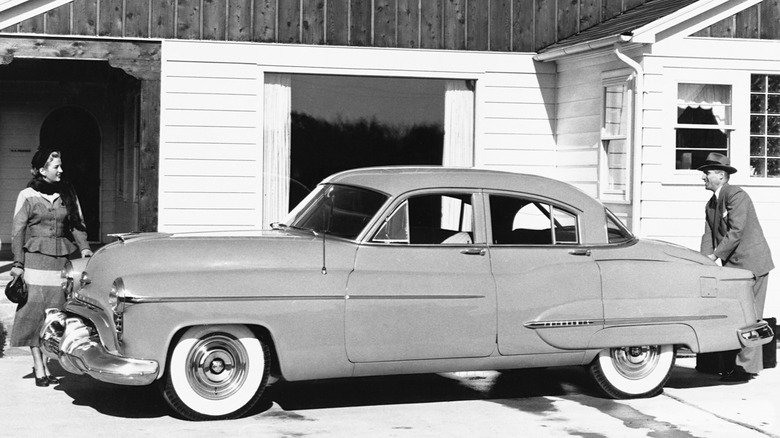
During the delivery of Richard Nixon's "Checkers" speech, in which he refutes accusations about his finances and gifts, including a dog named Checkers, Nixon references his 1950 Oldsmobile in an attempt to relate to the common man. The specific model in question is an Oldsmobile 98, which was exclusively offered with the 303-cubic inch Rocket V8 engine. Back then, a 1950 Oldsmobile 98 retailed for less than $2,300. Today, the Hagerty valuation tool puts the sedan models in the $12,000 to $14,000 range, though convertibles are over the $30,000 mark. Even so, the 98 can be considered a modest vehicle by both yesterday's and today's standards.
His rhetoric conveyed a sense of retaliation against the elite, which might sound similar to sentiments expressed by our current commander in chief, but unlike President Donald Trump, Nixon certainly did not come from wealth.
Another major difference between the two is the impact each has had on the automotive industry, specifically in regards to emissions regulations. While Trump has rolled back fuel economy standards and put a pause on the pursuit of electrification, Nixon is credited with the creation of the Environmental Protection Agency and signed the Clean Air Act of 1970.
Ronald Reagan: Subaru BRAT
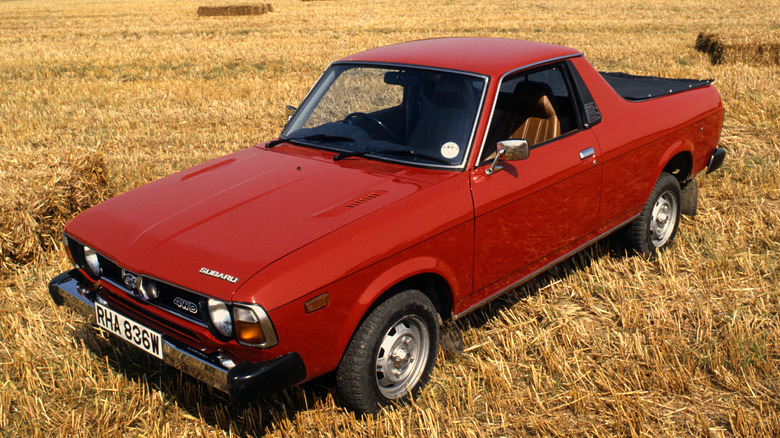
Ah yes, the Bi-Drive Recreational All-Terrain Transporter. Did you know that's how the Subaru BRAT got its name? How about the fact that its rear-facing bed-mounted seats were a means to avoid the "chicken tax," which was implemented by the aforementioned Lyndon B. Johnson and imposed a 25% tariff on imported pickup trucks? The extra seats allowed the vehicle to be classified as a passenger car. Did you also know that Ronald Reagan was the proud owner of a Subaru BRAT, which he loved to drive on his ranch in California?
According to a Jalopnik article published nearly 14 years ago, an agreement was made in which Reagan more or less became a secret Subaru test driver. Thanks to a connection between Richard V. Allen and someone he knew at Fuji Heavy Industries, Reagan was able to utilize the BRAT on his property under one condition: Performance reports had to be submitted every six months. Not a bad exchange, if you ask us. (Hey Subaru, we not only dare you to build these STI concepts, but we also offer our services if you're looking for more secret test drivers.)
Ironically, Reagan's administration negotiated a Voluntary Export Restraint (VER) with Japan, which limited the number of Japanese cars exported to the U.S. in an effort to protect American automakers.
Bill Clinton: 1967 Ford Mustang
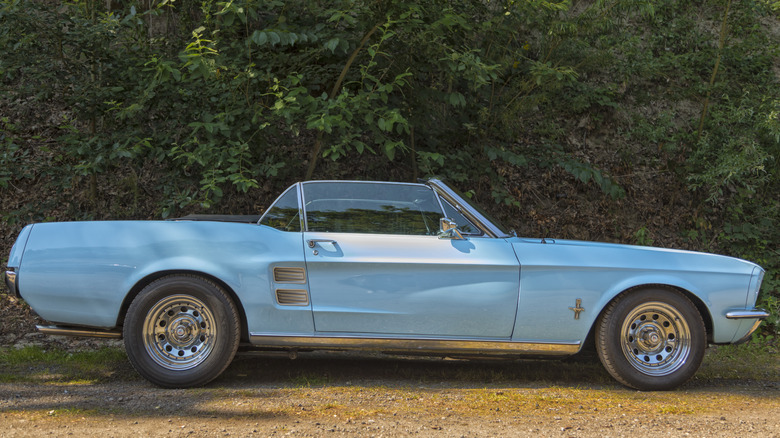
Bill Clinton's name has recently been reintroduced to the limelight, but we're here to talk about what's really important: his 1967 Ford Mustang convertible. Although sitting presidents are not allowed to pilot their vehicles on public roads, Clinton did get to drive his convertible in the presence of the public during a 30th anniversary event for the nameplate at Charlotte Motor Speedway in 1994. His Mustang looks quite similar to the one above, as it's blue with a white top and white interior. Mechanical features include a six-cylinder engine and automatic transmission.
The Mustang was originally purchased by his stepfather, Jeff Dwire, as a gift for Bill's little brother, Roger. Clinton purchased it from his brother years later. It might not be anything flashy, but during the aforementioned 30th anniversary event, Bill told a reporter that his Mustang was the thing he regretted leaving behind the most when he made his way to the White House. He joked that the other drivers in his home state, Arkansas, were better off without him behind the wheel. Now we're not saying Clinton was a speed demon, but he did sign the National Highway System Designation Act of 1995 into law, which repealed the 55 mph federal speed limit and shifted control over speed limits to the states. Coincidence? Maybe, maybe not.
Notably, Clinton's Mustang is not the only American icon to make this list. The next nameplate has an even richer history, and, like this Mustang, it too is a 1967 model year convertible.
Joe Biden: 1967 Corvette Stingray
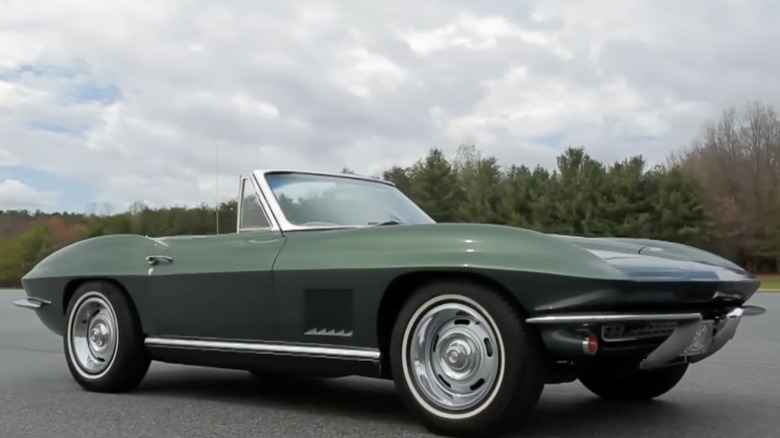
The next vehicle on the list is Joe Biden's 1967 Chevrolet Corvette Stingray convertible, which is equipped with a 327-cubic-inch V8 and 4-speed manual transmission. Now, this is an entirely subjective call, but if we had to pick the best-looking car on this list, then we'd be very tempted to make the former president's Corvette our choice. It'd be a shoo-in if it were a coupe, but it's still a top-three pick either way.
Biden has actually owned the Goodwood Green 'vert since 1967, as it was a wedding gift from his father, though he reportedly doesn't get to drive it very often. That said, you may recall seeing a video in which Biden lost a drag race after lining his C2 Corvette up against a C7 piloted by Michael Powell.
If you're a fan of V8-powered sports cars, then you likely don't have a strong appreciation for the stricter emissions standards imposed by Biden's administration, nor its push for electrification. However, the previous administration's ambitions to reach 50% electric vehicle sales by 2030 has been cut at the knees by the current administration, which we'll get into next.
Donald Trump: 1997 Lamborghini Diablo
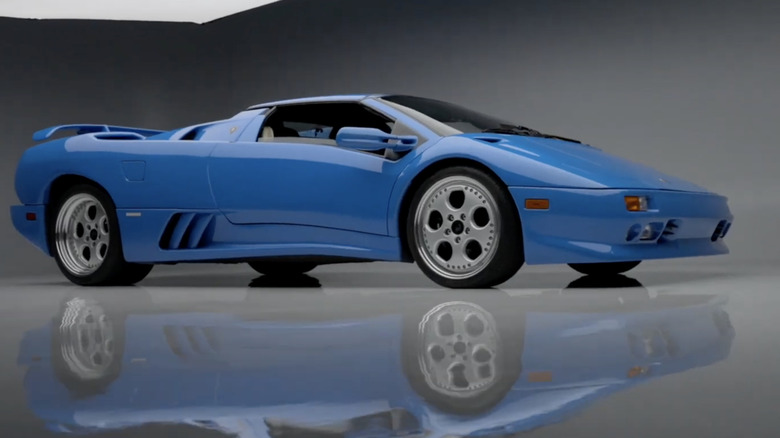
Last, but certainly not least, we have Donald Trump's 1997 Lamborghini Diablo VT Roadster, which sold for $1.1 million at auction. This custom-ordered Diablo VT Roadster is said to be the only Blu Le Mans unit built for the 1997 model year. It features a 5.7-liter V12 along with a 5-speed manual transmission. The engine's 492 horsepower and nearly 430 pound-feet of torque were sent to all four wheels. Politics aside, this is an objectively awesome automobile.
Notably, only 132 Diablo VT Roadsters were produced for the U.S. market. This vehicle is said to have a few personal touches, including a "Donald Trump 1997 Diablo" plaque on the door as well as a "Trump 2016" decal on the rear window. Trump no longer owns this Diablo. He sold it in 2002. It changed hands twice before crossing the block at the Barrett-Jackson Scottsdale Auction in 2024. At the time, the sale was said to be a new world record.
In yet another turn of irony, sales of new Lamborghinis are being stifled by trade policies implemented by Trump's current administration, as super rich Lamborghini buyers are getting scared off by the tariffs. As of this writing, it appears that there's still a 27.5% tariff on Lambos along with any other vehicle that's imported from Europe. There's been talk of it being cut to 15%; however, this is contingent upon a reduction in tariffs on certain goods that European countries import from the U.S. In addition to the tariffs, Trump has also heavily influenced the automotive industry by eliminating federal electric vehicle tax credits and introducing a tax measure that allows new car buyers to deduct the interest they pay on their new car loans as long as the vehicle was primarily built in the states.