

6 Fuel-Sipping Toyotas That Also Have Room For Huge Families
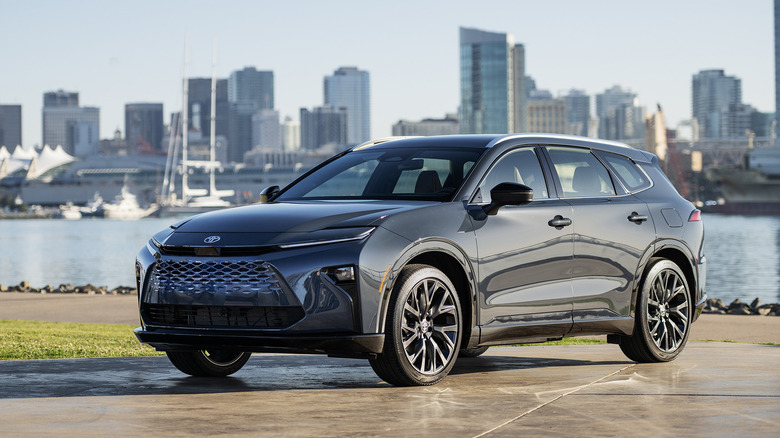
Given how we have been harping on about the soaring prices of gas all year, it's apparent that this is no momentary blip. Many shoppers are now turning away from gas guzzlers and instead relying on hybrid vehicles. Toyota was initially criticized for its delayed response to mass electrification of its models, as the brand instead opted to take a more gradual and considered approach to fully electric vehicles. It now seems as if that criticism was duly misplaced, as Toyota's prioritizing hybrid vehicles instead seems to have been a far safer bet.
Still, not every Toyota hybrid is ideal; models like the Sequoia, 4Runner, and Land Cruiser might have plenty of space for families, but being larger and off-road focused hinders their economy somewhat. Respectively, they return manufacturer-estimated combined fuel economy ratings of 20, 23, and 23 mpg, respectively.
Likewise, while smaller hybridized models like the Corolla and Prius are certainly efficient, they lack the space required to suitably support larger families, so instead, we have focused on SUV and minivan models instead here. But what if you could have both? Below are six new Toyota SUVs that all seek to use as little fuel as possible while also prioritizing practicality for family-minded buyers. We ranked them from least to most efficient according to their combined manufacturer fuel economy estimates.
2027 Grand Highlander Hybrid: 34 mpg combined
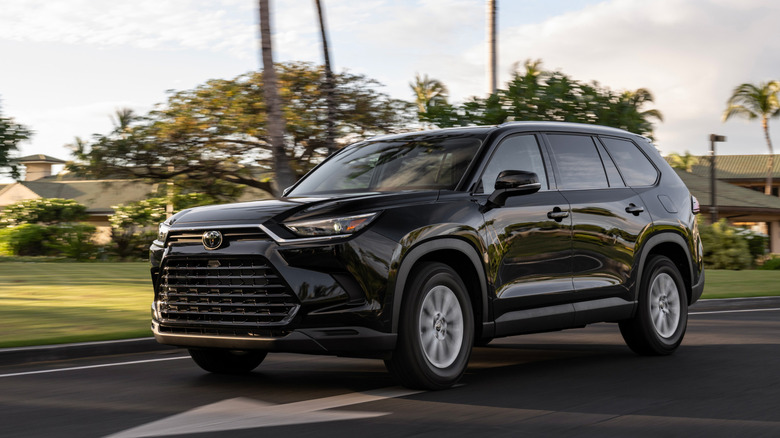
We looked at how much grander the space in Toyota's Grand Highlander is just earlier this year, and as the name suggests, there certainly is more in the way of room inside compared to the standard model. While certain measurements such as front leg and hip room are marginally smaller than those of the standard Highlander, on the whole, there is a lot more space to be had.
To throw a few numbers out there, the Grand Highlander can seat up to eight, depending on whether you opt for second-row bench seats, and its cargo space ranges from 20.6 to 97.5 cubic feet, depending on how many rows of seating are left upright. Passenger volume sits at a spacious 153.3 cubic feet, or 149 when a panoramic moonroof is optioned.
When it comes to matters of motivation, the Grand Highlander provides buyers with numerous options. The gas-only option makes use of a turbocharged 2.4-liter inline-4, as does the Hybrid Max, which combines that with a single electric motor to produce 362 horsepower and 400 pound-feet. However, the cost-conscious would be better off opting for the standard Hybrid, which combines a naturally aspirated 2.5-liter inline-4 with a pair of electric motors to produce 245 horsepower, and it's in this guise that the Grand Highlander Hybrid manages to achieve a respectable 34 mpg combined.
2026 Highlander Hybrid: 35 mpg combined
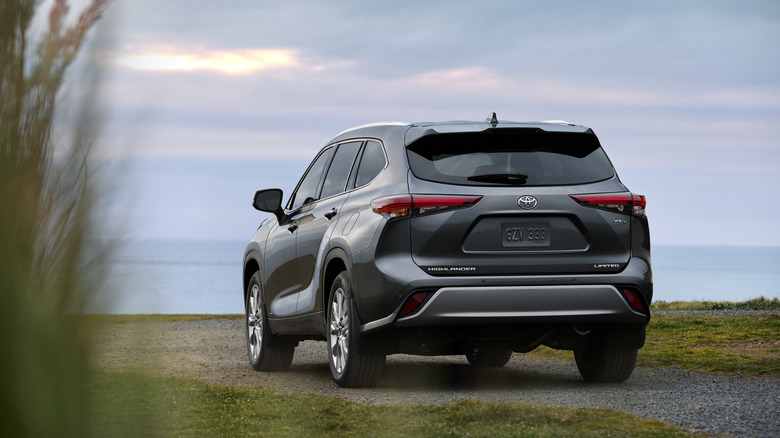
The standard Highlander Hybrid naturally comes with a similar set of benefits, but in a smaller package. Here, the 2.5-liter inline-four is paired with a total of three electric motors, giving the SUV a combined output of 243 hp and a combined fuel economy rating of 35 mpg – one mpg more than its larger sibling. The weight difference is not as large as you may expect, either. In all-wheel drive Hybrid XLE grades, the Highlander tips the scales at just 50 pounds lighter than the Grand Highlander.
Despite a slightly smaller stature, the Highlander is still more than up to the task of swallowing up a larger family and all their belongings. Its cargo space sits at just 16 cubic feet when all seats are in place, but it expands up to 48.4 cubic feet when the third row is stowed, and then to 84.3 cubic feet when the second row is also lowered. Much like the Grand Highlander, both 7- and 8-seat configurations are available, and here, total passenger volume sits at 139.5 cubes.
Those tempted by a hybridized Highlander will have to act fast, should they wish to secure a new one, as the nameplate is switching up its direction for the 2027 model year. As of next year, the Highlander will be electric-only, and it should boast a 320-mile range, while the Grand Highlander continues as it is.
2026 Sienna Hybrid: 36 mpg combined
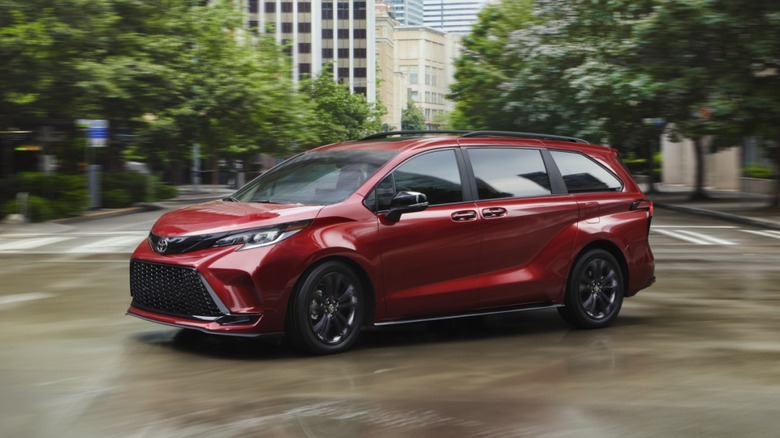
SUVs and crossovers are great for hauling the family around, but when space and practicality really are the top priority, a minivan still stands proud as the best option out there. Without a moonroof, the 2026 Sienna Hybrid boasts an impressive 195.7 cubic feet of interior volume and 162.5 cubic feet of passenger volume. With the optional moonroof equipped, those figures drop to 193.2 and 159.7, respectively. As for cargo volume, that sits anywhere between 33.5 and 101 cubes, depending on which rows of seating are in place, and once again, passenger capacity can be either 7 or 8.
Toyota's Sienna minivan went hybrid in 2021, and ever since then, it's been a tough ride to beat when both space and efficiency are the order of the day. Just like the aforementioned Grand Highlander, a naturally aspirated 2.5-liter inline-4 pairs with two electric motors to return a combined output of 245 hp — except in the Sienna's case, it manages to return better fuel economy.
The manufacturer boasts a combined rating of 36 mpg, which comprises 36 mpg in the city and 36 mpg on the highway. So, regardless of where you are going, expect 36 mpg at the helm of a hybridized Sienna. That is, unless you get the optional all-wheel drive system that is, which includes an additional third electric motor. That motor doesn't add any extra power, but it does see the city and combined MPG rating drop to 35.
2027 Crown Signia: 38 mpg combined
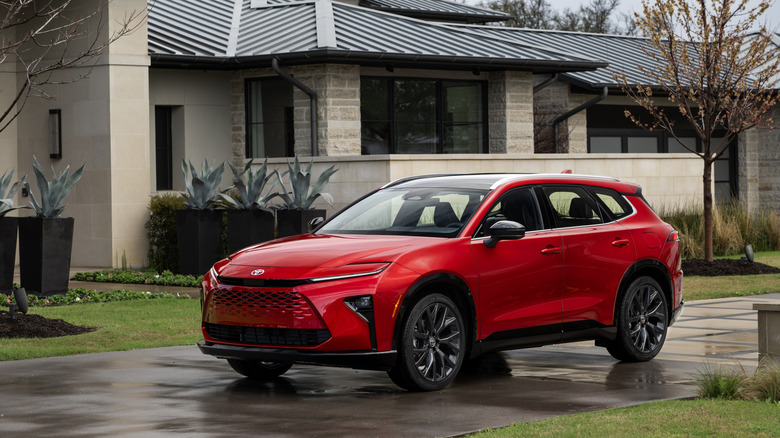
The Crown Signia is one of Toyota's newest nameplates, having been introduced as a 2025 model year. We weren't quite sure who the Crown Signia was for when it first arrived, but nevertheless Toyota managed to find 20,550 customers for it during its first full year in production; perhaps they were all family buyers who appreciate a fuel-savvy hybrid, as the Crown Signia certainly delivers in that regard.
Beginning with its drivetrain, the Crown Signia shares a similar setup to many of the aforementioned models, with a naturally aspirated 2.5-liter inline-4, coupled with three electric motors. A combined output of 240 horsepower is channeled to all four wheels via a CVT. When it comes to fuel economy, it outshines many other Toyota SUVs, delivering a combined rating of 38 mpg.
A part of that increase in efficiency may be down to the Crown Signia's modern and aerodynamic design tweaks, although there's a catch: Crown Signia is also smaller than the aforementioned models; it seats only five, and tips the scales at 4,210 pounds. For reference, that's 210 pounds lighter than a Highlander, and 400 pounds less than the Sienna.
Still, it's large enough for most families, delivering a maximum of 68.8 cubic feet of cargo space with the rear seats down, in addition to 42.1 inches of legroom and 37.7 inches of headroom in the front. Interestingly, rear passengers benefit from an extra inch-and-a-half of headroom, although legroom does drop to a less palatial 37.1 inches.
2027 Corolla Cross Hybrid: 42 mpg combined
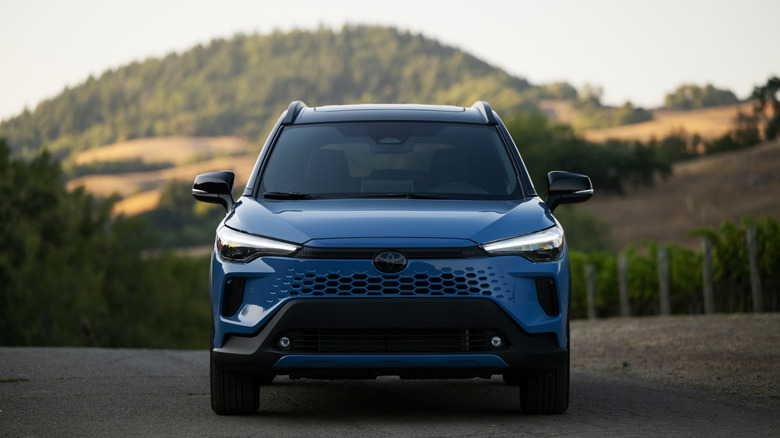
Yes, the Corolla Cross might be pushing the boundaries of what can be considered capable for "huge families," but it's still a crossover that's capable of seating five in comfort. Oh, and it offers more in the way of space than a Prius or Corolla too, which make popular daily drivers, so yes, we feel there is room for the Corolla Cross Hybrid on this list.
To be precise, the Corolla Cross Hybrid sports 21.5 cubic feet of cargo space in addition to 94.9 cubic feet of total passenger volume — or a slightly reduced 93.8 cubic feet if a moonroof is equipped. Where the Corolla Cross Hybrid really impresses, though, is in terms of economy. Thanks to its smaller stature than the other SUVs listed here, and its 3,329-pound curb weight, it manages to return a combined rating of 42 mpg. The powertrain underpinning Toyota's smallest SUV is a naturally aspirated 2.0-liter inline-4, which partners up with a trio of electric motors. All are all-wheel drive; the powertrain directs power — all 196 horses of it — through a CVT.
We're on record saying that, if you must get a Corolla Cross, then at least make sure you spring for the hybrid model. It's both quicker and more efficient, and at $33,010 including destination, it's really quite affordable, too. However, for just $885 more, buyers could be stepping into our chart-topping entry: the 2027 Toyota RAV4.
2026 RAV4 Hybrid: 43 mpg combined
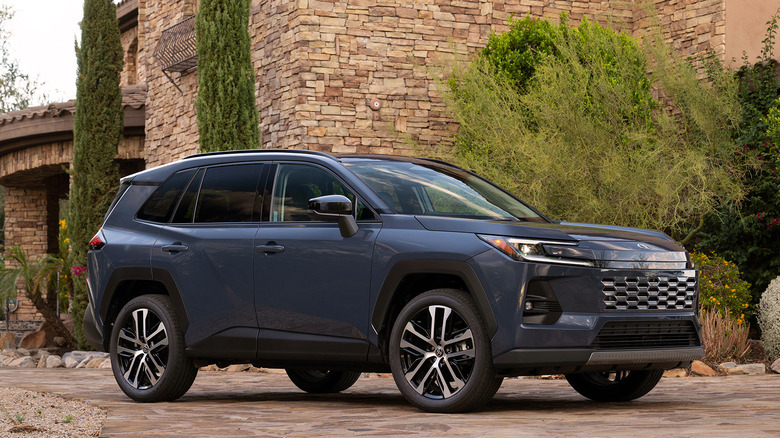
Of course, the all-new Toyota RAV4 — which has now gone hybrid-only — was always going to feature on this list somewhere, and perhaps to some surprise, it arrives at the very top. We say to some surprise, as the Corolla Cross is obviously a fair bit smaller and lighter, but the RAV4 manages to outperform it by a single mile per gallon.
In order to obtain its 43 mpg combined, the RAV4 must be specified as a base front-wheel drive conventional hybrid. In such a guise, it sports – you guessed it — a naturally aspirated 2.5-liter inline-4, which works alongside a pair of electric motors. Output sits at 226 horses, while the all-wheel-drive model benefits from an additional motor and an extra 10 hp. There is a plug-in hybrid model as well, which produces 324 horsepower and manages a combined rating of 39 mpg in its most economical grade.
As for space, the RAV4 Hybrid provides ample space for most. Of course, it can't match its three-row cousins in terms of sheer capacity, but with 37.8 cubes of cargo volume and 98.9 in terms of passenger volume, it is more than spacious enough for the average family. For families with more than five passengers, though, it will have to be one of the aforementioned models, as that's where the RAV4 caps its seating capacity.