

Are These 9 Concepts And Sporty Coupés Pre-Ford Mustang Pony Cars?
History books love romantic tales, like the one where Lee Iacocca, father of the Mustang, was responsible for giving birth to a whole new category of vehicles: pony cars. Sure, he was behind the creation of the most popular such vehicle, but the pony car concept was in the brewing stage years before the first-gen Mustang Mk1. While not strictly pony cars, these concepts and production sporty coupés already flirted with the concept of an enthusiast-grade compact car.
Of course, we don't mean to diminish Iacocca's genius. Yes, he didn't invent the wheel, but he definitely read the room better than his counterparts. In fact, some of the cars featured in this piece influenced him to create the special team of engineers that worked on the Mustang. From early Ford-based compact sports cars like the Budd XT-Bird Concept and Ford Falcon Futura Sport to rear-engine fun machines like the Chevrolet Corvair Monza Turbo, these pre-Mustang models warmed the public to the pony car idea.
1962 Budd XT-Bird Concept
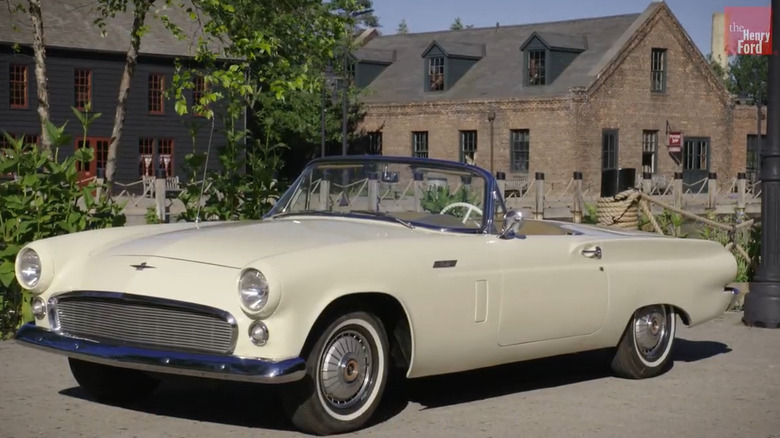
Iacocca wasn't the first to toy with the idea of a compact sports car for the masses. Edward Gowan Budd, one of the early 20th century's most important engineers and entrepreneurs, already had dabbled with the idea of a 2+2 sports car for the masses. Better yet, he pitched a working prototype of the XT-Bird directly to Iacocca, likely planting the pony-car seed in his mind.
The proposed car was based on a 1961 Ford Falcon unibody and a modified body shell from a 1955 to 1957 Ford Thunderbird. This let Budd's company, Budd-American Motors, stretch the Thunderbird's 102-inch wheelbase by 7.5 inches, turning it from a two-seater into a 2+2. Yes, the rear seats were tight and mostly unusable, but the 2+2 configuration became a hallmark of pony cars, allowing buyers to take their friends and family on a joyride.
Speaking of which, the XT-Bird Concept was equipped with a 170-cubic-inch (2.8-liter) inline-6 engine. Yes, it's not a V8, but Budd boosted it with a supercharger, so it should've been potent enough for the time. Power figures were never disclosed, but we know the XT-Bird Concept had a three-speed manual.
While the XT-Bird Concept influenced Ford in developing the Mustang, its clumsy attempt to modernize the classic Thunderbird fell flat. Budd smoothed out the Thunderbird's rear fins and accentuated headlight housings, resulting in a bland, somewhat forgettable design.
1962 Budd XR-400 Concept
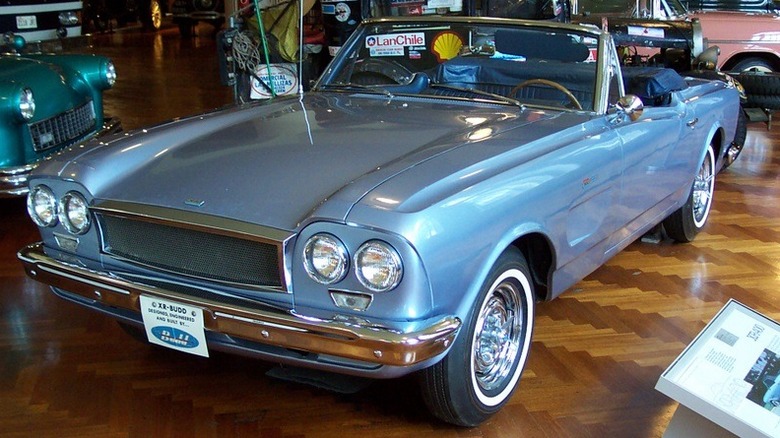
Ford never accepted Budd's XT-Bird proposal, but that didn't stop the ambitious engineer from making another attempt at an early pony car. Unveiled mere months later, the XR-400 Concept was another fully functional, production-ready sporty convertible.
This time, though, Budd used a Rambler Ambassador chassis and proposed the idea to American Motors Corporation. He went so far to create a full development plan, estimating a low $4.1 million to bring the car to market. Because the XR-400 Concept utilized an existing AMC platform, tooling and production would've also been cheaper than building the car from the ground up. Had AMC greenlit the XR-400, it would've beaten both the Barracuda and the Mustang to showroom floors, completely rewriting pony car history. Heck, it might even have saved AMC from the Chrysler buyout. Instead, AMC surrendered its head start and played catch-up with the other old-school pony cars using the 1968 Javelin.
Was the XR-400 good enough to save AMC, though? Well, it certainly looked sportier than the XT-Bird Concept, while also bringing AMC's 327-cubic-inch (5.36-liter) V8 into the fray. Budd even mounted the engine lower in the chassis, just as you'd expect in a sports car; shortened Ambassador's floor pan by 14.3 inches; and moved the cabin back 16.24 inches to give the car sportier proportions. The XR-400 Concept still offered 2+2 seating, though with less space in the rear than a Ford Mustang. Still, the XR-400 Concept was a textbook pony car convertible, two full years before the press coined the term.
1962 Ford Mustang I Concept
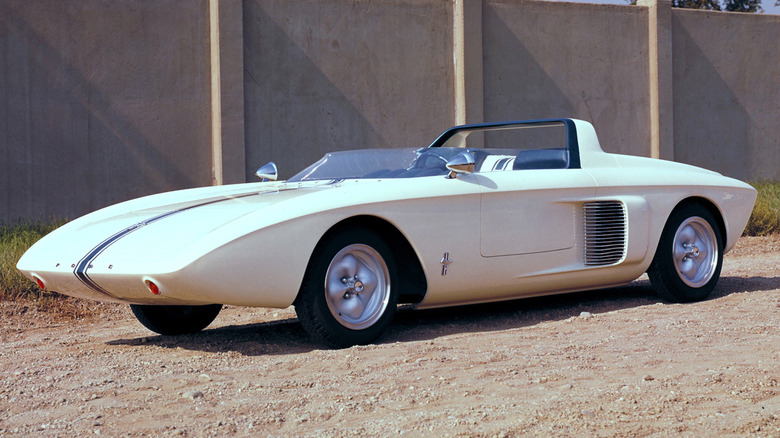
Budd wasn't alone in developing a compact sports car for the masses. Ford concurrently worked on a mid-engine Mustang concept that could've completely changed the nameplate's trajectory. With a sharp, wedge-like design, pop-up headlights, two-seat cabin layout, and a tight 90-inch wheelbase, the Mustang I Concept served as the antithesis of Ford's lineup at the time: the Falcon, Fairlane, Galaxie, and Thunderbird.
The Mustang I was one of those cool Ford concepts that never made it to production, but it spearheaded the development of America's most popular pony car. Crucially, it was a fully functioning sports car. Yes, it only had a 1.5-liter V4 engine making up to 100 hp (gross) in race trim, but it was also featherlight at only 1,544 pounds. This race-car-level lightness was achieved by using an advanced space-frame chassis and aluminum body panels. As a result, the Mustang I Concept reached 115 mph, an impressive figure for such a tiny motor. And, sure, the engine was only a half-V8, but at least it revved to relatively high 7,500 rpm.
Handling was a big reason why Ford toyed with a mid-engine layout for the Mustang. Unlike later pony cars, the Mustang I Concept felt stable and balanced in the corners. It stayed flat during cornering, too, perhaps thanks to the integrated roll bar that strengthened the chassis. Ford was so convinced of the concept's abilities that it organized a publicity stunt at the United States Grand Prix at what was then known as the Watkins Glen Raceway, in Watkins Glen, New York. With star F1 driver Dan Gurney behind the wheel, the Mustang I Concept lapped the circuit almost as fast as an F1 car of the day.
1963 Ford Mustang II Concept
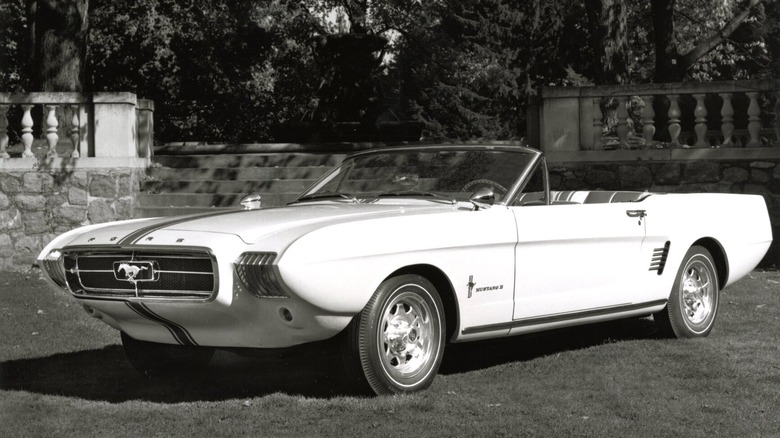
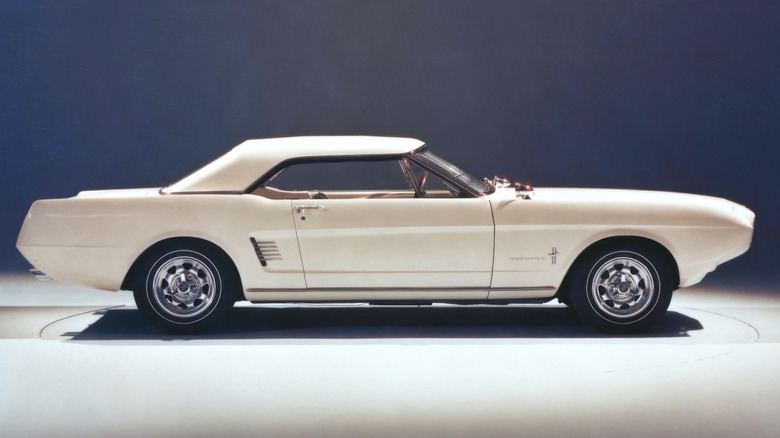
While the Mustang I Concept introduced the famous horse emblem, it was the Mustang II Concept that was the real preview of the production car. Featuring a classic pony car shape with a long hood, relatively short rear deck, chopped roofline, and tri-bar taillights, it looked similar to the Mustang Mk1. It was 5 inches longer than the production car, which gave it a somewhat sleeker look, but the Mustang blueprint is definitely there.
The similarities weren't only skin deep. Like the production car, the Mustang II Concept was also built over a Ford Falcon unibody chassis, and had the right power train — a 289-cubic-inch (4.7-liter) high-performance V8 with a four-speed manual transmission. Like the first Mustang concept, this was also a convertible, albeit with a removable fiberglass hard top. In classic pony car fashion, the Mustang II Concept offered 2+2 seating inside. Being a concept car, it also previewed some tech-forward features, like an electric trunk release.
Much like its mid-engine predecessor, the Mustang II Concept was dressed in stark white with blue center stripes, and was also shown at Watkins Glen. This time, though, Ford passed the opportunity to show its abilities on the track. Still, Ford made sure the audience could clearly hear the V8 rumble by filling the valve lifters with wax, which apparently gave the engine a race-car-like big-cam note.
1962 to 1964 Chevrolet Corvair Monza Spyder Turbo
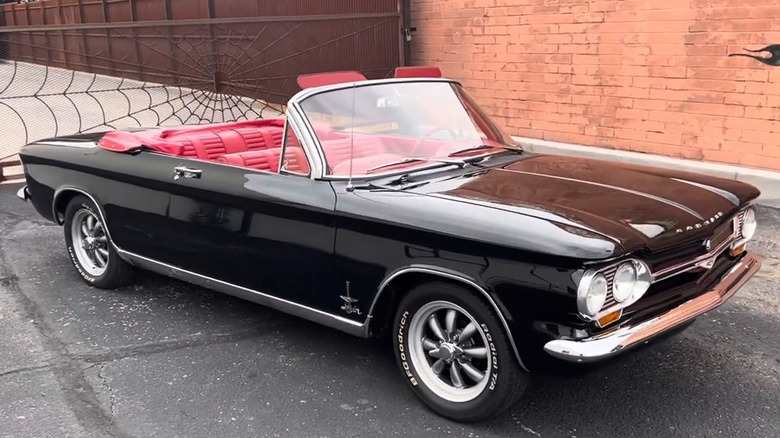
The Corvair was Chevy's revolutionary compact car designed to compete with the Volkswagen Beetle, featuring a rear-mounted, air-cooled flat-6 engine, multiple body styles, and a spacious interior. It proved to be an ill-fated attempt, but it also gave us one of the most interesting 1960s sports cars — the Corvair Monza Spyder Turbo.
The car that introduced turbocharging to the masses was the Mustang's opposite, given the Mustang's front-mounted, water-cooled V8. But it forced Lee Iacocca into creating the "Fairlane Committee" — the secret group of executives and engineers that decided Ford needed an attractive sports car, despite leading compact-car sales with the Falcon. And it was the Corvair Monza Spyder Turbo that served as the committee's inspiration, at least in terms of character and market positioning.
Of course, the Corvair Monza Spyder Turbo wasn't a pony car, per se. You could even argue that it's closer to the Porsche 911 Turbo, which arrived 11 years later with a turbocharged, air-cooled flat-6 in the back. Still, it was an enthusiast car with four seats, same as every pony car. The 2.4-liter turbocharged flat-6 also produced a healthy 150 hp, enough for a 0-60 sprint in 10.3 seconds, though, unsurprisingly, it suffered from significant turbo lag. For 1965, Chevrolet introduced the upgraded Corvair Corsa, which packed a larger 2.7-liter engine with 180 hp and accelerated to 60 in 7.8 seconds.
The Corvair Monza Spyder Turbo was also equipped with some enthusiast-grade features, like a standard four-speed manual; instrument panel with multiple gauges, including a tachometer; and bucket seats.
1963 to 1965 Ford Falcon Futura Sprint
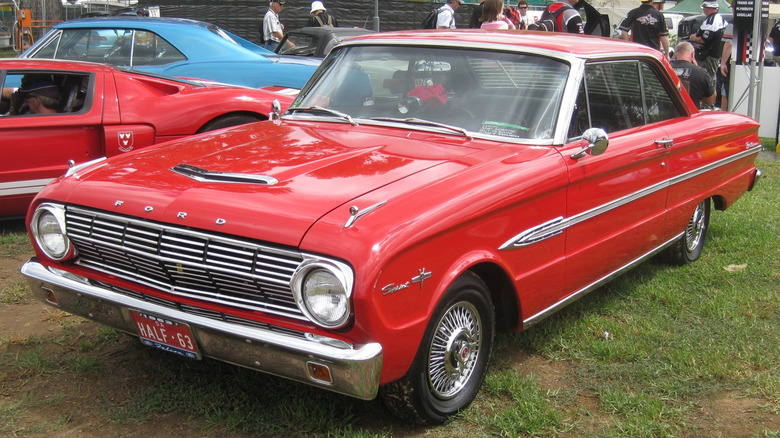
Strip away the attractive body style, and the 1964½ Mustang is essentially a Ford Falcon Futura. Launched as a direct answer to the Corvair Monza, the Falcon Futura, particularly in the Sprint trim, gave customers a taste of what the future of Ford sports cars hold.
The Futura Sport/Sprint shared most mechanical parts with the Mustang, and was even equipped with Ford's 164-horsepower, 260-cubic-inch (4.3-liter) Challenger V8 and a four-speed manual transmission. Yes, that's a far cry from the most powerful editions of the Mustang, like the 306-horsepower GT350, but good enough to serve as a stopgap model before Futura's more popular brethren arrived on the scene. Since the Futura was relatively light at 3,011 pounds, the V8 also propelled it to 60 in a solid 9.5 seconds.
To show its intention of attracting enthusiast drivers, Ford gave the Falcon Futura Sprint heavy-duty suspension and equipped it with a tachometer, bucket seats, and sporty steering wheel. Buyers could get the V8 as an option with all other trims, too, but would miss out on these features.
Despite having all the pony car features, minus the sporty styling, the Falcon Futura remained a low-volume proposition. Ford sold 15,081 during the first year of production, of which 10,479 two-door hardtops and 4,602 convertibles. Ford kept the Futura Sprint in production through 1965, but with the Mustang already in full swing by then, sales dwindled quickly. In fact, Ford sold 11 Mustangs to every Falcon, despite the Mustang being more expensive.
1962 to 1964 Studebaker Lark Daytona R1/R2
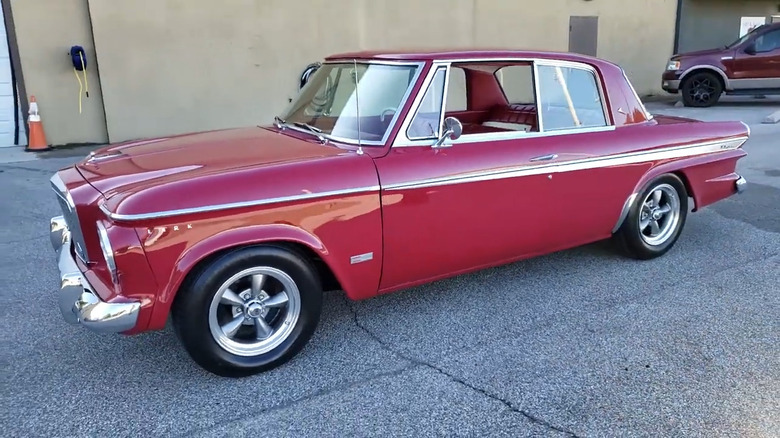
Studebaker might not be the first automaker you'd associate with pony cars. Still, it created one of the ultimate pre-pony sleepers with the Lark Daytona. From its compact dimensions to the highly potent engine in its R1 and R2 models, the Lark Daytona had all the ingredients for being called a pony car.
Based on the compact Lark, the sporty coupé Daytona version had pillarless doors and an unusual upright design. In that sense, it didn't look much like the "official" pony cars, but under its unassuming design, it hid a 289-cubic-inch (4.7-liter) V8. The engine was available in naturally aspirated (R1) and supercharged form (R2).
With 240 horsepower on tap, the non-boosted motor was already powerful enough to usurp rivals like the Corvair Monza Spyder Turbo and Falcon Futura, sprinting to 60 in the 7-second range when paired with the optional four-speed manual. Meanwhile, the supercharged version produced 289 hp, enough for a quicker 0-60 time of less than 7 seconds with the four-speed manual. The Lark Daytona was also available with automatic and manual three-speeds and a smaller 2.8-liter six-cylinder engine.
In many ways, the Lark Daytona punched way above its class, especially during the pre-pony-car era. Studebaker, though, couldn't outrun its misfortunes (our deep dive into Studebaker's rise and fall explains its desire for glory). The automaker was flying so high, in 1963 it launched a Corvette competitor called the Avanti. This sleek sports car was based on the Lark, but thanks to its more aerodynamic body, it reached a top speed of 178.5 mph using a 335-hp tune of Studebaker's supercharged V8.
1963 to 1966 Plymouth Valiant Signet 200
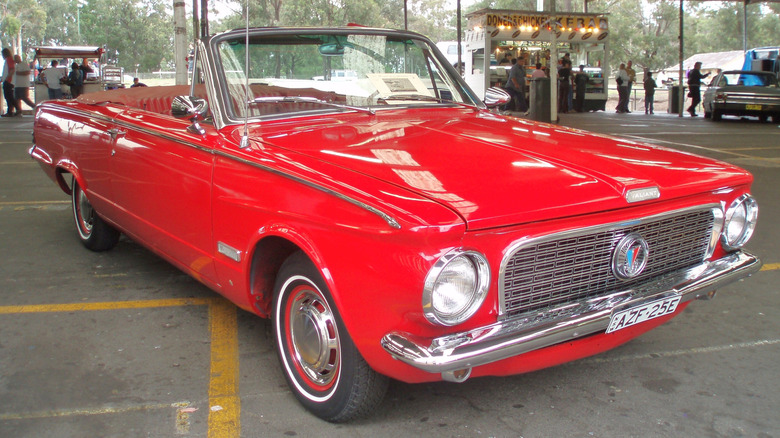
The Valiant was crucial for Plymouth. It brought the brand back to life after dismal 1962 sales, and its sporty version, the Signet 200, served as the backbone for the world's first pony car, the 1964 Barracuda. Since the Valiant and Barracuda shared most of their mechanicals, it wouldn't be wrong to say the Signet was also a pre-Ford Mustang pony car. The blueprint was already there. The Valiant Signet 200 was a two-door hardtop coupé or convertible aimed at enthusiasts, equipped with front vinyl bucket seats, chrome accents, and from 1964 on, an optional 273-cubic-inch (4.5-liter) V8.
Initially, the V8 engine produced 180 hp, but for 1965, Plymouth increased the compression ratio and replaced the two-barrel BBD carburetor with a four-barrel one, boosting it to 235 hp. That engine could also be paired with an optional Hurst four-speed manual, though most models were equipped with three-speed manual/automatic transmissions.
The entry-level engine was a 170-cubic-inch (2.8 liter) Slant-Six, though, good for only 101 hp. Still, to showcase the car's sporty pretensions, Plymouth also offered a lighter all-aluminum 225-cubic-inch (3.7-liter) Slant-Six with 145 hp initially, but it was quickly replaced with a cast-iron version because of poor reliability. The Valiant Signet 200 was never available with disc brakes or heavy-duty suspension, upgrades that started being offered as options once the real pony cars took over.
Dodge also had a sort of an early pony car that shared the A-body platform with the Valiant. However, the Dart was noticeably less compact, stretching roughly 10 inches longer, which also increased its weight. Still, like its sibling, the Dart was available with the 225-cubic-inch Slant-Six and 273-cubic-inch V8 engines.
1964 to 1966 Plymouth Barracuda
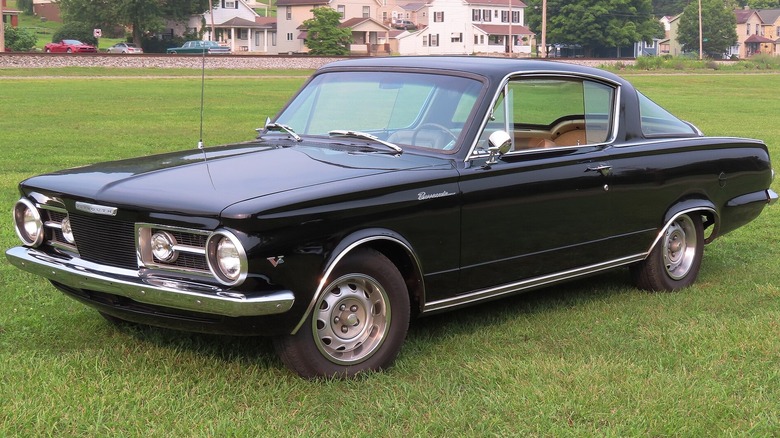
The Mustang might be the most influential, but the 1964 Plymouth Barracuda beat it to the punch by only 16 days, becoming the world's first pony car. Still, it wasn't a brand-new model, but a fastback body style of the Valiant Signet 200. See, the Barracuda didn't only share its platform and engines with Plymouth's compact car, but also carried Valiant badges on the body. Still, it was significantly more attractive, with a unique wraparound rear glass giving it a more dynamic, sporty look.
As far as performance goes, though, there was nothing to differentiate the two models. Like the Valiant Signet 200, the Barracuda was available with the 170-cubic-inch and 225-cubic-inch Slant-Six engines, alongside the 273-cubic-inch V8 with up to 235 hp in the Commando model. Enthusiast buyers could choose a Hurst four-speed manual with the V8, with Chrysler's three-speed auto also available.
Yes, the Valiant Signet 200 had exactly the same engine and transmission options, but from 1965, the Barracuda also had the supporting equipment of a true pony car. As part of the Formula S package, the Barracuda received an upgraded suspension and wider tires for sharper handling, with a tachometer inside.
These improvements let the Barracuda compete more closely with the Mustang, though Ford's legend was the better-rounded proposition. The Mustang was available with a more potent, 289-cubic-inch (4.7-liter) V8 with up to 271 hp, disc brakes, and a more comprehensive handling package with upgraded shocks, springs, and stabilizer bars.