

11 Of The Most Powerful Pony Cars Ever To Leave The Factory
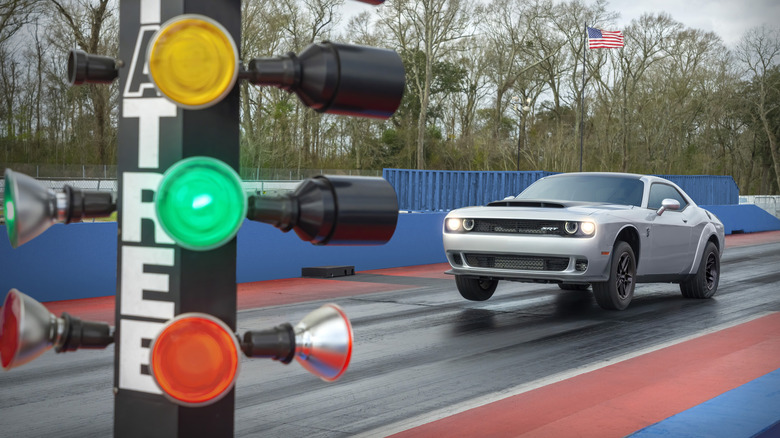
When Lee Iacocca set the pony car blueprint in 1964, the recipe was straightforward: compact footprint, modest mechanicals, and an affordable price tag. Over time, though, the pony car became more outrageous. Automakers started throwing big-block V8s in legends like the 1969 Mustang GT500 and 1970 Dodge Challenger R/T Hemi, blurring the line between the pony car and its bigger cousin, the muscle car.
The Malaise Era and ever-stricter environmental laws toned down 1970s and 1980s pony cars, with 1990s models, like the 1998 Mustang SVT Cobra and the 1997 Camaro SS again reigniting the horsepower war. Still, it's the 21st century that gave us the most powerful pony cars to ever leave the factory, and it's not even close. From the 390-horsepower 2003 Ford SVT Mustang to the unhinged, 1,025-hp 2023 Challenger SRT, pony cars again dominated headlines.
Yes, we know, the Challenger's power figures, in particular, verge too much into muscle car, heck, even hypercar territory, but we'll let that pass, as it's a direct Mustang and Camaro competitor. We also love supercharged-V8 shenanigans here at Jalopnik, so every riotous version of Dodge's pony/muscle car, like the Super Stock and Demon 170, made the cut. With that settled, here are the 11 wildest pony cars to leave the factory floor!
2017 to 2024 Chevrolet Camaro ZL1 (650 hp)
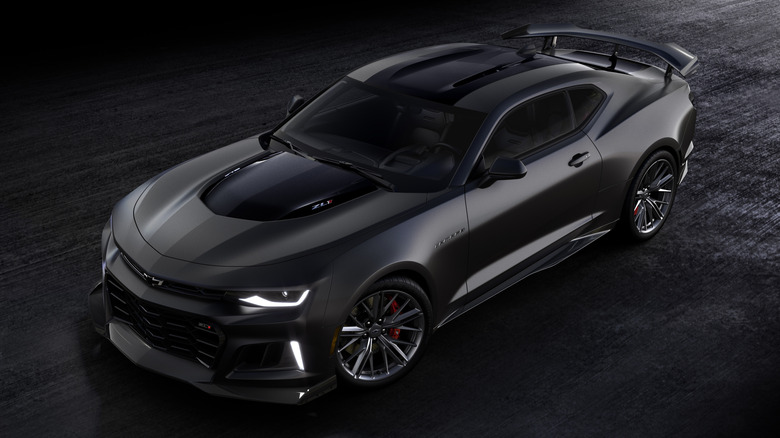
Chevrolet let the Camaro bow down quietly after the 2024 model year, without any special, "last call" version. Not that this was strictly necessary — even in 2024, the ZL1 had more than enough oomph to satisfy seasoned Camaro enthusiasts. Packing the C7 Corvette Z06's 6.2-liter supercharged "LT4" V8 with 650 horsepower and 650 pound-feet of torque, the Camaro ZL1 catapults to 60 in 3.5 seconds. The 198-mph top speed is perhaps even more impressive, putting Chevy's pony car in the supercar league.
But the powertrain doesn't even scratch the surface of the Camaro ZL1's capability. This is a driver-oriented sports car, after all, with handling and poise atypical of pony cars. Part of the reason is the light, agile Alpha chassis, but also the suite of Nürburgring-tuned upgrades that turned Chevy's pony car into a legitimate corner carver. Most notably, the ZL1 features magnetic dampers, an electronically-controlled limited-slip differential, and Brembo calipers.
The 1LE package upped the ante with lightweight, aluminum Multimatic spool-valve dampers, rear aluminum bushings, smaller, lighter wheels, stickier tires, and adjustable front suspension geometry, allowing drivers to dial in aggressive negative camber for maximum track grip. As a cherry on top, the ZL1 was available with either a six-speed manual or a ten-speed auto, letting customers choose between higher performance and more engagement.
Armed with the 1LE package, the Camaro ZL1 morphed into a genuine supercar hunter, lapping the Nordschleife in 7:16.04 back in 2017. For reference, that made it faster around the legendary track than exotics like the Ferrari 488 (7:21.00), Lexus LFA (7:34.00), and Koenigsegg CCX (7:33.55).
2013 to 2014 Ford Mustang Shelby GT500 (662 hp)
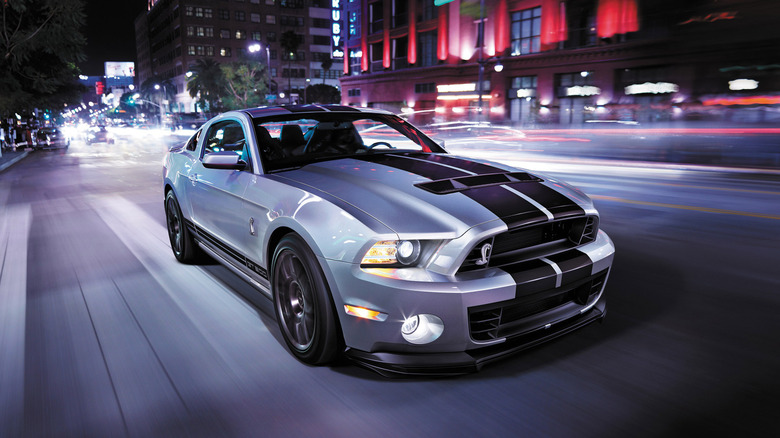
Ford did the 600-plus horsepower, overpowered pony car a few years before its Chevy rival, but with a different approach. Instead of the Camaro ZL1's advanced independent rear suspension, the S197-II-generation Mustang Shelby GT500 used an antiquated live axle, which sounds scary on a car packing 662 horsepower and 631 pound-feet of torque.
Did it matter? Not much, at least according to Motor Trend, which reported the GT500 had neutral and predictable handling — great to hear considering the engine's Earth-shattering potency. However, that's with the optional SVT Performance package, which consisted of Bilstein adaptive dampers with upgraded rear springs, a Torsen limited-slip differential, and forged wheels. While these upgrades should've probably been standard, every Mustang Shelby GT500 had beefy Brembo brakes and a lightweight carbon-fiber driveshaft.
There is nothing antiquated about the engine, though. The GT500's unique 5.8-liter supercharged V8 is a bored-out version of the 5.4-liter unit used in its predecessor, equipped with billet main-bearing caps for strength and plasma-transferred wire-arc bore coatings to reduce weight and friction, while improving heat transfer. To show how serious it was at reducing heat soak, Ford's SVT performance division also used a larger oil pump, piston squirters, and an aluminum sump. The optional Track package further maximized cooling with additional coolers for the transmission, differential, and engine oil.
Still, the Mustang Shelby GT500's pièce de resistance feature, at least from today's standpoint, is the Tremec six-speed manual transmission, which turns an already engaging car into an outright riot — one that slingshots to 60 in just 3.5 seconds and tops at more than 200 mph.
2015 to 2023 Dodge Challenger SRT Hellcat (707 to 717 hp)
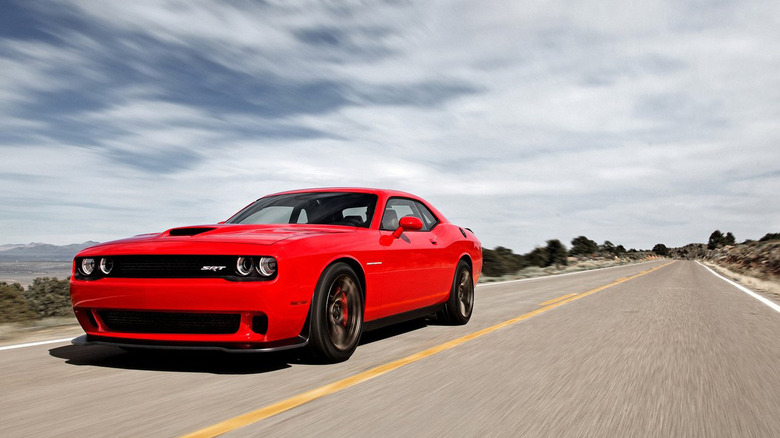
A pony car with 662 horsepower? That's cool, but why not put a 7 in front? That's perhaps what Dodge was thinking when Ford launched the Shelby GT500, as its pony-car monster, the Challenger SRT Hellcat, produced 707 horsepower, or up to 717 hp (after 2019) from its 6.2-liter supercharged Hemi V8. Impressive, but still on the low end for Hellcat Hemi V8s.
The result? Car and Driver managed to hit 60 in 3.6 seconds with the less powerful model and eight-speed automatic transmission. Yup, that's slower than the Shelby GT500, but the Challenger SRT Hellcat weighs a whopping 4,488 pounds — over 600 pounds more than its rival. The 717-hp model is a tad lighter (4,429 pounds) and, according to Dodge, clears the quarter mile sprint in 10.9 seconds (with a widebody treatment) and has a 195-mph top speed (199 mph without the widebody).
Naturally, that weight has an effect on how the Challenger SRT Hellcat handles. Still, the standard adaptive suspension keeps it flat in the corners, while settling into a compliant, comfortable cruise on demand. To combat the meaty 650 pound-feet of torque, Dodge equipped the SRT Hellcat with a standard limited-slip differential at the back, while the high-performance Brembo brakes ensured powerful deceleration.
While the Challenger SRT Hellcat's eight-speed auto was better for achieving quicker acceleration times, offering lightning-quick, 120-millisecond shifts, Dodge also catered to purists by offering a Tremec six-speed manual. Still, its engineers upgraded the Tremec 6060 unit shared with the Shelby GT500 with a bigger clutch and lighter flywheel to cope with the massive torque and enhance the shifting experience.
2020 to 2022 Ford Mustang Shelby GT500 (760 hp)
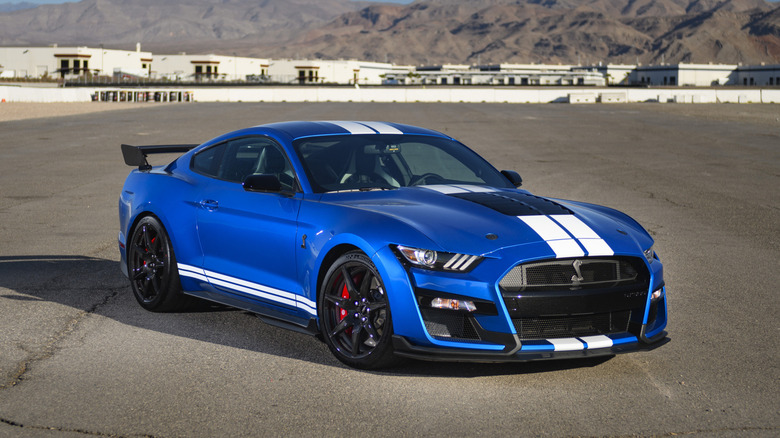
Introduced for 2015, the sixth-gen, S550 Mustang was a huge leap forward for the nameplate. For the first time in the model's history, Ford equipped the Mustang with an independent rear axle, alongside a MacPherson strut in the front. Thanks to these upgrades, the S550 was a much better platform for high-horsepower factory builds, though it took Ford another five years before it introduced the most potent Shelby GT500.
The wait was worth it, as the 2020 Shelby GT500 arrived with a brand-new 5.2-liter supercharged V8 producing a whopping 760 horsepower and 625 pound-feet of torque. Moreover, for quicker shifts, Ford implemented a new seven-speed dual-clutch automatic, which allowed a 0-to-60 sprint of 3.3 seconds. Top speed: electronically-limited 180 mph.
Yup, that's lower than the predecessor, but this time, Ford didn't chase the top speed crown. Instead, the 2020 Shelby GT500 was designed to be a complete track machine, producing outstanding lateral grip and agile, sports-car handling. The various packages Ford offered further cemented the GT500 as a track-day special. In particular, the Carbon Fiber Track Package brought lighter carbon-fiber wheels with stickier Michelin Pilot Sport Cup 2 tires, alongside an adjustable carbon-fiber rear wing that produces 550 pounds of downforce at 180 mph. Every model came with massive 16.5-inch Brembo front discs, important in a 760-hp car that weighs 4,171 pounds, and MagneRide dampers for better ride quality. The only thing missing: no manual transmission option.
2026 to present Ford Mustang Dark Horse SC (795 hp)
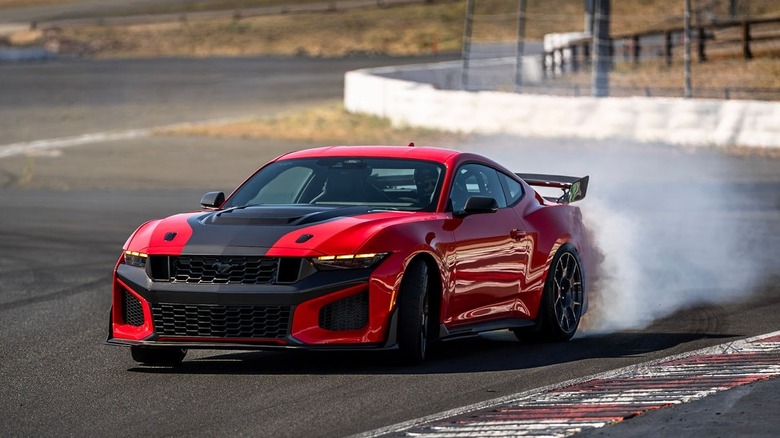
Ford ditched the Shelby GT500 moniker for its latest installment of a hyper-powerful, track-focused pony car. Naming aside, though, the Dark Horse SC, based on the latest S650-generation Mustang, is an equally bonkers machine. Developed to fill the gap between the Dark Horse and GTD, it packs a 5.2-liter supercharged V8 with 795 horsepower and 660 pound-feet of torque, paired to a seven-speed dual-clutch automatic. A stick shift is again missing, but at least the quick-shifting transmission helped bring the 0-to-60 time down to 3.0 seconds, per Car and Driver. Like its predecessor, the Mustang Dark Horse SC tops out at a governed 180 mph.
While the power bump isn't as meaningful, especially when compared to what Dodge was doing with the Challenger, the Dark Horse SC brings a host of handling improvements. Most notably, Ford utilized next-gen MagneRide dampers with firmer springs and updated stabilizer bars, front/rear knuckles, and front control arms. A new, standard magnesium strut tower brace also adds stiffness while reducing weight. Like its predecessors, the Dark Horse SC relies on Brembo brakes but also adds powertrain and rear-axle cooling for longer track-day sessions.
Buyers can also opt for the Track Pack. With standard carbon-fiber wheels and carbon-ceramic brakes, the package cuts 150 pounds of weight, while a massive carbon-fiber wing pins the rear axle with 620 pounds of downforce at 180 mph. Finally, the Track Pack's bespoke Michelin Pilot Sport Cup 2 R tires provide semi-slick levels of grip for maximum track attack.
2019 to 2023 Dodge Challenger SRT Hellcat Redeye (797 hp)
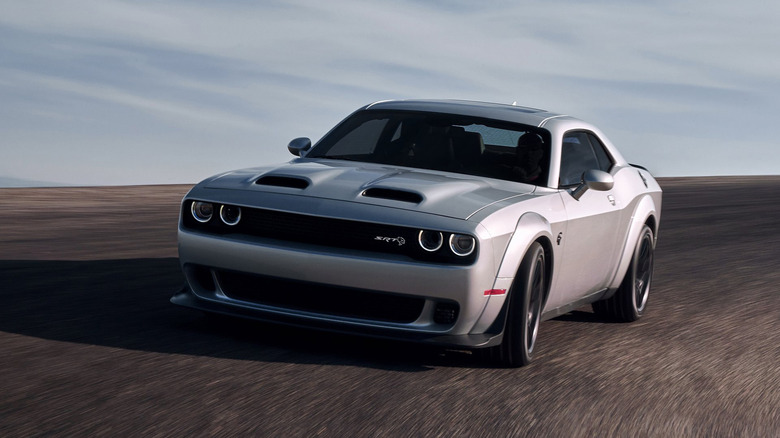
After shattering the pony car class with the Challenger SRT Hellcat, Dodge, being as sensible as always, introduced the even more unhinged Redeye version of its street racer for 2019. Equipped with a larger 2.7-liter supercharger, more boost, a higher 6,500-rpm limit, two dual-stage fuel pumps, and SRT Power Chiller tech that cools the intake air using the air conditioning, the Redeye's 6.2-liter Hemi again put the Challenger name on the cover pages with 797 horsepower and a brutal 707 pound-feet of torque.
Yes, that's wild, but it was still not enough for a sub-2-second 0-to-60 acceleration run. Having that much torque means traction is at a premium, so the Challenger SRT Hellcat Redeye needs 3.4 seconds to reach the benchmark figure. Still, the 10.8-second quarter-mile run (widebody version) is mightily impressive, as is the supercar-rivaling, 203-mph top speed.
Like the regular SRT Hellcat, the Redeye also came exclusively with an eight-speed auto with paddle shifters and no manual option. While not as engaging, the auto should work better in the real world, especially because every Challenger SRT Hellcat Redeye is equipped with a smooth-riding adaptive suspension setup from Bilstein. Of course, there is a stiff Track Mode for improving the handling and bringing the Redeye in line with the Shelby GT500 and Camaro ZL1 on the track.
2020 to 2023 Dodge Challenger SRT Super Stock (807 hp)
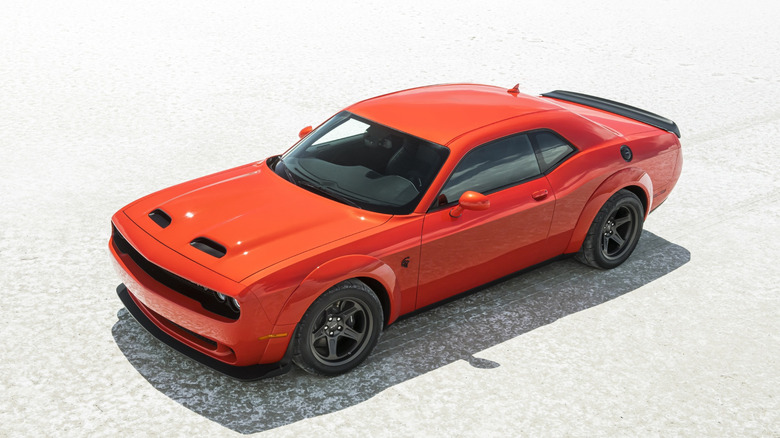
While the SRT Hellcat Challengers were designed with cornering in mind, the Super Stock is all about straight-line shenanigans. A proper drag car for the street, the Challenger SRT Super Stock packs 10 horsepower more than the Redeye while retaining the same torque figure.
Not a huge difference, sure, but it's the little things that differentiate the Super Stock from the Redeye — for example, the 315-mm wide Nitto NT05R drag tires with high sidewalls and smaller, lighter 18-inch wheels, and the retuned Bilstein adaptive suspension that squats the rear end during launches to maximize traction. The Super Stock also has standard launch control assist which varies the engine torque to further maximize grip. So, what did all that drag-strip trickery bring in terms of acceleration times? The Super Stock blasts to 60 in 3.25 seconds and covers the quarter-mile in 10.5 seconds.
That's meaningfully quicker, especially considering the slight power bump. Still, as you'd expect from a drag-focused car, there are some compromises. Dodge could only fit smaller 14.2-inch Brembo front discs in the smaller 18-inch wheels, so track days are off the table. Moreover, due to the Nitto drag radials, the Challenger SRT Super Stock's top end is limited to 168 mph, compared to Redeye's 203 mph. You could also imagine that the tall sidewalls kill handling response and sharpness. But we'll cut Dodge some slack here. The automaker has already built Challengers that handle well, which left place in the lineup for oddballs like the Super Stock.
2025 to Present Ford Mustang GTD (815 hp)
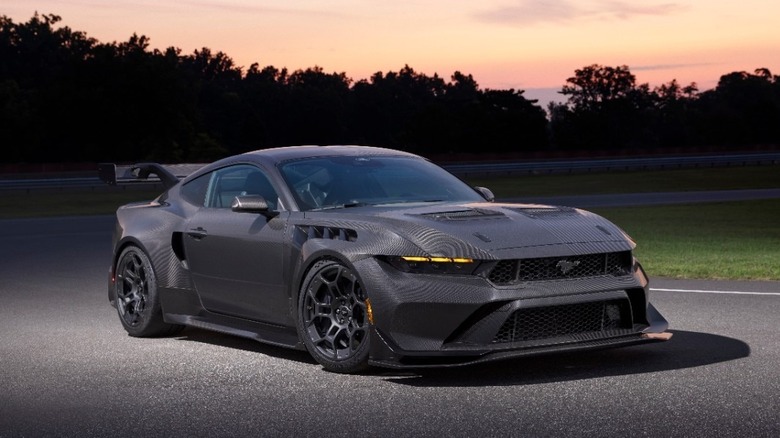
Even with 815 horsepower and 664 pound-feet of torque on tap, the Mustang GTD isn't the most powerful pony car. Good luck beating it on track, though, as Ford built it specifically to compete with the current supercar crop. Yes, it's quick in a straight line, sling-shotting to 60 in 2.7 seconds (per Motor Trend), but that's the least interesting thing about it.
That's a bold statement to make, considering the Mustang GTD packs a thunderous 5.2-liter supercharged V8, but it's where it resides in the car that makes all the difference. While regular Mustangs are strictly front-engine cars, the GTD has its engine slightly behind the front axle in a front-mid configuration to improve the weight balance. In addition, Ford moved the eight-speed dual-clutch automatic transaxle to the rear. The result is near 50:50 weight distribution and more predictable handling.
And the drivetrain placement only scratches the surface of the engineering behind the Mustang GTD. Ford implemented new front and rear subframes to maximize stiffness, a multi-link front axle, and racecar-like horizontal coilovers in the rear. You surely noticed the wilder, more aggressive body kit, which, again, was designed to cut lap times. Made from carbon fiber and featuring active flaps and a massive, DRS-style wing in the back, GTD's aero creates a whopping 1,950 pounds of downforce at 180 mph — higher than Porsche 911 GT3 RS' 1,895 pounds at 177 mph.
As a result, the Mustang GTD made a 6:52.072 lap around the Nürburgring, beating the legendary Porsche 918 Spyder's time of 6:57. Recently, the upgraded Mustang GTD Competition lapped the Nürburgring 11 seconds faster, annihilating the 1,250-hp Corvette ZR1X's time of 6:49.275.
2018 Dodge Challenger SRT Demon (840 hp)
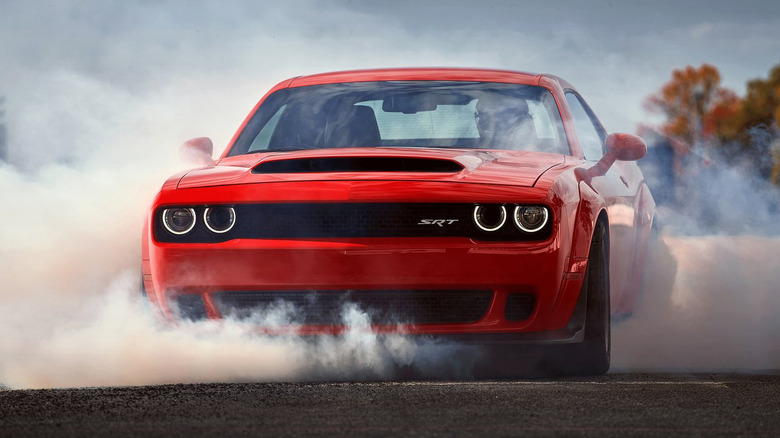
Back in 2017, Dodge started a horsepower revolution with the Challenger SRT Demon. Launched as a 2018 model, the Demon packed the same 6.2-liter supercharged Hemi V8 as all other wild Challenger builds, but with up to 840 horsepower and 770 pound-feet of torque, making it the most powerful American production car at the time.
As standard, the Demon produced 808 hp and 717 lb-ft of torque, though, with higher figures available by purchasing the $1 Demon Crate. The kit included a different ECU programmed to run on 100-octane gas and skinnier front tires, among other things. Yes, this means that without it, the Demon's figures are closer in line to Super Stock's, and the similarities between these models don't end there. The Challenger SRT Demon was also designed with straight-line acceleration in mind, so it came with a unique adaptive suspension setup and drag tires.
Still, the Demon's party trick is the "TransBrake" for the eight-speed automatic, which locks first and second gear simultaneously, letting the Hemi V8 build boost before it unleashes it on the rear tires at your command. Dodge claimed a quarter-mile sprint of 9.65 seconds using this tech — probably on a prepped surface — and a 0-to-60 time of 2.3 seconds. Naturally, like every high-horsepower factory Challenger build, the SRT Demon wasn't available with a manual.
2023 Chevrolet COPO Camaro (1,004 hp)
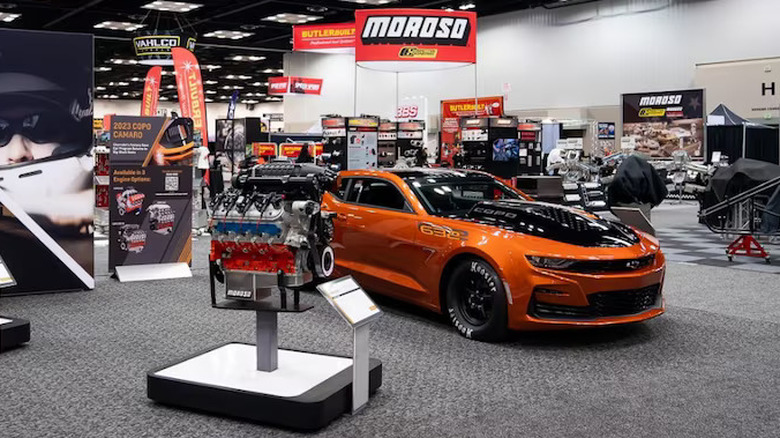
Chevy has never launched an official answer to the barrage of overpowered pony cars from Dodge and Ford. That is, of course, if we don't count the COPO (Central Office Production Order) builds, which allowed customers to exploit a fleet-ordering loophole and drop insane big-block GM engines into the Camaro. In fact, the first-ever 1969 Camaro ZL1 was built using the COPO system and featured a 427-cubic-inch (7.0-liter) V8 with around 500 horsepower, cementing its place among the rarest pony cars.
That's nothing in comparison to the latest COPO Camaro, which packs Chevy's most powerful big-block ever made. A 632-cubic-inch (10.4-liter) V8 colossus, this crate engine produces a ridiculous 1,004 hp and 872 pound-feet of torque on regular 93-octane gas! It revs to 7,000 rpm, too, which is crazy considering its capacity. A special engine requires a special transmission, so the 2023 COPO Camaro was also equipped with an ATI Racing Products Treemaster MRT three-speed automatic with a Hurst shifter.
You no doubt noticed that the 2023 COPO Camaro rides on Hoosier drag slicks for faster acceleration, meaning it isn't street legal. Still, it rolled out of a Chevrolet assembly facility, which essentially makes it a factory-built vehicle. Chevy built only 69 units of the 2023 COPO Camaro, matching the 1969 Camaro ZL1's production run.
2023 Dodge Challenger SRT Demon 170 (1,025 hp)
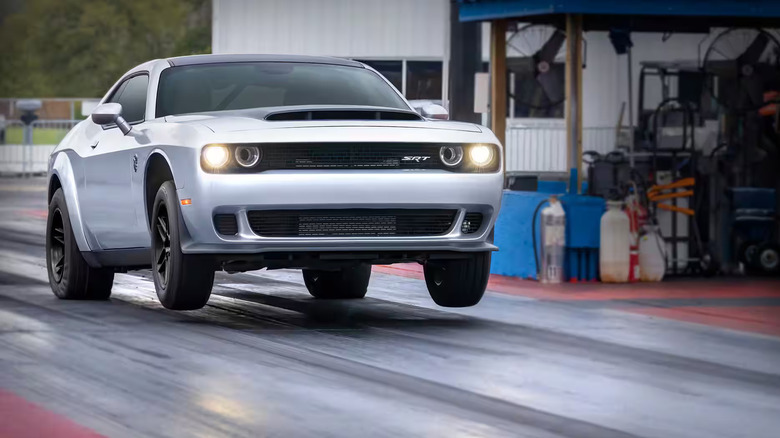
What could possibly be more unhinged than a 10.4-liter, factory-built drag missile? One with license plates and even more power. Enter the Dodge Challenger SRT Demon 170 — the most powerful pony car to ever leave the factory. It's street-legal, too, though also limited at 3,300 units, so don't expect to see many in the wild.
Not that we expected high-volume series production of a brute with 1,025 horsepower and 945 pound-feet of torque. That's on 170-proof E85 fuel, hence the name, but you get a more than respectable 900 hp and 810 lb-ft of torque on 91-octane fuel. In other words, it's not just the fuel that makes the difference, but also the massive 3.0-liter supercharger accompanying the 6.2-liter Hemi V8 and new internals, including pistons, connecting rods, and crankshaft. Dodge also gave Demon 170's engine new fuel injectors to match the supercharger's air-boosting properties with more fuel.
Like its predecessor, the Demon 170 rides on smaller 18-inch front wheels and 17-inch rears wrapped in drag radials. Unlike the COPO Camaro, the Mickey Thompson ET Street R tires are street-legal, yet sticky enough for a 0-to-60 time of 1.66 seconds on a prepped surface – the quickest 0-to-60 time ever set by a production car. The Demon 170 continues to pull hard past 60, reaching the quarter mile in 8.91 seconds with a 151.2-mph exit speed. Naturally, reaching these figures on regular asphalt is nigh on impossible, despite the Demon 170's upgraded, adjustable TransBrake settings.