

6 Hellcat Hemi V8s Ranked From Least To Most Ridiculous Horsepower
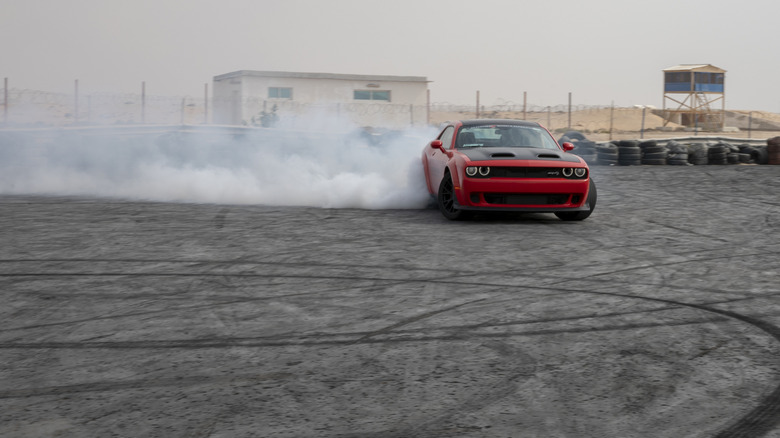
A new V8 Dodge Charger Hellcat is coming, because of course it is. Taking a relatively ordinary vehicle, dropping a supercar-worthy powerplant inside, and selling it across the showroom from a Jeep Wrangler is as American as deep-fried Twinkies. It began in 2015 when Dodge released the Challenger SRT Hellcat. It had 707 horsepower, which was almost unthinkable at the time but would barely qualify for this list by today's standards. What a difference a decade makes.
Since then, Dodge has launched all manner of Hellcat variants, from incrementally more powerful iterations of the Challenger to a couple of flavors of Demon that push past the 800-horsepower mark and then well over 1,000. Not only has this bonkers 6.2-liter supercharged V8 continued escalating in an apparent arms race within its own brand lineup, but it has also escaped muscle car containment and found its way into everything from the Grand Cherokee to the Durango to the Ram 1500. Nothing was safe, except for the Pacifica (though we're keeping our fingers crossed anyway). Let's start with the truck.
Ram 1500 TRX (702 hp)
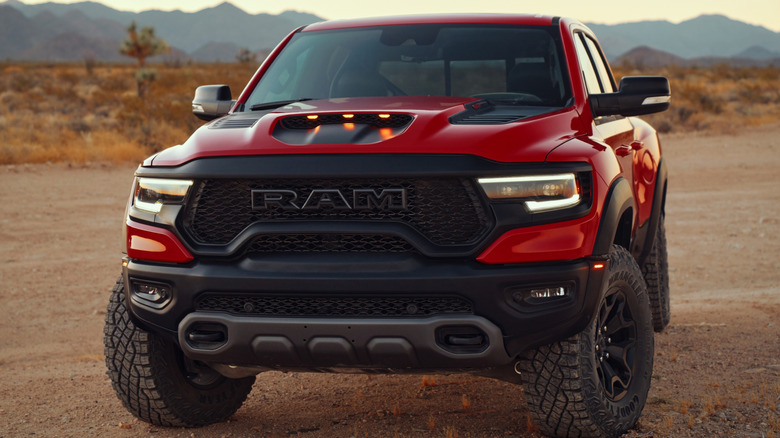
The original 1500 TRX was Ram's answer to the Ford Raptor. Ram may or may not have intended for its three-letter name to roll off the tongue as T-Rex, i.e., a dinosaur bigger than a raptor, but they have at the very least leaned into the premise since, including giving the Ram 1500 TRX an anti-raptor, pro-dinosaur-cannibalism Easter egg under the hood.
The truck arrived for 2021. To put this in the context of Hellcat evolution, this was after the Jeep Grand Cherokee Trackhawk and the same year as the Hellcat Durango, so right in the thick of FCA's experimentation with putting Hellcat motors in places you might not expect a Hellcat motor to be. This version of the supercharged 6.2-liter Hemi V8 made 702 horsepower and 650 pound-feet of torque, paired with a manually shiftable eight-speed automatic.
Ram estimated that its new truck would go 0 to 60 miles per hour in 4.5 seconds and do the quarter mile in 12.9 seconds. Car and Driver would later put it through its paces in the real world and determined that the TRX was actually significantly faster than that; they got to 60 in 3.7 seconds and through the quarter mile in 12.3. If somehow you feel like this doesn't quite meet your fast truck needs, don't worry. They took another shot at it a few years later, and we'll get to that one in a minute. But first, the Hellcat that started it all.
Dodge Challenger SRT Hellcat (717 hp)
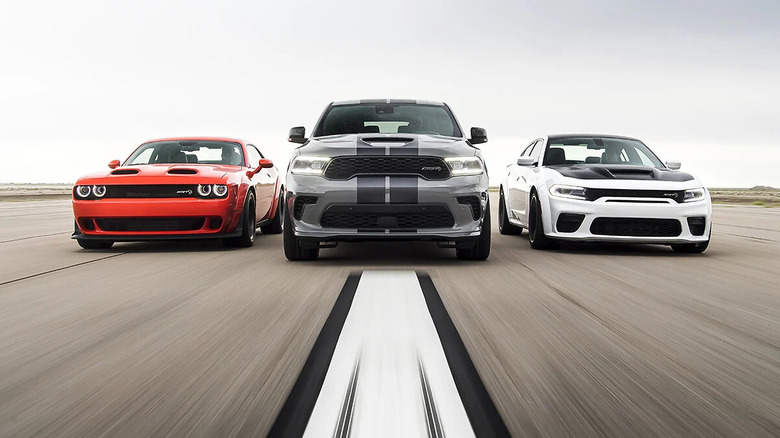
The Challenger SRT Hellcat is very much where it all began, making its debut with the headline-grabbing 707 horsepower that was a visceral reminder of how America fell in love with V8 engines in the first place. The engine was also made available in the Charger, and then the Jeep Grand Cherokee Trackhawk was introduced as well. Then, just when it seemed that the recipe was going to be simply to drop this new 707-horsepower game-changer into vehicles across the FCA portfolio, they also continued tinkering with the motor itself. For 2019, Dodge turned the Hellcat dial up even further, getting the same base motor up to 717 horses.
In 2021, it was back to finding new homes for the engine, and the Durango SRT Hellcat was born, this one boasting a comparatively modest 710 horsepower. Though when it comes to both adding performance and expanding the range of vehicles available with Hellcat power, the party was just getting started. But also, didn't we say there'd be another TRX?
2027 Ram 1500 TRX SRT (777 hp)
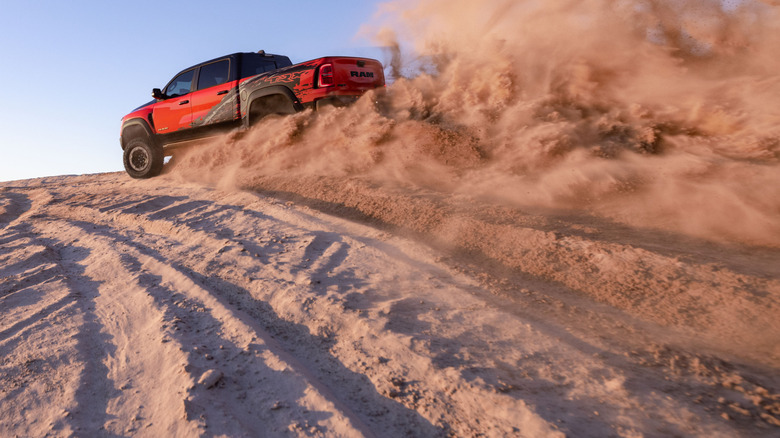
If the original TRX that we opened with doesn't exactly feel like ancient history, that's because it isn't. It was still available until 2024, and the hiatus that followed wasn't long, with Ram bringing back the 1500 TRX for 2027, now with 777 horsepower from its supercharged V8. You can also order one right now, and together with the Durango, it's one of just two Hellcat-powered vehicles currently on sale, and neither is a muscle car. But don't call it a cynical throwback, because Ram has fully committed to the bit, also announcing the 2027 Ram 1500 Rumble Bee – a track-focused truck version of the 1500 available with the Hellcat Hemi.
In any case, the new TRX SRT isn't just the old motor with a new tune. It climbs to that 777-horsepower mark (and 680 pound-feet of torque) with help from a new intake system, increased fuel pressure, and an ECU adjustment that raises the rev limiter. It now revs to 6,500, which is higher than the indicated redline. It also picks up some hardware you'll find in the Redeyes and Demons. With all this coming together in a pickup with a crew cab that can be yours starting at $99,995, it appears that the Hellcat ethos remains alive and well. (They also moved the dinosaur right into the TRX logo, so for sure feel free to call it a T-Rex.)
Dodge Challenger SRT Super Stock (807 hp)
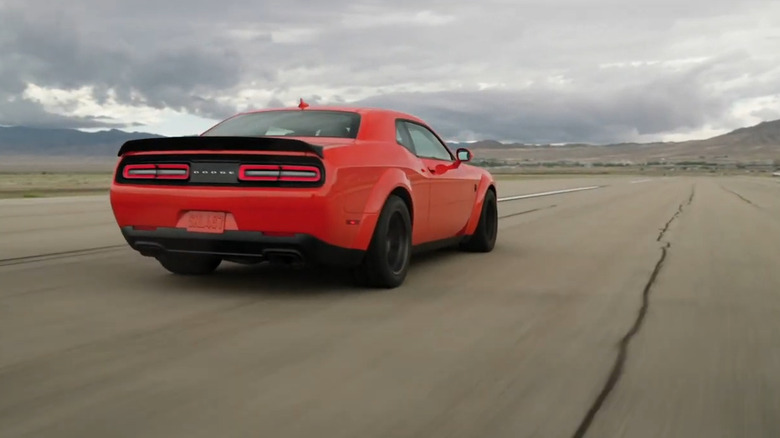
At this point, the Hellcat hierarchy starts getting a little messy. From here on out, we're not really talking about steady evolution of power and technology dropped into increasingly novel vehicles, but rather a handful of borderline alarming jumps in pure performance. In 2019 arrived the Challenger SRT Hellcat Redeye. Dodge got there in about as simple a fashion as possible: by taking the previous model year's Demon engine and putting it in the Challenger. The reason it wasn't able to put out Demon power levels was that the newer car's hood design restricted airflow a little bit.
The Super Stock was built on that 797-horsepower foundation. It came out in 2020 and squeezed another 10 horsepower out of the trusty 6.2-liter V8 for a final horsepower figure of 807, just 1 hp below the Demon, probably not accidentally. By then, Dodge had hit a potential second wave of a divisive car formula, reopening old debates of outrageous power dropped into fairly mainstream cars for the sake of it, with many unable to figure out whether they loved or hated something like the Dodge Challenger SRT Hellcat Redeye. Regardless, it's all increasingly bonkers Demons from here, so let's just get on with it.
Dodge Challenger SRT Demon (840 hp)
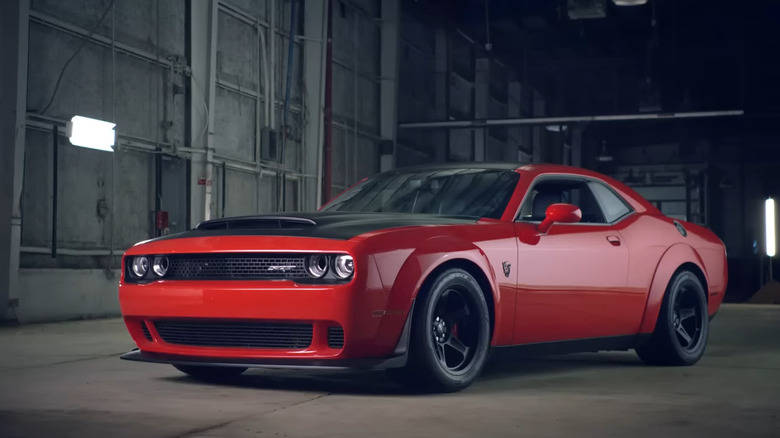
Not only did it feel like the Dodge Demon represented the internal combustion engine in its final form, but it also exposed the challenge of coming up with increasingly menacing-sounding car names when you start with something as cool as Hellcat. It's of course still a Hellcat motor, but this time around it had an outrageous 2.7-liter supercharger that helped lift total horsepower to 808 on pump gas and 840 on race gas with the matching ECU tune. The drag-strip-focused add-on package that gets you the latter setup (plus some drag-friendly front wheels) was known as the "Demon Crate" and set buyers back exactly $1.
While one might argue that Hellcats are probably happiest making noise and destroying tires, the Demon's design revolved largely around actually pointing all of that horsepower and torque in a productive direction. That meant launch control, drag radials, a special eight-speed automatic, and shorter gearing. All of it was designed not to shred tires, but to get drivers down a drag strip. And that it does: 0 to 60 in 2.3 seconds and a quarter mile in 9.65 seconds, per Dodge. The factory drag racer had arrived.
Dodge Challenger SRT Demon 170 (1,025 hp)
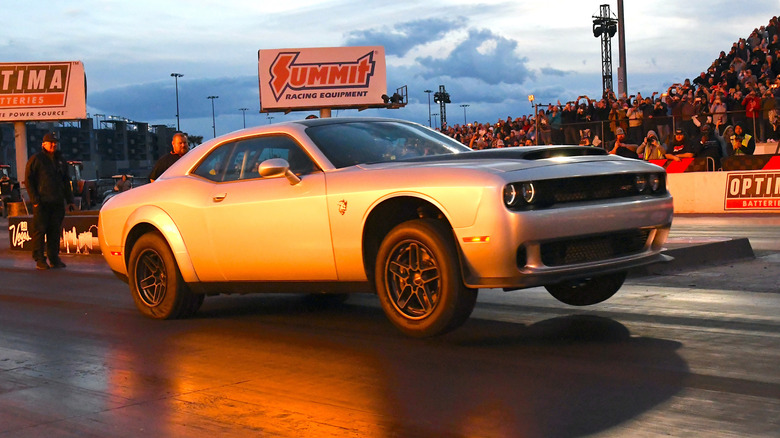
The magic of electrification has taken some of the mystique away from 1,000-plus-horsepower beasts that you can drive off a dealership lot, but in 2023 the SRT Demon 170 still pushed factory internal-combustion performance into territory that would have sounded ridiculous even by Hellcat standards just a few years prior. This one delivered 1,025 horsepower on E85, perhaps a surprising plot twist in terms of fuel, especially after the prior Demon wanted race gas to reach its full power potential.
So how do you get from a mid-800-horsepower number all the way up to a number with a comma? There's a lot of additional forced induction, to be sure – the Demon 170 has an even larger supercharger, this time a 3.0-liter producing 21.3 psi. But there's more going on than just turning up the boost, with Dodge upgrading everything from the supercharger pulley to the throttle body to the valvetrain and spark plugs. The main and rod bearings were redone in copper-lead, and the connecting rods beefed up to withstand the increased pressure. The result was a proper monster worthy of its name that could do 0 to 60 in 1.66 seconds and drub its 840-horsepower sibling in the quarter mile by more than half a second with an NHRA-certified 8.91 seconds.
It was a factory race car with an MSRP of $96,666 that could hold its own on the drag strip against purpose-built projects and most anything else that could show up with a proper license plate on the back. For buyers, there's really only one question that remains: once you nail the launch control sequence at the track, what do you do with it tomorrow?