

6 WD-40 Myths Gearheads Need To Stop Believing
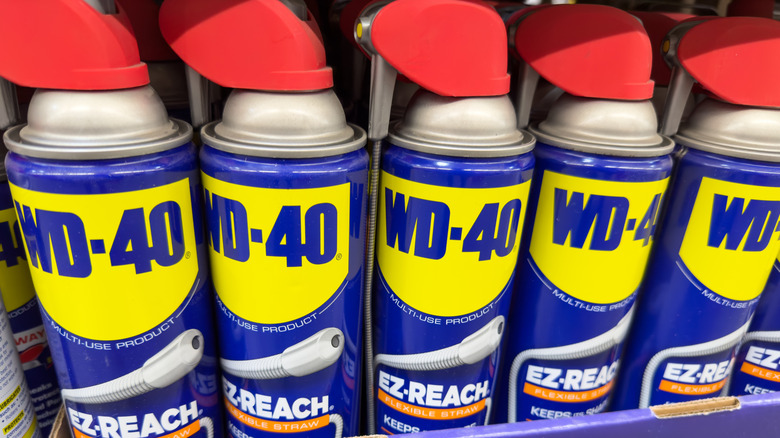
If someone came to you selling a product with an incredible range of uses made from a secret formula first tested on missiles, you might think it's BS. However, this progression represents WD-40's actual origin.
WD-40 was created by the Rocket Chemical Company, which was founded in 1953 by Norm Larsen. Three Rocket Chemical staff members achieved the product's formula after 40 trials, which is naturally where the name WD-40 comes from. What goes into the formula is considered a trade secret, like the recipe for Coca-Cola, Kentucky Fried Chicken, or the Tesla FSD data snagged by Dutch regulators. Furthermore, trade secrets don't expire the way patents do. Aerospace contractor Convair initially used WD-40 on its Atlas Missile (America's first successful intercontinental ballistic missile) to protect against rust and corrosion.
When discussing WD-40, it's important to recognize the range of stories that aren't true. Below are six WD-40 myths that continue circulating, some of which are downright baffling.
#1: It lubricates just about any part of a car
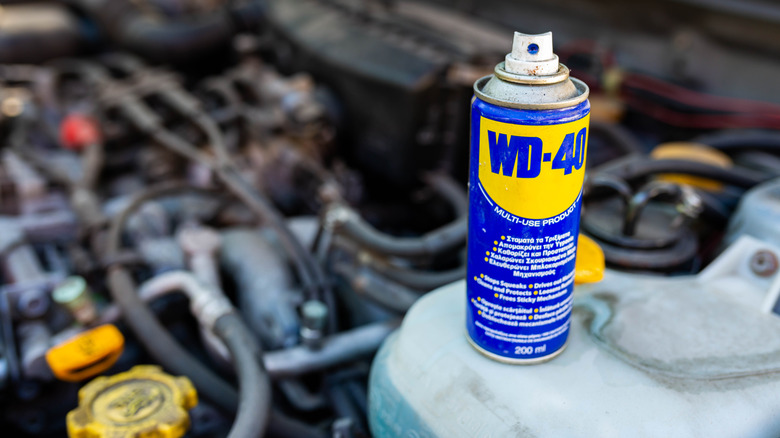
If you've been reading Jalopnik recently, you'll know this one isn't true. Right off the bat, you shouldn't use it on your wiper blades; it's terrible for squeaky engine belts, and it can lead to some entertaining damage if you replace your engine oil with the stuff.
Part of the misconception has to do with WD-40's lubricating properties. The company itself says that the Multi-Use Product is "a unique, special blend of lubricants" that works to keep your car's door hinges and hood latches moving free and easy. It's just that the experts don't always agree. Yes, WD-40 may help in the short term, but it will quickly evaporate and, in some cases, clean off and dry up the original factory grease.
On the other hand, WD-40 is still too slippery to spray on your brake components, and that's no matter how squeaky they sound. Moreover, that noise could be telling you it's time for new brakes, anyway.
Just remember that we're talking about WD-40's traditional Multi-Use Product here. The company has a full family of WD-40 products that can pick up the slack where the regular stuff isn't up for the job. To properly lubricate parts long-term, like those door hinges, for instance, the company makes WD-40 White Lithium Grease.
#2: WD-40 will not cure arthritis or joint pain

Since WD-40 has some lubricating properties, some might think it could do the same for your joints. While many know it cannot, we'll still explore where this ridiculous misconception can stem from.
Occasionally, you'll see healthcare publications compare synovial fluid — the natural lubricant that's supposed to keep joints moving free and easy — directly to WD-40 as a metaphor. Additionally, a newer treatment for joint pain, which literally injects natural lubricants into your joints, is described as, "work[ing] like WD-40 to lubricate the painful joint[,] which reduces friction and therefore pain."
Despite WD-40's exact ingredients being a secret, it says right on the can that the product contains petroleum distillates, which are known to cause skin inflammation in the short term and dermatitis in the long term. In other words, please don't try to drink WD-40 like some kind of arthritis medicine. While the WD-40 Material Safety Data Sheet says it has "low oral toxicity," there's also a long list of potential health issues that could result.
#3: WD-40 can help you catch fish

This one's a two-part myth that starts with an incorrect belief that one of WD-40's secret ingredients is fish oil. As a result — according to some people — coating a fish hook with WD-40 will help increase your catch likelihood. The supposed logic here stems from the mostly false idea that putting a little fish oil on your bait increases your odds of attracting catches. Even if we don't know exactly what's in WD-40 — the manufacturer's website confirms that fish oil isn't part of the picture.
It's also worth pointing out that WD-40 contains volatile organic compounds (VOCs), a family of chemicals that was problematic enough to force car makers to switch to water-based paints. The bottom line from WD-40, however, is that you can use the product to help keep rust and corrosion from forming on your fishing gear, but using it to attract fish is not recommended.
#4: WD-40 is bad for your bike chain
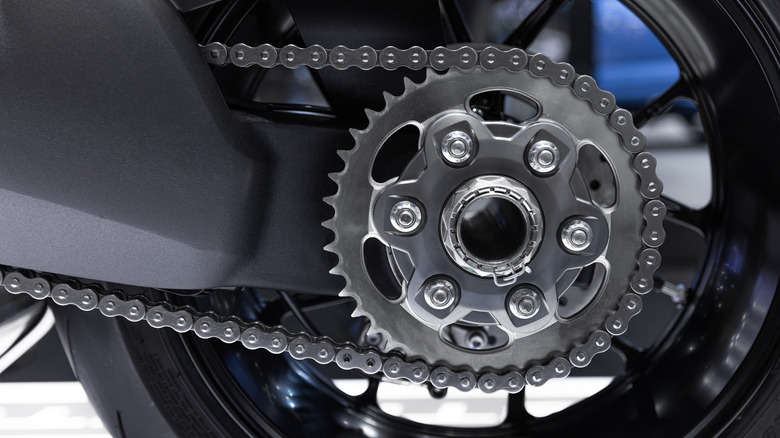
Again, we've got a couple of different things going on here, depending on what kind of bike we're talking about. Let's start with motorcycles with sealed chains, which have tiny rubber O-rings between the side plates and inner links. These are the "seals" that help keep oil trapped inside the links while making sure they're not contaminated by dirt or water. Some riders say WD-40 can dry the seals out to the point of failure, but Motorcyclist Magazine put the question to the test and found out it's not true.
As for traditional bicycle chains, the situation is a little vague. WD-40 has a page for myths, and one claim the company says isn't true is that regular WD-40 should not be used on bike chains. The thing is, the company never explicitly claims you can use it to lubricate chains. Instead, it says the multi-use product "is formulated with strong lubricating oils and other ingredients, and is a terrific product to use for bike maintenance." The one caveat given is that, before you hit the pedals, you should make sure your chain is free from any excess product. You should also know that the company does have a separate, dedicated product — WD-40 Specialist Bike Chain Lube — for long-term bike-chain lubrication.
#5: WD-40 makes screwing a pleasure

If you've spent enough time on the Internet, you've probably come across some pretty weird car commercials and funny ads for automotive accessories. For example, you might have even seen a vintage ad recommending that folks with tight nuts and rusty tools opt for WD-40 in the man-size pressure pack. Offered in a perhaps-optimistically measured 9-inch can, complete with a red knob at the end, the product was touted for lubricating dry passageways and giving better penetration — making screwing a pleasure. Unsurprisingly, that ad is fake.
Don't try personally testing the ad's claims, either. We're not going to get involved in what goes on between consenting adults, but don't forget that WD-40 can dry out your skin and cause irritation. Plus, WD-40 is classified as about 50% mineral spirits of some kind, and they don't play well with latex. One study, posted on the NIH National Library of Medicine website, reported that a latex condom can lose 90% of its strength after being exposed to mineral spirits for just 60 seconds.
#6: WD-50 is even better than WD-40
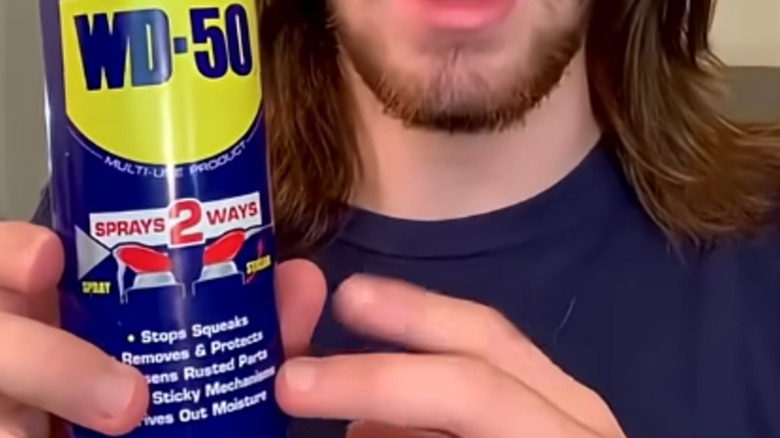
Sure, WD-40 can be used successfully to solve a lot of problems, but WD-50 claims to take those uses to the next level. WD-50 doesn't simply displace moisture — humidity checks the forecast and cancels itself. Nor does it only prevent corrosion — corrosion takes one look at the can and reconsiders its life choices.
The catch is that there is no WD-50 in the real world. This "product" started as part of an internet meme. WD-40 company puts a positive spin on the meme, too, saying that only a brand as strong and well-known as WD-40 can inspire that kind of homage.
That said, there are other WD-40 versions beyond the original. There's the line of WD-40 bike chain cleaner we touched on earlier, for instance, as well as specialist products fine-tuned specifically to act as a rust remover, gel lube, cleaner and degreaser, electric parts cleaner, penetrant, and more. All, to be clear, carry the WD-40 name.