

What Sort Of Entertaining Damage Happens When You Replace Engine Oil With WD-40?
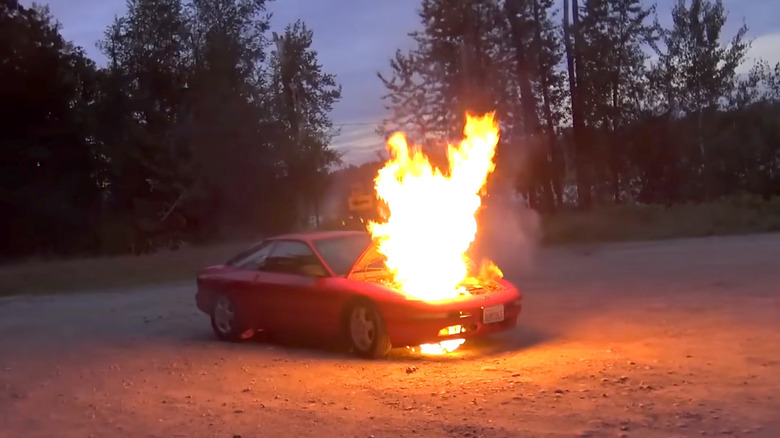
There are few testing methods more entertaining than those that include a cheap beater. When it's a car that you simply don't give a dang about in any way, shape, or form, why not use it to test certain common consumer products to the extreme? That's exactly what the crew behind the YouTube channel Life OD did, running an experiment to find out if an engine would survive having its oil replaced with good ol' WD-40 — a product that was originally designed to prevent missiles from rusting and doesn't fare well on wiper blades. You can probably guess how things turned out.
However, it must be said that, up until the engine in their Ford Probe testbed — a later generation model, not the very '80s-looking Ford Probe — gave up the ghost, the car ran surprisingly well, all things considered. After all, there probably was some residual engine oil left in its two liters of displacement before they filled it up and let it rip. Life OD's methods caused some truly catastrophic damage, including a red-hot exhaust and massive, massive flames. Let's take a look at their very scientific approach.
One brutal and drawn-out death
The Probe in question was (thankfully) not a V6 model, but rather possessed a naturally aspirated 2.0-liter inline-four that found its way into many engine bays of the Fozda era. This impotent mill made 118 horsepower and 127 pound-feet of torque from the factory, which was enough to haul its 2,690-pound curb weight from 0 to 60 mph in, well, who cares. Though, Life OD's example sounded pretty good with a clearly aftermarket header and exhaust setup.
In the experiment, the little 2.0 — a beater, but not a bad beater — held up surprisingly well, surviving a massive burnout, getting repeatedly redlined in motion, and only starting to make some weird noises thereafter. You have to wonder if the engine would've lasted a lot longer if it was driven more gently — food for thought if a zombie apocalypse ever happens.
However, the ultimate test was the following: while stationary, fire it up and immediately jam the throttle in neutral with a pipe, then see how long it lasts. It bounced off the rev limiter for just about three-and-a-half minutes before the engine finally died, and, surprisingly, it lasted for a decent chunk of that time while engulfed in flames. Good job, Ford and Mazda. While stationary, there's only so much that the water pump and radiator can do to rein in temperatures, and the increase in friction caused by the significant decrease in lubrication certainly didn't help. We can only assume that it was a chain reaction of brutal destruction under there, and that the massive fire was a product of both the WD-40 and gasoline. What a truly entertaining demise.