

12 Quick EVs That Can Hit 60 MPH In 3.5 Seconds Or Less
You can bash EVs as dull to drive. You can also claim they are limited by range and charging infrastructure. What you can't say, however, is that they are slow. EVs have pushed the performance envelope forward so significantly that they have begun to challenge decades of internal-combustion supercar development.
Today, you can buy an electric crossover like the Volvo EX30 Twin Motor Performance and embarrass most supercars at the light. Heck, you can do it in a pickup truck (Rivian R1T) or a luxury sedan (Lucid Air Sapphire). These are just some of the vehicles that will feature in our list of EVs that can hit 60 miles per hour in 3.5 seconds or less. For the uninitiated, that's supercar territory, with some EVs even reaching hypercar acceleration figures! The real kicker is that many of these EVs are relatively affordable for the performance they offer.
To keep the figures realistic, every price tag mentioned below factors in the mandatory destination charge, and all 0-to-60 times are official manufacturer claims. Let's begin.
Volvo EX30 Twin Motor Performance (2025 to 2026): 3.4 seconds
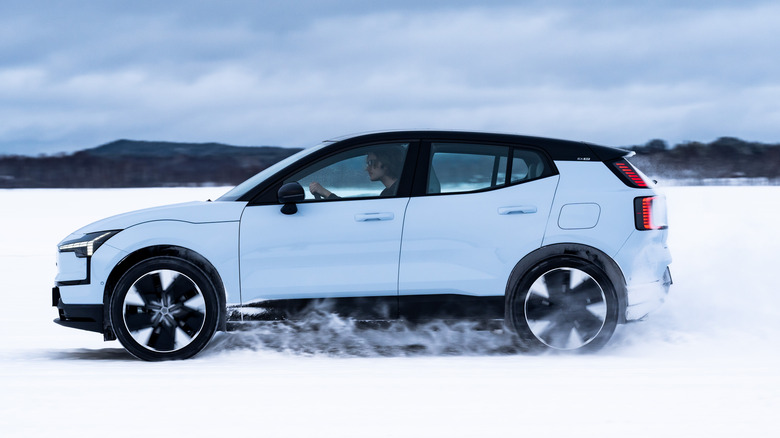
From the outside, the Volvo EX30 Twin Motor Performance looks just like any other subcompact SUV built for grocery runs and school zones. But underneath, this Swedish sleeper packs a dual-motor drivetrain that pumps out 422 horsepower and 400 pound-feet of torque, which propels it to 60 in a supercar-rivaling 3.4 seconds — quicker than a base Porsche 911 Carrera. Yes, the EX30's top speed is limited to 114 mph, but its off-the-line acceleration is truly rapid.
Unfortunately, you'll struggle to cover meaningful mileage with the Twin Motor Performance model. Volvo equipped it with a relatively small 69-kWh battery, which, according to Volvo, provides a 253-mile range. However, in Car and Driver's 75-mph highway test, the dual-motor EX30 managed only 160 miles before it needed a charger. Also, don't mistake the ferocious straight-line acceleration for handling poise. The Volvo EX30 Twin Motor Performance is a comfort-oriented crossover, not a hot hatch replacement. In that sense, the single-motor, rear-wheel-drive EX30 suits the chassis better, with its rear 268-hp motor providing a brisk 0-to-60 time of 5.1 seconds. It also starts at $40,345, undercutting the Performance variant by $6,000 ($46,345).
Crucially, every Volvo EX30 model is quiet and refined inside. Moreover, the cabin is relatively comfortable, though, given the car's dimensions (166.7 inches long), the rear seats aren't the most accommodating. As you'd expect from a Volvo product, the dashboard looks clean and premium, even with the extensive use of recycled materials. Still, the Swedish automaker might've gone too far with the "Teslaization," incorporating a single 12.3-inch screen and no instrument cluster or physical climate controls.
Chevrolet Blazer EV SS (2025 to present): 3.4 seconds
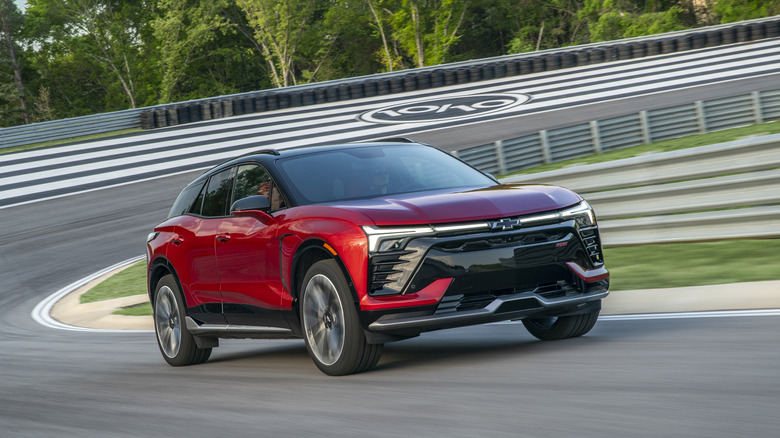
You could argue that naming Chevy's mid-size electric SUV a Blazer and calling the high-performance variant "Super Sport" is blasphemous. Semantics aside, the Blazer EV SS provides supercar speed in a family crossover package at a relatively affordable $62,495. Heck, it's easily the quickest Chevrolet SS variant to date, sprinting to 60 in only 3.4 seconds thanks to the dual-motor drivetrain delivering 615 hp and 650 lb-ft of torque.
The curveball is that the Blazer EV SS also handles the twisties well. It's not as agile as a sports car (it weighs 5,737 pounds), sure, but the upgraded performance suspension aids high-speed stability and keeps body roll in check, all while keeping the cabin well isolated. Unlike the EX30's battery, the 102-kWh battery in the Blazer EV SS has enough juice to provide a decent EPA-estimated range of 302 miles. It also charges up to 190 kW, and, for 2027, comes as standard with Tesla's NACS charging port.
The Blazer EV SS's cabin is spacious across both rows, too, and the 25.5-cubic-foot trunk can easily accommodate bulkier gear. Chevy did a good job combining high-tech features, like the massive 17.7-inch infotainment screen and the 11-inch digital instrument cluster with physical climate controls. Unfortunately, the Google-based operating system doesn't support Apple CarPlay or Android Auto, though every SS model comes as standard with the hands-free-driving Super Cruise system.
Cadillac Lyriq-V (2026 to present): 3.3 seconds
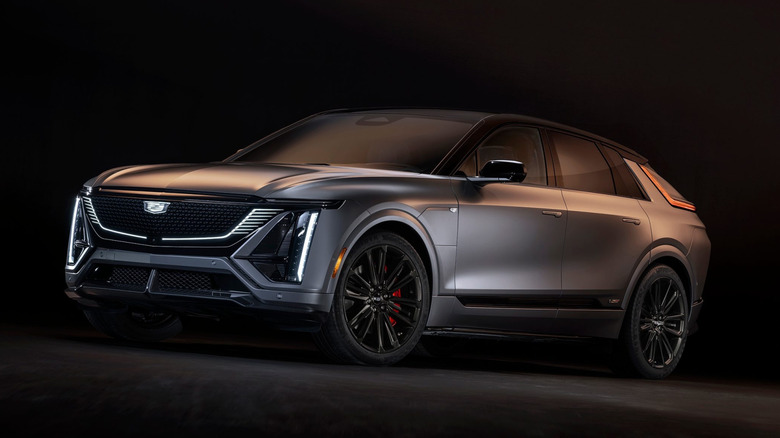
It may not look like it, but the Cadillac Lyriq-V is an upmarket version of the Blazer EV SS. The models are built on an identical platform, and share the same dual-motor drivetrain delivering 615 hp and 650 lb-ft of torque, as well as the 102-kWh battery that supports charging at speeds of up to 190 kW. Still, despite being heavier (6,062 pounds), Cadillac says the Lyriq-V sprints to 60 in 3.3 seconds (with launch control). The weight had an effect on range, however, with the Lyriq-V rated at an EPA-estimated 285 miles.
Small differences in performance and range aside, with a starting price of $80,495, the Lyriq-V is significantly more expensive than the Blazer EV SS. Still, Cadillac's electric crossover makes sense for drivers who want it all. Most notably, its cabin feels far more upmarket, with premium materials, like open-pore wood, giving a luxurious touch. Furthermore, instead of two separate screens, the Lyriq-V incorporates one big 33-inch OLED touchscreen, which also supports Apple CarPlay and Android Auto. Thanks to the use of noise-canceling tech, the Lyriq-V's cabin is also quieter.
That isn't to say you can't hustle the Cadillac. The Lyriq-V comes with more advanced adaptive valve-based dampers from Sachs, stiffer springs, and Continental PremiumContact 6 summer tires for higher lateral grip and stability. Like the Blazer EV SS, the Lyriq-V also comes as standard with six-piston Brembo front brakes.
Dodge Charger Daytona Scat Pack (2024 to present): 3.3 seconds
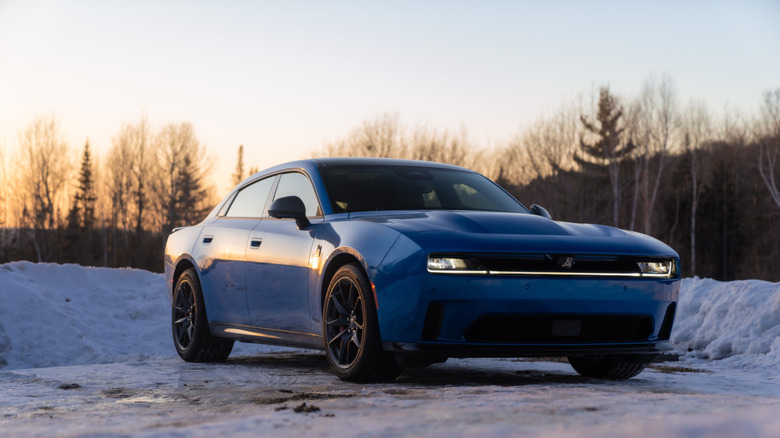
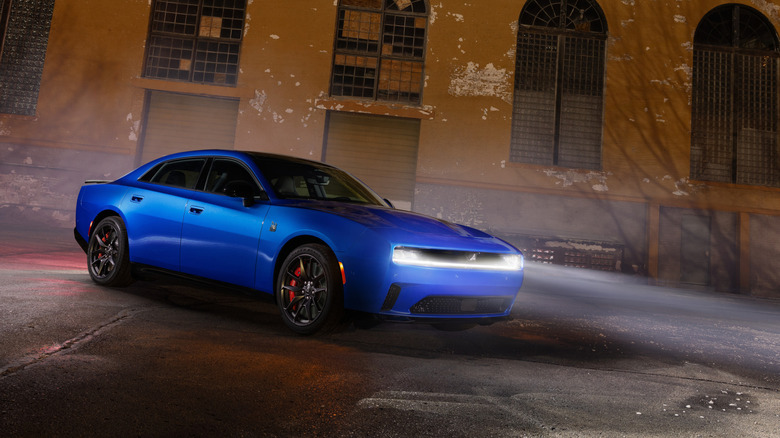
Dodge likes to call the Charger Daytona EV a "next-gen" muscle car, which Mopar fans would probably consider sacrilege. However, as far as performance figures go, the brand's first EV at least matches the previous-gen Charger Hellcat Redeye, which packed a 6.2-liter supercharged V8 making 797 hp and 707 lb-ft of torque. The Daytona Scat Pack only produces 670 hp and 627 lb-ft across two electric motors, but since it has AWD and no gearshifts to slow it down, it accelerates to 60 in 3.3 seconds.
And it's not just straight-line speed. The Charger Daytona EV's muscle car cosplay is convincing in other areas, too. For example, it has a dedicated Fratzonic Chambered Exhaust system, which utilizes chambers, woofers, and mid-range speakers that produce a V8-like rumble, albeit with an electric twist. Dodge also incorporated chassis-mounted force generators, which channel vibrations into the cabin to make it feel like it has an engine. The Charger Daytona EV can even be optioned with Donut and Drift driving modes. Meanwhile, the interior design plays the retro-muscle-car game, albeit with a futuristic, screen-laden makeover.
The Charger Daytona EV Scat Pack is fun in its own unique way, but it doesn't do the EV bits very well. Although it packs a relatively big 100.5-kWh battery, its EPA range rating is an abysmal 241 miles. Also, the battery charges at a solid 183 kW, though finding the charging settings in the car's buggy software is an exercise in patience. But, hey, at least it starts at an affordable $61,990 (coupe) and $63,990 (sedan)!
Hyundai Ioniq 5 N (2025 to present): 3.25 seconds
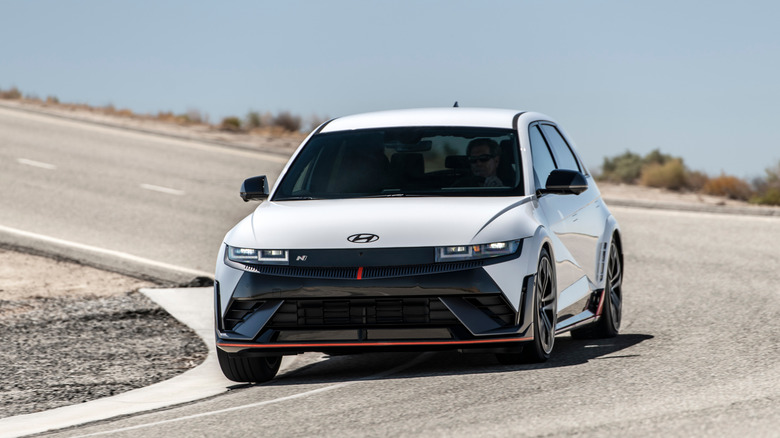
The Hyundai Ioniq 5 N is the gold standard for a fun-to-drive electric performance car. As you'd expect from an EV, it has a blistering pace in a straight line. The Ioniq 5 N packs a 601-hp dual-motor drivetrain, with 641 hp available for 10 seconds with N Grin Boost enabled, resulting in a blazing 0-to-60 time of 3.25 seconds.
Yet, that barely scratches the surface of the 5 N's dynamic capabilities. Hyundai's N division has also done a stellar job with the handling, which can be predictable, balanced, or downright wild if you want it to be. That's because the 5 N's AWD system can vary the torque distribution between the axles to deliver agility and stability, while also enabling drifting shenanigans with the N Drift Optimizer Pro mode. And on top of that, Hyundai equipped it with simulated gearshifts and engine sounds, which are geeky, but sprinkle some more of that grin-inducing magic.
Unfortunately, there is a significant tradeoff for choosing the performance-oriented Ioniq 5 N — it has an EPA-estimated range of only 221 miles. Admittedly, it charges quickly (10% to 80% in as little as 18 minutes on a 350-kW charger), but the short range puts a question mark on its capability as a family crossover. Too bad, because the Ioniq 5 N has a spacious cabin with useful tech, a 26.1-cubic-foot cargo capacity, and a palatable $61,550 base price.
Porsche Macan Turbo Electric (2024 to present): 3.1 seconds
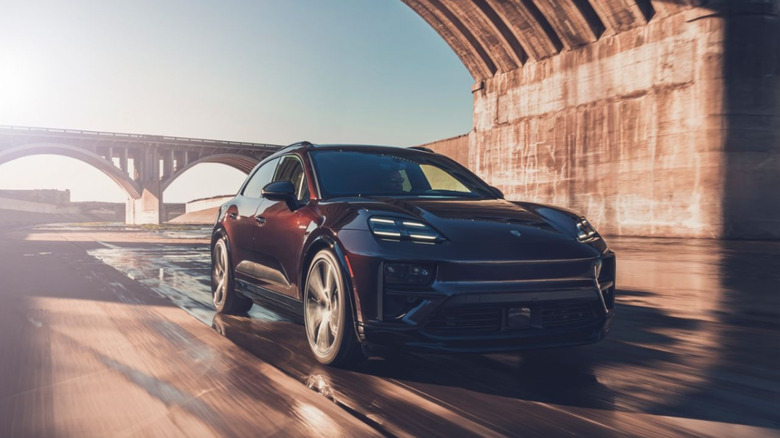
Just as Hyundai did with the Ioniq 5 N, Porsche showed it can successfully instill its driving DNA in its entry-level electric crossover. That's true for every model in the range, but it's the GTS and Turbo variants that will attract driving enthusiasts. Both of these models have an electronic limited-slip differential, torque vectoring for sharper handling, and a performance-tuned air suspension.
We tested the Macan GTS Electric earlier this year and liked the good balance between comfort and driving dynamics. The GTS is very quick, too; with launch control enabled, the 563-hp (with overboost) dual-motor drivetrain brings it to 60 in 3.6 seconds. However, the 630-hp Macan Turbo Electric is even quicker, ripping past 60 mph in 3.1 seconds. The top speed of the Turbo is also higher, at 162 mph versus 155 mph. The Macan Turbo Electric adds $7,400 to the GTS's hefty $107,650 starting price, though. That's expensive for a compact SUV, especially since the Macan Electric isn't the most practical.
The Macan has a relatively small 20-cubic-foot trunk (frunk and trunk) and a tight rear bench. Moreover, its tech-rich interior doesn't feel as premium as the price would suggest, with hard plastics in places. That said, the Macan Turbo Electric has an excellent 293-mile range and charges at 270 kW.
Tesla Model 3 Performance (2024 to present): 2.9 seconds
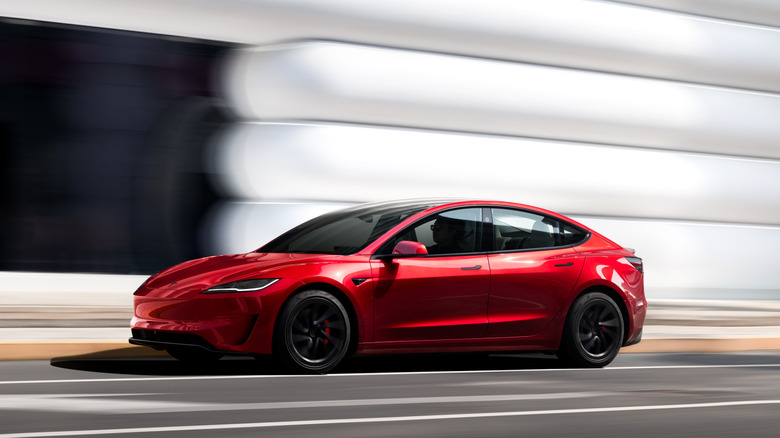
Introduced in 2018, the Model 3 Performance was one of the original performance EVs. Tesla has since updated it with a sharper design, upgraded chassis, adaptive dampers, and a more potent 510-hp dual-motor drivetrain. These revisions made it a far more complete proposition, but even with the Track driving mode enabled, the Model 3 Performance isn't even remotely suited for track duty.
The narrative changes on the road, however. The Model 3 Performance feels stable and playful on twisty roads, with good grip and precise steering. It's stupendously quick, too, arriving at the 60-mph mark in just 2.9 seconds and maxing out at 163 mph. The highlight, however, is the excellent 314-mile range, one of the highest among performance EVs.
Inside, the Model 3 Performance still has the divisive button-free dashboard, with a 15.4-inch screen controlling most of the functions. As for space, it's good in the front and has a great 24.1-cubic-foot cargo capacity, but the rear seats aren't the most accommodating. Still, at just $56,630, the Model 3 Performance is one of the most affordable performance EVs.
Rivian R1T Quad (2026 to present): 2.5 seconds
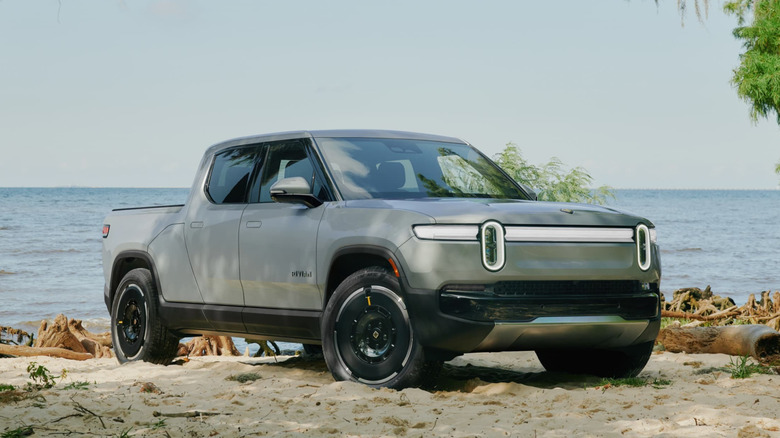
There is probably no better showcase of the straight-line superiority of EVs than an electric pickup truck. Case in point: the Rivian R1T Premium with Power Upgrade comes with a 665-hp dual-motor drivetrain, good for a brisk 0-to-60 time of 3.4 seconds — on all-season tires! The R1T Performance packs three electric motors — two on the rear axle — and produces 850 hp and 1,103 lb-ft of torque. As a result, it catapults to 60 mph in just 2.9 seconds. And if that wasn't crazy enough, the R1T Quad model with four motors, 1,025 hp, and 1,198 lb-ft of torque reaches 60 in a stupendous 2.5 seconds.
Yes, this means that all R1T trims apart from the entry-level 533-hp model deserve a place on this list. Still, we chose the top-end Quad variant because it offers some other advantages. Most notably, having a motor on each wheel means superb torque control, which translates into better on-road handling and off-road traction. Last year, we found this system wasn't just a gimmick — the R1T Quad is truly off-road capable on any type of terrain. It can even rock crawl!
With an EPA-estimated range of 374 miles, the R1T Quad is also ready to be taken deep into the wilderness. Yes, at $117,885, it's expensive, but it's a unique offering with almost no alternative on the market, apart perhaps from the failed Cybertruck. Rivian also sells a three-row SUV variant called the R1S Quad, which has a 0.1-second slower 0-to-60 time, but the same 374-mile range.
Audi RS e-tron GT performance (2025 to present): 2.4 seconds
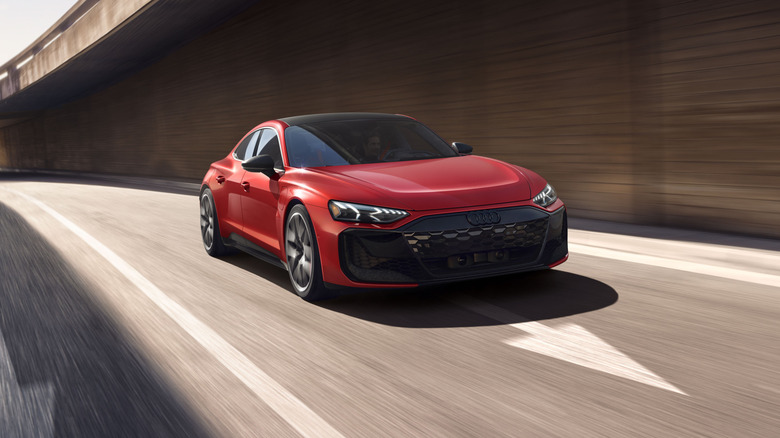
The limited-run Audi Nuvolari supercar is a special piece of kit, packing the Lamborghini Temerario's 4.0-liter twin-turbo V8 hybrid with 987 hp and a 10,000-rpm rev limit. Still, with a 0 to 62 mph (0 to 100 km/h) time of 2.6 seconds (Audi still hasn't published 0 to 60 mph figures), it's not quicker than Audi's EV top dog, the RS e-tron GT performance.
Packing a 912-hp (737 hp without overboost) dual-motor drivetrain, this Porsche Taycan-based EV blasts to 60 in 2.4 seconds (0 to 62: 2.5 seconds) with launch control, making it the quickest Audi model currently on sale. According to Car and Driver, the RS e-tron GT performance is even quicker, reaching 60 in only 2.1 seconds.
The base Audi S e-tron GT isn't too far back, either. It also has a dual-motor drivetrain, albeit with 670 hp on tap, which propels it to 60 in a brisk 3.3 seconds. With a starting price of $129,095, the base model is also significantly cheaper than the $171,895 RS e-tron GT performance, and has a longer 300-mile range, with the RS rated at 278 miles. Both models charge at a peak speed of 320 kW. The RS offers upgrades like ceramic brakes and active suspension that's similar to Porsche's Active Ride.
Porsche Cayenne Turbo Electric (2026 to present): 2.4 seconds
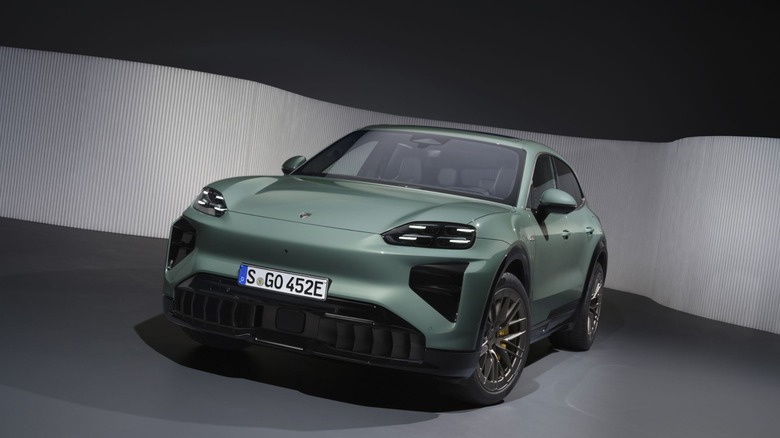
The Cayenne Electric raises the EV bar across nearly every metric that counts. For instance, it can charge up to an astonishing 400 kW, enough to replenish the relatively large 113-kWh battery from 10% to 80% in only 16 minutes. Thanks to Porsche's Active Aerodynamics, it also has a drag coefficient of only 0.25, helping it squeeze 303 miles of range (with all-season tires).
Still, the headline-grabbing figure is the Cayenne Turbo Electric's dual-motor drivetrain with 1,139 hp and 1,106 lb-ft of torque, which propels the luxury SUV to 60 in only 2.4 seconds (with launch control). Car and Driver says it's even quicker, reaching 60 in just 2.1 seconds. Top speed is equally impressive at 162 mph. The Cayenne Electric is also available in two other flavors: the base 435-hp model (0 to 60: 4.5 seconds) and the 657-hp Cayenne S Electric (0 to 60: 3.6 seconds).
The Cayenne Turbo Electric is so good not only because of its straight-line muscle, but also its cornering capabilities. As standard, it comes with an adaptive air suspension and torque vectoring for more agile handling, but it can be upgraded with Porsche's Active Ride setup and rear-wheel steering for even better driving dynamics and ride comfort. The Cayenne Turbo Electric starts at $165,350, while the sleeker Coupe commands a $5,000 premium.
Porsche Taycan Turbo GT (2025 to present): 2.2 seconds
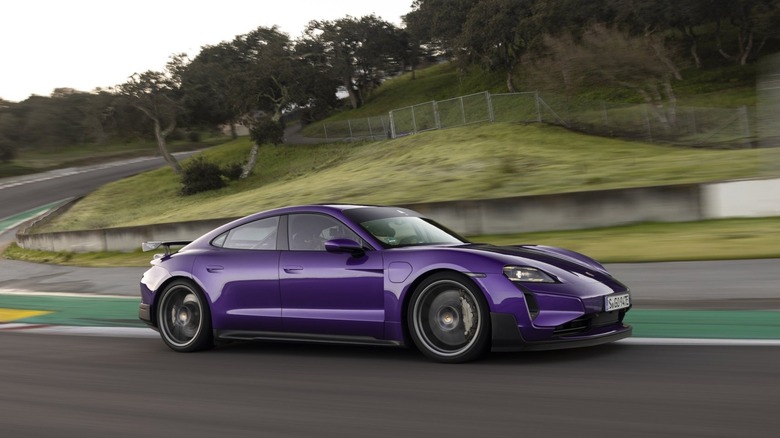
The Cayenne Turbo Electric is stupendously quick for an SUV, but Porsche's quickest EV remains the Taycan Turbo GT. Thanks to its dual-motor drivetrain with up to 1,019 hp and 914 lb-ft of torque (with overboost), it reaches 60 in only 2.2 seconds (with launch control). The Taycan Turbo GT also dispatches the quarter-mile in 9.5 seconds and tops out at 180 mph. The EPA-estimated range is 276 miles.
The figures get even wilder if you opt for the Weissach Package. It comes with no rear seats and swaps some of its steel hardware for aluminum and carbon. This has cut 0.1 seconds from the 0-to-60 time and raised the top speed to 190 mph. The Weissach Package also brings more aggressive aero, like a front spoiler, aeroblades, a diffuser, a fixed rear carbon wing, and a specially designed underbody, making it the logical next step for track-day fans.
The Taycan Turbo GT is undoubtedly impressive, but it also starts at a whopping $245,950. You can cut almost a quarter of that price by opting for the Taycan Turbo. It starts at $186,850 and still offers supercar pace (0 to 60: 2.5 seconds) thanks to its 871-hp dual-motor drivetrain.
Lucid Air Sapphire (2024 to present): 1.89 seconds
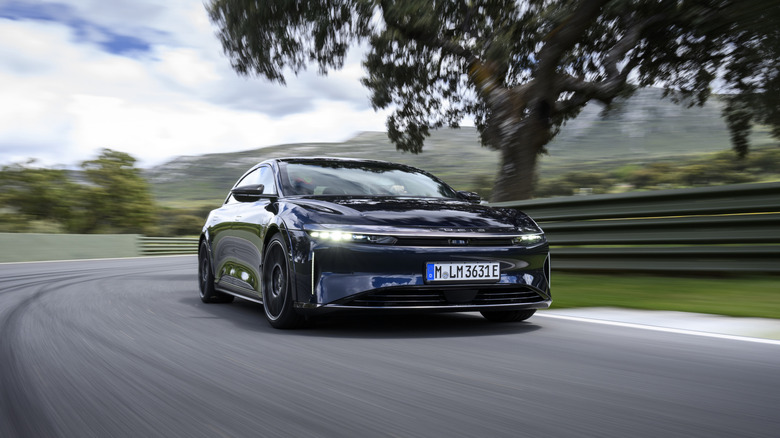
Starting at $250,500, the Lucid Air Sapphire looks like it competes directly with the Porsche Taycan Turbo GT. Still, it plays the numbers game even better, packing a tri-motor drivetrain that produces an insane 1,234 hp and 1,430 lb-ft of torque. The result is a hypercar-beating 0-to-60 time of 1.89 seconds and a top speed of 205 mph.
Perhaps even more impressive is the 427-mile EPA-estimated range, which turns the Lucid Air Sapphire into a true long-distance grand tourer. The twin rear-drive unit also allowed Lucid to incorporate true torque vectoring, with the track-tuned suspension keeping it flat in the corners. Ceramic brakes are also standard, as they should be on a car that accelerates so violently it can make you barf.
Did we mention that Lucid actually markets the Air Sapphire as a luxury sedan? Its cabin might be too screen-dependent, but the materials are top-notch and the cabin provides ample space for passengers. The kicker — you can enjoy a similar ambiance for well under half the price. The Air Grand Touring starts at $116,400, sprints to 60 in 3 seconds (819 hp), and has a range of up to 512 miles.