

5 Motorcycles Faster Than Honda's CBR1100XX, Once The Fastest Factory Bike Ever Built
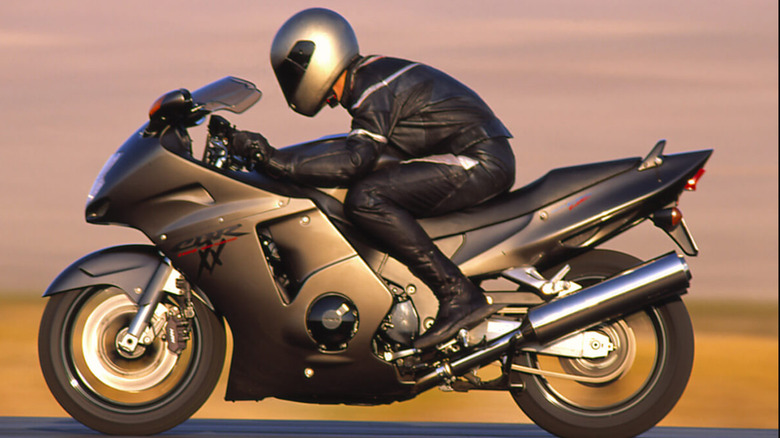
When Honda launched the revolutionary CBR1100XX, the 178 mile per hour superbike colloquially nicknamed Super Blackbird after the Lockheed SR-71 spy plane, it completely changed the trajectory of the motorcycle industry. Particularly in Japan, bikemakers started targeting outright top speed as the new metric of performance. Compared to everything that came before it, the CBR1100XX pushed the envelope of motorcycle aerodynamics, handling, and acceleration. The Blackbird was an instant sales smash success, moving over 17,000 units, pushed almost entirely on its high-speed stability merits, and soon others wanted in on that game.
With 149 horsepower from a 1,137 cc four-cylinder engine, the big speed Honda had everything you need to go super fast in a sleek and stable package. Not only was this the fastest motorcycle available at the time, it was also the fastest thing Honda had ever sold to the public, as it exceeded the top speed of the contemporary NSX by 10 mph. Very few sports cars could go faster than this at the time, and all of them were significantly more expensive.
It took a few years for the Blackbird's top speed to be beaten, and few motorcycles have had the power to top it in the three decades since. For several years there was even an unofficial "gentleman's agreement" between motorcycle manufacturers to tone down the top speed competition for fear of speed limiter legislation. There are a small handful of motorcycles that have broken the informal treaty, however, and some have even managed to crack the 200-mph barrier in stock form. Here's a rundown of five totally awesome motorcycles capable of faster top speeds than the Blackbird.
1999 Suzuki Hayabusa - 194 MPH
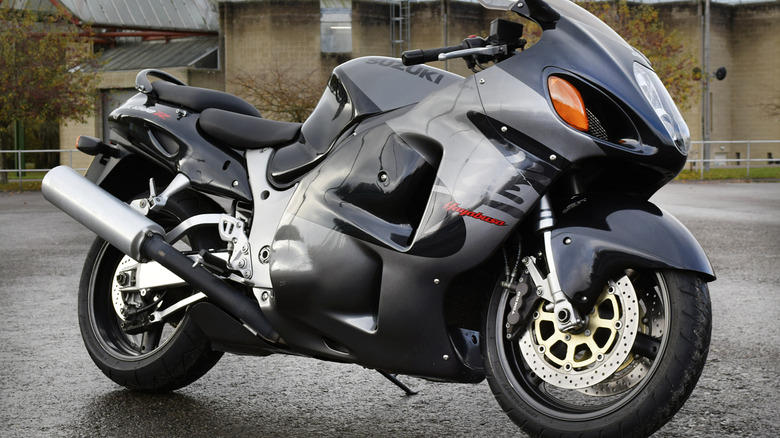
Just three years after the Super Blackbird was unveiled, Suzuki upped the competition with a faster and more powerful 1.3-liter motorcycle, the GSX-1300R Hayabusa. Hayabusa is the Japanese word for falcon, as in the predator of blackbirds. With a full 175 hp onboard and smooth, fluid aerodynamics, the Hayabusa went out in search of top-speed prowess and owned the mark almost exclusively for a couple of decades. The Hayabusa was capable of a stunningly fast claimed 194 mph.
Writing for Cycle World, Mark Hoyer painted the Hayabusa in an otherworldly light, saying, "As much as Suzuki's soul gets its divine light from the GSX-R, the Hayabusa is where engineering put supernatural powers, with lights and a license plate, in our hands."
The Hayabusa was so fast that motorcycle manufacturers were concerned about a top speed arms race getting out of hand. The industry saw the writing on the wall, particularly as European lawmakers increasingly groused about the danger of faster and faster superbikes. Collectively, Japan's big four manufacturers wanted to rein themselves in and set a voluntary cap on motorcycle top speeds of 300 kph (around 186 mph). It's better to police yourselves, reckoned Honda, Yamaha, Suzuki, and Kawasaki, than to be policed.
To this day, the fastest street legal bikes from Japan are artificially limited to under 300 kph top speeds. After its initial launch in 1999, Suzuki reduced the top speed of the incredible Hayabusa to exactly 300 kph, though without a drop in power or displacement. The Japanese superbike remains electronically limited even today.
2007 MV Agusta F4 R 312 - 194 MPH
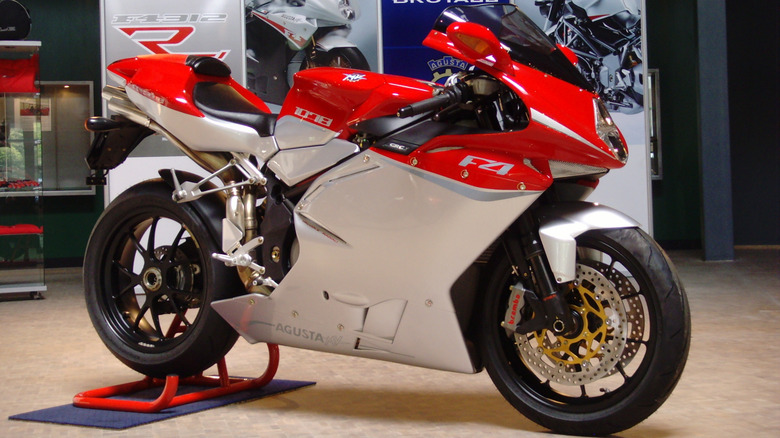
MV Agusta was the first European motorcycle maker to break the gentlemen's agreement on top speed, seven years after the fact, with the 2007 F4 R 312. In this case, the 312 stands for how many kilometers per hour the motorcycle could reach at flat chat, the equivalent of 194 mph, matching the numbers posted by Suzuki's Hayabusa. To MV Agusta's credit, the company was not present for the agreement, and never intimated that it would follow the same self-imposed limits as the big companies did.
With a brand-new price tag of $24,995, the 312 was a whole lot of bucks brand new. With MV Agusta's boutique brand, the world's fastest bragging rights, and hand-assembled components, it was seen by some as worth it, but very few were sold. The then-current F4 1000 R model laid the foundation for the 312, exchanging some of the former's low-end torque for a nine-horsepower bump with titanium valves, larger throttle bodies, and shorter intake trumpets. Outside of the engine, the 312 shares almost everything else with its F4 1000 R siblings, from the chassis and forks to the brakes and the Massimo Tamburini-sculpted design.
With a claimed 183 hp and just 423 pounds to carry around (that's a dry weight), the MV was both more powerful and significantly lighter than the Hayabusa it was dancing with at the top. The Italian flyweight is also a much better-looking bike than the Hayabusa, which Cycle World said looked "like some copper-colored cosmic suppository." Then again, the Hayabusa was also much, much cheaper.
2021 BMW M 1000 RR - 195 MPH
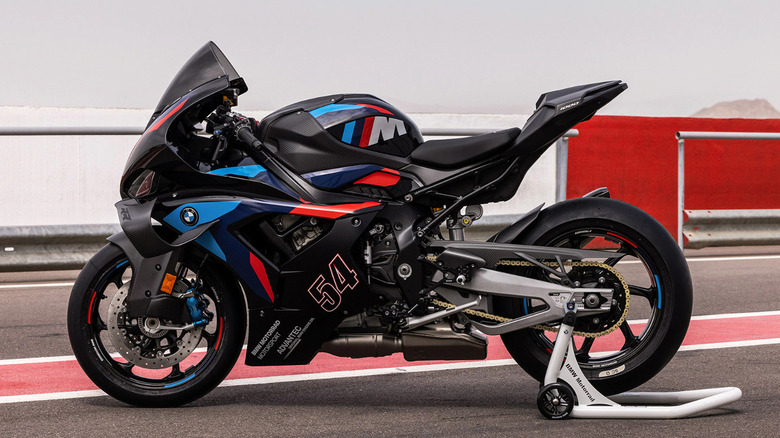
Prior to the launch of the M 1000 RR in 2020, BMW's Motorrad and M Performance divisions had never worked together toward a common goal. An extension of the already incredibly fast S 1000 RR, BMW got the weight down to just 423 pounds with some carbon fiber wheels and an Akrapovič exhaust, then juiced up the four-cylinder engine to 218 hp (up from 205 ponies) with lighter pistons, titanium connecting rods, and updated "ShiftCam" technology. That little engine can spin up to well over 15,000 rpm, which certainly doesn't hurt.
Unlike any of the bikes we've discussed thus far, the M 1000 RR was created explicitly for race homologation purposes. BMW wasn't particularly reaching for the golden ring of raising the top speed of its fastest bike, though it was the knock-on effect of lower weight and increased power. While the S 1000 RR is already capable of an incredibly fast 300 kilometers per hour, the M-tuned version leapfrogged over the MV Agusta's 312 straight to 314 kph, or a smidge over 195 mph.
This wasn't the first bike to exceed the limits of 1999's incredible Hayabusa, but by 2020 the gentlemen's agreement was largely left in the rear view of motorcycling history. That said, it was the first time BMW had exceeded the 300 kph cap. The U.S. market M 1000 RR is limited to just 189 mph, as the bike was throttle-limited to meet strict U.S. noise and emissions regulations. It isn't clear, however, whether the regulations it was limited to meet still exist under the current administration's hack-and-slash job within the Environmental Protection Agency.
2019 Ducati Panigale V4 R - 197 MPH
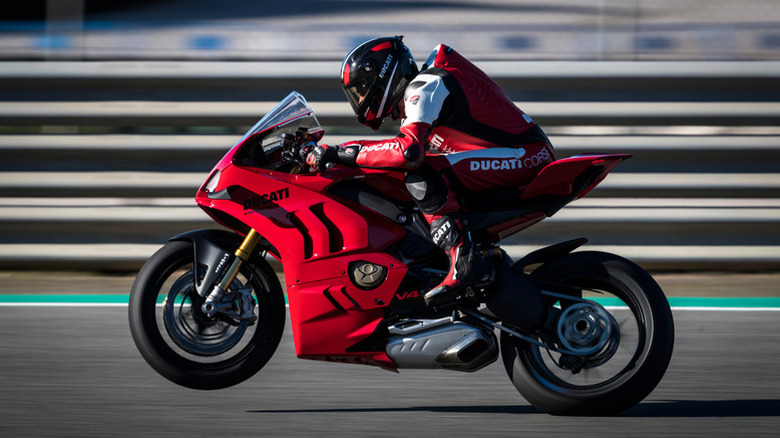
It's impossible to argue that Ducati's Panigale V4 is anything but ridiculously fast. Shortly after BMW unveiled its updated K67-generation S1000 RR, Ducati set its race team about making an even faster Borgo Panigale product. And to one-up the Deutsche dorks, they only needed a single R in the bike's name to do it. Also a World Superbike class homologation special, the Panigale V4 R delivers Ducati's highest echelon of street-legal performance.
Equipped with a street version of the race bike's Desmosedici Stradale R engine, the V4 R is rated at an impressive 221 hp and 83 lb-ft of torque. The R was also ten pounds lighter than the standard Panigale V4. This is, arguably, the fastest motorcycle on the planet with a number plate, with a claimed top speed of 197 mph.
Ducati wasn't happy with just 197 mph, however, and set its sights on reaching the much ballyhooed "double ton" mark. If you were one of the people who ordered a Panigale V4 R, you could also tick an option box to get a Ducati-developed racing kit with a lightweight Akrapovic exhaust. This exhaust doesn't pass emissions or noise regulations, so it's not strictly street legal. With that kit installed, the bike's power jumps up to 239 ponies, and over 10 pounds are removed from its frame. With the racing kit installed, the top speed of the Panigale V4 R increases to an unfathomable 205 mph.
Before the V4 R, there had never been a street-legal motorcycle to break the 200 mph barrier. While the Ducati is available in a street-legal configuration, and there's very little stopping an owner from running the racing kit on the street, it still falls just short of the goal.
2015 Kawasaki Ninja H2R - 248.5 MPH
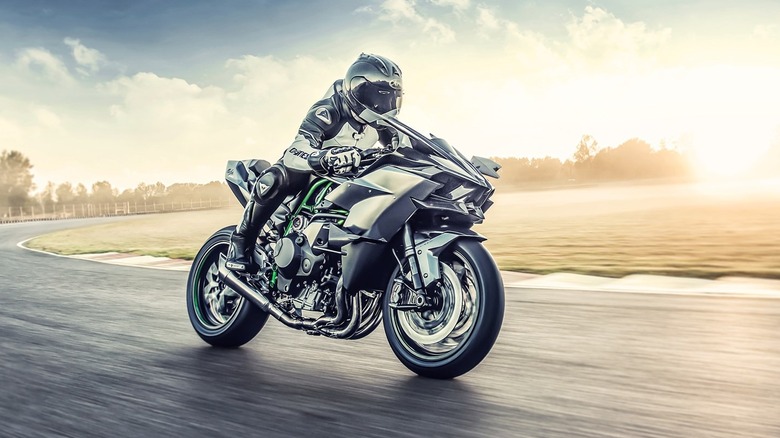
While the rest of the world was still thinking about superbikes, Kawasaki jumped straight into the hyperbike sphere with its 2015 Ninja H2. The street-legal Ninja H2 was already incredibly fast, featuring a 240-hp 998cc supercharged inline-four and the same 186 mph top speed as every other street superbike. But with the standard bike's governor tuned out, the H2 is more than capable of speeds in excess of 200 mph. Kawi won't sell them that way, though, and we can hardly count a modified version as the speed king of motorcycles.
Like Ducati, however, Kawasaki will sell you a non-street-legal version of its fastest and most powerful motorcycle (for a limited time window each year and for over $62,000), and it is easily capable of over 200 mph. The track-only H2 R claims an incredible 322 hp peak, and an even more bonkers 121.5 lb-ft of torque. This machine is a little heavier than the lightweight race homologation specials from Europe, tipping the scales at 476 pounds in ready-to-ride specification.
Any motorcycle with a power number in the 300-plus range is bound to be blisteringly fast. And with WorldSSP Challenge rider Kenan Sofuoğlu aboard the good ship H2 R, the bike reached an incredible top speed of 400 kph (the equivalent of 248.5 mph) on the Izmit Bay Bridge in Turkey. Kawasaki claims the stock version of the bike tops out at 380 kph, but Sofuoğlu maintains that he "made small changes" but did not modify the bike. A hair's breadth from 250 mph on a stock motorcycle is just next-level speed, regardless of its street legality.