

Kawasaki's Fastest Motorcycles, Ranked By Top Speed
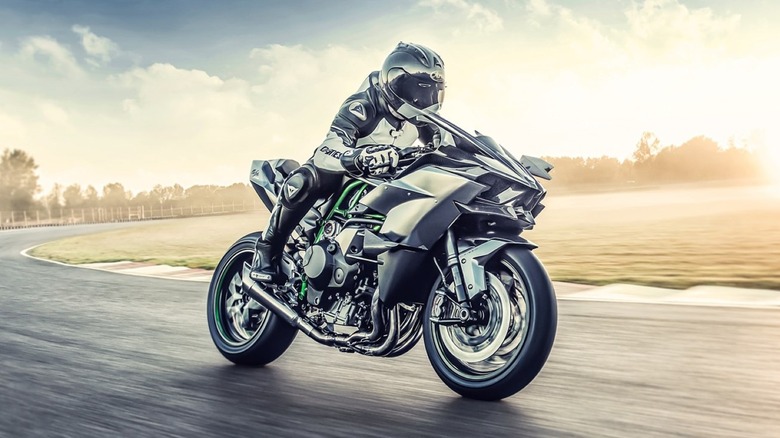
The Japanese "big four," Honda, Yamaha, Suzuki, and Kawasaki, have been battling for motorcycle dominance since the 1950s, producing ever faster and better superbikes. Each of these companies has its own philosophy on what makes the perfect superbike, and Kawasaki's has always been akin to "nothing else on the tarmac should pass you." From the Z1 900, which shattered the 24-hour speed record in 1972, to the famous Ninja line, Kawasaki has always represented the ultimate top speed benchmark.
You could argue that Kawasaki's pursuit of speed was also one of the biggest reasons motorcycle manufacturers reached a gentlemen's agreement to limit all bikes to a top speed of 186 mph. This, of course, deprived us of the excitement a new speed demon brings to the table. Every new superbike, and particularly Kawasaki's models, is easily capable of going past that figure and landing in the 200-mph realm. But, of course, we can't know which one is the fastest, because they all have the same 186-mph top speed.
But don't you worry, because in our list of Kawasaki's fastest motorcycles — which includes models like the GPZ900R Ninja, the ZX-10 Tomcat, and the Ninja ZX-9R — we'll also give you the derestricted top speed of some models, showing you how far this manufacturer has really pushed the game. And to be absolutely sure about the top speed figures, we cross-referenced data from official brochures and reputable publications, aiming to be as precise as possible. Now, let's unpack Kawasaki's fearsome speed kings!
1984 to 2003 Kawasaki GPZ900R Ninja (157 mph)
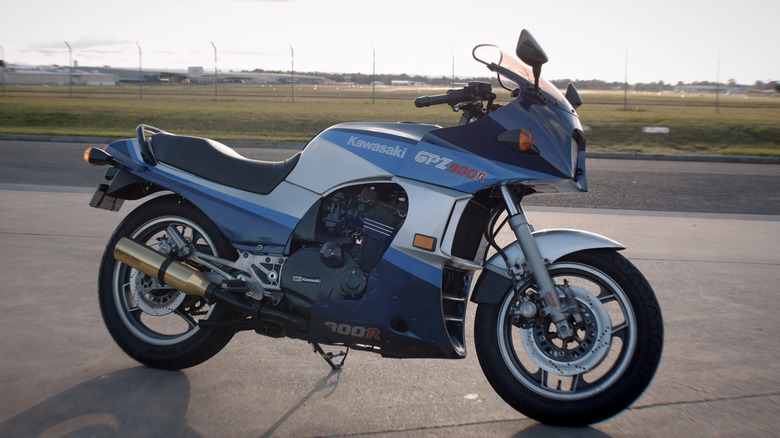
The year is 1984. Honda has already changed the high-performance bike game with the agile Interceptor 750, while Suzuki topped the top-speed charts with the brutal, air-cooled GS1150ES, reaching over 140 mph. Kawasaki's answer, the GPZ900R, also known as the Ninja in the U.S., was a bit of both — a superbike that would push the top speed game, while remaining nimble and entertaining to ride.
To clinch the ultimate speed crown, Kawasaki equipped the GPZ900R with a 908cc liquid-cooled, 16-valve inline-4, producing 115 horsepower. The bike also featured an aerodynamic fairing, crucial to beat the rivals at the top end. According to Bennetts, it was enough for a top speed of 157 mph, though most publications state a top speed of 155 mph. Both were high enough to crown the GPZ900R as the fastest bike in the world, and helped it snatch a prominent role on the big screen as Maverick's (Tom Cruise) motorcycle in the 1986 "Top Gun" movie.
Yet, the straight-line speed was never the most impressive part about the first Ninja. To make a 160-mph bike that was also agile enough in the corners, Kawasaki introduced a new lightweight, race-inspired "Diamond" frame. The relatively narrow inline-4 engine was used as a stressed member to further stiffen up the chassis, aided by a state-of-the-art suspension tech. Chiefly, The GPZ900R featured front 38-mm Kayaba forks with hydraulic AVDS (Automatic Variable Damping System) anti-dive technology, paired with a Kayaba Uni-Trak rear mono shock. The end result was a fast and stable bike that still feels modern to ride today. No wonder it remained on sale for almost two decades.
1988 to 1990 Kawasaki ZX-10 Tomcat (166.5 mph)
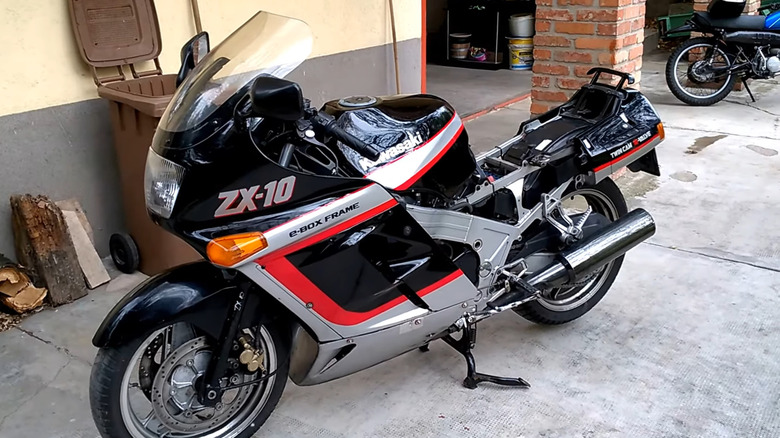
To protect its top speed crown, Kawasaki quickly followed the GPZ900R with the GPZ1000RX. Equipped with a 998cc inline-4 and a full fairing, the 125-hp machine reached 159 mph, higher than its 1.0-liter class rivals. However, the GPZ1000RX was a significantly heavier machine, weighing in at 524 pounds dry, compared to the GPZ900R's 502 pounds.
So, only two years after its release, Kawasaki followed it with the ZX-10 Tomcat. The new bike's main feature was the lighter and more rigid "E-box" frame, which featured aluminum beams running around the engine. As a result, the ZX-10 had a dry weight of only 490 pounds, which made it not only lighter than the GPZ1000RX, but also the GPZ900R Ninja.
Still, Kawasaki never intended to make the Tomcat a track bike. The ZX-10 had a relatively soft suspension, which made it more of a fast grand tourer that felt stable at higher speeds. To that end, the bike featured an improved version of the engine found in the GPZ1000RX. Featuring a higher 11.0:1 compression ratio and four 36-mm Keihin CV carburetors, the updated engine produced 137 hp at 10,000 rpm. It was paired exclusively to a six-speed gearbox.
Aided by the smooth, slippery bodywork, the liquid-cooled engine allowed the ZX-10 to a top speed of 166.5 mph in Motosprint magazine's 1985 comparison test (via Motorcycle Specs), though some publications stated an even higher top speed of 168 mph. Either way, Kawasaki's flagship was again rated as the fastest bike in the world.
1998 to 2003 Kawasaki Ninja ZX-9R (175 mph)
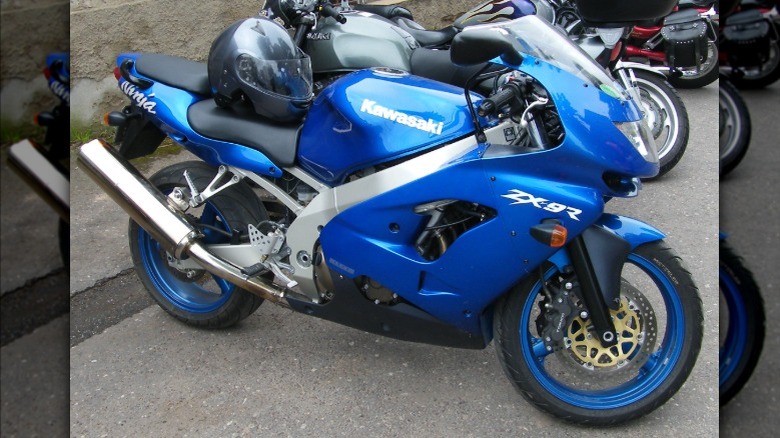
The Ninja ZX-9R was Kawasaki's sub-liter superbike during the 1990s. However, the first model launched in 1994 wasn't a class-beater like its predecessors, due to its high dry weight of 477 pounds, particularly when compared to the featherlight Honda CBR 900RR Fireblade (408 pounds).
So, for 1998, Kawasaki made a significant revision in order to bring it closer to its rivals. Thanks to a new aluminum twin-spar frame, the upgraded "C model" was 66 pounds lighter, weighing in at just 403 pounds, and received a significant power bump. Kawasaki retained the liquid-cooled inline-4 engine, but it was massaged to 143 hp at 11,000 rpm. As a result, the ZX-9R could reach up to 175 mph, making it one of the fastest 900cc bikes of its era. Beyond the radical chassis diet, the ZX-9R also had a shorter wheelbase for more responsive handling, lighter 46-mm KYB front forks, and a lighter rear piggyback shock.
Overall, these changes improved the bike dramatically, making it better than the Fireblade in many aspects. Unfortunately for the Ninja ZX-9R, Yamaha launched the YZF-R1 in 1998. Boasting a 998cc engine with 149 hp and a curb weight of just 390 pounds dry, the YZF-R1 set new performance standards in the superbike category. What it didn't do, though, was beat its Kawasaki rival at the top end — thanks to its ram-air system, the Ninja ZX-9R had a higher top speed than its rival, which only mustered 172 mph.
1990 to 2001 Kawasaki Ninja ZX-11/ZZR1100 (178 mph)
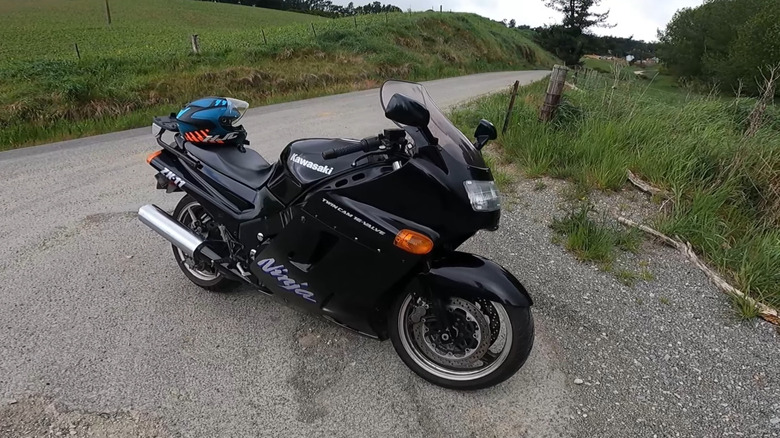
After largely dominating the 1980s top-speed wars, Kawasaki opened the next decade with a new missile designed to outdo its rivals at the top end. To do that, the company utilized a 1,052cc inline-4 engine, good for 147 horsepower and a meaty 81 pound-feet of torque, paired to a six-speed gearbox. Aided by a ram-air system that fed the engine with cool, pressurized air at high velocities and a full aerodynamic fairing, it again brought Kawasaki the top speed crown. In a Motorcyclist Magazine test (via Hot Rod), the 1990 ZX-11 reached 173 mph with crosswind.
And things got even crazier with the upgraded 1993 ZX-11 "D model." Featuring a lighter aluminum frame, slightly longer wheelbase, and a larger ram-air system, the ZZ-R 1100, as it was called in other markets, reached a top speed of 178 mph in a 1993 Motosprint test (via Motorcycle Specs). In fact, the Cycle World Magazine reported a 180-plus mph top speed was "likely" for the upgraded 1993 model on a long enough road and close to sea level.
Yet, the ZX-11 wasn't just a one-trick pony. It was also good in the corners, despite its hefty dry weight of 514 pounds, and fairly comfortable, too. The upgraded 1993 model also felt more stable at speed, thanks to the upgraded steering geometry, and had larger front brakes. The ZX-11 remained virtually untouched through 2001, a testament to how complete the original engineering package truly was.
2018 to present Kawasaki Ninja H2 SX (186 mph)
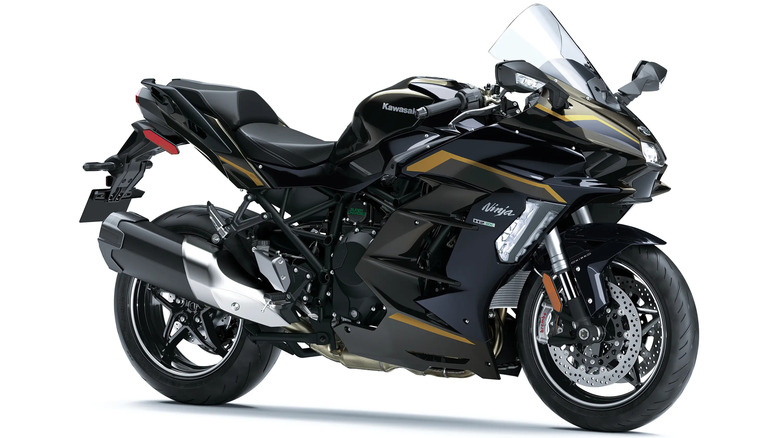
Bikers in the 1990s would've been in awe if you brought them a 186-mph motorcycle that's not built for the track, but for the long haul. Tell them it tipped the scales at a hefty 573 pounds, and that top speed becomes all the more unbelievable. It's all thanks to Kawasaki's unique supercharged platform, which allowed it to produce a highly comfortable sports tourer with a superbike-like top end.
Launched in 2018, the Ninja H2 SX packs a 998cc supercharged inline-4 engine that produces 197 hp, or 207 hp with the ram-air effect at higher velocities. More importantly, the boosted engine boasts a class-leading 101 pound-feet of torque. This mid-range pull suits the sports-tourer nature of the bike, providing effortless acceleration at all speeds. As you'd expect, an engine that powerful is good enough for an electronically limited top speed of 186 mph, installed because of the gentlemen's agreement that capped motorcycle speed. Derestricted, it could probably go near the 200-mph mark, an impressive feat for a sports-tourer bike.
Indeed, the Ninja H2 SX can accommodate two passengers comfortably, thanks to wide and thick seats. The higher-end SE trim, available since the 2022 model year, also has Kawasaki's latest rider assistance systems. These include Kawasaki Corner Management Function (KCMF) and Kawasaki TRaction Control (KTRC), alongside the Kawasaki Electronic Control Suspension (KECS) and Brembo Stylema front monobloc calipers. To enhance the rider's comfort and safety, Kawasaki also implements adaptive cruise control and blind-spot detection in the 2026 Ninja H2 SX SE.
2004 to present Kawasaki Ninja ZX-10R (186 mph)
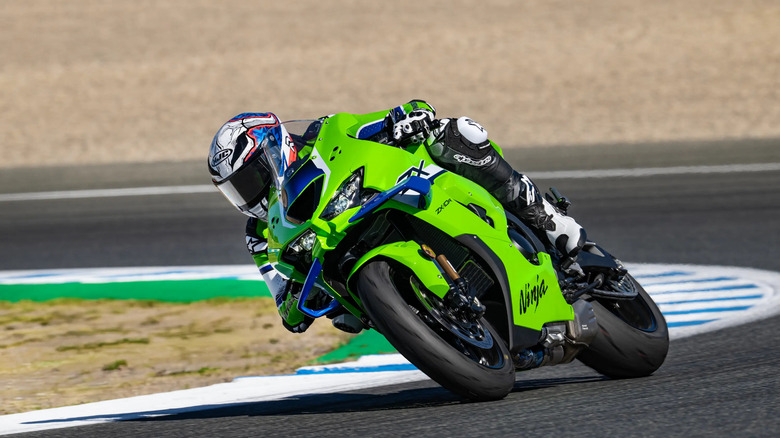
Back in 2004, Kawasaki shoehorned a 998cc engine in a 600cc bike chassis, creating one of the wildest superbikes at the time. This uncompromising approach has brought the Ninja ZX-10R the "widow maker" moniker, a reputation Kawasaki already earned with the 1972 H2 beast. With 160 horsepower on tap and a wicked low dry weight of 375 pounds, the ZX-10R brought Moto GP levels of performance (179-mph top speed) and agility to the hands of regular riders.
But that was only the beginning. Kawasaki continually improved the Ninja ZX-10R formula, massaging the engine for more linear power delivery and improving the handling with a stiffer frame, new geometry, and better suspension components. Later models were also more powerful, producing up to 210 hp with the ram-air system, enough to break the 180-mph barrier. Jump forward to the 2021-to-2025 model, and the Ninja ZX-10R again featured a 998cc inline-4, producing 200 hp and allowing a top speed of 186 mph.
For the 2026 model year, Kawasaki made a few changes to the platform. Chiefly, the engine was upgraded to be compliant with the more stringent Euro 5+ emission laws, which has brought the output down to 193 hp in Europe and 190 hp in North America. Kawasaki hasn't published the top speed of the latest model, but an important new feature are the front winglets, which enhance front-wheel downforce by 25%. Kawasaki also equips the latest Ninja ZX-10R with Showa suspension with revised geometry, front Brembo M50 monobloc calipers, and an Öhlins steering damper.
2000 to 2006 Kawasaki Ninja ZX-12R (187 mph/197 mph derestricted)
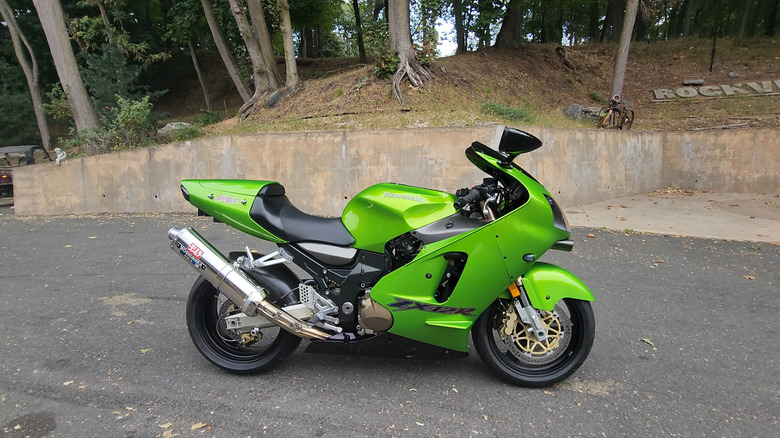
With a groundbreaking top speed of 194 mph, the Suzuki Hayabusa was by far the fastest production bike at the turn of the millennium. Kawasaki, of course, wasn't happy, and launched a response in the name of the Ninja ZX-12R.
Powered by a 1,199cc inline-4 engine with 178 horsepower, the high-capacity Ninja was designed to bring back the crown back to Kawasaki. And in the bikemaker's internal tests, the bike reportedly reached 197 mph, unrestricted. The problem was that the gentlemen's agreement to limit all bikes to 186 mph had just started being implemented, and Kawasaki wasn't able to show what the ZX-12R was really capable of. In the end, Cycle World measured a top speed of 187 mph in its test (perhaps Kawasaki's speed limiter wasn't that precise) and a quarter-mile time of 10.04 seconds.
But the spec sheets didn't capture the full Ninja ZX-12R picture. Kawasaki's speed demon was also good in the corners, thanks to a more aggressive geometry, shorter wheelbase, and fuel tank positioned below the seat for a lower center of gravity. The ZX-12R was also the world's first bike with a monocoque backbone aluminum frame with no side spars, which allowed for a much narrower and more aerodynamically efficient design. At 463 pounds dry, the Ninja ZX-12R was also lighter than the Hayabusa, which weighed in at 480 pounds dry.
2006 to Present Kawasaki Ninja ZX-14R/ZZ-R 1400 (186 mph/208 mph derestricted)
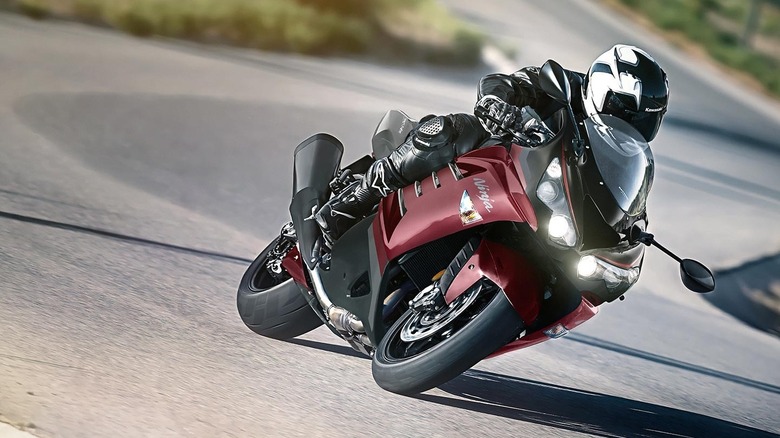
Launched as a successor to the ZX-12R straight-line wonder in 2006, the Kawasaki ZX-14R finally gave the Hayabusa a run for its money. Thanks to its large 1,352cc engine with 187 horsepower (197 hp with the ram-air effect) and relatively light aluminum frame, Kawasaki's high-capacity sportbike sprinted to 100 mph in brisk 6 seconds and reached an electronically limited top speed of 186 mph.
But that was just Kawasaki warming up. For 2012, the bikemaker introduced a more potent 1,411cc engine with 200 hp, or 210 hp at higher speeds, thanks to the ram-air system. The ZX-14R is still sold with the same engine today, as it went relatively unchanged for over a decade. The bike did receive standard ABS in 2014, but it's otherwise mostly the same model it was back in 2012.
And in this case, that's not a bad thing. The so-called "King of the Quarter Mile" dispatched the quarter-mile in just 9.64 seconds back in 2012, with an astonishing exit speed of 149 mph, per Cycle World. The 0-to-60 time of 2.6 seconds also makes it one of the quickest street legal motorcycles ever made. Kawasaki still kept it limited at the top end because of the gentlemen's agreement, but the Ninja ZX-14R was always capable of a much higher top speed.
How much higher? Well, in 2013, the Ninja ZX-14R set the new Australian Land Speed record in the 1,650cc class at Lake Gairdner with a top speed of 208.153 mph. The record-breaking motorcycle had different gearing and tires, and its speed limiter was obviously removed, but it was otherwise bone stock, which makes the feat even more impressive.
2015 to present Kawasaki Ninja H2 (186 mph)
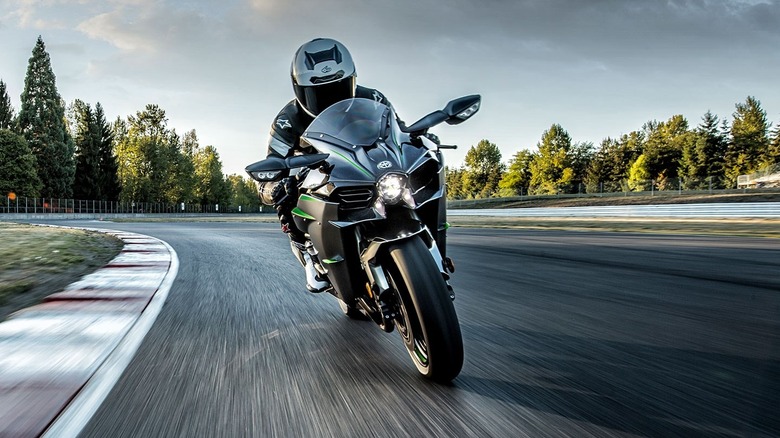
Supercharged motorcycles were nothing new in 2014 when Kawasaki launched the Ninja H2. But that didn't make the launch less shocking. The Ninja H2 quickly stole the headlines thanks to its groundbreaking 998cc engine equipped with a centrifugal supercharger. And this wasn't your standard off-the-shelf supercharger from Eaton or Rotrex. Instead, Kawasaki tasked its own Gas Turbine & Machinery division to come up with a more efficient supercharger, capable of spinning at over 130,000 rpm.
As a result, the supercharged beast of an engine produced 200 horsepower (210 hp with the ram-air effect). Yup, that's not much different from the naturally aspirated ZX-10R, but the supercharged H2 generates significantly fewer emissions. Plus, it produces a higher 98 pound-feet of torque (ZX-10R: 82 pound-feet). Yes, Kawasaki had to limit the top speed to 186 mph, but the Ninja H2 got there faster than other one-liter-class bikes, dispatching the quarter mile in just 9.87 seconds (per Motorcycle News).
Besides, thanks to the supercharged platform, the H2's engine is easy to tune way past the factory figures. Cycle World tested a model with Brock's Performance Stage II kit that produced over 274 hp and reached a top speed of a staggering 226.9 mph. That's faster than the Ferrari F80 hypercar (217 mph) and Kawasaki's drag-strip king, the Ninja ZX-14R.
Oh, and the current Ninja H2 is even more powerful, producing 240 hp with ram-air pressure and an even higher 104.5 pound-feet of torque. It's still limited at 186 mph, but it's more than powerful enough to break the 200-mph barrier with the governor removed.
2015 to present Kawasaki Ninja H2R (248 mph)
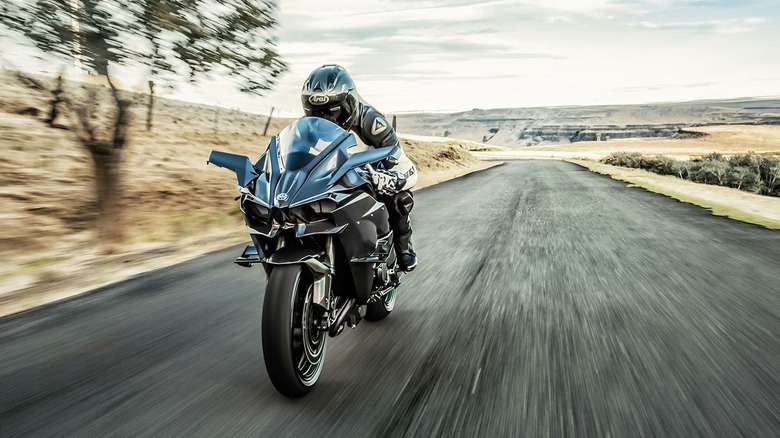
Kawasaki didn't let the public wonder how fast its supercharged platform go unrestricted. Right next to the H2, the Japanese bikemaker also launched the H2R — a track-only machine designed to bring speed crown back to Kawasaki.
The H2R is truly an extreme bike, powered by the same 998cc supercharged engine as the H2, but tuned to a staggering 322 horsepower with the ram-air effect at higher speeds, and 121.5 pound-feet of torque. For comparison, Ducati's track machine, the Panigale V4 R, packs a 998cc V4 engine that produces 218 hp stock (208 hp in the U.S.), and only 84 pound-feet of torque.
With WSSP rider Kenan Sofuoğlu on the saddle, the Ninja H2R flexed its muscles by reaching a top speed of 248 mph on the Izmit Bay Bridge in Turkey, thus breaking the world speed record. According to Kawasaki, the production bike will reach around 240 mph on an open straight, which isn't any less bonkers.
But what's truly impressive about the H2R is that it's also built to be good in the corners. Thanks to the extensive use of carbon fiber, it's a much lighter and smaller bike than the previous speed kings, like the Hayabusa and ZX-14R, with a wet weight of just 476 pounds. Considering the relatively aggressive geometry for such a fast bike, Kawasaki implemented front winglets on the H2R to increase downforce and keep it stable at speed. For ample stopping power, the H2R features Brembo Stylema monobloc calipers, while a 43-mm inverted Kayaba AOS-II front fork and rear Öhlins TTX36 piggyback shock keep it planted on the track.