

SpaceX Is So Confident In Its New Starship Rocket That It's No Longer Taking Reservations For The Dependable Falcon 9
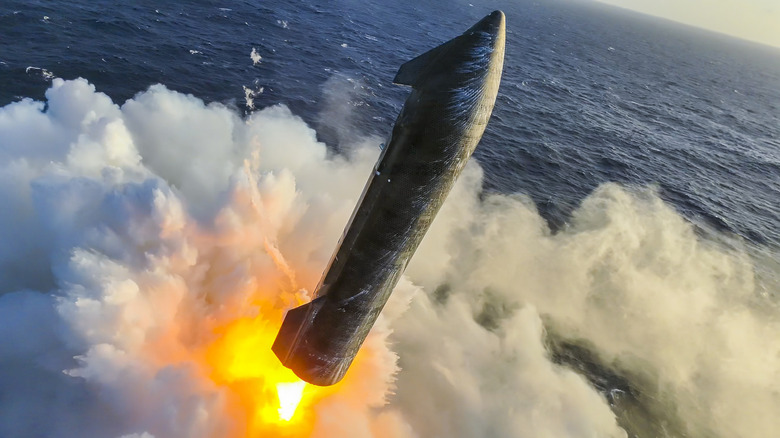
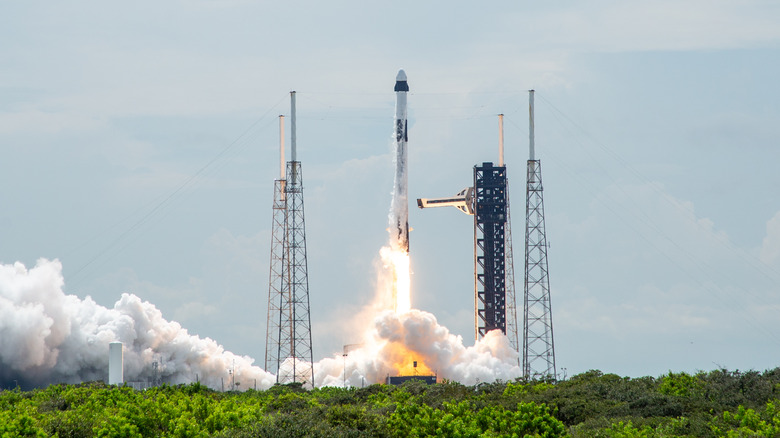
What does space look like with the Falcon 9 rocket from SpaceX? We may be about to find out, since according to numerous industry and government sources, SpaceX is no longer taking reservations for its workhorse past 2028. The company's belief is that, by then, its new Starship rocket will be up and running, capable of flying the Falcon 9's mission profile and so much more. The concerns are whether or not Starship can actually make that schedule and, even if it can, whether it really can do everything the Falcon 9 does. Naturally, SpaceX could change its mind, but what will other satellite companies do in the meantime as they're trying to get mass to orbit?
In 2025, the Falcon 9, by itself, accounted for nearly half of all launches from planet Earth, a truly astonishing accomplishment. It achieved orbit 165 times, delivered every payload, and only failed recovery once. Its reusable booster stage and frequent flights dropped the price of putting cargo in space, opening up an entire new orbital and lunar economy. It's one of those vehicles that legitimately changed the world.
Now, SpaceX CEO Elon Musk wants to get rid of it: "Once Starship is flying reliably several times per week, it makes sense to shift super scarce SpaceX engineering and production resources to Starship to get launch rate to several times per day, which means winding down Falcon." On its surface, that's fine. A company wants to put all its weight behind its new product, not its old one, and he's saying that this will only happen once Starship proves itself. The trouble is that SpaceX is refusing to take post-2028 reservations now, meaning that it has simply decided that Starship will have proven itself by then.
The many missions of the Falcon 9

Many of these customers are satellite operators, startups or small companies that could never have afforded to go to orbit before the Falcon 9. This often takes the form of a space-sharing arrangement, whereby several companies put their satellites into the cargo stage of the same rocket's upper stage. But even with these deals in place, concern was growing that America was headed for a so-called "space crunch," lacking sufficient spaceports and rockets to handle all of the demand. Pull out the Falcon 9 — half of all launches on Earth! — and you can see the issue.
But SpaceX's former golden boy does more than just this — it's also the current American provider for both cargo and astronaut services to the International Space Station (ISS). The ISS may get a life extension all the way to 2032; if SpaceX stops even flying ISS missions, which is the rumor, there's a four-year gap there. That could be filled by the Russian solution, the Soyuz rocket. Or if Boeing's Starliner can sort out its issues, that might be it. But for certain, the enormous Starship upper stage is simply not capable of docking with the station. There's also a possibility that NASA itself is the reason for the ambitious 2028 target date.
Signals from space(X)
The original plan for landing American astronauts back on the Moon is fairly complicated. Basically, the astronauts will board an Orion capsule atop an SLS rocket, just like the Artemis II mission. Separately, a SpaceX Starship would launch, and its upper stage would be refueled on-orbit 15 times. Then the upper stage would fly itself into lunar orbit, rendezvous with the Orion, and receive two astronauts for landing. This is all scheduled for, you guessed it, 2028.
In other words, to keep its NASA lunar contract, SpaceX has to get the Starship operational by that year. And if that has to be true, then you can start making other decisions, like winding down the Falcon 9. After all, Starship will be ready by 2028, because it has to be! So the company may be refusing reservations as a kind of signal to the space agency.
NASA is less certain. It re-opened the contract for the lunar lander, and the only other candidate is Blue Origin. The newest version of the Starship prototype only started flying this year, and has never been to orbit; the first attempt is scheduled for September 28. That ought to be a clue as to how close to 2028 Starship actually is. In the meantime, other rocket companies may try to cover SpaceX's gap, but none of them launch as often as the Falcon 9. When a whole human endeavor is underpinned by one company, this is the sort of thing that happens.