

2027 Nissan Rogue Hybrid Debuts With An EV-Like Driving Experience And 40 MPG
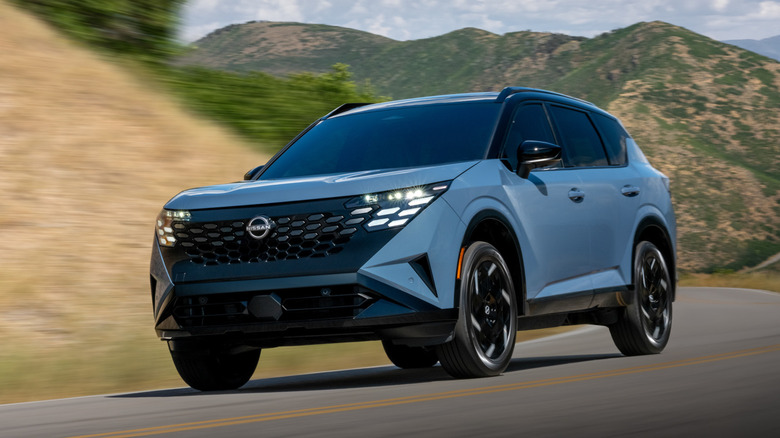
The humble compact crossover is undoubtedly the most important segment in the automotive industry, both here in the U.S. where they make up more than 20% of the market, and globally where they're also super popular despite what people say about SUVs being solely an American obsession. The Rogue has been Nissan's best-selling model for years, but in its segment the car has been slipping behind — at this point it's six years old, and there hasn't been a hybrid option with this generation.
Nissan sees big demand and growth opportunities for hybrids in America, so now, a few months after the exterior design was first teased, the fourth-generation 2027 Nissan Rogue Hybrid has been revealed for the U.S., debuting Nissan's e-Power hybrid technology in North America for the first time. While every other plugless hybrid in the U.S. is a parallel system, with the electric motors working with the gas engine, the e-Power system is a series hybrid, where the engine is just used as a generator for the electric motors that drive the wheels, giving it a much more EV-like driving experience than any other hybrid.
It's even got one-pedal driving
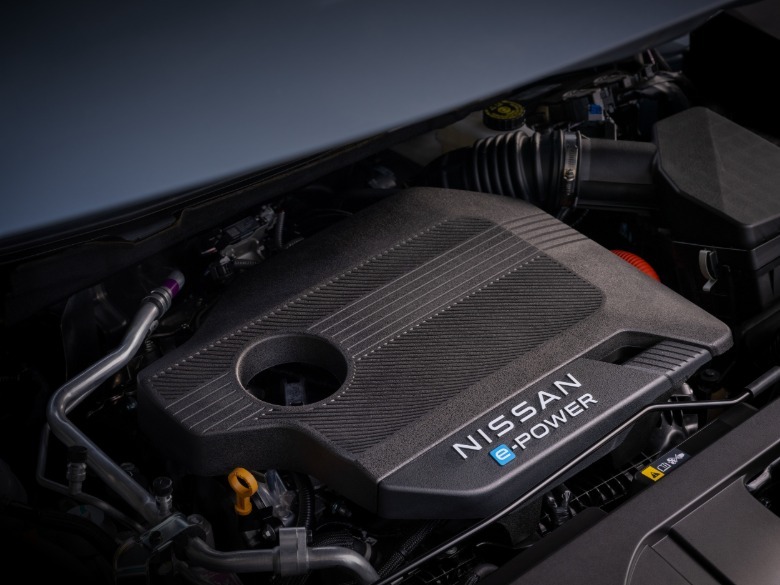
Nissan has already made nearly two million e-Power hybrids worldwide — in Europe and Asia it's available in all sorts of segments from the tiny Note hatchback and Kicks crossover to the large Elgrand minivan — so the technology is pretty proven at this point. Under the hood is a turbocharged 1.5-liter inline-3 engine that produces 148 horsepower and 171 lb-ft, and though that's the same configuration as the old Rogue, this engine is a unique development for the e-Power system. The automaker says it's "specifically tuned for quietness and efficiency," and it has 42% thermal efficiency. When the 1.67-kWh lithium-ion battery pack has enough charge the engine will shut off, and while the outgoing Rogue was only offered with a continuously variable automatic transmission, the e-Power system has no transmission at all.
 Nissan
Every Rogue Hybrid has two electric motors, one on each axle, giving it standard all-wheel drive and continuously adjusting torque vectoring. The larger front motor has 202 hp and 243 lb-ft while the one on the rear axle makes 134 hp and 144 lb-ft; total system output is 225 horsepower, 24 hp more than a current nonhybrid Rogue. Nissan doesn't give a 0-to-60-mph figure, but says it will have "swift, smooth and confident acceleration," and even with the engine running it should feel more like an EV than a regular hybrid. It'll be able to tow 1,500 pounds.
EPA figures aren't available yet, but for the mid-range SR trim Nissan is estimating the Rogue Hybrid will get 38 mpg combined, 40 mpg city and 36 mpg highway. That's better than the Kia Sportage and Hyundai Tucson, about the same as the Honda CR-V and a few mpg worse than the Toyota RAV4. Unlike all those parallel hybrids, the Rogue has regenerative braking with EV-style one-pedal driving, as well as a Smooth Stop function that "automatically modulates brake pressure at the end of a stop, reducing head-toss and creating a more controlled, refined stopping experience." That'll be nice for the thousands of these that will surely be used as Ubers.
Nissan is finally taking some risks again
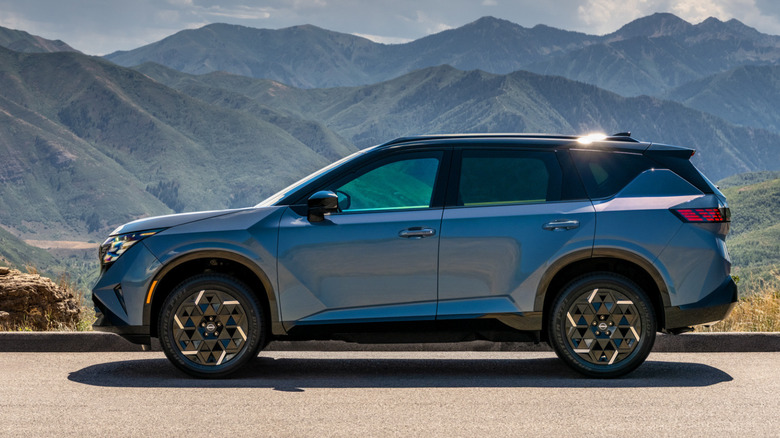
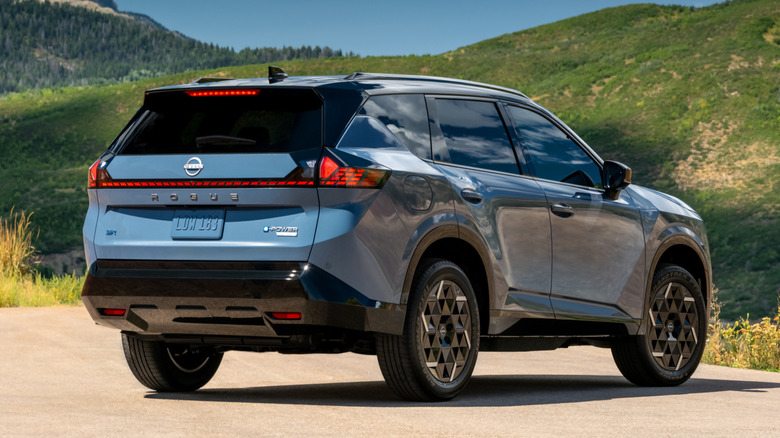
Nothing about the Rogue Hybrid's design has changed since Nissan showed the first images in April, and it still looks really great. Nissan's design language has been getting a lot bolder and more interesting, as evidenced by its angular surfacing, hexagonal lights and technical detailing. The one you see in these photos is the SR trim, which gets sportier styling with more black accents. There will be eight paint colors, five of which can be paired with a black roof. Aurora Dune Pearl, Alpine Metallic, and this Horizon Blue Pearl Metallic are new, the last of which "shimmers red-yellow in the sunlight."
Compared to the outgoing Rogue, the new model is a tenth of an inch longer, four tenths of an inch narrower, and 1.2 inches taller; the 106.5-inch wheelbase is the same. There's a few tenths more ground clearance, too. Despite all the hybrid stuff, the e-Power isn't that much heavier than a regular Rogue. In its lightest SV trim the Rogue Hybrid weighs 4,065 pounds, against 3,657 pounds for a nonhybrid Rogue SV with all-wheel drive.
This is a pretty big glow-up
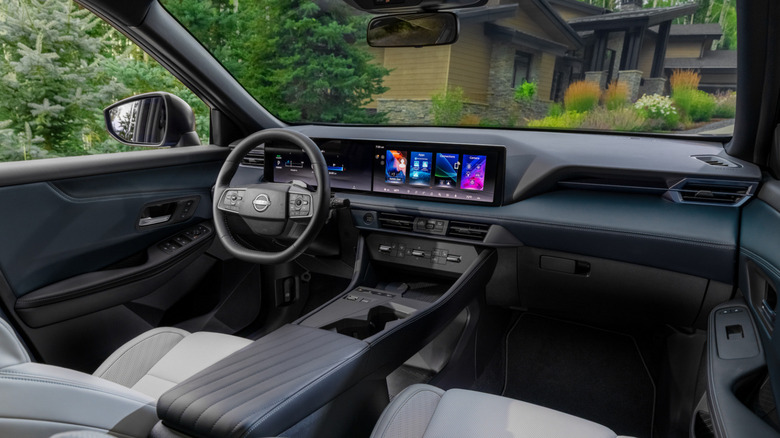
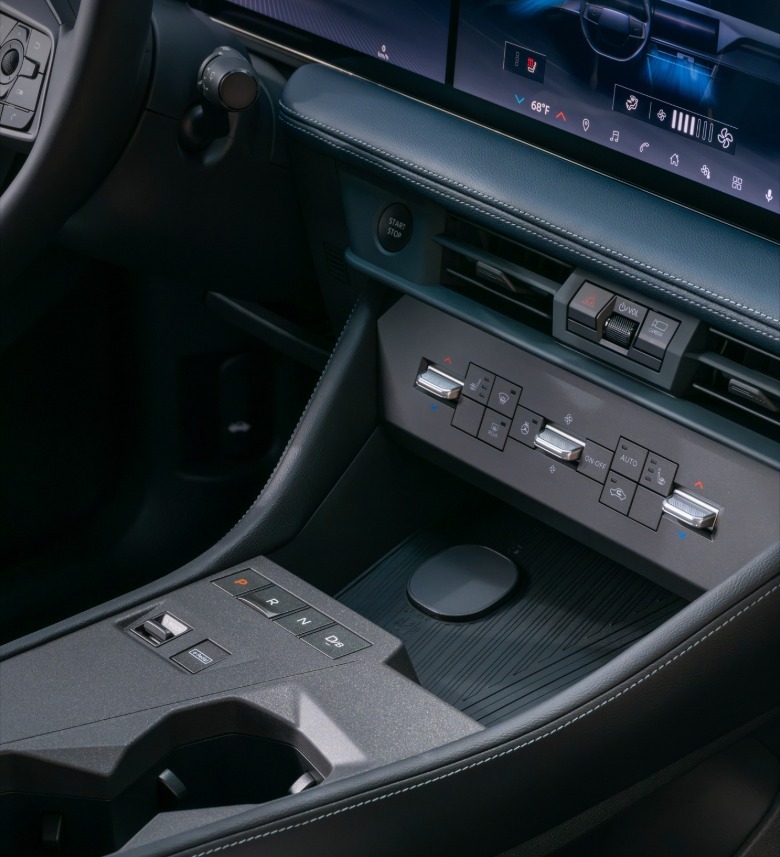
The Rogue's glow-up is even more extreme inside. It seems like there are nicer materials and a bigger use of accent stitching, and I love the partially blue color scheme seen here. Because there's no transmission, the center console has a large space underneath the bridge where the cupholders, wireless charging pad, shifter buttons and drive mode switches are located. A pair of wide screens stands free from the angular dashboard, with both screens being 12.3 inches as standard or 14.3 inches as an option. The infotainment system looks like a nice upgrade from Nissan's current system, though the surround-view cameras still don't look great. You do get 64-color ambient lighting, at least.
 Nissan
You'll surely appreciate the Rogue Hybrid's climate-control setup. Yes, there's an expanded climate control menu in the touchscreen, but just below the manually adjustable air vents in the dash are physical toggles for temperature and fan speed, plus buttons for the heated steering wheel, heated and ventilated seats (the latter being new to the Rogue), windshield and rear window defrosters, and recirculation and auto buttons. In between the air vents are a button for the cameras and a roller knob for volume.
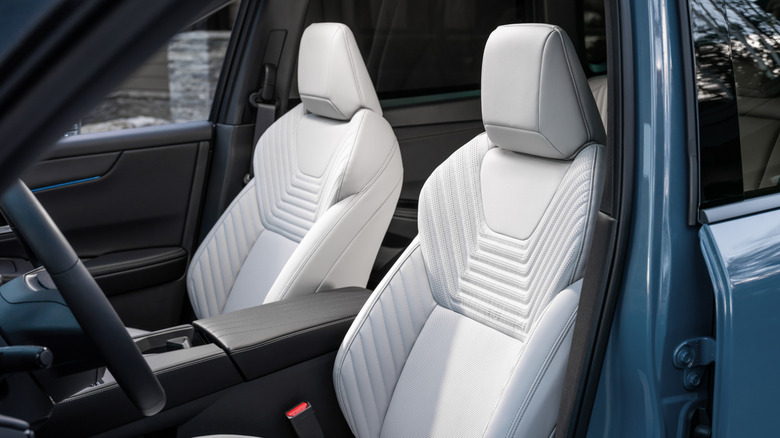
Nissan says the rear doors open to almost 90 degrees so it's easier to put in a car seat, and the Rogue has LATCH anchors for the center seat, something many other SUVs don't offer. With the rear seats up there's 31.1 cubic feet of cargo space, only slightly less than the current Rogue, and with the rear seats folded that expands to 65.9 cubes. 1.8 inches of additional trunk length was gained by thinning the inner liftgate trim.
On sale soon
Every Rogue Hybrid will come standard with Nissan's latest ProPilot driver-assistance technology that is promised to be more natural. The adaptive cruise control has one more following distance setting (for a total of four) and better low-speed operation, and it can detect slowing or stopped cars 33% sooner. Also improved are the steering assist and lane centering, with Nissan saying "the system 'looks' an additional second farther down the road and has 12% more steering authority," whatever that means. Hands-off Traffic Jam Support and automatic lane changes are new options, and other standard features include blind spot assist, automatic high beams, automated emergency braking with pedestrian and cyclist detection, lane departure warning and rear cross traffic alert.
First to go on sale this fall will be the SR trim with the SR Technology package, which starts at $43,065. Following in early 2027 will be the rest of the lineup: the $37,065 SV, $39,065 SR, $39,165 SV with SV Premium package, and $45,065 Platinum. Now that the Rogue Hybrid is out, the Mitsubishi Outlander-based Rogue PHEV should be getting quickly phased out. And though it seems like a given that the e-Power will be joined by a regular Rogue that does without the hybrid system, that hasn't been confirmed.