

China Plans To Return Samples From Mars In 2031 After The U.S. Cancels Its Own Plans
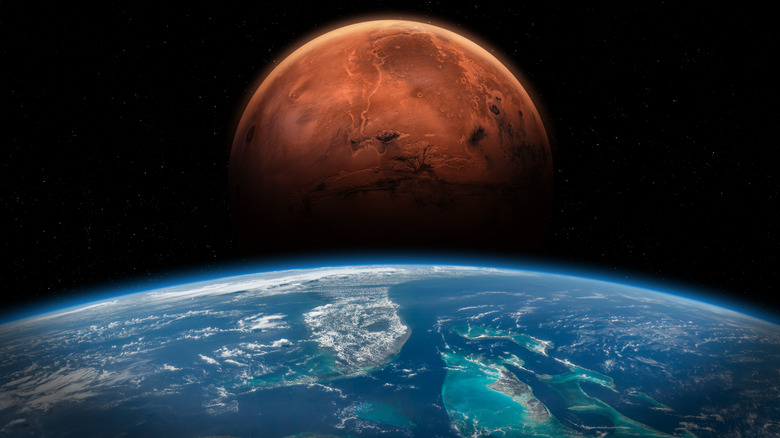
In an interview with state media, Chinese scientist Hou Zengqian has confirmed that the Tianwen-3 mission is on pace to launch to Mars in 2028 and then return a rock and soil sample to Earth in 2031. There are a number of technical challenges to overcome along the way, but as the mission's chief scientist, Hou seems bullish. That stands in stark contrast to America's own Mars Sample Return (MSR) mission, which is the one project that Congress didn't save from President Donald Trump's proposed cuts to NASA funding. So even though the Perseverance rover has collected a number of samples over the last five years to be retrieved later, it's unclear if that retrieval will ever happen.
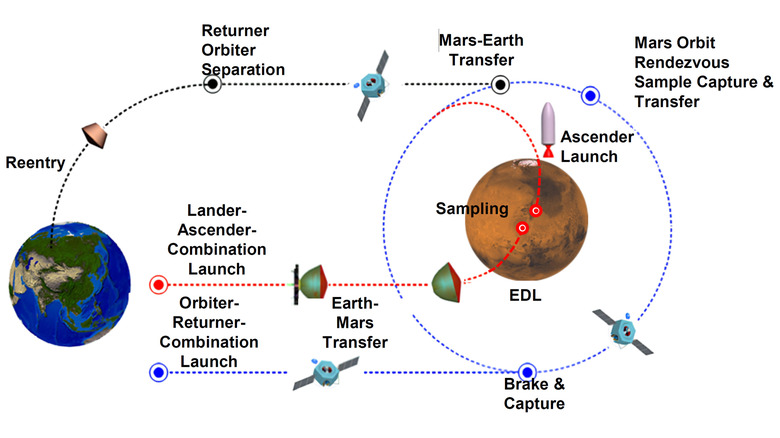
The reason the Chinese mission seems on course here is simple: It's simple. The NASA mission was designed as a multi-stage affair: a rover on the move would drill various rocks and soil, and then a later mission would arrive to gather them all and launch them back into Martian orbit. Tianwen-3 cuts most of that out of the process. It's just a stationary lander, no roving required. It will plop down on red soil, drill down seven feet, suck in 18-ish ounces of material, and then launch it straight back into orbit. It won't need to wait for a second mission to collect what it's drilled out. Total mission time after landing: about two months. In contrast, Perseverance got to Mars in 2021, and while it continues to do great science on its own, its poor samples are just sitting there on the surface, all alone, so lonely. And they'll be like that for a while.
Coming home is hard
Getting to Mars is easy. NASA sent its Viking landers there all the way back in 1976. The hard part, and the reason no humans have ever gone, is coming back to Earth again. To do that, a rare and precious resource is required, possibly the rarest in the whole universe: funding. NASA's MSR project just kept ballooning in price, with the latest estimate being no less than $7 billion and as high as $11 billion. Lockheed Martin, in the name of science (and profit), offered to do it itself for a mere $3 billion. Fortunately for the U.S., the NASA Authorization Act of 2026 would allocate $8 billion to getting this done if it gets passed.
China's much simpler mission keeps things cheap, at least in theory. While Hou announced that things were moving into the prototyping stage, there's a long way from there to "Mission Accomplished." Besides, while the Tianwen-3 plan is simpler than the NASA one, this is still rocket science. The plan is to launch two Long March 5 rockets in 2028, one carrying the lander, the other carrying an orbiter for Mars. After a three-year voyage, the lander will land, drill, collect, and launch the sample back to space. The orbiter will grab that sample and then come back home to Earth.
National pride on another planet
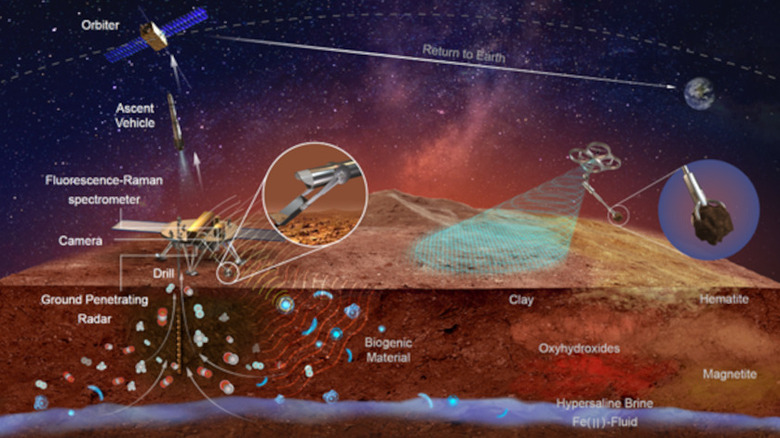
The subtext here is the broader geopolitical struggle between the U.S. and China. NASA is the most prestigious space agency in the world, what with its multiple Mars rovers, the Artemis II mission around the Moon, and plans for a Moon Base in the near future. China is trying to grab a win in the outer heavens to prove its mettle. Landing taikonauts on the latest missions to the Moon before astronauts could do it. So could returning samples from Mars before NASA. If there's evidence of Martian life in that sample, which is the explicit goal of the mission, it could be a devastating blow to the pride in the American space program.
In fact, if this works, don't be surprised if China eventually tries to grab NASA's own samples just sitting there on the Martian surface. You know, "for humanity," or "for science." In completely unrelated news, here's how Hou described the mission to Chinese state outlet Xinhua: "Tianwen-3 will uphold the principle of open cooperation and work with scientists around the world to explore the mysteries of Mars, contributing China's expertise and solutions to expanding humanity's scientific frontier and advancing planetary science."