

Weird Myth That EV Batteries Die All The Time Refuted By Yet Another Study Conducted By Actual Scientists Who Didn't Graduate From Facebook University
EVs already make some of the best daily drivers, and if you have the ability to charge at home, they basically have no downsides. In fact, they're such great daily drivers that once someone buys an EV, they almost never go back to gas. So what are EV haters to do? Admit they were wrong? Of course not. They double down on long-disproven lies, like claiming that EV batteries only last a few years, and before you know it, you'll be on the hook for a $25,000 repair. That's obviously wrong, but in case you needed more evidence, ArsTechnica reports it's been proven wrong once again.
The anti-EV conspiracy theorists would never let facts or research stop them from spreading pro-oil industry propaganda, but if you're a regular person just trying to avoid making an expensive car mistake, don't worry. Aviloo, an Australian EV analytics firm that sounds similar to Recurrent, looked at 20 popular used EV models and computed the median state of health (SoH) for their batteries. While they insisted on using kilometers in their calculations, the results should put your battery replacement worries to rest for good.
As you may (or may not!) already know, modern battery degradation follows an S-curve, with mild range loss in the beginning as the battery "breaks in," followed by a long period where decline remains fairly flat. It's only at the end of a battery's life that you'll notice range dropping off again. Aviloo's test included a wide variety of EVs — Audi, BMW, Ford, Hyundai, Mini, Mercedes, Peugeot, Polestar, Renault, Volkswagen, and Tesla, among others — and found that after 50,000 km or 31,000 miles, median SoH varied between 91% and 97%.
At 100,000 km (or 62,000 miles), median SoH had only slipped to between 88% and 95%, and after 150,000 km or 93,000 miles, the median SoH sat between 87% and 94%. Not bad. Not bad at all. Of course, that's to be expected considering EV manufacturers are federally required to warranty their batteries for a minimum of eight years and 100,000 miles, and if your battery's SoH drops below 70% in that time, you get a free replacement. Car companies just aren't going to build batteries that constantly need to be replaced, regardless of what the "Landman" fans in your life so boldly claim.
Taking care of your car helps
Based on the figures presented here, you could buy a new BMW iX3 with a 434-mile range today, and in 2034, fully expect to still have between 378 and 408 miles available. You may not even notice the range drop, since 375 miles still covers some seriously long drives. Forget visiting my aunt in Charlotte. I could easily drive a 93,000-mile iX3 from Athens to Durham, Nashville, or Jacksonville without stopping to charge. Not bad.
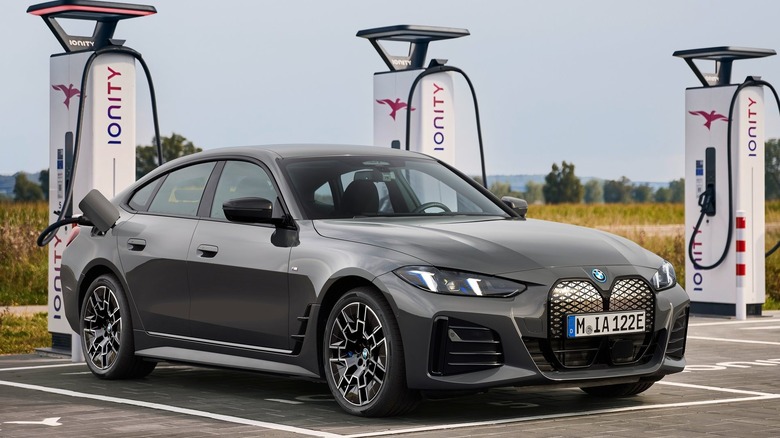
Battery retention did vary by brand and vehicle, though, with the Mercedes EQA's average 94% SoH taking the top spot, followed closely by the Hyundai Ioniq 5 at 93.8% and BMW i4 at 93.6%. At the bottom of the list sat the Tesla Model 3 at 88.9%, Mini Cooper SE at 87.1%, and the Nissan Leaf at 86.7%. While the Tesla appears to be an outlier, you'd also expect a lower SoH from small EVs with small batteries that need to be recharged more often. Still, they're doing a solid job of holding their own, and it's not like you buy an electric Mini with family road trips in mind.
The study blames the lack of Chinese EVs on too little data, but researchers still managed to test the SoH on more than 500,000 EVs globally between 2022 and 2026. So yeah, this definitely wasn't some fly-by-night study that some marketing agency whipped up in a few hours. As you can imagine, while median and average figures are still useful information, when it comes to individual cars, how they're treated causes some pretty big swings in their batteries' SoH down the road.
Second-generation Nissan Leafs are perhaps an extreme example here, but as ArsTechnica explained:
For Nissan's Leaf ZE1 model, which requires more frequent charging to cover the same distance than other EV models due to the smaller size of its battery, the median SoH at 150,000 km varied by as much as 13.5 percentage points—equivalent to about 29 km of real-world range per charge and the largest spread among the 20 EV models covered by the study.
Aviloo said the spread between the individual cars could vary by up to 11 percentage points for Tesla's Model Y, 11 and 12 points for VW's ID.4, and more than 12 points for Hyundai's Ioniq 5.
Berger said batteries of EVs in hotter climates degraded faster, while another key factor was how much the batteries were charged when the EVs were parked. "What very few consumers know is: don't park your cars with 100, 90, or 80 percent state of charge. It's just harming the battery," he said, adding that the ideal level was between 30 and 70 percent.
Ignore the Jets fans

As previously mentioned, this is not new information. The eight-year/100,000-mile battery warranty dates back to the first-generation Nissan Leaf. It's not like Biden invented it on his way out the door at the end of 2024. Plenty of previous research has shown that the batteries automakers put in electric cars should be perfectly healthy after more than a decade — a decade where they didn't need oil changes, coolant, new spark plugs, replacement starters, or fresh alternators. Expensive timing chain, belt, gasket, and transmission work? EVs don't have them, so there's no need to pay for them.
Even if you think you drive a lot, I promise you EVs aren't big, scary hassles that need constant repairs like some people may have told you. And I know this because I leased the slowest-charging, shortest-range new EV on the market to see for myself just how hard it was to live the EV life on hard mode. Spoiler alert: Even hard mode is pretty easy. The best part is, pick literally any other new EV, and it will be easier to live with than my Fiat. Sorry to the haters, but EVs are about as close to perfect as daily drivers get.
So why do these myths that EV batteries need to be replaced every few years persist? Well, when EV batteries do fail, those failures tend to be caused by manufacturing defects that show up quickly, which means some people do occasionally buy new EVs that almost immediately needed a (free) battery replacement. But it's more than that. Sadly, it's so much more than that.
EVs need very little maintenance, which makes them a threat to dealers who make all their money changing oil and replacing starters. EVs don't need gas, either, which makes them a threat to the entire oil industry. Of course, the oil industry also owns the Republican party and spends a lot of money ensuring Republican politicians stack everything in their favor. They're definitely pushing propaganda. But perhaps the most depressing explanation is probably that far too many people believe the entire world is one big sports rivalry.
Jets fans love the Jets and talk trash no matter how many times the Eagles prove they're the better team, so why not treat politics the same way? It's just a game to them. Red's the best! Blue team bad! And now we're seeing it applied to powertrains in vehicles. Because of course we are. It isn't logical, but then again, it's not like Jets fans are known for their logic. There's still a lot of value in patiently answering people's good-faith questions, especially with so much misinformation out there. But don't waste your time with all the trolls and sea lions. You're just arguing with rabid Jets fans, and no one wins when you argue with Jets fans.