

Trump Hasn't Brought Back The Auto Manufacturing Jobs He Promised
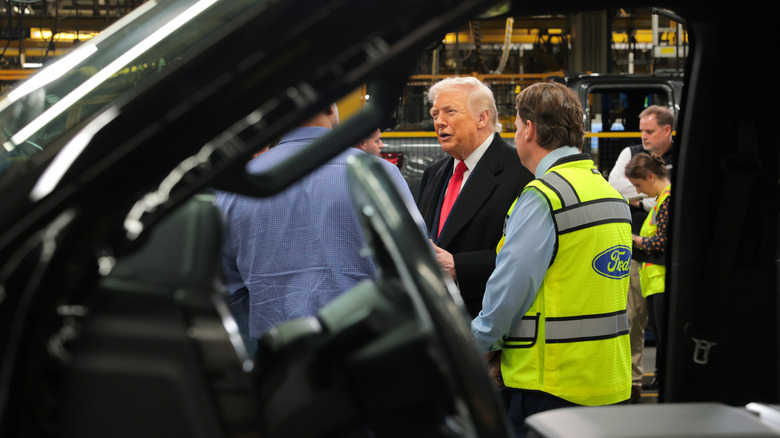
When Donald Trump was running for reelection in 2024, he talked at length about how he was going to bring back U.S. manufacturing jobs — especially U.S. automotive manufacturing jobs — if he was elected. Well, if you didn't notice, Trump was elected, but those jobs haven't come back. In actuality, the Bureau of Labor Statistics says auto manufacturing jobs are declining, probably because of woke.
Earlier this month, the President took to his social media site, Truth Social, posting "Manufacturing is BOOMING! [...] With TRILLIONS OF DOLLARS of new Investment pouring into the United States, and more Factories, more Construction, and more High Paying Jobs on the way, the results are impossible to hide." That doesn't seem to be what's happening with auto parts manufacturing, though, according to Automotive News. Payrolls at vehicle and parts facilities across the U.S. fell about 1% in July of this year to 964,500 jobs. That's down from the 975,300 jobs there were in March of 2025, before Trump's new tariff rules took effect. Obviously, these numbers fly in the face of Trump's goal of using tariffs to bring manufacturing jobs back to the U.S.
The latest jobs report, which was released a few weeks ago, is a glaring example of the issue the Trump administration is facing when it comes to auto manufacturing jobs. Despite what he considers his best efforts, his policies have coincided with slight job losses in the sector, including layoffs, resignations, retirements, deaths and hiring freezes following departures, Auto News reports. Because these companies are contending with the higher costs tariffs have brought on, they've simply got less money to spend on personnel. Add in the fact that they spent all this money on portfolio electrification, which is now deeply wounded (if not completely dead thanks to Trump's efforts) as well as the war in Iran, and the money starts getting very tight.
Manufacturing doesn't mean jobs
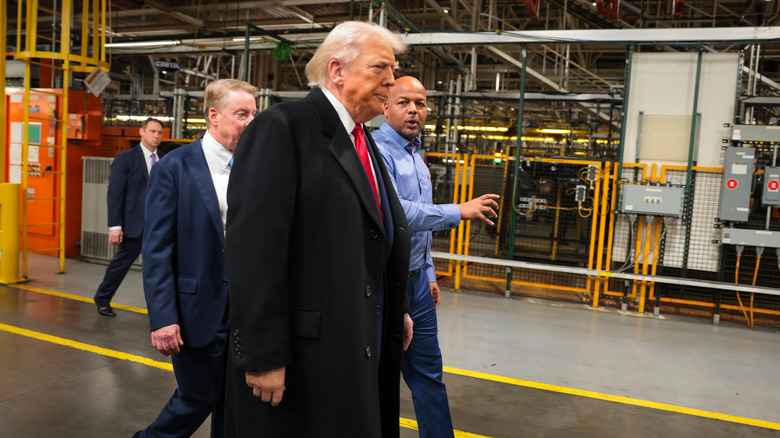
Exacerbating the problem is the fact that, while manufacturing in the U.S. is actually increasing, jobs aren't coming with it. An index from the Institute for Supply Management shows that economic activity in the manufacturing sector actually expanded in July of this year for the seventh consecutive month, Auto News reports. In fact, July actually saw the index's highest reading since May of 2022.
However, that hasn't meant squat for more jobs. Automakers and suppliers are increasingly turning to automation and artificial intelligence when it comes to manufacturing, and that — plain and simple — means fewer jobs are needed.
Still, it doesn't mean more jobs aren't on the horizon. In July, Toyota announced plans to build a $3.6 billion assembly plant in San Antonio, Texas, and shift Tacoma production back to the U.S., according to Automotive News. Honda has also mulled over the idea of bringing an eighth assembly plant to the U.S., and Ford is moving production of some Lincoln models from China to the U.S. by the end of the decade, something we covered last week. Maybe Trump's plans will pay off, or maybe we'll continue to be stuck in this rut of dwindling jobs despite the promises.