

10 George Barris Custom-Built Cars Every Gearhead Should Know
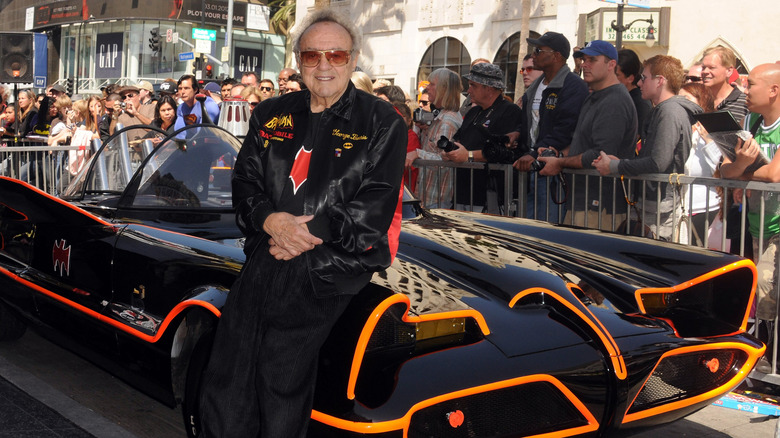
Mention automotive design, and enthusiasts immediately picture the famous car designers behind the world's most iconic cars, like Giorgetto Giugiaro and Marcello Gandini. However, what does the average Joe think of when they hear the word 'iconic' in reference to a car — a Lamborghini Miura, or the quirky creations they remember from the movies? After all, every child knows about the Batmobile, but not every driver can rattle off specific Ferrari models.
That's what we're looking at today — the designer of some of the most whimsical, ostentatious, and memorable cars of the 20th century. When it comes to designing theatrical cars, one name stands out: George Barris, the "King of Kustomizers." Chicago-born Barris wasn't a car designer, per se, but more of a car customizer. His creations were extravagant, exaggerated, visually shocking, and outrageous. You wouldn't use these attributes to describe a good-looking car, but Barris was never interested in that. Instead, Barris wanted to create characters that added to the narrative, often stealing the spotlight. Something like these vintage vans that want to be cartoon stars, but way, way more extravagant.
You probably already know that he created the iconic 1960s-era Batmobile, but there are many other custom-made Barris cars gearheads should know about. Some are classic beauties, but most are so wild and extreme you'll have to look twice to believe they're real. True, some of these cars were designed by his employees, but the ones on our list all had work done at his coachwork shop, Barris Kustoms. So, from Hollywood screen icons to ground-scraping lead sleds, here are the most famous Barris cars.
1952 Hirohata Merc
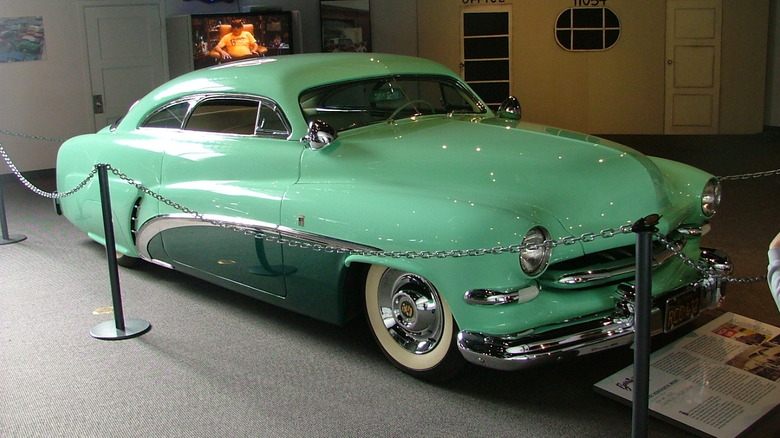
Lead sled is one of those hot rodder terms you may not have ever fully understood. Yet the term covers some of the coolest-looking hot rods out there, which are defined by features like ultra-low ground clearance, chopped roofs, and recessed lights. However, the standout design element of these custom cars is the way that the melted lead used as body solder creates a seamless silhouette, which in turn offers the illusion that these hot rods are sliding down the road like a sled.
We are telling you all this so we can move smoothly to one of the most famous lead sleds of all time — the striking 1951 Hirohata Merc. Created at Barris Kustoms at the request of Bob Hirohata, the Hirohata Merc was based on a 1951 Mercury Club Coupe (like many famous lead sleds), but modified to unrecognizability to achieve those fluid, elegant looks. George, his brother Sam, and Frank Sonzogni were given a blank check to do what they wanted with the car, and they went wild. Notably, the Hirohata Merc has a significantly lower roof (7 inches in the rear), Ford headlights, Lincoln taillights, elongated fenders, and unmistakable Ice Green paint.
Unsurprisingly, the Hirohata Merc won many awards at custom car shows, but it was also a functional road-trip machine. Hirohata famously drove this radical lead sled from Los Angeles to Indianapolis and later chronicled the road trip in his 1953 Rod & Custom article titled "Kross Kountry in a Kustom – Mile After Mile in My Modified Mercillac." Why Mercillac? Hirohata went on the road trip after replacing the original 255 cubic-inch Mercury V8 with a peppier 331 cubic-inch Cadillac V8.
1957 Ala Kart
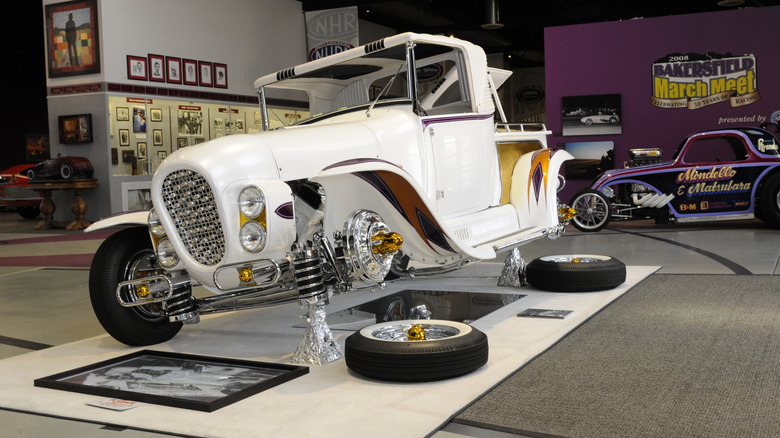
Built for Richard Peters, a close friend of George Barris, the Ala Kart is easily one of the most impressive hot rod roadsters ever made. Based on a 1929 Ford Model A Roadster Pickup, the Ala Kart features a rear body section from a 1927 Ford Roadster, three-piece aluminum hood, 1957 Chrysler headlights, 1956 DeSoto taillights, and a raked shiny grille that gives the retro body a futuristic, space-age look.
The Swedish White Pearl livery with gold accents and custom interior white Naugahyde upholstery, black velvet pleats, and chrome inserts further accentuated the car's exquisite look. All these modifications weren't just for looks — the Ala Kart was also equipped with a 1954 Dodge Hemi V8 with Hilborn injectors and chrome valve covers for that striking show-car aesthetic. Unsurprisingly, the Ala Kart was the king of show cars during its time, winning the AMBR (America's Most Beautiful Roadster) Award in 1958 and 1959. Yet it came close to never happening at all. The Barris Kustoms shop suffered a fire in 1957, which destroyed 14 cars, but not the Ala Kart, as it was stored in a nearby building.
Ala Kart's showroom success was only the beginning. AMT (Aluminum Model Toys) released a 1:25 model toy kit, which became one of its most popular creations. Later, the Ala Kart had a tumultuous life, as it was modified by a careless owner, who changed the engine and chassis. Fortunately, it was restored to its original glory in 2008 by Roy Brizio, a hot rod legend in his own right.
1954 Golden Sahara
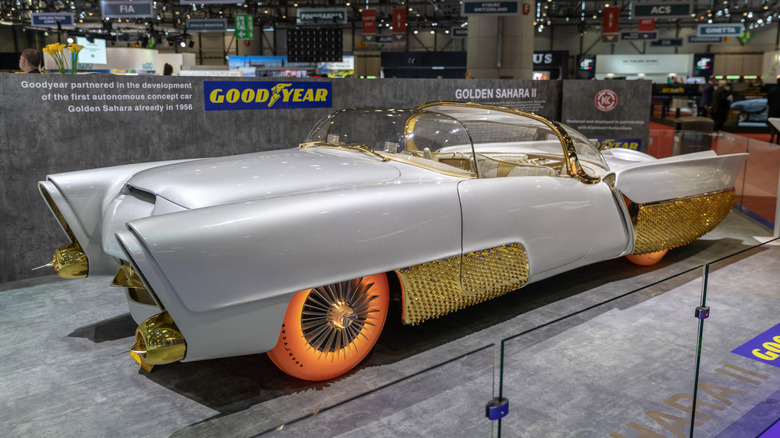
If you thought the Ala Kart's backstory was wild, the Golden Sahara almost matches it twist for twist. This space-age stunner actually started as a 1953 Lincoln Capri that Barris slammed into a truck while towing a friend's car. The collision nearly sheared off the roof, but rather than scrapping the mangled wreck, Barris used it to craft one of his greatest masterpieces.
Financially aided by Ohio-based businessman Jim Street, Barris used novel design features on the Golden Sahara, such as a wraparound windshield and a custom bubble top. The car was also painted in a golden pearlescent finish, which Barris achieved by using literal fish scales in the paint. The 24-karat gold inserts inside and outside gave the Golden Sahara the glitz it deserved, while the futuristic interior tech turned it into a lounge on wheels. The Golden Sahara had a built-in television set, a rear-seat cocktail bar, and a tape recorder — features that were considered fairly sci-fi at the time.
However, in reality it's the second iteration that etched the name in custom car history. Interestingly, the Golden Sahara II wasn't built at Barris Kustoms, but at the Delphos Machine and Tool shop in Dayton, Ohio. However, it's the same car, although Jim Street packed it with tech we would consider advanced even today. Like, how about automatic braking or driving the car via a remote? Yes, today this is probably not even enough for Level 1 automated driving, but imagine how wild they looked in the 1950s! Heck, the Golden Sahara II even had translucent Goodyear tires!
1957 El Capitola
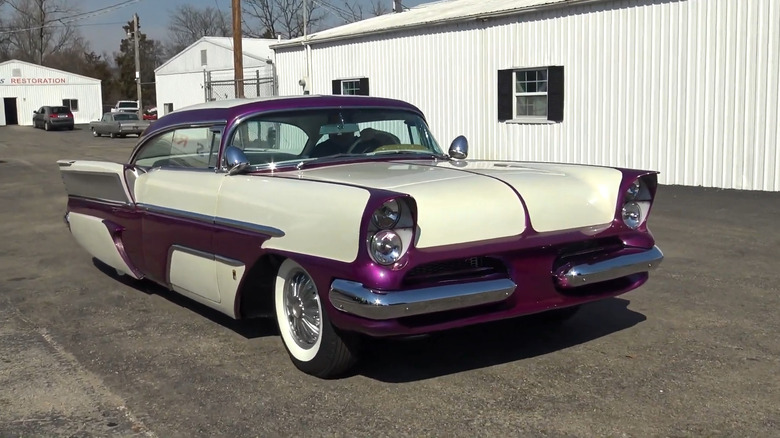
If 1950s American car culture had a poster child, it was the Chevrolet Bel Air. With its razor-sharp tailfins, dramatic two-tone paint, sweeping jet-age chrome, and optional V8 engines, the Bel Air brought class to Chevy's Tri-Five car range for the people. Of course, the Barris brothers thought it needed further work to stand out. So, they took a 1957 Chevrolet 210, replaced seemingly every panel with parts from other vehicles, and turned it into the El Capitola.
As a result, you'll hardly notice this custom was based on a Chevy Tri-Five car from just looking at it. The dramatic rear fins were borrowed from a 1957 Lincoln, while the split bumpers were from a 1957 DeSoto. Meanwhile, El Capitola's front end was adorned with canted quad headlights recessed into sculpted oval housings and a custom twin-floating front bumper. The ultra-low, elongated profile gave the car a sweeping stance that accentuated the other details.
As expected from a Barris build, the paintwork on El Capitola is a total showstopper. The otherworldly finish — a two-tone blend of diamond-dust-infused Cerise pearl and pure pearl — required a staggering 10 gallons of lacquer paint to pull off. The luxurious interior matched this with Naugahyde faux leather, chromed instrument panel, gold inserts, swiveling seats, and even a free-standing TV.
Apart from being an icon, the El Capitola is also significant for being the last major custom design Sam and George Barris worked on together. Shortly after, Sam became an accident investigator, leaving the customization business to his brother.
1962 Beverly Hillbillies Truck
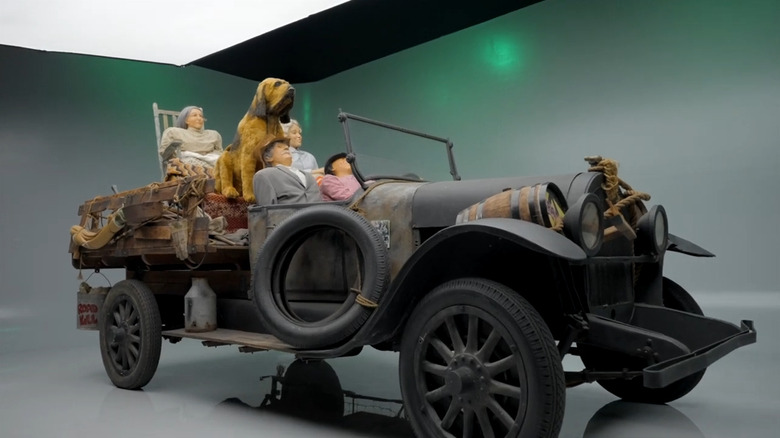
While George Barris' early builds pushed the boundaries of extravagance, the Beverly Hillbillies Truck falls into more eccentric territory. Designed for the 1962 TV series "The Beverly Hillbillies," this car highlighted Barris' talent in bringing any vehicle concept to life. His previous creations were characterized by the flawless glossy lacquer, while the Beverly Hillbillies Truck looks rusted out, battered, and ancient.
It's the perfect addition to the series where a poor Ozark family strikes oil and moves into a Beverly Hills mansion, but keeps the old truck. In fact, the vehicle remained a fixture throughout all nine seasons, serving as a reminder of the family's past. By the time the show ended in 1971 it was five decades old, as it was based on a 1921 Oldsmobile Model 43-A. Unsurprisingly, it was seriously underpowered, packing a four-cylinder engine with only 43 hp.
Interestingly, Barris sourced the vehicle from a feed store in Fontana, California. The truck was already old and rusted by that time, with the rear passenger section sliced off to turn it from a passenger vehicle into a truck. In other words, the previous owner had done most of the work for Barris. However, to fit the whole Clampett family, he fabricated a wooden rear platform with a high-rise park-bench seat for Granny and Elly May. This only exemplified the truck's high-riding, narrow, and unstable stance.
Later, Barris built four more versions of the Beverly Hillbillies Truck. One, as reported by Barrett-Jackson, was based on a 1921 Oldsmobile Model 46 with a Ford truck chassis. Finally, for the 1993 The Beverly Hillbillies feature film, the truck was upgraded to a Chevrolet 350 engine.
1964 The Munster's Koach
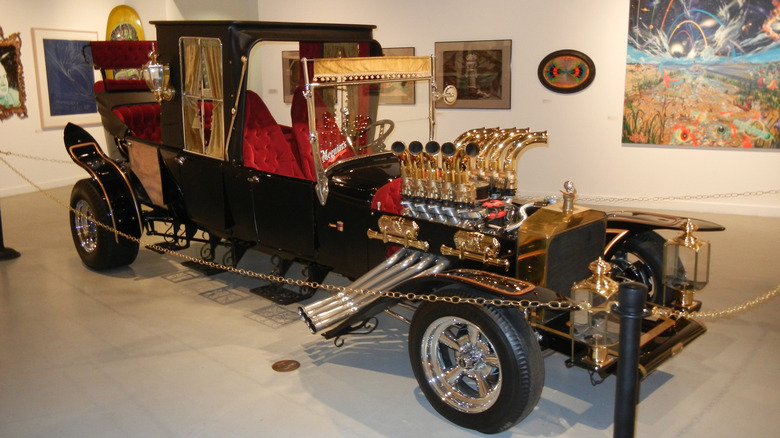
How do you design a creepy car for a family of monsters? Of course, you go with "Frankencar" engineering! To design the perfect vehicle for the legendary TV series "The Munsters," George Barris spliced together three separate vintage Ford Model T bodies on a handmade 133-inch chassis.
This created a menacing, 18-foot-long, gothic hot rod that perfectly complemented the Munster family. Yes, it was a complicated project, but Barris Kustoms finished it in just 21 days because of a tight deadline. Fabricators Tex Smith and Dick Dean spent hundreds of hours to finish the design, and the result is nothing short of astonishing.
However, the Munster's Koach wasn't only a show car. The shop could've installed a dummy engine block for filming and nobody would've batted an eye, but instead, they stuffed a real, 289 cubic-inch Ford Cobra V8 equipped with Jahns high compression pistons. Of course, Barris Kustoms added glitz in the form of 10 chrome plated Stromberg carburetors and Bobby Barr racing headers. Further accentuating the car's performance credentials, Barris Kustoms equipped it with racing slicks and Astro chrome spoke wheels.
The finer touches were just as eye-catching. The front end of the Munster's Koach was dominated by a brass radiator shaped like a tombstone, accompanied by spider web headlights and rolled-steel scrollwork along the running boards. Meanwhile, the interior was outfitted in dramatic blood red velvet upholstery — the same as you might find in a vampire's coffin, perhaps — alongside diamond buttons and gold gauges.
1964 DRAG-U-LA
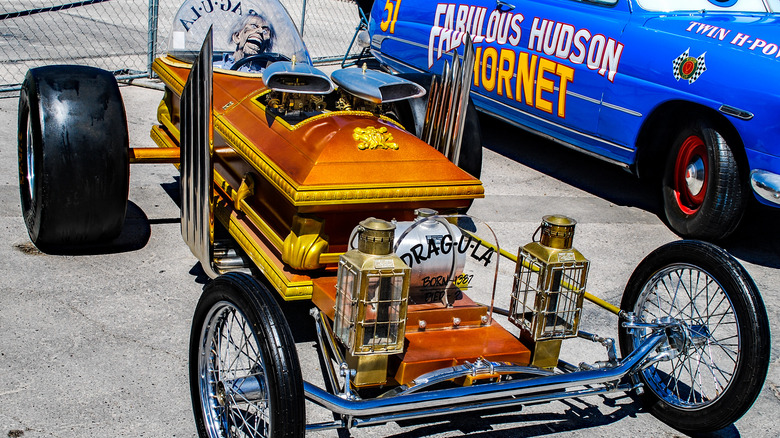
If the Koach was the Munsters' family vehicle, the Drag-u-la was their flat-out quarter-mile menace. That's exactly how the story goes in the series — the Munsters lose the Munster's Koach in a race and then go on to design a lighter, faster car. Well, at least that's how it went on screen — it was, as you might imagine, actually George Barris who built five cars for the show, which appeared in the TV Series and the 1966 movie "Munster, Go Home!"
Of course, nothing else worked better as the basis of the Drag-u-la than a coffin. A real coffin, that is, constructed from fiberglass — remember, the car needed to be light — and finished in bronze and gold. Instead of a grille, the Drag-u-la had a marble gravestone up front, nestled between antique lanterns serving as the headlights. The sides were adorned by a unique pipe organ-like exhaust, while at the top of the coffin sat an intricate intake snorkel. Inside, minimal purple upholstery and the customary spider web details gave glitz to an otherwise spartan cabin. Funnily enough, once settled, Herman sat with his crotch around the differential, protected from the environment with a plexiglass bubble roof.
The real treat, however, was that the Drag-u-la had the bite to match its bark. The coffin was mounted on a tubular dragster chassis and packed the same 289 cubic-inch Ford V8 as the Munster's Koach. Equipped with two four-barrel carburetors, it produced 350 hp, more than enough to catapult the light chassis into the triple digits. To help with traction, Barris slapped Firestone drag racing slicks in the rear, accompanied by skinny front tires for better aerodynamics.
1966 Batmobile
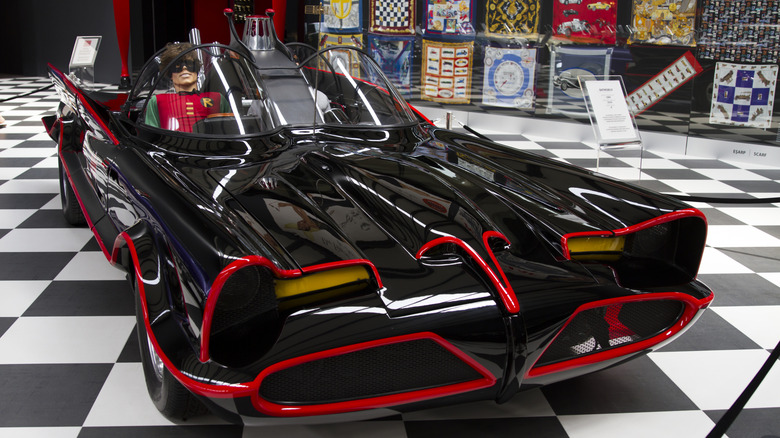
Following his work on "The Beverly Hillbillies" and "The Munsters" shows, Barris landed the task of creating the iconic 1966 Batmobile. However, he wasn't the producers' first choice. Initially, the crew contacted Dean Jeffries, a custom builder who also created cars for movies before. His idea was to use a 1959 Cadillac, but he apparently couldn't finish the car on time, so George Barris was brought on to help. The only problem? Barris had just three weeks to deliver the finished product.
Even so, Barris ditched Jeffries' idea and instead opted for a forgotten 1955 Lincoln Futura concept car. A space-age classic, the Futura had everything Barris needed, like a clear double-bubble canopy that could fit both Batman and Robin, hooded headlights, low and wide grille, as well as intricate tailfins. It cost Ford $250,000 (over $3 million in today's money) to build the concept at the Italian coachworks company Ghia, yet Barris reportedly bought it for just one dollar a few years before he used it to create the Batmobile.
Alas, the Batmobile was more than just a black Futura with red accents. The team at Barris Kustoms installed a functional rear turbine exhaust that blew real flames, a hydraulically operated blade up front, dual laser beams, and even rocket launchers. The interior was full of gadgets, like a full-vision Batscope, Bateye anti-theft control, Anti-Fire Activator, automatic tire inflation, and a Batphone. While these features were largely represented by special effects, these sorts of gimmicks were crucial to turning the Batmobile into a cultural icon.
1966 Fireball 500
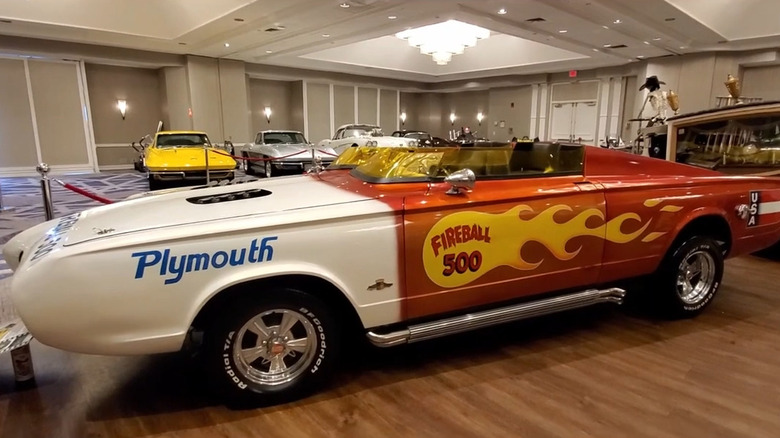
The Plymouth Barracuda fastback was famous for having the largest piece of glass of any car when it was launched in 1964, a feature that still looks impressive today. Well, George Barris begged to differ, because he removed it to create the Fireball 500, which starred in the 1966 movie of the same name.
In fact, Barris also chopped off the roof and windshield, deleted the rear seats, and divided the cabin into two cowl cockpits. He also fitted the car with dual jet-inspired windshields and flared headrests, a grille with recessed rectangular headlights, and taller slimline taillights. Wide Firestone tires, Rader racing alloys, and dual side-mounted exhausts finished off the racing-car look.
Naturally, Barris made sure the Fireball 500 had the brawn to compete — it was starring in a racing movie, after all. The car was equipped with the famous 426 cubic-inch HEMI engine producing 425 hp that was paired to a four-speed manual gearbox. This was reportedly enough for a quarter-mile exit speed of 160 mph.
As with his other creations, Barris invented an intricate paint scheme for the Fireball 500 he called the Fireheat. The scheme was created by applying 40 coats of hand-rubbed lacquer with a white pearl essence, which transitioned into gold Murano, Kandy Tangerine, translucent Kandy Red, and burgundy via a striking gradient. The paint job is so elaborate it looks like it was created in Photoshop, and all told it took four people and six days to create.
1966 to 1989 Love Machine/Vandora/Super Van
The Super Van also had a leading role in the eponymous 1977 movie, and is a prime example of his ability to create an icon out of nothing. Barris used a Dodge Sportsman for this reincarnation, changing its classic van shape into a futuristic shape and christening it the Love Machine.
So while Super Van might be the name burned into pop-culture history, it didn't start life with that badge. He finished the first incarnation in 1966, right in the middle of the hippie era, so you'd think that's why it was called the Love Machine. But, nah, Barris is way cooler than that. He outfitted the cargo bay with a circular red-velvet bed, a mirrored ceiling, and a hanging disco ball.
A decade later, Barris added a sky blue blend to the burnt-orange paint for the 1977 movie "SuperVan." Despite the film's title, however, the car itself was actually named Vandora on screen. That wasn't even this van's last cameo — it also appeared in the 1986 "Condor" TV movie and the 1989 "Back to the Future Part II." It's the Super Van name that stuck, however.
Alas, like most of the Kustom King's creations, the Super Van wasn't only a show car. It featured a standard 318 cubic-inch V8 from the Dodge Sportsman alongside Bilstein shocks for better handling. The Vandora version even had solar panels, while the cabin featured a quad-speaker array with light bars, a Panasonic color TV, and a video recorder.