

Should The 1957 Chevrolet Bel Air Be Considered A Muscle Car?
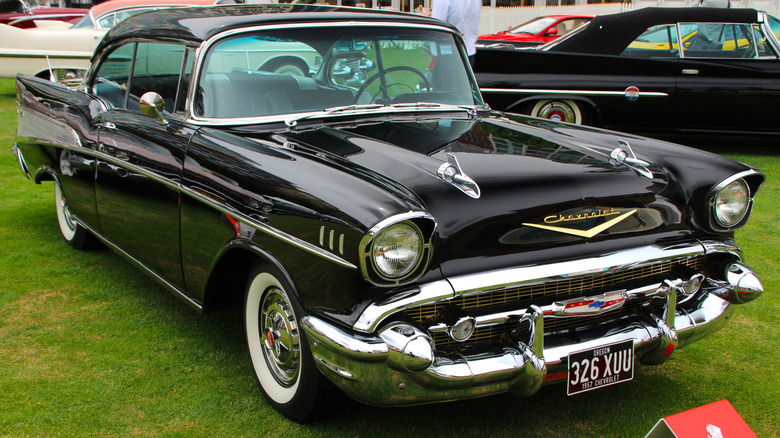
Does the 1957 Chevrolet Bel Air belong in the same class as early muscle-car legends like the Pontiac GTO, Ford Fairlane Thunderbolt, or the Dodge Charger? Well, the Bel Air is an absolute icon of the auto industry, celebrated for its bold style, innovative features, and strong performance. It was even available with the same Super Turbo-Fire naturally aspirated 283-cubic-inch V8 as that year's Corvette. Backed by Rochester Ramjet mechanical fuel injection, the motor was good for 283 horsepower at a time when making 1 horsepower per cubic inch was no mean feat.
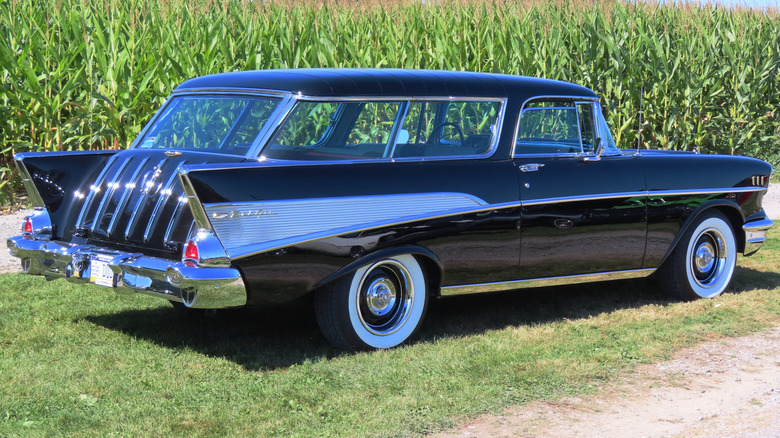
Yet many considered the Bel Air to be a family car, too, complete with an available station wagon body style offering two- or four-door configurations. The two-door Bel Air Nomad wagons represent the rarest Chevy Bel Air variants, with approximately 6,200 built out of a total 1957 production run that exceeded 720,000 units.
Now, this familiar formula we just mentioned — stuffing a hi-po V8 into what was originally a large family-focused ride — is indeed a defining characteristic of a muscle car. Yet that's only part of the picture. Some folks think the muscle-car label should only be applied to cars from American brands, for example. Others insist on the differences between muscle cars and pony cars.
As for the Bel Air, we're going to steal a page from the NFL playbook of the late 1980s and early 1990s. We'll review some of the so-called muscle-car rules and then you make the call – using the poll at the end of this article.
Yes, the Bel Air's motor makes it a muscle car
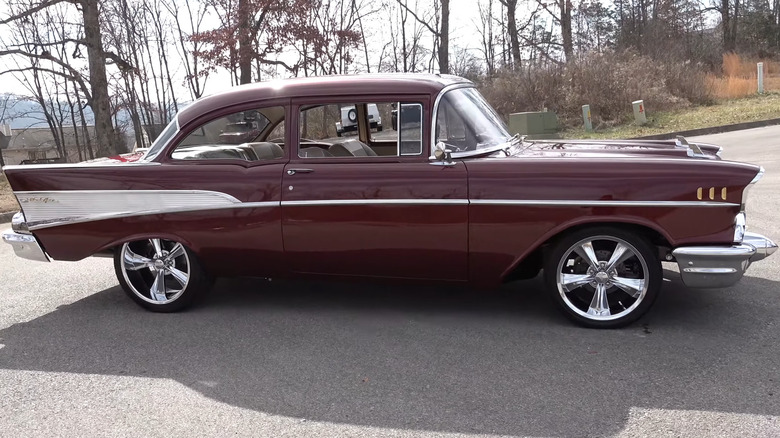
The Bel Air certainly seems to qualify at first glance, starting with the first ingredient of any proper muscle car: the engine. For 1957, the Bel Air actually came with a six-cylinder mill as standard and offered a choice of five available V8 setups. At the top of the heap was the 283 V8 that — in the Corvette — was among the first in the industry with fuel injection. The engine wasn't cheap, however, as it was a $480 option on the Bel Air. For context, the least-expensive Bel Air sport coupe started at $2,399.
Remember, the 283 V8 was specifically engineered to transform the Corvette into a true sports car, and its 1:1 horsepower-to-cubic-inch-displacement ratio helped Chevy deliver what's considered the first mass-produced and domestically branded car ever to achieve that mark. As for the 0-60 benchmark, the Corvette could get that done in only 5.7 seconds and additionally reach a top speed of 132 mph.
The Bel Air was bigger than the Corvette, of course, but that only adds credence to its muscle-car claim. The original muscle cars were called midsizers, although many were much larger than modern cars in the segment. So, the 1964 Pontiac GTO — an unexpected success often called the original muscle car — was a whopping 206.4 inches long with a wheelbase of 115 inches. The Bel Air rode on the same-sized wheelbase, while its older styling cues gave it a length of 200 inches.
It's also worth noting that 1957 Bel Airs would go on to show their performance potential in the years after they premiered. In fact, they went on to become one of the most iconic platforms for hot-rod conversions.
No, the 1957 Bel Air was too mild for a muscle car
The problems for muscle-car purists also begin with the Bel Air's engine. While the 1957 Corvette was called "the fastest-accelerating genuine production car" ever tested by Sports Cars Illustrated (now Car and Driver) at the time, the Bel Air was nearly 2.5 seconds slower to 60. Direct evidence of that isn't exactly easy to find, but extrapolating the Corvette data suggests the bigger, heavier Bel Air would take about 8 seconds to get there. In other words, the Bel Air may have been quicker than its direct rivals — and advertised as "the Hot One" — but it simply wasn't sports-car fast.
Moreover, on the topic of advertising, the Chevrolet Bel Air couldn't place much emphasis on thrills to build up its sporty reputation. Plymouth could get away with claiming the 1968 Barracuda was "a natural for sanctioned drag racing," but Chevy wasn't able to leverage performance in its ads the same way. In 1957, an industry group had recommended automakers pull back from any kind of racing support, even advertising, and that's exactly what GM did. The result wasn't the cringiest car marketing ever seen, but it wasn't laser-focused on gearheads like the ads of the 1960s either.
With that in mind, do you think the Bel Air's mighty V8, improved relative performance, and mainstream origins make it a true muscle car? Or is it disqualified by its weak absolute performance and more family-friendly market position?