

9 Vintage Vans That Secretly Want To Be Cartoon Stars
Modern vans and minivans are just too serious. Sure, they look modern and sleek — but half a century ago, vans looked like animated characters. They might not have been good-looking in the standard sense, but they had their own unique personalities. Some had a cute smile, and others looked like they are undergoing a hilarious existential crisis. Put them together and they could make up the cast of a cartoon — and there are a few models that would make for the perfect characters in such a show.
Honestly, I didn't even know some of these vans existed. I came across them when I showed my five-year daughter cute-looking cars (hopefully, she succeeds me one day) and these inevitably popped up. And whenever they appeared, they were accompanied by "aww, that's so cute" comments. So, as much as this list is mine, it's also hers.
But it's not just the whimsical looks. All these vans have unique, quirky traits that make them deserve a special place in automotive history. They also pioneered many concepts that are standard across the industry today. So, from fearless optimists to pouting pessimists, here are the vans that want to be cartoon stars. Who knows — maybe you'll also rate them among your favorite vans after reading this article.
DKW Schnellaster (1949 to 1962)
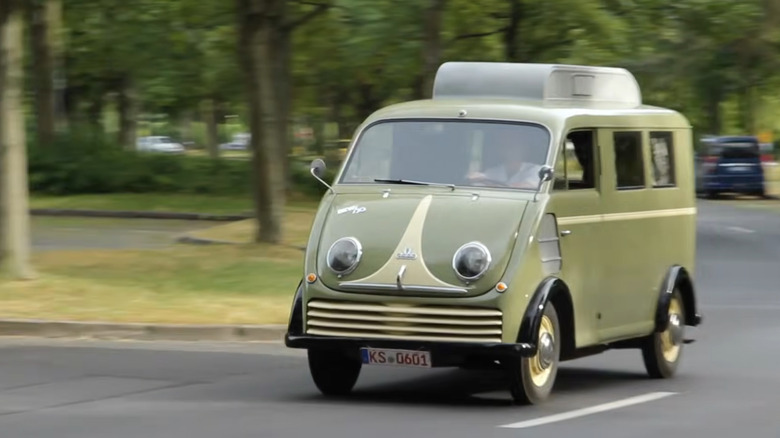
The DKW Schnellaster has the looks that would make it a perfect protagonist of this hypothetical cartoon. Its high-set, wide-eyed headlights look innocent and endlessly optimistic — just the right set of characteristics for a brave, almost naïve hero. Particularly a hero that can carry everything, despite its small stature.
These positive vibes are exactly what Germany needed after WWII. Launched in 1949, the Schnellaster wasn't just a friendly-looking van — it was also forward-looking. Its front-engine, front-wheel-drive configuration and one-box, aerodynamic body are reminiscent of modern minivans, allowing excellent interior space with a fully flat floor that plays perfectly with our "eager to carry everything" hero. Today, we take this design for granted, but FWD cars weren't exactly widespread after the war. In fact, DKW was the first company to mass produce front-wheel-drive vehicles, long before FWD became the default for cheap cars. They were an answer to Volkswagen's rear-engine, rear-wheel-drive Beetle. That would make the Schnellaster a direct rival to the VW Bus T1, with the former arriving first to the market.
The Schnellaster isn't a legend today, but it's not like it was unsuccessful. DKW launched passenger, cargo, pickup, and camper versions, each propelled by relatively underpowered two-stroke engines from DKW's motorcycle efforts. Initially, the automaker opted for a 20-horsepower 700cc two-cylinder unit, good for a top speed of 43 mph. Ironic, seeing as how Schnellaster in German means "fast transit." DKW gave later models larger engines, up to a 900cc three-cylinder with 32 hp. Again, not exactly powerful, but can you imagine this wide-eyed hero with anything other than a huffing-and-puffing two-stroke chimney?
Tempo Matador (1949 to 1951)
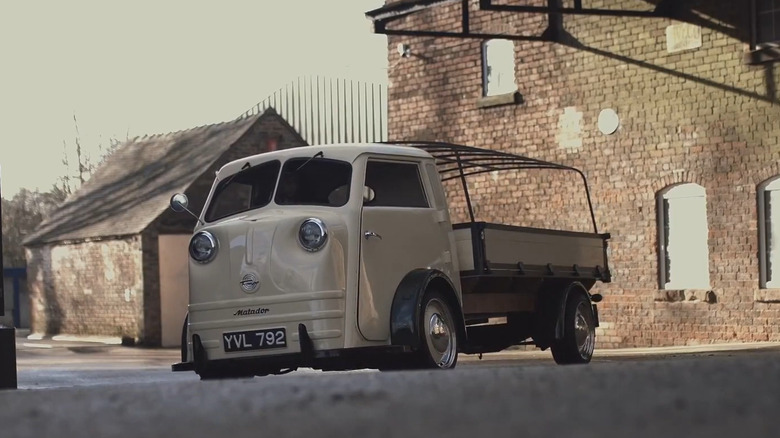
If the DWC Schnellaster is the endless optimist, the Tempo Matador is the melancholic persona. Its headlights sit closer together and recessed in the body, giving it a look similar to Droopy the dog. The rear-hinged doors further reinforce the gloomy personality, with the Matador almost looking like it has arms out in despair when they're open. (My daughter immediately said "aww" as she saw it that way.) The top-mounted windshield wipers are the cherry on top, looking like worried eyebrows. The Matador is still lovable, but in a more pessimistic way. So you could see it as part of the hero's team — the character that is always afraid but ultimately gets the job done.
The Matador was launched in 1949 in Germany — the same year as the Schnellaster – and it came exclusively with a 25-horsepower air-cooled Volkswagen engine and ZF transmission. Like the Schnellaster, the Matador was front-engine and front-wheel drive, and it could be had as either a van or a pickup truck. However, VW blocked Vidal & Sohne, the company that built the Tempo Matador, from using its engine because the van was seen as a direct competitor to the Bus. So this early iteration of the Matador stopped being sold in 1951, with only 1,300 examples produced. However, that didn't stop the company from reviving the nameplate for an improved Matador van with a four-cylinder four-stroke engine, developed in collaboration with the Indian Bachraj Trading Company. The new model didn't have the same cartoonish face, though.
Fiat 600 Multipla (1956 to 1967)
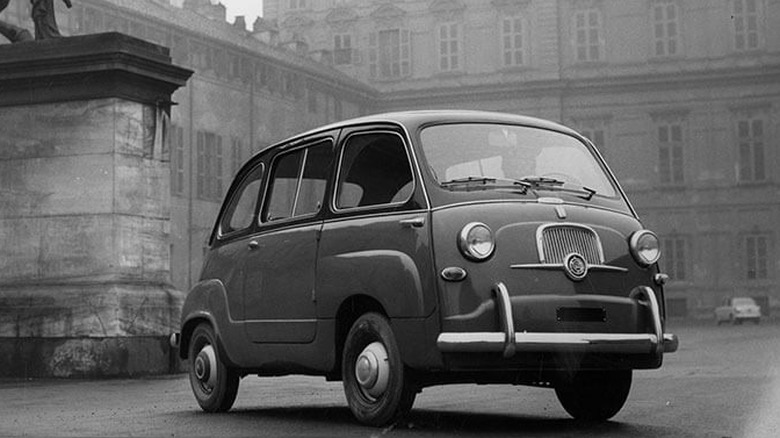
Next to the Schnellaster and Matador, the 1956 to 1967 Fiat 600 Multipla looks confident and clever, but in a completely whimsical way. It almost has a manic energy to it, with the small footprint emphasizing its agile, hyperactive nature. Yet it's still able to carry six people, underlining its smart use of space. It's just about 139 inches long, 57.1 inches wide, and 62.2 inches tall, yet it packs three rows of seating inside.
That sounds almost like magic from today's perspective, but you need to remember that the 600 Multipla also has no frontal crash protection. The driver and passenger are basically glued to the vertical front end. The engine is in the back because the microvan was based on the Fiat 600 platform, which allowed legendary engineer Dante Giacosa to make such a versatile vehicle. Indeed, owners could fold the second and third row, creating a flat surface for carrying cargo.
The Fiat 600 Multipla wasn't particularly powerful, packing a 633cc four-cylinder miniature of an engine with 21.5 horsepower. Still, it was fairly light at around 2,535 pounds, so it could still achieve a top speed of close to 56 mph. It was certainly enough for taxi fleets; the Fiat 600 Multipla proved immensely popular as a commercial people-carrier. Curiously, the Fiat 600 Multipla might've been faster in reverse (with the correct gearing), as it was more aerodynamic back-to-front than front-to-back.
Mazda Bongo Gen 1 (1966 to 1975)
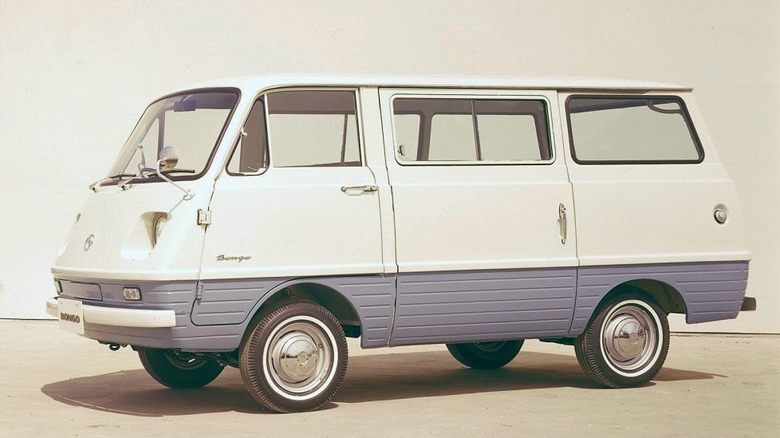
The recessed headlights combined with a flat, grille-free nose and an elegant two-tone body with pastel colors give the first-gen Mazda Bongo a very intelligent appearance. It looks almost like an inventor — the type of cartoon character that always comes up with the brightest ideas. The Bongo was bright in the real world, too. It had a particularly low floor of just 17.7 inches, allowing its owner to load the van more easily. The pickup variant also had folding side doors to further ease loading, while the passenger variant had enough space for eight passengers. That's impressive when you consider that the Bongo was just 148.4 inches long and 59.1 inches wide.
The earliest Bongo vans from 1966 came with a 782cc water-cooled engine with 36 horsepower in the back. The 1968 Bongo later received a larger near-1.0-liter variant with 51 horsepower. Even more impressive was the fact that Mazda equipped the Bongo with independent suspension on both axles, which gave it wagon-like driving dynamics.
The Bongo proved very popular, and not only as a Mazda product; Ford, Mitsubishi, and Nissan also produced badge-engineered variants. Furthermore, the model spanned across five generations up until 2020 — though none had the cutesy looks of the original. An even bigger hit to the original is the fact that Mazda still sells two vans that carry the Bongo nameplate today. However, they are not Mazda products, but badge-engineered Toyota Hiace and Lite Ace vans.
Peugeot D3/D4 (1950 to 1965)
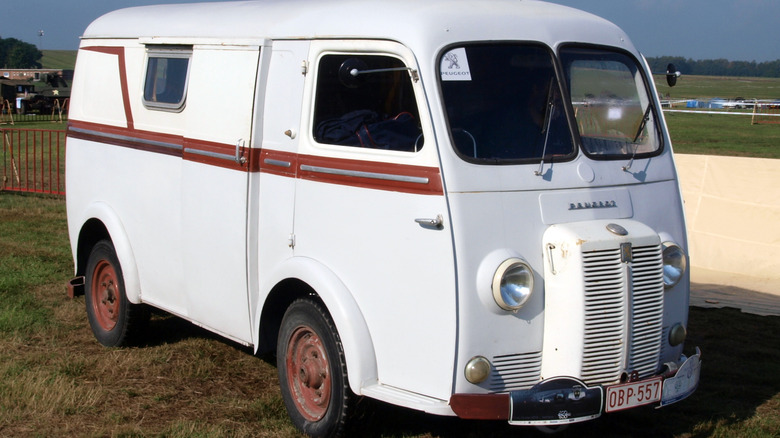
The French called Peugeot's 1950s van "nez de cochon" (or "pig nose") because of its protruding grille. It's a fitting name, sure, but for the cartoon we're positing here, the Peugeot D3 will be the foodie character. You could think of the nose acting as a literal food radar system, letting this van smell good food from miles ahead before hurrying to take a bite. Indeed, the Peugeot D3 and D4 (latter models carried this name, though they looked largely the same) were widely used as food vans. Barn Finds even spotted a Coca-Cola-branded variant, which looks particularly cool. Of course, these vans were also used to transport wine and other goods, as well as people.
By now, you must be wondering what the deal is with the weird-looking nose. Well, the D3 and D4 weren't really Peugeot vans. They carried Peugeot's branding, sure, but the platform was actually borrowed from the 1946 Chenard-Walcker CPV front-wheel-drive van. That vehicle was equipped with a small two-cylinder, two-stroke engine, good for only 26 horsepower. This engine was underpowered for the chassis, so Chenard-Walcker opted for the 1.1-liter inline-four engine from the Peugeot 202 sedan. The larger engine needed to go somewhere, so the pig nose made room for it. By 1950, Peugeot had full ownership of Chenard-Walcker, so it started selling these vans under its own brand. Although this wasn't Peugeot's original design, the D3 and D4 are technically the company's first FWD vehicles.
Nissan S-Cargo (1989 to 1991)
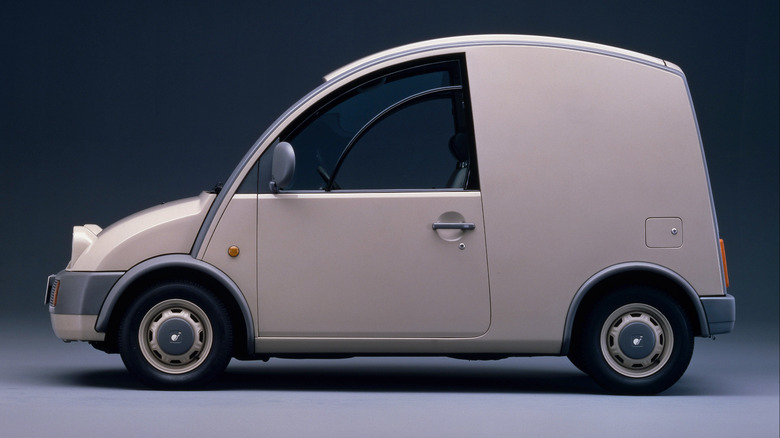
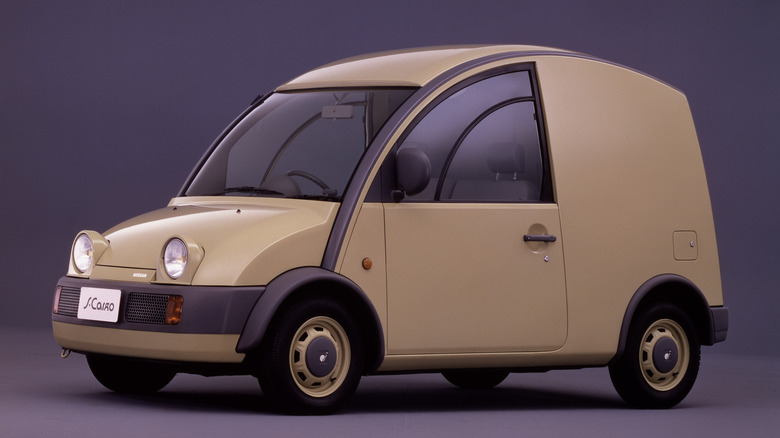
This van is a character that was already named and thought out. The S-Cargo's name reads exactly like "escargot," which means "snail" in French. The tiny van indeed looks like a snail, with the protruding headlights reminiscent of snail's antennae and a cabin/cargo area that looks like a snail's shell. The S-Cargo just might be the most cartoonish vehicle to ever roll off the assembly line, though the widebody Nissan Figaro sure looks like it could star in the next "Cars" animated movie. In fact, both the S-Cargo and Figaro were part of Nissan's retro-futuristic "Pike" cars launched by the end of the 1980s, accompanied by the Be-1 and Pao. Each has a whimsical appearance, combining retro elements with futuristic design cues.
The S-Cargo was the only commercial vehicle from the series, and its design wasn't just a nod to snails. The massive body sides were an open canvas for advertisements, while the tall roof enabled excellent headroom. The S-Cargo was also available with an electric canvas roof, which was a cool lifestyle addition you don't see in other vans.
At 137 inches long and 62.8 inches wide, the S-Cargo is a tiny and not incredibly practical vehicle. Still, the diminutive footprint and tall cabin are perfect for pizza delivery — you could stack up quite a lot of boxes inside. Crucially, the 1.5-liter four-cylinder engine isn't very potent, producing just about 72 horsepower. At least it certainly isn't enough to unsettle whatever boxes are inside. Heck, Nissan even equipped the S-Cargo with a three-speed auto, which further accentuates its snail-like looks and pace.
Barkas B 1000 (1961 to 1991)
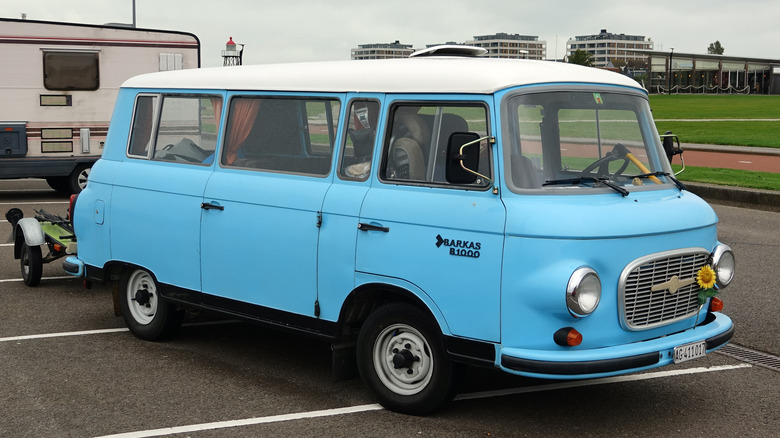
For the next entry, we have a periscope-eyed gentlemen from 1961's German Democratic Republic: the Barkas B 1000. This wise character scans every situation with its googly eyes and only provides its thoughts when necessary. The B 1000's superpower is that it can also use its eyes to peer around a street corner, sensing danger before it arrives. Cartoonish qualities aside, the B 1000 was a very practical van for its time. Front-wheel drive allowed it to boast a high payload capacity and useful cargo storage. In fact, as a rival to the VW Bus (Transporter), the B 1000 was easier to load. Barkas produced an estimated 170,000 of these vans, making them a frequent sight in East Germany for quite a long time.
The Barkas B 1000 was available as a van, but also a flatbed truck, minibus, and even a locomotive vehicle. It was built over an unusual suspension layout, with diagonal links between the front and rear wheels. As for propulsion, Barkas initially used a tiny 900cc three-cylinder two-stroke engine, good for 40 horsepower. Later models were equipped with a larger 992cc unit, which produced 52 horsep. Both engines were paired to four-speed manual transmissions. However, Barkas also produced a limited production run of 1,900 models with a Volkswagen 1.3-liter engine, which the automaker built in its factory under a VW license.
Renault Estafette (1959 to 1986)
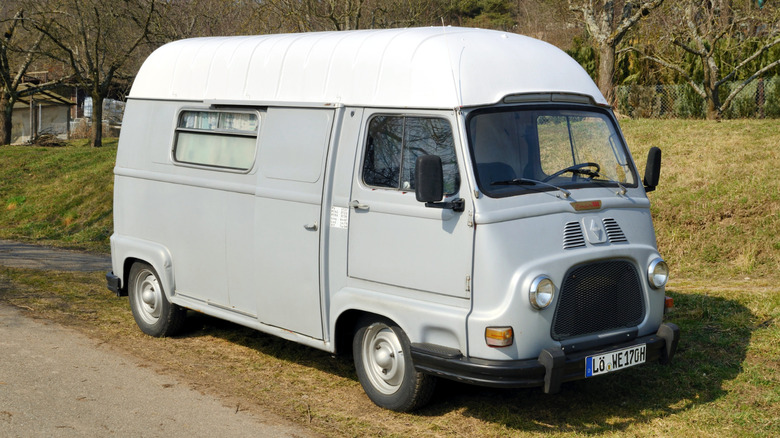
While the Volkswagen Transporter and Barkas B 1000 were the commercial backbone vans of West and East Germany, respectively, the Renault Estafette served the same role in France from 1959 to 1986. Renault itself claims that it was the French police's (gendarmes) favorite van, which supposedly even let it star in numerous movies. The round headlights and mustache-like grille are the perfect fit for a small-town police inspector. In a cartoon, the Estafette might be taking its job almost too seriously, continuously monitoring the neighborhood for criminal activities.
The Estafette was also Renault's first front-wheel-drive vehicle. This layout allowed for a low, completely flat floor for loading and a maximized cargo area. It also let the company launch countless versions of the Estafette; it was available as a pickup, raised van, nine-seater minibus, and even a camper van. Yet it was also compact on the outside, measuring 161.4 inches long and about 70.1 inches wide, making it perfect for France's tight city streets.
As was the theme with many European trucks at the time, the Estafette initially came with a tiny 845cc engine, though latter versions were equipped with a 1.3-liter unit with 44 horsepower. It wasn't much, but the Estafette was a very light van, so it made better use of that horsepower while still being able to carry nearly 1,323 pounds. Renault ended up selling over 500,000 Estafettes, and its name lives on today. Decades after the last Estafette left the production line, Renault revived the nameplate as an electric van concept. And even this newer model looks striking, seeming like it came straight out of an anime movie.
Bedford CA (1952 to 1969)
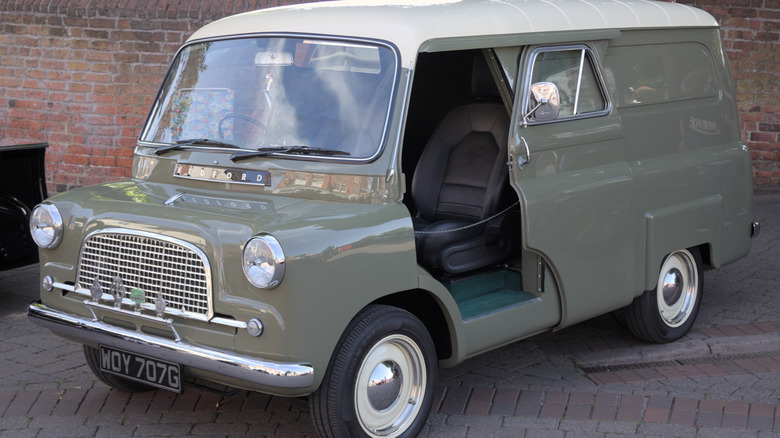
Continuing with the theme of national vans, the Beford CA is an absolute staple of post-war British commercial motoring. What you might not realize is that this van is a General Motors product, as Bedford was the commercial vehicle arm of Vauxhall, GM's British subsidiary. It managed to gain immense popularity that lasted at least until Ford launched the Transit in 1966, 14 years after the CA's debut. Interestingly, the Transit had a similar stubby hood as the Bedford's van, but the latter is significantly more whimsical. It almost looks a bit chubby, though its short hood and eyebrow-enclosed headlights give it a proud appearance. For hypothetical cartoon character roles, the Bedford CA would be perfect as a hyper-polite British butler treating every cargo delivery like a royal assignment.
Unlike its European rivals, the Bedford CA is a traditional front-engine, rear-wheel-drive van. However, the engine wasn't really accessible from the front. There was only a small hood owners could use to top up the coolant. The Bedford CA was initially available with a 1.5-liter unit, though the last model had a 1.8-liter engine that allowed a top speed of over 60 mph.
The Bedford CA quickly established itself as the preferred commercial vehicle in the country, finding use as a police van, mail delivery vehicle, and ambulance. However, it's the camper that's still popular among enthusiasts. The Bedford CA Dormobile was a direct answer to the Volkswagen Camper. Developed by coachbuilder Martin Walter Ltd., the camper featured special "Dormatic" seats, which could be folded flat to reveal a large double-bed sleeping area.