

The Transverse Inline-6 Is A Stupendously Rare Engine Layout For Good Reason
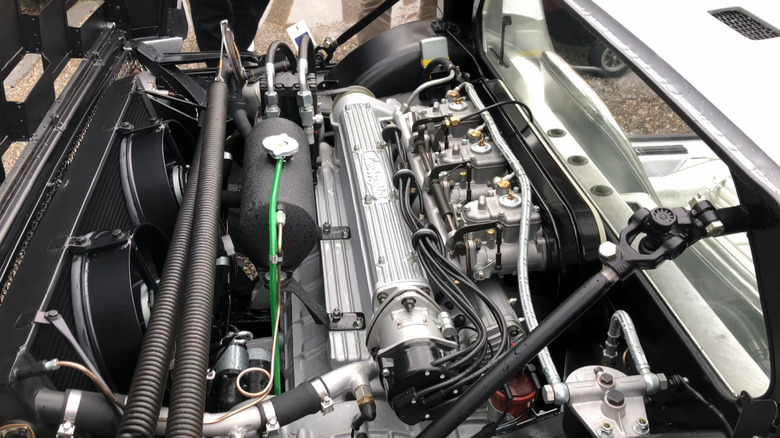
On paper, a transverse inline-6 sounds ideal, combining the silky smoothness of a straight-6 with the packaging efficiency of a transversely mounted engine. In reality, it's an awkward packaging challenge that very few automakers have attempted to pull off. Simply put, inline-6 engines are long, and slotting them under a hood sideways creates headaches for engineers. That difficult-to-package size is one of the main disadvantages of inline-6 engines, and as better, more practical options are available, it's an engineering struggle that's quite easily avoided.
Due to the arrangement of the cylinders in a single row, as opposed to the staggered pattern in a VR engine or V-arrangement in a V6, the amount of lateral space required is greater than what other six-cylinder designs require. So naturally, when an inline-6 is selected for motivation — a great choice due to the configuration's naturally balanced design and innate smoothness – it is typically mounted longitudinally, where there is more room.
It is physically possible to mount an inline-6 transversely, but engineers then also have to work around the limited space in order to squeeze a variety of engine accessories in, such as suspension and steering gear, and a front crash structure. These drawbacks become even more significant on front-wheel-drive cars, where the transmission must also fit in the same space.
As a result of the packaging penalties, plus obvious benefits of V versus inline engines in this instance, very few automakers have attempted to make the transverse inline-6 configuration work.
Some automakers made it work
One of the more notable efforts of making the configuration work comes from British Leyland. The storied but now defunct automaker developed its E-Series 2.2-liter inline-6 engine, and then mounted it transversely in models such as the Austin and Morris 2200, Wolseley Six, and Princess. The E-Series engine was always accompanied by a front-wheel-drive layout too, proving that it is possible to slot a six-pot engine and transmission under the hood. This was before the days of complex crash structures and other under-hood accessories, and many were sold without power steering and air conditioning too, further freeing up room.
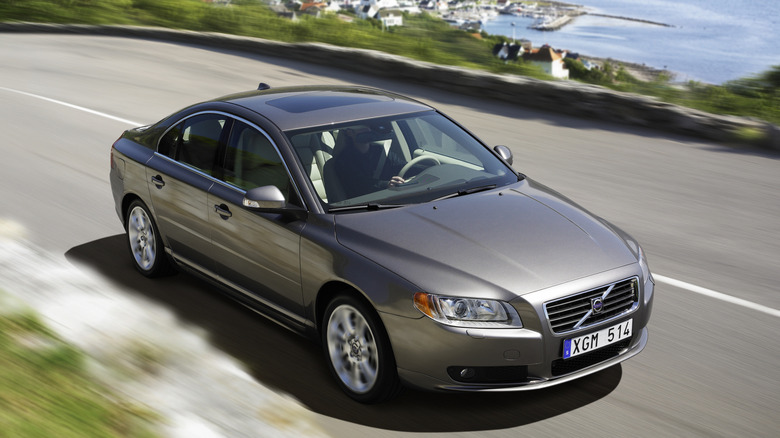
Decades later, Volvo proved that the configuration was possible in a much more modern application, with its compact SI6 engine. It was engineered specifically to fit transversely, for safety reasons, and by mounting all ancillaries at the rear of the crankshaft, above the transmission, the smart Swedish automaker was able to package everything required into the S80, V70, XC60, XC70, and XC90. So impressive was Volvo's engineering here that the SI6 engine measured just 3 millimeters longer than the firm's legendary inline-5 engine.
Daewoo had a crack at it too, squeezing 2.0- and 2.5-liter sixes under the hood of various models. One-off creations include Lamborghini's wild Marzal concept, which utilized half a Miura's V12, and Irish engineer David Woods' own creation, the DAWB 6, which used a transversely mounted 1.4-liter air-cooled inline-6. The bizarre creation arrived in 1962 and now resides in a museum collection.