

These Are Porsche's Most Important Engines, From Flat Six To V10
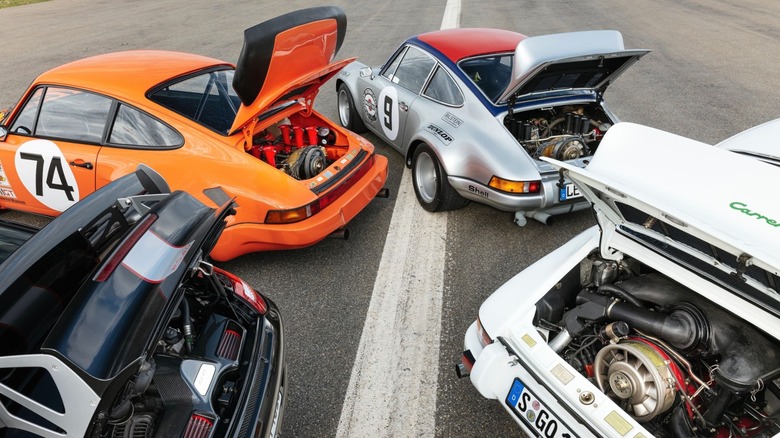
From the eyes of the casual observer, Porsche's entire identity is marked by the flat-6 engine. That's hardly surprising, as it's the engine configuration of choice for Porsche's most popular nameplate, the 911. The highly engaging 718 Cayman GT4 RS also has a naturally aspirated flat-6.
However, not all Porsche engines are flat-6s. Always aiming to outrun the competition, Porsche has been experimenting with more engine types than most manufacturers. We are not talking only about prototypes — these engines dominated competition in racing and broke acceleration/speed records for road-legal machines.
And in this piece, we'll give you all those important Porsche engines, some of which you didn't know existed. We'll also touch on the air-cooled and water-cooled eras and Porsche's highly successful racing endeavors, all through the eyes of cylinder configurations. So, without further ado, let's see how Porsche transitioned from the uninsulated, air-cooled mechanical theater of early 911s to the highly potent and efficient masterpieces of the modern era. Enjoy!
The air-cooled flat-6 originals
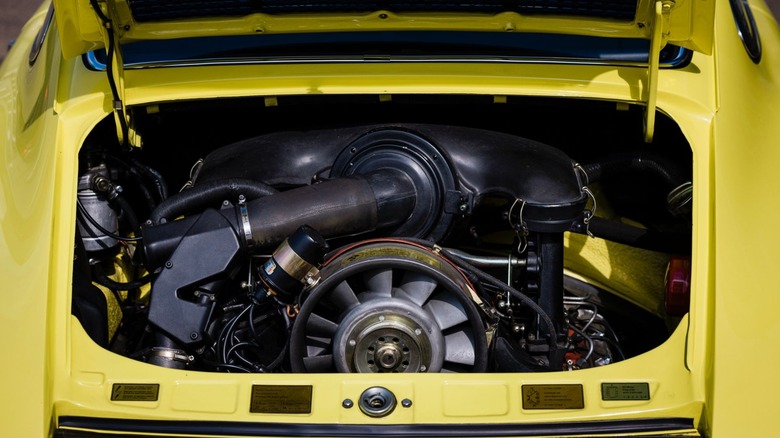
Nothing screams Porsche more than an air-cooled flat-6. The fact that the automaker retired this configuration with the 993-generation 911 back in 1998 only adds to the allure of (arguably) Porsche's most beloved engine platform. Porsche aficionados will certainly point out that these engines weren't only cooled by air, but also by an oil cooler.
Still, the fact remains that for almost 3 decades, the air-cooled flat-6 appeared in many memorable 911s — like the lightweight 1967 F-Series 911 R or the attractive, ducktail-equipped 1973 911 Carrera RS 2.7. Even the first-ever 1974 911 Turbo had a 3.3-liter air-cooled flat-6 with a bombastic (at the time) 300 horsepower. The best part — these engines had a unique personality. The Italians had their V12s. Porsche had the raw, mechanical, air-cooled flat-6. And every spine-tingling note of this engine tracks back to a single engineering icon: Hans Mezger. Before he arrived on the scene, Porsche's bread-and-butter sports car, the 356, had an air-cooled flat-4 engine, just like the Beetle.
For the 911, however, Ferdinand Porsche's son, Ferry, ordered Mezger to build an engine platform that would continue to dominate performance metrics, while keeping the original's horizontally opposed cylinder design. The first-ever air-cooled flat-6, designated 901, still had the same 2.0-liter capacity as the flat-4 in the 356 Carrera but, crucially, allowed for much higher capacities later down the line. The motor had a forged steel crankshaft, six Solex carbs, and opposed pistons that had the same up-and-down movement, like a boxer. Meanwhile, an oversized fan ensured each cylinder was cooled successfully.
The water-cooled flat-6 revolution
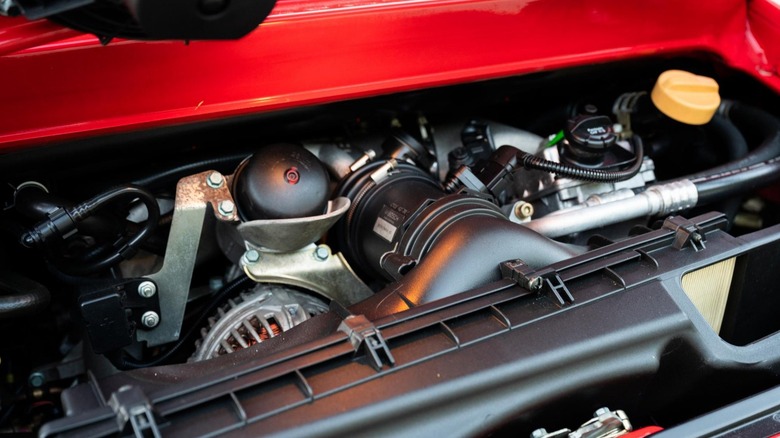
The air-cooled flat-6 had a great 34-year run, but in the 1990s, it was caught between the jaws of the modern horsepower wars and stricter emission standards. To compete, Porsche needed to completely overhaul the platform and introduce water cooling.
So, starting with the much-maligned 996-generation 911, Porsche introduced its first-ever water-cooled flat-6 engine. The 3.4-liter unit produced 296 horsepower, with larger versions arriving later with increasingly higher power figures. The 996 911 Turbo was also equipped with a water-cooled flat-6. The twin-turbo 3.2-liter unit produced 414 hp, or up to 476 hp in the GT2 variant. Evidently, Porsche could again compete with Ferrari and Lamborghini in terms of power, while meeting stricter emission regulations.
Indeed, the latest 2026 911 Turbo S T-Hybrid packs an electrified 3.6-liter twin-turbo powerhouse that produces 701 hp and a whopping 590 pound-feet of torque available from 2,300 rpm to 6,000 rpm. It gets to 60 in just 2.4 seconds and meets the Euro 7 regulations. Meanwhile, Porsche kept the raw DNA of the air-cooled engines with the naturally aspirated water-cooled lineage — the latest 4.0-liter flat-6 in the GT3, GT3 RS, and Cayman GT4 RS is one of the best naturally aspirated engines ever made, with up to 520 hp, a 9,000-rpm redline, and a spine-tingling sound.
Some Porsche enthusiasts still lament the loss of the mechanical, analog intimacy of the air-cooled engine. But let's celebrate the flat-6 as long as we can — water cooling be damned. The era of gas-burning horsepower has entered its final countdown, anyway.
The water/air-cooled hybrid
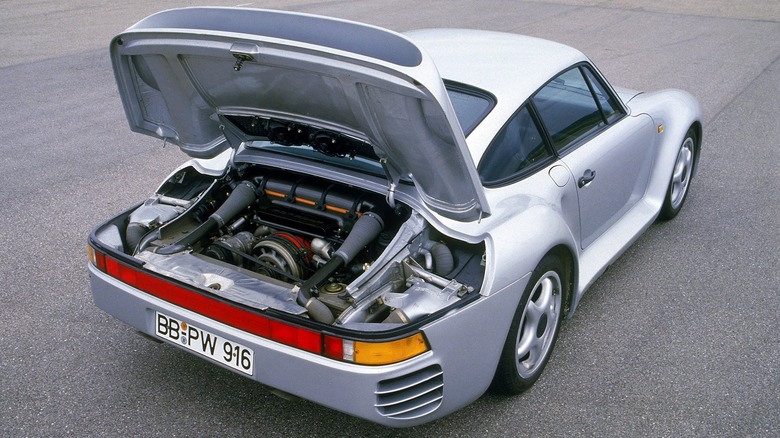
Before Porsche waived goodbye to air cooling, it flirted with water cooling in the 959 that we called a 1980s sci-fi supercar. Easily the most advanced car of its era, the 959 had a height-adjustable suspension, an AWD system with selectable torque split, and a lightweight, aerodynamic body made from aluminum and Kevlar. The magnesium wheels also formed a sealed chamber with the tires, allowing Porsche to implement a tire-pressure monitoring system.
Among all these advanced technologies, it's easy to forget that the 959 also packed a twin-turbo flat-6. Although it had a capacity of only 2.85 liters, it produced 450 horsepower, enough for a top speed of 199 mph. Yet, the most impressive part about this engine is that it utilized both water and air cooling. Like any other Porsche flat-6 at the time, the block was air cooled, but the head was water cooled. A strange concept, sure, but it added to the 959's appeal. Not to mention, the engine wasn't shared with any other road-going Porsche but had its roots in the Porsche 936 "Black Widow" racecar.
The high-displacement inline-4
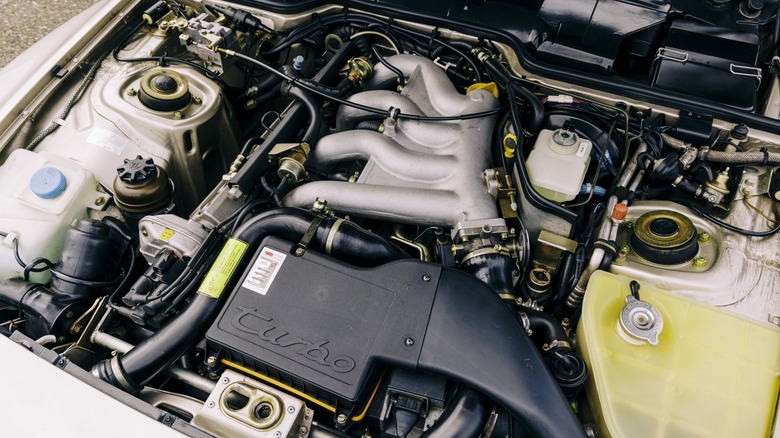
Porsche's first water-cooled engine wasn't a flat-6, but an inline-4. Yes, not the most exciting configuration, but it still defined an era in Porsche's history — an era of balanced handling, thanks to the front-engine, rear transaxle configuration.
Of course, these engines also needed to be powerful, so Porsche went with a higher capacity than usual for a four-cylinder engine. The first inline-4, found in the 1976 Porsche 924 was a 2.0-liter unit with 123 horsepower, which didn't exactly fit the bill, so Porsche later introduced a 168-hp turbocharged version.
In the next-gen 1983 Porsche 944, however, a larger 2.5-liter unit with 143 hp was introduced, which was bumped up to 247 hp in the turbocharged variant. The 944 Turbo S sprinted to 60 in just 5.5 seconds and had a top speed of 162 mph. Then, in 1989, Porsche introduced 2.7-liter and 3.0-liter versions of its inline-4 engine. The larger engine produced 208 hp and helped the 944 S2 reach a top speed of 150 mph.
The 1991 Porsche 968 was the final showcase of the brand's inline-4 lineage. It was equipped exclusively with the larger 3.0-liter engine, albeit with added variable valve timing to meet emission standards. The improved engine had more torque (225 pound-feet) and produced 236 hp. The 968 Turbo S also used a turbocharged version of the larger 3.0-liter engine, producing 305 hp and 369 pound-feet of torque, which was finally enough to match the platform's handling credentials. The 968 Turbo S reached 60 in 4.5 seconds. Top speed: 175 mph.
The flat-4 experiments
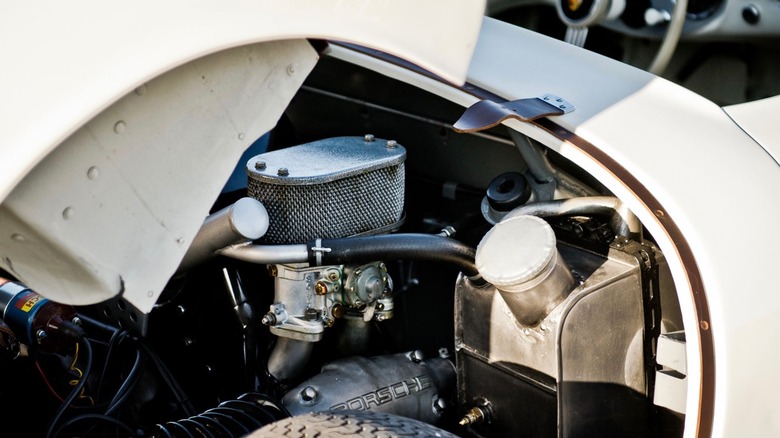
Porsche's early days were marked by the flat-4 engine. The 356 sports car, introduced in 1948, started with a tiny, 1.1-liter air-cooled unit, good for only 34.5 horsepower. That's less than a modern 400cc motorcycle, but Porsche played the lightweight game back then. The 356 weighed just 1,290 pounds, so it could still reach 83 mph. Subsequent iterations had higher 1.3-liter, 1.5-liter, and 1.6-liter capacities that produced up to 99 hp. Further down the line, the 356 B and C series received even larger 2.0-liter flat-4 engines with up to 138 hp.
Still, it's the Fuhrmann four-cam engine that launched Porsche on the world stage. This highly sophisticated 1.5-liter engine was first introduced in the 1953 Porsche 550 Spyder. In the featherlight, 1,213-pound sports car, it produced 110 hp, utilizing two camshafts per cylinder bank. Porsche also used it in the 356 A 1500 GS Carrera, where it produced 99 hp.
Porsche wasn't done with the Fuhrmann engine, though. The 1957 Porsche 718 received an even more potent 1.6-liter variant with up to 160 hp, while being even lighter than the 550 Spyder (1,168 pounds). As a result, it reached 162 mph, an astonishing figure for the era. It was so good, in fact, that single-seater versions competed in F1!
Almost 60 years later, in 2016, Porsche again revived the flat-4 formula for the 718 Cayman and 718 Boxster. This time, the 2.0-liter and 2.5-liter engines replaced the previous 3.0-liter flat-6, using turbocharging to produce up to 365 hp in the 2018 Cayman GTS.
The grand-touring V8s
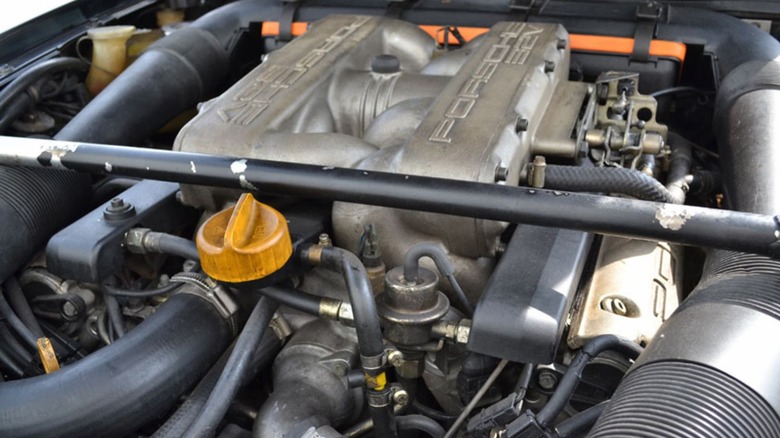
Porsche was already flying high during the 1970s. The 911 Turbo competed with the contemporary supercar elite at the time, while the mid-engine 914 and front-engine/rear-wheel-drive 924 served as great entry-level sports cars for enthusiasts. However, Porsche missed a high-end grand tourer to measure up. So, in 1978, Porsche launched the 928 – a bigger, more luxurious alternative to the 911.
Much like the 924, the 928 was a transaxle design for better weight distribution and drivability. However, instead of an inline-4, the 928 had a 4.5-liter 90-degree V8 with 16 valves and 219 horsepower. Sure, that was not very impressive, but Porsche continued to improve on the V8 formula. The 928 S packed a 4.7-liter variant with up to 310 hp in the 1986 model. Meanwhile, the 928 S4 and 928 GT had 5.0-liter V8s with 32 valves and up to 326 hp in 1991.
In 1992, Porsche introduced the most potent 928 GTS variant. Packing a 5.4-liter, 32-valve V8 with 345 hp and 369 pound-feet of torque, this 928 sprinted to 60 in 5.1 seconds and had a top speed of 171 mph.
In the 2000s, Porsche again introduced new V8 engines, this time for its first SUV effort, the Cayenne. The 4.5-liter and 4.8-liter units were available in naturally aspirated and twin-turbo versions and produced up to 542 hp. Porsche's current 4.0-liter twin-turbo V8 was developed in collaboration with Audi.
The high-revving supercar V8
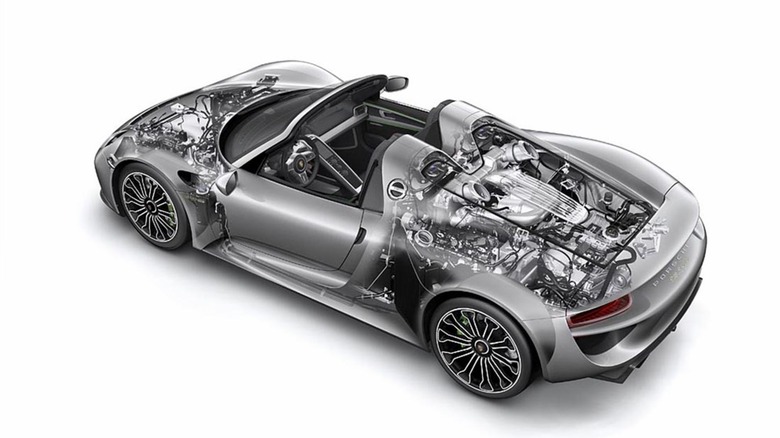
Porsche's true rise to V8 prominence happened in 2010, when the company introduced the mid-engine 918 Spyder hypercar. Yes, it was a part of a hybrid configuration, but it's still one of the greatest Porsche engines ever built. It was so good, in fact, that Porsche later used it in the 963 GTP hypercar. A naturally aspirated gem, the 918 Spyder's 4.6-liter V8 revs to a hypnotic 9,150 rpm and produces 608 horsepower. It sounds like an angry animal, too, with that furious rush as the redline approaches, and even spits flames through the dual, upward-pointed exhaust tips.
Yet, it's the two electric motors that gave this powertrain hypercar-level performance. Like in most modern setups, Porsche sandwiched one motor between the engine and the seven-speed dual-clutch transmission, while the other powers the front wheels for AWD traction. The combined hybrid system output of 887 hp and 944 pound-feet is still impressive today, allowing a 0-to-60 sprint of just 2.2 seconds in Car and Driver's tests. Top speed: 211 mph.
Of course, the 918 Spyder is much more than just an advanced powertrain car. It's built over a stiff carbon tub, with the suspension attached directly to it for more responsive handling. As a result, the 918 Spyder was also the first-ever production vehicle to go around the Nürburgring Nordschleife in under 7 minutes (6:57).
The screaming V10
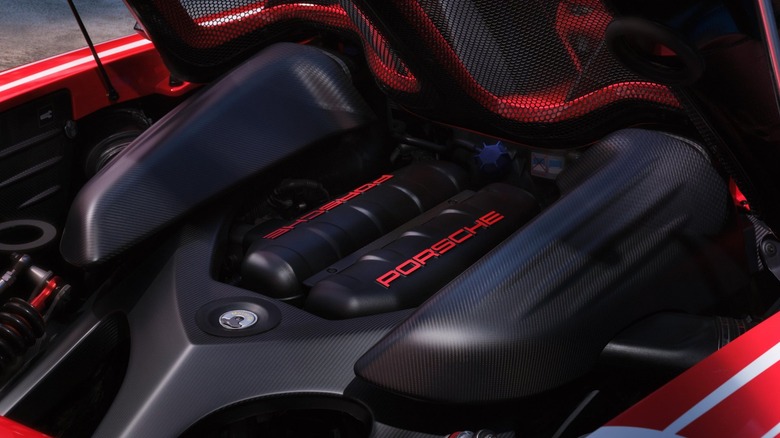
The 918 Spyder's V8 sounds like a dream, but the Carrera GT's V10 is a whole new level of auditory feast. Often touted as one of the best-sounding engines of all time, this screaming, 8,400-prm V10 provides that raw, racecar-like noise that everyone loves. The fact that it's paired with a six-speed manual with ceramic clutch only adds to the enthusiast appeal.
But Porsche's only V10 isn't just about the drama. It's actually a racing engine, developed for the prematurely killed LMP2000 Le Mans racer, which was later adapted for use in a road-legal sports car. Originally a 5.5-liter engine, the one in the Carrera GT has a capacity of 5.7 liters. The 68-degree V10 produces 603 horsepower at 8,000 rpm and 435 pound-feet of torque at 5,750 rpm, enough for a 0-to-60 sprint of just 3.5 seconds. Top speed: 205 mph.
Because the Carrera GT is a barebones sports car, rather than a heavy, complex hybrid hypercar, it weighs only 3,042 pounds. As a result, it's a riot on a twisty road, with lightning-fast reflexes. And it's not just because of the lack of heavy batteries — the Carrera GT features a carbon-fiber monocoque,exotic magnesium/Kevlar parts to keep the weight at check, and ceramic-composite brakes.
The forgotten flat-8 race winners
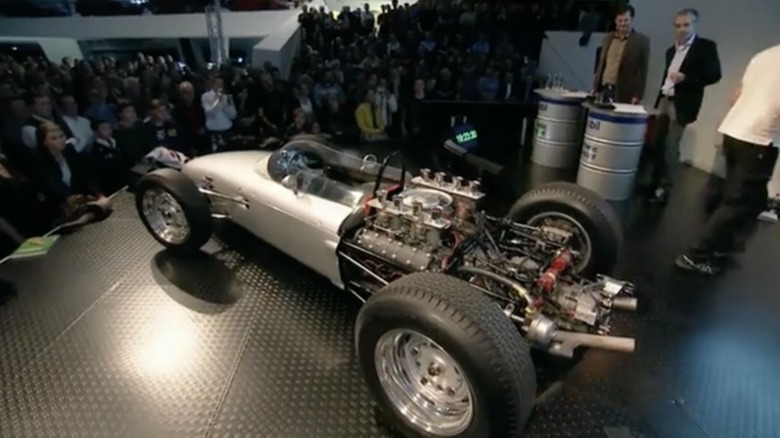
The 928's V8 wasn't the first time Porsche dabbled with eight cylinders. True to its origins, the company developed an air-cooled flat-8 for its 1962 F1 challenger, the 804. Internally called Type 753, this 1.5-liter engine produced 177 horsepower at 9,200 rpm and, understandably because of its small capacity, 112.8 pound-feet of torque at 7,200 rpm. However, it only had to haul around 1,000 pounds, so it could still reach a top speed of 167.8 mph.
More importantly, it brought Porsche a one-two victory at the Solitude race near Stuttgart, with famous racing driver Dan Gurney finishing first and Jo Bonnier second. Back in the day, this win indicated an era of competitiveness for Porsche. Unfortunately, racing in F1 proved costly for Porsche at the time, so the company killed the flat-8 project by the end of the season. The complex Type 753 engine didn't help here — it had four camshafts and took 220 hours to assemble. Thus, it had no use in Porsche's road cars, which was the driving force behind the automaker's racing endeavors.
Fortunately, the Type 753 engine evolved into the larger Type 771, which had a capacity of up to 3.0 liters. The Type 771 was mainly used in hill climb racing, but it reached legendary status inside the 908/2 sports car, which won the 1969 Makes World Championship title.
The air-cooled flat-12 that ruled Le Mans and Can-Am
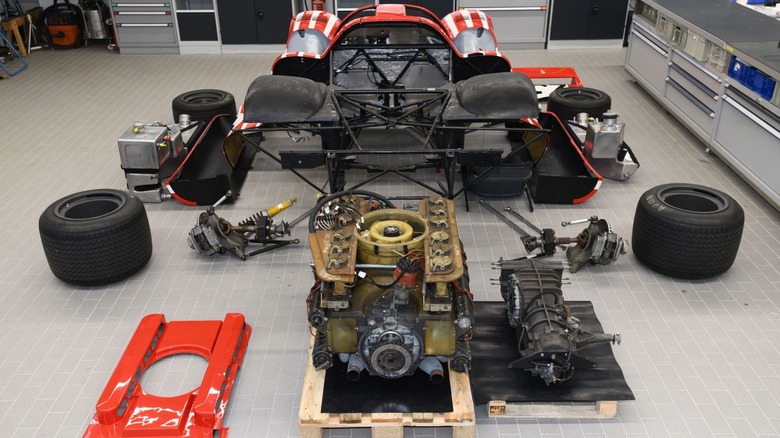
Porsche's flat-8 era was incredibly successful in racing, but the brand's flat-12 racing prototype, the 917, reached new heights. The combo brought Porsche the 1970 and 1971 24 Hours of Le Mans victories, and then demolished the Can-Am field, winning two championships (1972 and 1973), powered by a turbocharged version of the flat-12 engine.
Initially, the Type 912 flat-12 had a capacity of 4.5 liters, making it Porsche's biggest engine at the time. It produced 620 horsepower, with forced induction bringing that figure up to 850 hp. However, Porsche increased the capacity to 5.4 liters for Can-Am, bringing the twin-turbo flat-12 to nearly a whopping 1,200 hp, with some reports saying it produced 1,580 hp in qualification trim!
Curiously, though, the Type 912 wasn't a boxer engine, as its opposing pistons shared the same crank pins. This has reduced complexity, as it required just eight main bearing journals instead of fourteen. It also reduced the weight of the already lightweight magnesium crankcase and allowed Porsche to make the engine a bit shorter. Meanwhile, to reduce torsional strain, Porsche attached the accessory gear drive in the center of the crankshaft. The Type 912 flat-12 also had two sparks per cylinder, a magnesium crankcase, advanced Dilavar head bolts, and, like every Porsche engine at the time, it was air-cooled.
The twin-turbo V6 that dominated F1
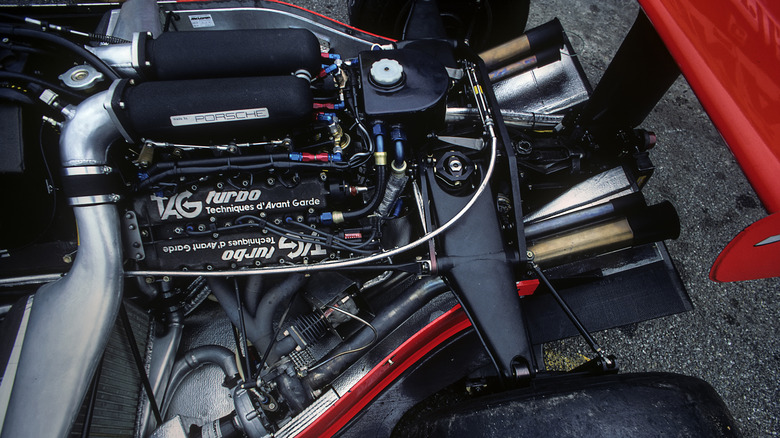
Back in 1982, F1 teams agreed on a new powertrain format, with 1.5-liter turbocharged engines taking the center stage. Because it has always been successful with small engines, Porsche decided to compete with the TAG TTE P01 1.5-liter twin-turbo unit.
The idea was to create a powerful, but also compact, fuel-efficient, and reliable engine. So, famous designer Hans Metzger went with an 80-degree V6 layout, although he initially toyed with the idea of a flat-6. The engine was also equipped with titanium connecting rods and forged pistons to reduce weight, making the TTE P01 one of the lightest engines on the grid. Meanwhile, overlapping rod throws on opposing cylinders reduced fuel consumption, while intricate coolant channels ensured good cooling and durability.
Initially, the TTE P01 lacked power compared to its rivals, producing around 600 horsepower in race trim. However, Porsche continually improved the engine, and by 1984, it produced 820 hp in race trim, or up to 870 hp in qualifying trim. Then, nestled inside the McLaren MP4/2, the TTE P01 won 12 out of 16 races and brought legendary driver Niki Lauda his third and final title.
Next year, Alain Prost, Lauda's teammate, won the title with an improved engine and McLaren chassis. Prost won four races in 1986 and three races in 1987 with an even more powerful variant of the engine producing up to 1,060 hp in qualifying trim. He missed on the 1986/1987 championships, but with 25 wins in 68 races, the TTE P01 is the most successful Porsche F1 engine.
The tiny V4 that conquered Le Mans
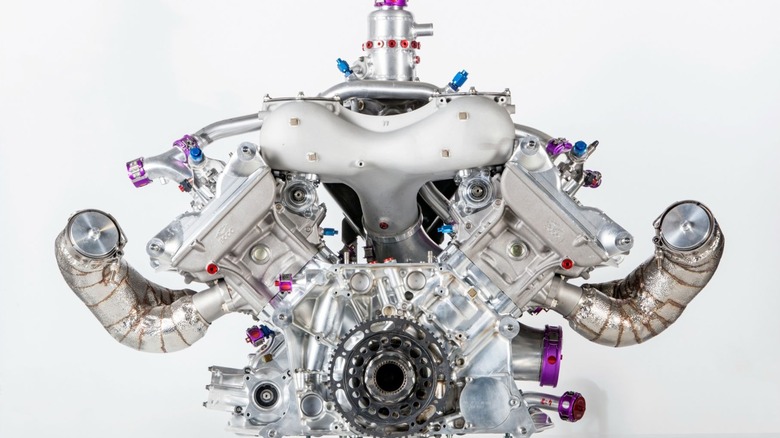
Porsche's small-engine racing dominance is perhaps best represented by the V4 inside the 919 LMP1 endurance prototype. The 2.0-liter turbocharged engine produced over 500 horsepower and was paired with a unique MGU-H exhaust gas recovery hybrid on the rear axle. This system utilized two exhaust turbines, one of which was used to recover energy and charge the battery. The 919 prototypes had an additional MGU-K electric unit on the front axle, which provided AWD capability. The hybrid system provided an additional 400 hp, pushing the overall output to 900 hp.
But why did Porsche go with a V4? After all, its main LMP1 rivals, the Audi R18 and Toyota TS040, had larger engines — the R18 had a 4.0-liter V6 diesel, while the TS040 employed a naturally-aspirated 3.7-liter gas V8. Well, the smaller engine is more efficient in terms of fuel consumption and packaging. The 919 V4 proved to be Porsche's most efficient engine at the time, and because of its 90-degree V4 layout, it was compact, too. As a result, Porsche took the honors at the 2015 24 Hours of Le Mans race and won again in 2016 and 2017. Porsche later used some of the tech in the 718 Boxster's turbocharged flat-4, meaning the V4 also had road relevance.