

A Modern Production Car Is About To Debut Without A Hydraulic Braking System For The First Time
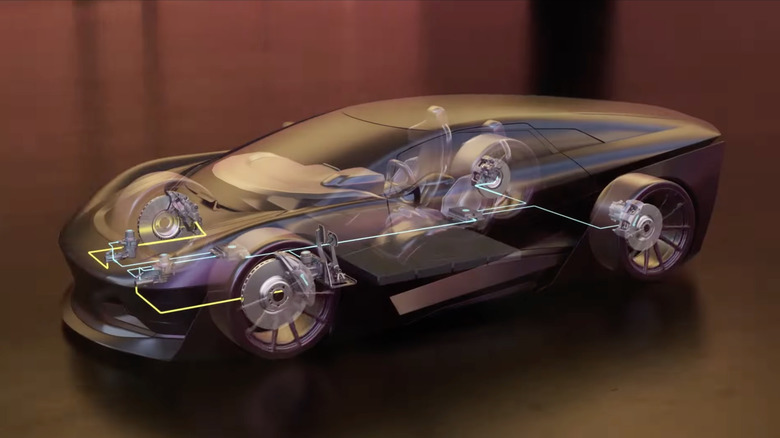
Drive-by-wire throttle systems have been around for a while, and steer-by-wire is starting to appear in more cars as well. It's only a matter of time until brake-by-wire makes its way into more common cars, and it may end up replacing fluid-based braking systems sooner than you think. Brembo has announced that its Sensify brake-by-wire system has entered production for use by "a leading global vehicle manufacturer."
Seemingly, since the dawn of modern automobiles, braking systems have used physical hydraulic connections all the way from the brake pedal to each wheel. Pressing the pedal squeezes brake fluid inside the brake lines directly to each caliper (or wheel cylinder for drum brakes) to press the friction surfaces together to slow and stop the car. In brake-by-wire systems like Sensify, that direct physical connection goes away, replaced by wires, motors, and electronic controllers to apply the brakes instead.
Car and Driver tried out an earlier version of the Sensify system on a pair of Teslas, one with Sensify brakes and the other with its original brakes. Most of us are familiar with the loud chattering and vibration of the brake pedal when activating ABS during hard braking. These were absent in their testing, replaced with smooth brake application that held each tire perfectly at its limit of traction. This smoothness and instant response would also apply to any other driver aid system that uses the brakes, like traction and stability control. A fully electronic system is also easier for autonomous driving systems to control, making it potentially more appealing for driverless cars.
Pros and cons
Earlier versions of Sensify offered both fully electronic and partially hydraulic braking systems, but Brembo now describes it as "a fluid-free architecture that distributes intelligence at wheel level, removing hydraulic circuits and centralized actuation." Call me old-fashioned, but that idea concerns me for the same reason as electronic parking brakes. Unlike hydraulic brakes, there's no way to apply or release the brakes when there's no power, just like a Tesla door. However, a small battery or even a capacitor dedicated to powering the brakes in an emergency could solve this.
On the plus side, it can be tricky to run brake lines all over a car, but it's easy to run wires anywhere you want, and electric brakes would also eliminate the common snow belt issue of brake lines rusting out and springing leaks that compromise brake performance, not to mention ruin your paint. No more brake fluid means no more boiling the brake fluid, too. Changing from left to right hand drive would be as simple as installing the pedals on the other side, with no bulky master cylinder taking up space in the engine compartment. Like the electronic throttle and steering, brake sensitivity could be adjusted to a driver's individual preference. There are lots of potential benefits.
Brembo has not yet announced exactly which "leading global vehicle manufacturer" will be the first to use Sensify brakes, and declined to tell The Drive when asked directly. Brembo emphasizes that they can be used on any car, from tiny city cars to commercial vans and everything in between. I imagine that early on, the new technology would cost more than a traditional braking system, and would likely appear first on a high-end luxury vehicle, probably an EV. Over time, however, the cost may come down as the technology becomes more common, especially if used across many vehicles regardless of manufacturer, something Brembo already does. While Brembo's is not the only brake-by-wire system out there, or the first to ever exist, it may be the first to see public roads in a production vehicle without a hydraulic backup.