

Brake-By-Wire Sounds New-Fangled, But It's Been Around For 25 Years
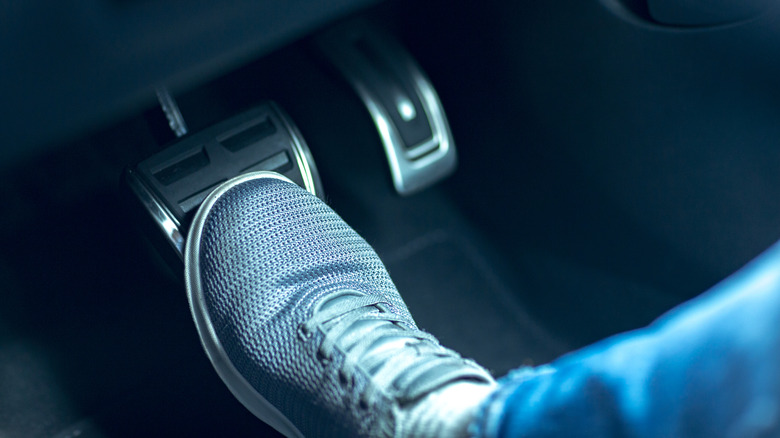
Bosch has been an important innovator in the braking industry since 1927, pioneering systems like anti-lock brakes and electronic stability programs back in the 20th century. The company — whose magneto ignition device made spark plugs possible – hit the headlines in 2025 with another advance: a brake-by-wire system in which the brake pedal isn't mechanically part of the braking system at all. Instead, it's connected to an onboard computer that gauges driving conditions and applies braking force as needed.
Now, Bosch touts some key benefits of its new setup, and we'll discuss those below, but for those who started paying attention to stoppers in the early 2000s, this must have seemed like déjà vu. After all, the same company was boasting about the same basic type of system about a quarter century earlier, when it introduced its Sensotronic Brake Control (SBC) brake-by-wire technology first used in the 2002 Mercedes-Benz SL. Mercedes began expanding the system's availability to the E-Class and CLS-Class soon after, and it appeared on the SLR McLaren and contemporary Maybach models as well.
The success was short-lived, though, and Mercedes dumped SBC after a pair of huge recalls tied directly to problems with the system. Since SBC was designed in partnership with Daimler, and Mercedes-Benz was the only OEM using it at the time, the result was that Bosch put brake-by-wire on the back burner for a while. Bosch further claimed its electronic stability programs had advanced to the point where they could match SBC's performance anyway. So what's behind the return of brake-by-wire? Let's find out!
How does brake-by-wire work?
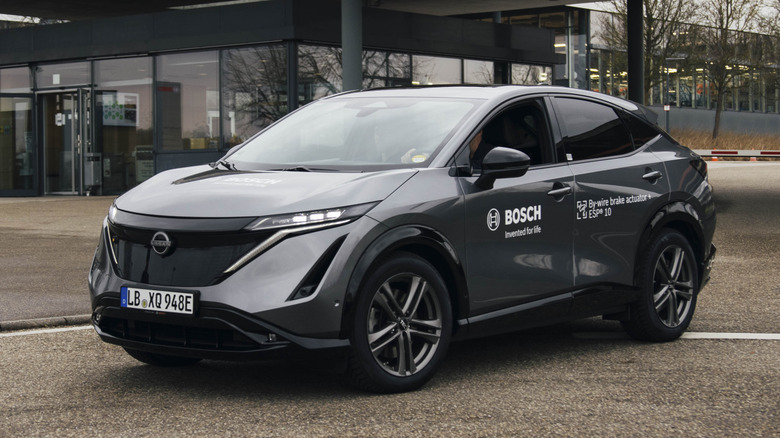
First off, the current crop of brake-by-wire systems still relies on hydraulic pressure to mechanically squeeze the brake calipers, which then push the brake pads against the rotors to slow the car down via friction. But where a traditional brake system uses mechanical and hydraulic means to transmit your muscle strength to the brake pads, brake-by-wire uses computer control. Basically, you press on the brake pedal, the computer registers how much force you want to apply to the brakes, and then it activates what's called an electric actuator, not leg power, to initiate the hydraulic pressure. Just keep in mind that this means these are still technically electrohydraulic brakes.
Moreover, there are actually two separate electrical channels in the Bosch setup, one for the brakes proper and one for the ESP system. As a result, if one fails, the other can still handle braking for all four wheels as a backup — although, again, it retains hydraulic brakes.
That said, another well-known auto supplier, ZF, is working on ditching hydraulics and entirely swapping out conventional brakes for electric motors on each wheel — which would help capture electricity through regenerative braking, too. (A DIY rig may be the best explanation of regenerative braking itself.) Anyway, ZF calls it a "dry" setup because no brake fluid is involved. Current electrically powered vehicles, whether they're EVs or hybrids, have both regenerative braking and full hydraulic braking systems.
The benefits of brake-by-wire don't stop there
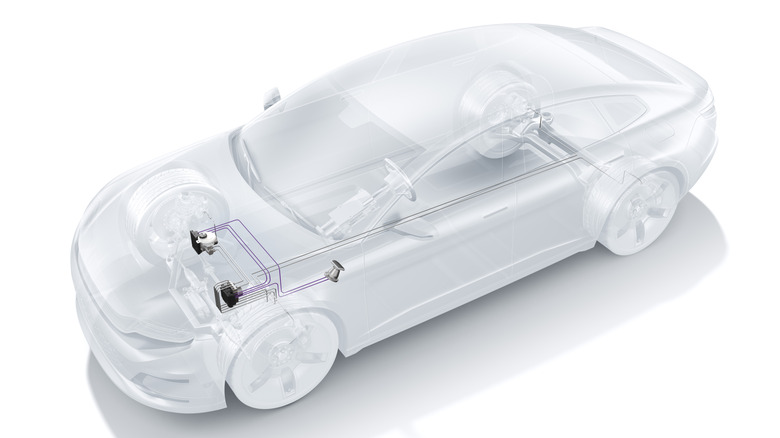
What's a little weird here is that the biggest advantage of brake-by-wire systems has nothing to do with how well they can stop a car. According to Bosch, the main benefit is in packaging. Without the need for a physical connection between the brake pedal and the rest of the brake system, individual components don't have to be placed in a direct line from the pedal to the system. They can be put just about anywhere you can run a wire. For instance, mounting parts directly in front of the pedal puts them between a driver's feet and potential crash forces from a head-on collision, where they can lead to foot or leg injuries. But the same parts can be moved to a safer place, or eliminated, with brake-by-wire.
The same extra design freedom can impact manufacturing costs, as the brake-by-wire components can be specifically relocated to where they're easiest and least expensive to install on the assembly line. Bosch also claims that its system can be up to 25% lighter than comparable traditional braking setups. And with less weight to move, the vehicle can be more efficient.
Finally, we know that some of our Jalopnik experts are aware of modern "drive-by-wire" systems that launched between the two Bosch introductions, including on some of the latest production cars with the best braking times. The defining difference between those setups and today's Bosch system is that the former still had an entire traditional brake system on board as the backup. The new system, recall, keeps the hydraulic brakes, but they're engaged by actuators.