

10 Wickedly Cool Carroll Shelby Cars That Made The Man A Legend
Pushing cars past their limits was Carroll Shelby's modus operandi from the moment he began converting an AC Ace into the AC Cobra roadster in 1962. This continued throughout most of his professional life, with Shelby taking what other automakers had already built and making it better, lighter, and more powerful. This relentless pursuit of speed and faster lap times has, in return, brought us some wickedly cool street and race cars. It also helped Ford win at Le Mans and aided Dodge in producing its most wicked sports car.
Undoubtedly, the man is an American automotive legend. In this article, we'd like to celebrate his love for cars and engineering ingenuity by showing you 10 of his best creations. We had a hard time narrowing the list down to 10, because he built so many amazing enthusiast-grade cars over the years. Still, we believe these cars best capture Shelby's ascendance to the highest echelon of the performance hierarchy. So, from the mad Super Snake machines to his in-house supercar, these are the cars that best represented Shelby's Goes Like Hell philosophy.
1962 to 1965 Shelby AC Cobra 260/289
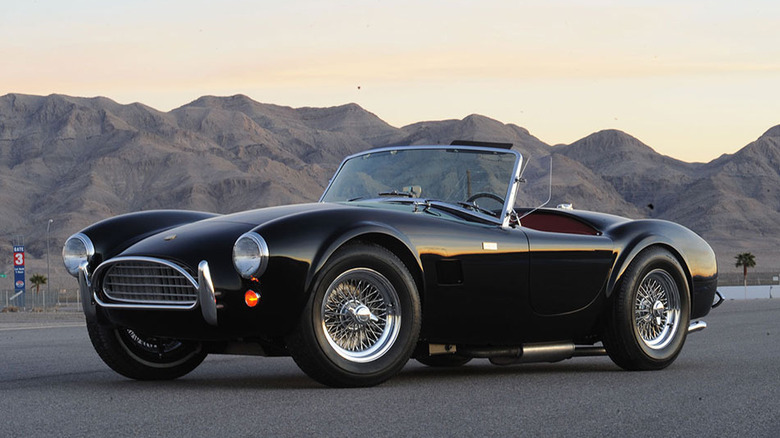
By the early '60s, the AC Ace was an established entity in the British sports car category. It was compact, lightweight, and fun to drive. Handsome, even. What it wasn't, though, was fast enough for what Carroll Shelby needed. He wanted a machine that was lightweight enough to win races, but could still be improved by adding an American V8. To do that, he convinced the Ford brass at the time that a V8-powered AC Ace was a winning recipe and ended up building the first AC Cobra 260.
Equipped with Ford's 260-horsepower 4.3-liter V8, the AC Cobra was an entirely different beast. For comparison, the most potent AC Ace Bristol had a 2.0-liter inline-six, which was good for only 125 hp. Of course, Carroll Shelby wasn't entirely satisfied, so a year later launched the improved AC Cobra 289. Now packing a larger 4.7-liter V8, the roadster had 271 hp and meaty 314 lb-ft of torque at its disposal.
As a result, when equipped with a four-speed manual transmission, it blasted to 60 in 5.8 seconds, reaching a claimed top speed of 150 mph – although MotorTrend could only get a 1963 Cobra 289 up to 130 mph. Either way, that's frankly astonishing for a car without much in the way of safety tech and bias-ply tires. The racing version had four Weber carburetors, which bumped the output to 335 hp, yet it weighed just 2,120 pounds (960 kg), so it was even faster.
Unsurprisingly, reviews from the time praised the Shelby AC Cobra, particularly the handling and raw power. The roadster was also competitive in racing, often trading blows with Corvettes and Ferraris. It wasn't dominating, but the balanced chassis and immense power proved to be a solid foundation for what was coming next.
1964 Shelby Cobra Daytona Coupe
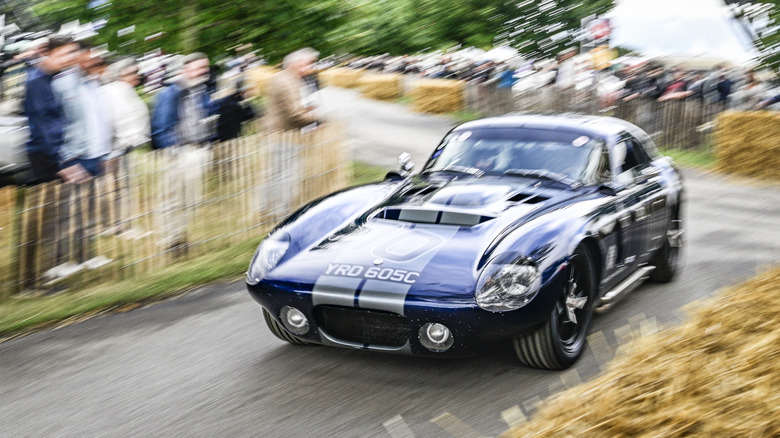
What the Shelby Cobra roadster lacked to compete at the highest level was more efficient aerodynamics. Enter the Cobra Daytona Coupe — a racecar that dominated straights thanks to its wind-cheating design.
Sure, the implementation of the roof was already a big improvement, but Shelby engineer Peter Brock went further and incorporated aerodynamic theories that were invented in 1930s Germany. In particular, the swooping roof and chopped-off Kammback tail dramatically increased the aerodynamic efficiency of Shelby's racecar. These practices were unproven at the time, and the project's chief engineer, Phil Remington, thought the aerodynamic angle was a waste of time. Other engineers called it ugly. Heck, even Shelby was skeptical.
But the proof was in the pudding. The Cobra Daytona Coupe set Daytona and Sebring track records, and then won the GT Class at the 12 Hours of Sebring. A few months later, Shelby's coupe set lap records at Le Mans and Spa, and then won the GT Class again at the 24 Hours of Le Mans race in 1964. And it did all that while using the same 4.7-liter engine as the Shelby Cobra 289 roadster.
It's far from ugly, too. In fact, it competes with the Chevy Corvette C2 as one of the best-looking American sports car from the 1960s. The sleek, elegant body and long hood make it look very contemporary. Unfortunately, Shelby built only six units, with just one sold to a customer as a street car. Still, Shelby built a limited series of Daytona Coupes for the car's 60th anniversary, with period-correct mechanical parts and an improved interior.
1965 to 1968 Shelby GT350
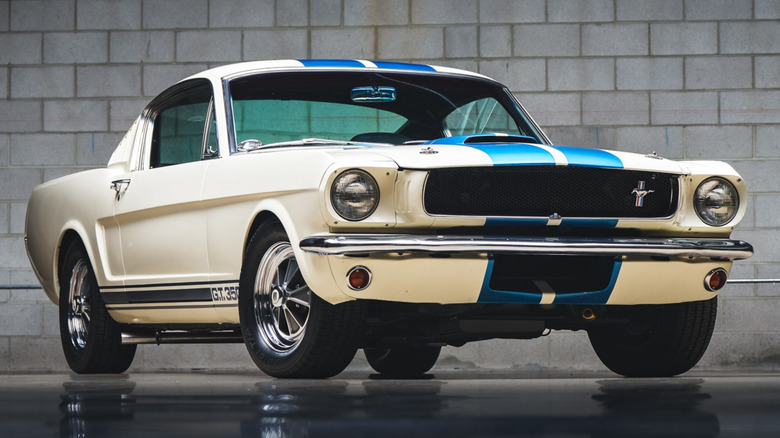
Production cars don't really get more wicked than the original Shelby GT350. Yes, it was a reworked Mustang, but with almost every part improved by Shelby. The 4.7-liter V8 was the same engine found in the Cobra roadster but equipped with a high-riser intake manifold with a four-barrel carburetor, new headers, and cast aluminum rocker covers. As a result, it produced 306 horsepower. Still, Shelby American offered an optional Paxton supercharger kit, which brought the V8 to over 380 hp!
That was just the beginning. The GT350 also had a lighter fiberglass hood, stiffer front anti-roll bar, rear limited-slip differential, and adjustable Koni shocks. Shelby also made the steering more responsive and increased grip with special Goodyear semi-racing tires. To keep the weight in check, Shelby used an aluminum case for the four-speed manual transmission and offered optional alloy wheels. Overall, the Shelby GT350 weighed around 2,800 pounds, or 225 pounds lighter than the original car. As a result, MotorTrend recorded its acceleration time to 60 mph as just 7.0 seconds. Top speed: 130 mph.
Perhaps an even more interesting development was the 1966 Shelby GT350-H Rent-a-Racer version. Launched under a collaboration between Shelby American and Hertz, this was the same car as the GT350, though one you could rent and explore its limits. The nameplate continues to be sought-after today; Shelby American brought back the GT350 and GT350R in 2025, with the latter packing a supercharged 5.0-liter V8 good for 830 hp. The centerpiece, though, is the stick shift, just like on the original.
1966 Shelby Cobra 427 Super Snake
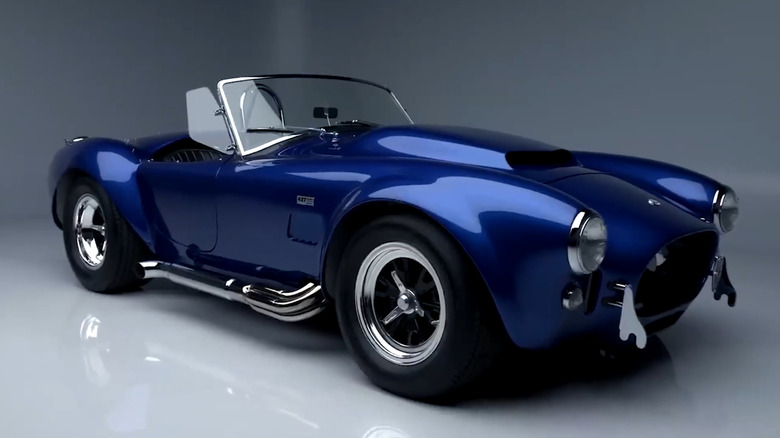
The original Shelby Cobra had already enticed enthusiasts, but they weren't ready for what followed in 1966 — the Cobra 427 Super Snake. And this thing is truly wicked, as it packs a 7.0-liter V8 powerhouse equipped with two Paxton superchargers. According to Shelby, this combo was rated 800 horsepower, which might've been an exaggeration, but it was still enough for an 11-second quarter-mile run. This was all despite the fact that the Super Snake was equipped with an ancient three-speed automatic transmission.
What's perhaps more interesting about the Cobra 427 Super Snake is that it was Shelby's personal car. In fact, Shelby built only two Super Snakes. The other one was sold to Bill Cosby, although the infamous actor parted ways with his Super Snake and the next owner lost his life when driving it off a cliff. This was a scary car to drive, as it weighed just 2,282 pounds so the massive V8 had no trouble propelling it forward like a rocket. The 165 mph top speed was also impressive for the time.
Of course, this performance overkill was only logical when you learn that Shelby built this beast to take on a Ferrari. We're not talking about the Ford vs. Ferrari story – this time, Shelby raced a 427 Cobra against his attorney Stan Mullin, who drove a 275 GTB, on the highway. The Ferrari won, prompting Shelby to go on the supercharging route. We are certainly glad this happened!
1966 Ford GT40 Mk II
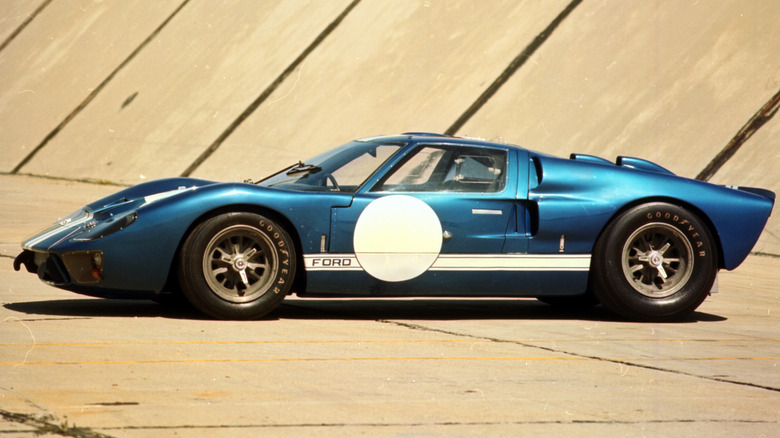
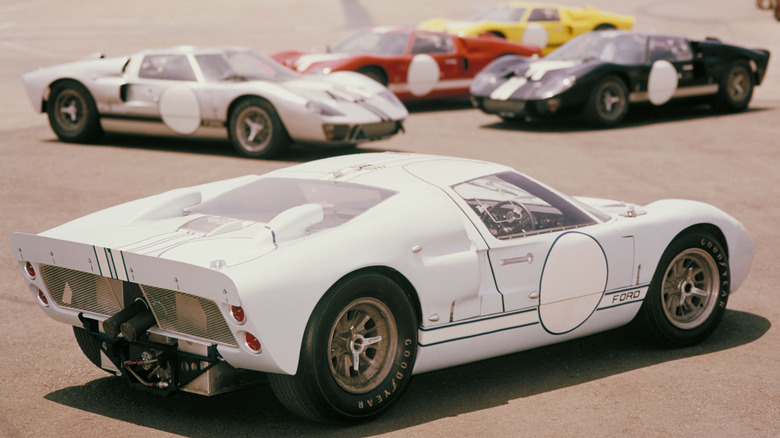
How do you beat Ferrari at Le Mans? Manufacturers like Porsche, Toyota, and BMW don't seem to have the answer today, as Ferrari won the last three Le Mans races. Shelby probably have been the best person to ask, as he famously beat the Prancing Horse with the 1966 Ford GT40 Mk II.
Yes, the GT40 was initially a Ford project. However, the Blue Oval struggled with the car in 1964, failing to finish the 24 Hours of Le Mans due to mechanical issues. The 289-cubic-inch (4.7-liter) engine was also not particularly potent, producing around 380 hp. So, to save the project, Ford brought Carroll Shelby to the team. It immediately paid off, with the GT40 winning the 1965 Daytona 2000 km Continental race with Ken Miles and Lloyd Ruby driving.
Still, the big leap came later that year, when Shelby opted for the 427-cubic-inch (7.0-liter) big block V8. With up to 505 hp and 470 lb-ft of torque on tap, the GT40 surely had enough to beat Ferrari. Sadly, the win eluded Ford and Shelby in 1965. The V8 was perhaps too powerful for the transmission, leading to reliability issues. Once Shelby opted for a synchronized Toploader four-speed transaxle setup, though, the GT40 became one of the most legendary racing cars in history, famously winning the 1966 Le Mans race in a 1-2-3 fashion.
The big-block engine certainly played a huge role in the success, bringing the GT40 to over 200 mph at the Mulsanne Straight. Still, the GT40 handled corners beautifully and proved very reliable, too. Undoubtedly one of Shelby's finest works and an American racing legend.
1967 Shelby GT500 Super Snake
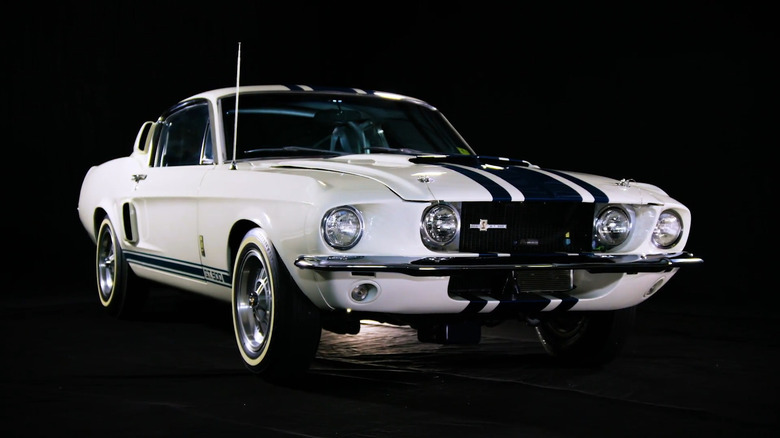
The 1967 Shelby GT500 Super Snake is one of the most over-engineered and truly wild Shelby machines ever made. Not that the standard GT500 wasn't out there already, but the Super Snake is on a whole new level. Instead of the 428-cubic-inch (7.01-liter) big-block V8, the Super Snake came with the 427-cubic-inch (6.99-liter) V8 borrowed from the Le Mans-winning GT40 Mk II, producing around 600 horsepower. Stronger transmission and rear axle were implemented to cope with all that power, while an external oil cooler ensured the engine stayed cool. Meanwhile, a stiffer suspension gave the car better stability.
The Super Snake also had Goodyear Thunderbolt economy tires. Wait, what? Yup, Goodyear wanted to showcase its new economy line by doing a high-speed run. Of course, the company contacted Carroll Shelby, who tasked Fred Goodell, an engineer at his company, to build the GT500 Super Snake. When the car arrived at the proving grounds, the Shelby team reportedly overinflated the comically thin Thunderbolt tires with nitrogen so they could better cope with the high velocities. With the economy tires and Shelby behind the wheel, the Super Snake reached 170 mph.
Unfortunately, Shelby decided against bringing the GT500 Super Snake to market, deeming it too expensive for the market. The original model built for the demonstration run remained as a one off until 2018, when Shelby American decided to build ten more cars for enthusiasts. Now priced at $249,995, these Super Snakes even came with a 427-cubic-inch V8. Meanwhile, the original became most expensive Mustang ever sold in 2019, when it sold for $2.2 million at Mecum Auctions.
1986 Dodge Shelby Omni GLHS
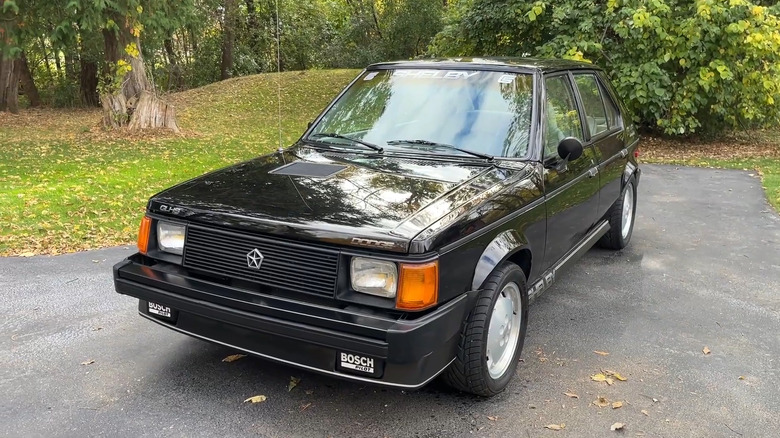
By the 1980s, it became evident that Carroll Shelby knew how to build extravagant sports cars, brutal muscle cars, and race-winning machines. In 1986, however, he showed that he also knew how to make economy cars go fast. Only this time, he didn't do it with Ford, but with Chrysler.
Based on the 1986 Dodge Omni GLH, Shelby's FWD hot hatch pushed the power-to-weight envelope to new heights. The Omni GLHS came with the same 2.2-liter turbo-four, but it was fitted with a new air-to-air intercooler and intake manifold. As a result, it produced 175 horsepower — a 29-hp boost over the regular model. Torque also went up from 168 lb-ft to 175 lb-ft. In a car that weighed just 2,540 pounds, this meant a 0-60 time of just 6.5 seconds. The quarter mile came in 14.9 seconds, while top speed was 130 mph. This made it significantly faster than the 1986 Golf GTI 16V, which was one of Europe's best hot hatches at the time.
Still, the amped-up engine was only a part of the story. The Shelby Omni GLHS also received adjustable Koni coilovers and wider Goodyear Eagle VR50 tires for higher grip. A five-speed manual was also on board to boost engagement. Nothing was done to counteract torque steer, but this was an issue that plagued just about every FWD from that era.
Shelby built only 500 examples of the Omni GLHS, making it a rare sight on roads today. It's still relatively affordable, though. You can find well-maintained examples for $20,000 to $35,000, which isn't much for a turbocharged piece of Shelby history.
1989 Dodge Shelby CSX-VNT
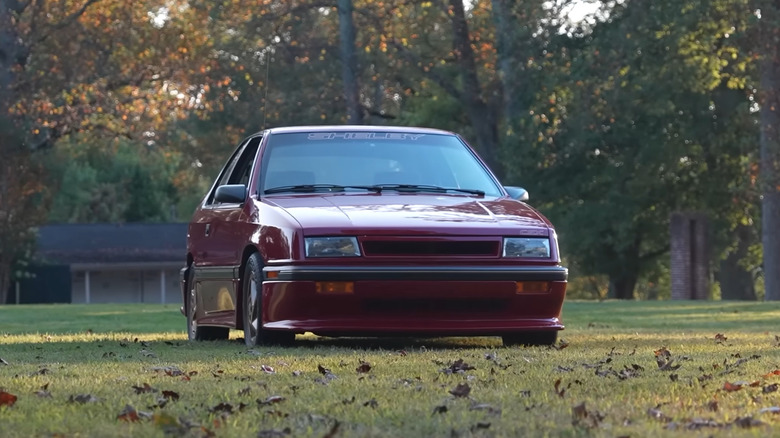
The Omni GLHS was cool, but the CSX-VNT represented the peak of the Chrysler and Shelby collaboration. A technological tour-de-force, the CSX-VNT was the world's first car to implement Garrett's variable-geometry turbocharger, which at the time Chrysler called Variable Nozzle Turbo, or VNT.
The idea, of course, was to reduce turbo lag. To showcase the technology, Shelby used an improved version of the 2.2-liter turbo-four found in the Omni GLHS. Apart from the new turbocharger, the engine also had a forged crankshaft and better engine cooling. As a result, it produced 174 horsepower, but more importantly, 205 lb-ft of torque available at just 2,100 rpm.
That certainly proved the effectiveness of the VNT, but Chrysler and Shelby weren't done with the innovative tech. The Dodge Shelby CSX-VNT was also the world's first car with composite wheels. Called Fiberride, these wheels were lighter than alloy wheels, further reducing unsprung mass. What makes this even more impressive is that they were implemented on a FWD car, rather than an exotic supercar.
Still, the fact that the CSX-VNT was based on the front-wheel-drive Dodge Shadow means it is sometimes overlooked by Shelby fans. Prices today can occasionally reach over $30,000, but that's nothing compared to other Shelby cars. Either way, it showed that Shelby was able to evolve as time went by. Instead of high-capacity V8s, his company was now focusing on technologies that pushed the performance envelope of cheap, daily drivers. Today, many modern cars have variable-geometry turbochargers and carbon-fiber wheels are becoming common in supercars and hypercars – including the latest Corvette C8.
1992 Dodge Viper RT/10 Mk1
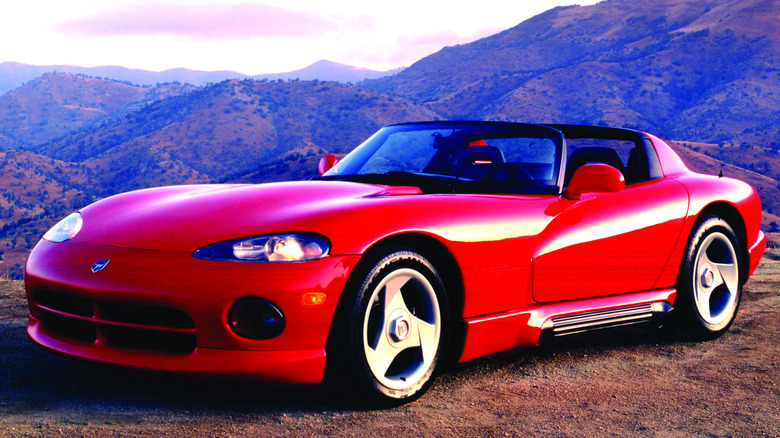
To set the records straight — Carroll Shelby didn't design the first Dodge Viper. Still, he was a consultant on the project, which is evident once you learn about Viper's key features such as the lightweight, 3,400-pound chassis made from a tubular steel frame, the fiberglass composite panels, and the Koni coilovers. The aerodynamic body also had its roots in Shelby's successful racing endeavors.
Still, the thing that screams 'Shelby' the loudest is the high-capacity V10 monster under the long hood. The 8.0-liter unit produced 400 hp and a whopping 465 lb-ft of torque, sent to the rear wheels via a six-speed manual. You guessed it — that's remarkably similar to the design ethos of the Shelby Cobra 427. Still, the Viper RT/10 was decidedly more modern. It had an independent suspension developed with computer-aided design. Massive 335/35 R17 tires at the rear. Heck, its V10 engine was co-developed with Lamborghini.
Despite all that, the Viper RT/10 was a wild car to drive. It had no ABS, airbags, or air conditioning to cool the driver once things got heated. And things could get tense quickly in the Viper RT/10, as it accelerated to 60 in just 4.4 seconds and reached a top speed of 165 mph. Dodge later refined the formula and turned the Viper from a twitchy beast to a predictable handler. This makes the early, 1992 Viper RT/10 even more of a Shelby-like vehicle — a lightweight brute with a massive engine and a chassis that was barely fit for purpose.
1999 Shelby Series 1
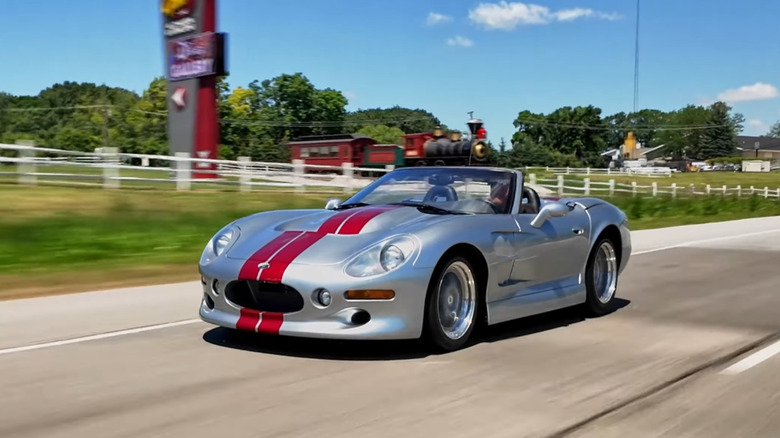
It seems almost impossible that it took Shelby almost four decades of meddling with engines and chassis from other manufacturers to finally design his own car. His idea was to create a modern Cobra successor with all the modern tech available at the time. The result, however, may not have been what Shelby fans expected. See, the Series 1 wasn't as wild as the 427 Cobra. Its Oldsmobile-derived Aurora V8 had a capacity of only 4.0 liters. With only 320 horsepower and 290 lb-ft of torque available, some found it underpowered.
However, the Shelby Series 1 had a trick up its sleeve — it was as light as air. It weighed just 2,650 pounds, and Shelby didn't achieve this by taking things out of the car. The Series 1 had an innovative structure made from 6061 aluminum and aluminum honeycomb, which was heat-treated after welding to increase stiffness. It was surrounded by lightweight carbon-fiber and fiberglass panels. Famously, the chassis was almost half the weight of Corvette C5's yet twice as rigid, showcasing Shelby's ability as an engineer.
As a result, even the small 4.0-liter engine brought the Series 1 to 60 in just 4.4 seconds and was able to hit a top speed of 170 mph. Not impressed yet? Shelby also built a supercharged version with 450 hp, which sprinted to 60 in just 3.2 seconds. So, should the supercharger should've been standard on all cars? Perhaps, but really it was the production challenges that made the Shelby Series 1 all but forgotten today. Shelby only built only 249 examples, of which only 70 were supercharged. Although rare, the Series 1 is still somewhat affordable, with prices ranging from $135,000 to $165,000.