

2027 Kia Telluride Extends Its Reign As The Best Three-Row SUV
When Kia revealed the Telluride concept at the 2016 Detroit auto show, most people (myself included) thought it looked awesome, but that surely the production model wouldn't be that cool, and it probably wouldn't be a particularly exciting product either. This was after Kia's first couple generations of genuinely good cars with interesting designs, but Hyundai Motor Group hadn't yet reached its current world-dominating heights, and the three-row crossover space is notoriously tough to break into and really be successful in, so everyone was justifiably skeptical.
Well, three years later the production Telluride debuted, and not only did it look nearly as awesome as the concept, it was a genuinely excellent vehicle. The Telluride became an immediate smash hit for Kia both critically and commercially, with customers lining up at dealerships like that yodeling lady banging on the bus door. Sales have increased 108% since the Telluride's first year, with Kia moving 123,281 of the things last year, and its market share has surged from 3.5% in 2019 to 8% in 2025.
Seven years and more than 670,000 sales later, the second-generation Telluride is here, and it's hard to think of a recent mainstream automotive follow-up that's had this much to live up to. While there's a chance the new Telluride's more outrageous styling may turn off some traditionalists, I don't think that will matter much, and Kia doesn't think so either — the automaker says its factory in Georgia is increasing production capacity by 50% for the new model. That'll be necessary, as the 2027 Kia Telluride is excellent on basically every level, keeping its spot atop the summit of Three-Row SUV Mountain.
Full disclosure: Kia invited me to drive up to Santa Barbara, where it put me up at the Ritz and fed me for two nights so I could drive the 2027 Telluride.
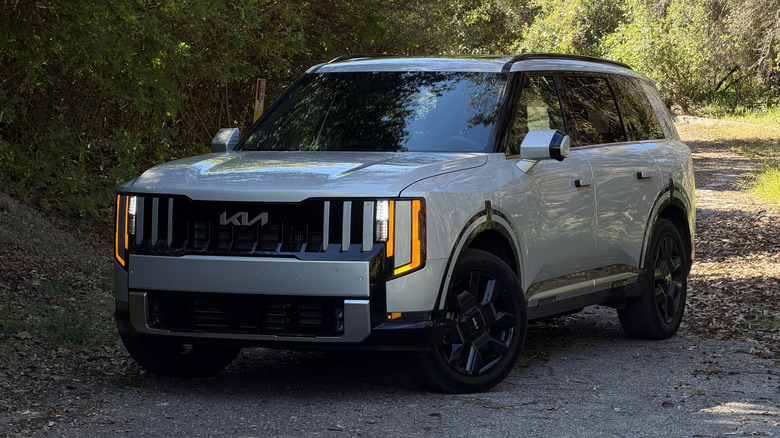
Just look at it!
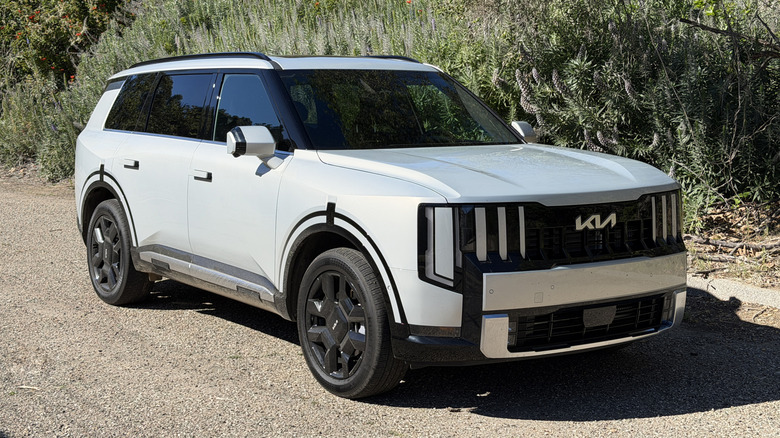
The second-generation Telluride is larger and more spacious, has a pair of totally new powertrains, offers more luxurious features, is more capable off-road and better to drive on-road, and is still a damn good deal. Those and more are reason enough to speak effusively about the Telluride, but what I keep coming back to is its styling. I went pretty long on the new Telluride's design when it was first revealed back in November, but I had yet to see it in person. Now that I have, I love it even more. This thing just looks so f**king cool. Judging from the reaction in my DMs, it's a total love it or hate it design, which I would always rather have than something normal and boring.
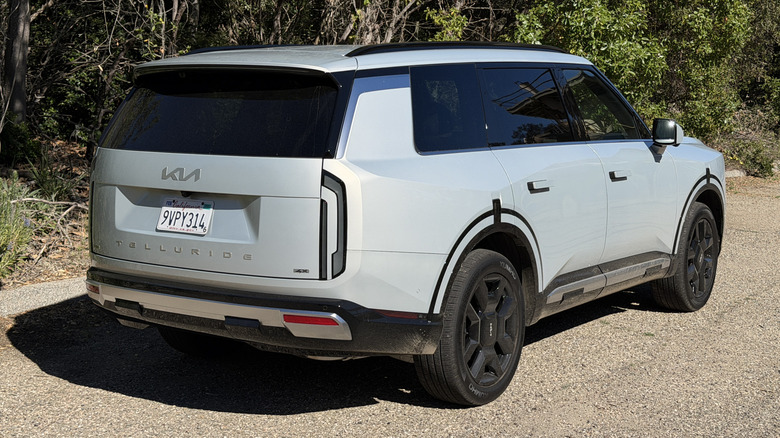
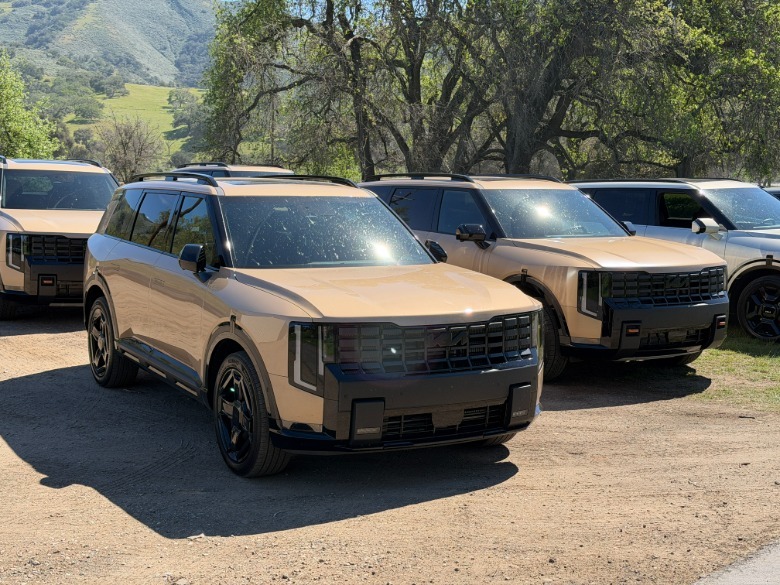
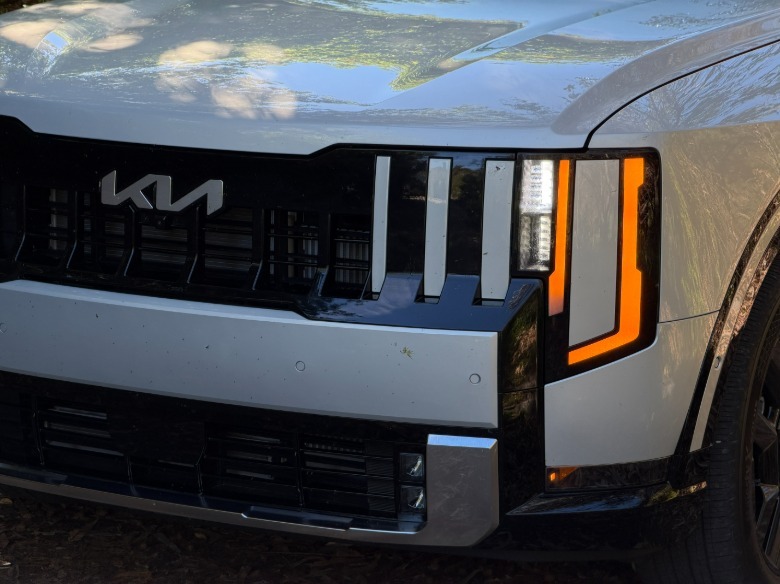
I prefer the front-end styling of the standard Tellurides versus the more blacked-out X-Line and X-Pro (below is an X-Line on the left and an X-Pro on the right), though the blocky grille and chunky bumper of those off-roady models do look good. But it's the stranger the better for me, so I like the vertical motif of the normal front, especially on hybrid models where the grille inserts and the panel between the running lights are color-matched. The amber DRLs look even more distinct than the outgoing Telluride's, and there's four different unlock animations to choose from. (Annoyingly, it was almost impossible to correctly capture the DRLs with my iPhone.) The actual headlights are tiny rectangle units in the grille just inboard of the running lights, giving it a fascinating light signature at night. The dual-line taillights, similarly shaped to the DRLs while also an evolution of the old model's, sit flush on the rear end and are greyed out when the car is off.
 Daniel Golson/Jalopnik
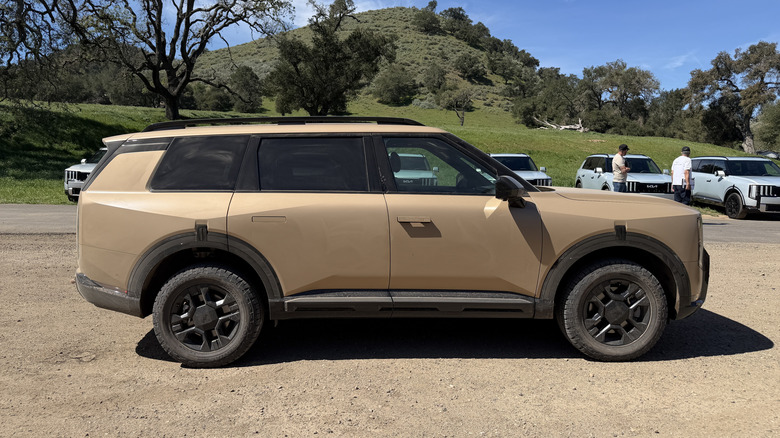
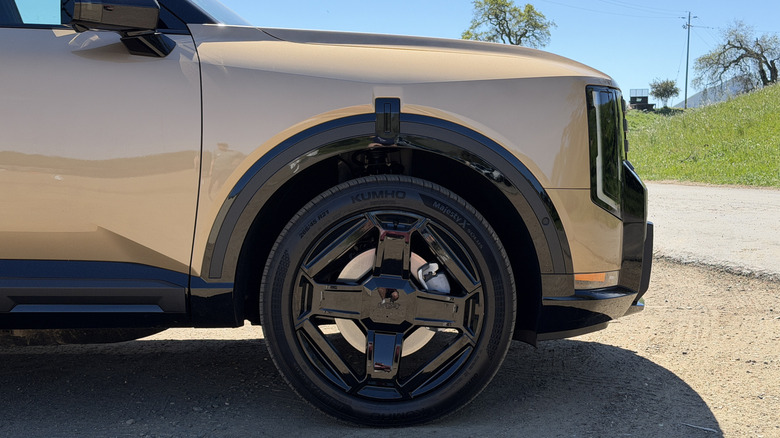
The new Telluride is 2.3 inches longer and about half an inch taller than the old one, but despite the increased size and blockier stance, Kia says it's almost 10% more aerodynamic. Pop-out door handles and chiseled surfaces certainly help with that. I love the triangular shape of the fender flares, the strange notches and concentric lines on the wheel arches, the subtle chamfering and surfacing of all the body panels. The side windows are less interesting than before but the D-pillar is more so, and the blockier tail end is a nice evolution of the old Telluride. While walking around the SUV I was even remarking how much I enjoy the treatment of the license plate surround and the design of the side mirrors.
Sadly all the Tellurides that Kia brought to Santa Barbara were the same spec, painted in Ivory Silver, a color that does at least have some nice champagne sparkle to it. But while much of the Telluride's color palette is boring, there are some real bangers on offer. Depending on trim level, you can get a sweet denim blue, emerald green, and a great sand beige, the last of which comes in either gloss or matte finishes. There's a matte grey on offer, too. Kia also continues to kill the wheel design game, with every trim level having four-spoke wheels that are up to 21 inches in size. Too bad they're all mostly just black.
Get the hybrid
Even if you don't like how the Telluride looks on the outside, you'll love how it drives. Where the old Telluride had a naturally aspirated 3.8-liter V6 appealing to classic SUV fans, under the hood of the 2027 Telluride is a turbocharged 2.5-liter inline-4 with 274 horsepower and 311 pound-feet of torque, sent to the front wheels or, optionally, all four wheels through an 8-speed automatic. That's down 18 hp but up 49 lb-ft over the V6, and while the new Telluride is about half a second slower to 60 mph than the old one in Car and Driver's testing, it's plenty quick enough, recording a 7.4-second 0-to-60 time. (That's quicker than the Telluride's twin, the Hyundai Palisade, which still uses a naturally aspirated V6.) Weighing in at 4,381 pounds in base FWD form and 4,744 pounds in most feature-filled AWD trim, the new Telluride is a few hundred pounds heavier than the SUV it replaces, which definitely contributes to the acceleration deficit.
I only drove the nonhybrid model in X-Pro trim while off-roading, so most of my driving impressions are of the hybrid Telluride, but that's fine — it's definitely the powertrain you want. Kia adds two electric motors to the turbo four, bringing total output to 329 hp and 339 lb-ft, and the hybrid's 0-to-60 time should be in the low-6-second range. The hybrid system's operation is very smooth; the switch between gas and electric power is seamless, there's barely any audible drone or drivetrain roughness from the engine, power delivery is linear, and brake feel is good. There are two fewer gears in the hybrid's automatic transmission, and that's totally fine, as its operation isn't really noticeable.
 Daniel Golson/Jalopnik
There are only three drive modes — Eco, Sport and a My Drive customizable mode — and switching between Eco and Sport doesn't change too much aside from powertrain responsiveness. The steering is quite heavy, which I like; the power steering motor has been moved from the column to the rack, improving precision. The suspension is extremely well-damped, enough that you don't need to worry about a ride quality penalty if you go for a higher-end trim with 20- or 21-inch wheels, and it's composed enough to feel stable instead of sloppy in tight corners. Perhaps the Telluride's best dynamic attribute is how damn quiet it is inside. It legitimately seems as quiet as a Mercedes-Benz S-Class, which further adds to the Telluride's overall feeling of solidity. The old Telluride already had a more premium driving experience than its price tag suggested, and the new one takes that up a notch.
Oh, and fuel economy is pretty good. The regular Telluride will return 22 mpg combined, 20 mpg city and 26 mpg highway in front-wheel-drive form (the same as the old V6), or 20/18/24 with AWD (1 mpg better on the highway than the V6). Go for the hybrid, though, and the FWD Telluride will get 35 mpg combined, 34 mpg city and 36 mpg highway; each of those figures drops by 4 mpg for the AWD model. That makes it slightly more efficient than the Palisade hybrid that shares the same powertrain, and the Telluride is only an mpg or two behind the Toyota Grand Highlander. Over the course of my day in the Telluride, I saw about 28 mpg, and that's including a lot of spirited back-road driving. The hybrids boast a 637-mile driving range, more than 200 miles beyond the standard engine.
Cows not pictured
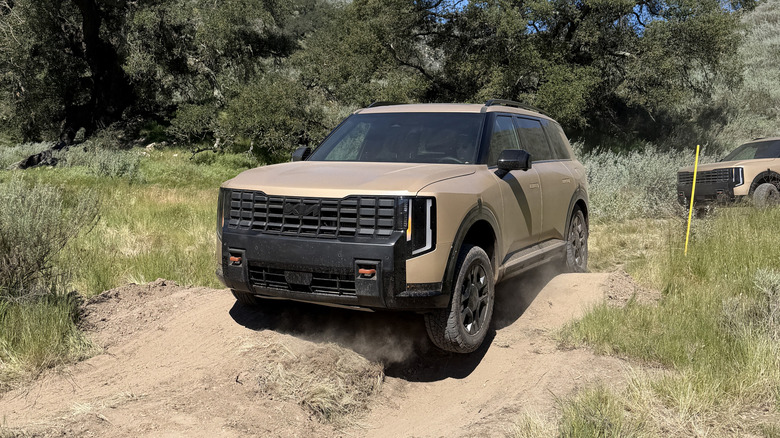
Our lunch stop was a 7,000-acre ranch that's been in the same family since the 1890s, where we got to experience the Telluride X-Pro in its natural habitat: on a bunch of off-road trails, surrounded by 600 cows and beautiful scenery. The automaker introduced a Telluride X-Pro with the previous-gen's facelift, but aside from all-terrain tires, more ground clearance and some styling tweaks, it wasn't a compelling choice for people who actually do nature-y things. The new X-Pro is a different story. In addition to 18-inch wheels with Continental CrossContact all-terrains, it has 9.1 inches of ground clearance (0.7 inch more than the last one) and specially tuned suspension, an electronic limited-slip differential, three Terrain drive modes (Mud, Sand and Snow), off-road camera views, and even more distinct styling cues that include functional recovery hooks. And that's on top of what you get in the SX Prestige, the otherwise-top trim level.
 Daniel Golson/Jalopnik
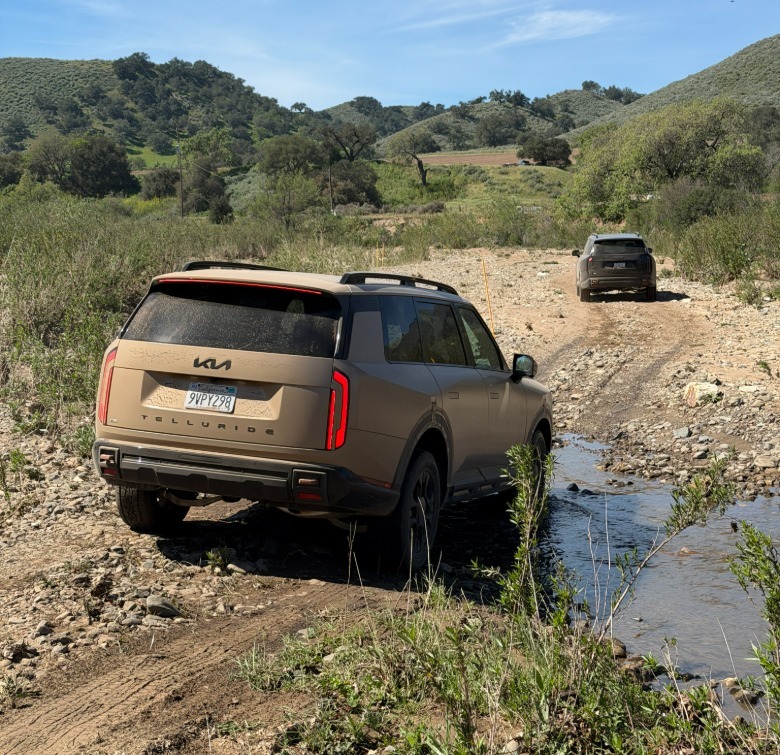
Kia only offers the X-Pro with the nonhybrid engine, apparently because engineers couldn't get the capability and towing capacity they wanted from the hybrid; the electrified Tellurides tow 500 pounds fewer, so only 4,500 pounds. That seems like a load of BS to me. The extra oomph, instant electric torque and overall quietness would all be beneficial when off-roading, and I can't imagine that 500 pounds will really make a difference to all X-Pro buyers. I'd expect an X-Pro hybrid to be introduced in a year or two. But the turbo four did a fine job powering the X-Pros along the mixture of paved roads, dirt trails, rocky creeks and muddy hills we drove them on, and it sounded kinda good too.
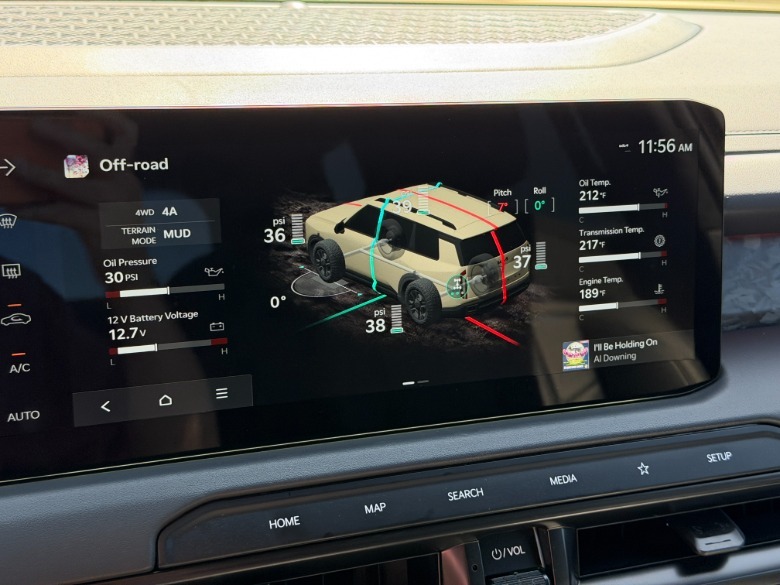
You can bring up a data screen that shows a three-dimensional model of the Telluride surrounded by information about tire pressure, the amount of load being put on each wheel, pitch and roll angles, and a bunch more powertrain stuff. It's really well done, but I wish the gauge cluster was able to show graphics like it as well. What's not as well done is the surround-view camera system. The cameras themselves are already fairly low-res for 2026, and while the off-road views are helpful, like the underhood view, the camera feeds turn off if you exceed 6 mph, which I did many, many times in the hour I was off-roading.
 Daniel Golson/Jalopnik
Most dudes who love driving on trails will say, "Pssh, you don't need wimpy camera views anyway, just look out the windows like a real man." I reject toxic off-roader masculinity, and want lots of good cameras on any car I drive, but I will admit that visibility is pretty good in the Telluride, and it didn't feel too big or unwieldy, even when driving around a rocky curve at a 27-degree angle. Its shockingly tight turning radius definitely helps. The X-Pro felt totally sure-footed on every sort of obstacle we tackled, with capabilities clearly beyond anything we were doing. Other than one X-Pro with a banged-up skidplate, the Tellurides survived the day unscathed.
Necessary space
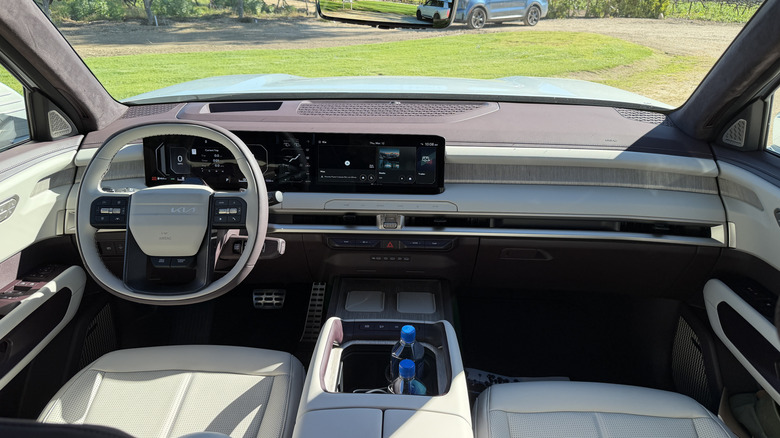
Spending hours in these two top-end Telluride trims gave me a lot of time to appreciate the interior, which is a big upgrade from the old one. Don't get me wrong, the outgoing Telluride is nice inside, but it definitely feels outdated against other new Kia offerings, especially the EV9. Its layout and design is like a mix of EV9 and the old Telluride, retaining the first-gen's prominent center console with a grab handle on each side. The dashboard wraps around onto the door panels, which looks fab and creates two-tone color splits, and configurable ambient lighting is used to great effect.
Like most other Kias there is a 12.3-inch gauge cluster display (4.2 inches on low-end trims) and 12.3-inch touchscreen sandwiching a 5-inch touchscreen for the climate controls, which can be annoying to use while driving. The rest of the infotainment system is great, though, and has wireless Apple CarPlay and Android Auto. There are seven USB-C ports throughout the interior, plus two wireless chargers in the center console with rubbery pads that will actually hold your phone in place pretty well. An 8-speaker sound system is standard, but you can get a 14-speaker Meridian surround-sound system that would feel right at home in a true luxury car.
 Daniel Golson/Jalopnik
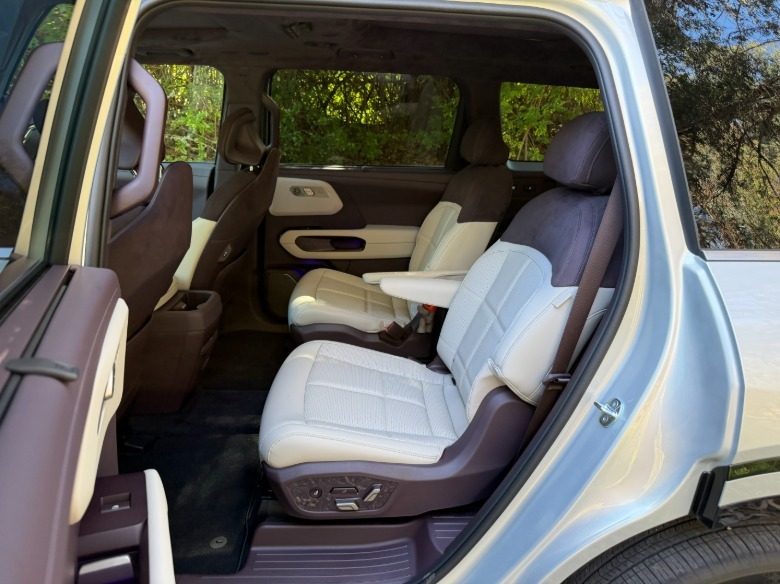
Depending on trim level the Telluride has no sunroof, a single-pane power sunroof above the first row of seats, or a large dual-pane panoramic roof, the front pane of which opens. If you get the big one, which my test cars had, the new Telluride has more headroom in all three rows of seats than the outgoing model. Shoulder room is better for second-row passengers, and there's over half an inch more leg room in both the second and third rows. Kia says third-row ingress has been improved by 2.3 inches, and it does seem easier to get in and out with, either with the available powered second-row captain's chairs or the manually adjustable ones. Both are pretty easy to use, and while unnecessary, the power ones seem to better move out of the way. (According to a Kia spokesperson, the Telluride is unaffected by the Palisade's power-seat-related recall.)
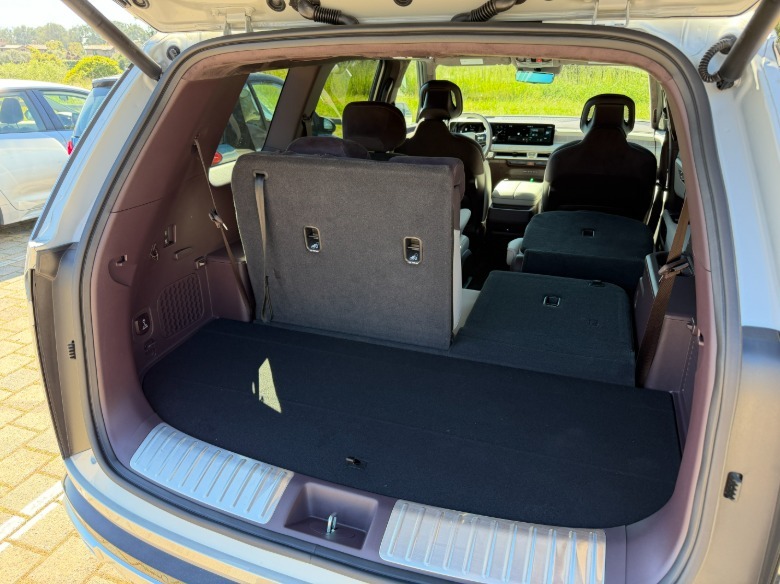
In SUVs like this cargo space is just as important as passenger space, so the Telluride has more of it, too. With the third row up there's 22.3 cubic feet of space including the bit of room under the luggage tray cover, 1.3 cubes more than the old Telluride. Folding the third row expands that to 48.7 cubic feet, 2.7 more than before, and if you also fold the second row flat (doable with buttons in the cargo area) there's a total of 89.3 cubic feet, an increase of 2.3 cubes. Going for the hybrid only takes away 1 cubic foot from each of those measurements, which is really not bad. The center console storage is expansive, as are the door pockets.
 Daniel Golson/Jalopnik
An often-overlooked feature of a car are the overhead lights, but you'll be happy to know Kia did some innovating with the one in the Telluride X-Pro's tailgate. Not only is the brightness adjustable — and it gets very bright — you can also adjust the hue of the light from normal to cool or warm. There's also exterior ground lighting that illuminates all four sides of the vehicle.
The Tellurides at the drive all had Kia's carpeted floor mat accessory package, which includes a mat that covers the cargo area and the back of the third row, velcroing on. They looked fine with the third row folded flat, but the mat weirdly bunched up when the seats were in place. That could just be because it was new and stiff, but floor mat lovers beware. See? That's the sort of nitpicky stuff you come to Jalopnik for.
Details matter
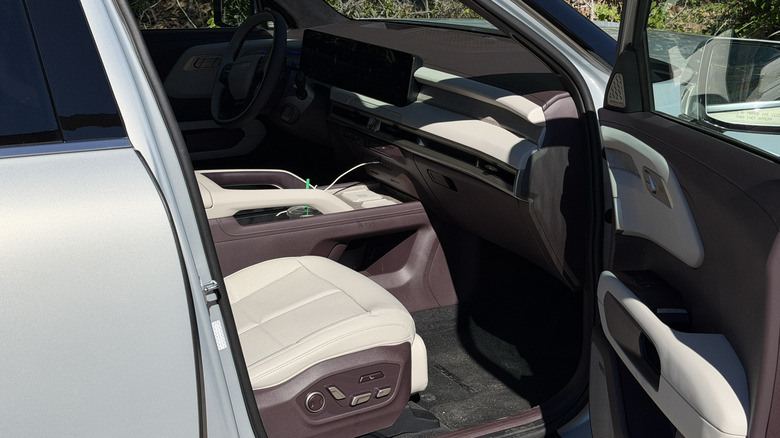
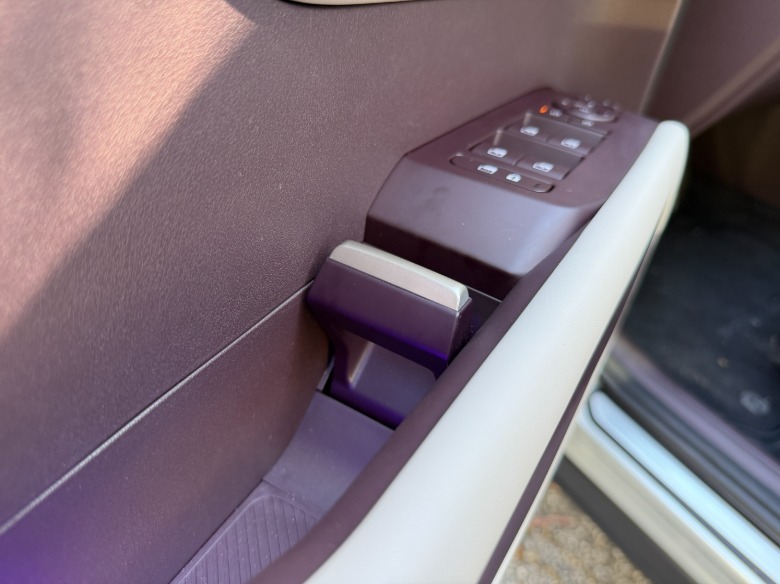
The magic of the Telluride's interior is in the details and materials. You get what Kia calls "engineered wood" (it doesn't really explain what that means) that looks and feels very nice, and you'd never guess that the SynTex synthetic leather isn't real cow hide. It's paired nicely with suede on the upper sections of the seats and the headliner on the SX Prestige and X-Pro models. Major touchpoints and surfaces, as well as some minor ones, are well-padded, but even the hard plastic pieces look and feel higher-end. All of the buttons, switches and knobs feel wonderful to press and use, as do the air vents that have a cool action to adjusting airflow. The door handles are a vertically oriented pull tab with a metal-like end cap that have a great action, like a lever in a Star Wars ship.
 Daniel Golson/Jalopnik
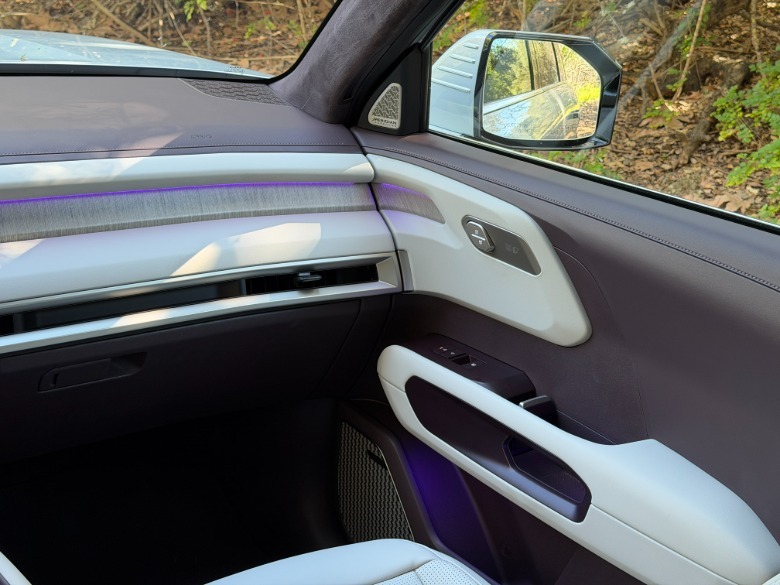
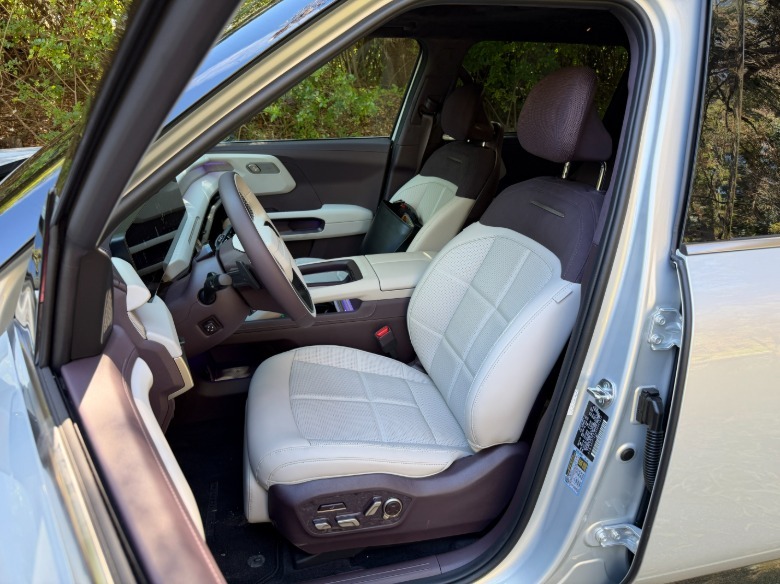
What really pushes the Telluride's cabin into show-stopping territory is the use of color inside. Now, this is something that Hyundai Motor Group excels at in general, ever since cars like the Hyundai Venue Denim and earliest Genesis GV80s came out. Some trim levels are available with Butter Brown or Saddle Brown upholstery that look nice if fairly plain, or green-ish Millstone used sparingly along with black. For full drama, go for one of the SX Prestige trims, which can be had with the excellent combination of Deep Navy and Tuscan Umber — or, only in the hybrid SX Prestige with a couple of the paint options, the Blackberry and Sand Beige you see here.
 Daniel Golson/Jalopnik
When you go for one of those two schemes, every single thing you see inside the car is color-matched. The door sill guards and plastic surround in the cargo area, all the tiny plastic pieces on the dashboard and door cards, the shrouds for the seat bases, all the hooks and clips and fasteners, the seatbelt outlets and seatbelts themselves, the headliner, the rubber door pocket liners... It's all color-matched to beige and purple. The only bits of black inside are the carpets and the steering wheel stalks. It's hard to even describe the feeling I get when gazing upon this level of color-matching, which is something not even Rolls-Royce and Bentley do. Have you ever been to a Beyoncé concert and felt the air vibrate and the stadium floor shake from the crowd's energy as her silhouette appears on stage? That's what it's like to notice another purple component in the Telluride.
This fantastic color scheme requires the $1,200 SX Prestige Executive package, which gets you 6-way powered second-row seats with a relaxation mode, heated outboard third-row seats, and 10-way power front seats with adjustable lumbar, a 2-way power leg extension and "premium relaxation comfort settings." They really are comfortable seats, though it sucks that the massage function is only for the driver.
It's more expensive but still a good value
The cheapest 2027 Telluride is the LX trim level, starting at $40,735 including destination, an increase of $2,800 over the old one. It's a very base model, with cloth seats that are manually adjustable and a tailgate you have to manually open — the horror! At the very least, you'll want to jump up to the $2,900-pricier S trim, as it adds a power driver's seat, roof rails, a power tailgate, a sunroof, 20-inch wheels, heated front seats and second-row captain's chairs. Then there's the EX trim that just cracks the $45,000 mark, putting the second-row bench back in and giving you ventilated power front seats, SynTex upholstery, and a few other niceties; spend another $3,500 and you get the X-Line EX, which is mainly about the styling. The LX is FWD-only, while AWD is a $2,000 option on the S and EX, and standard on every other Telluride.
 Daniel Golson/Jalopnik
Kia says more people are buying higher trims of its vehicles, which is probably why all the really good stuff comes when you get to the SX ($50,335), X-Line SX ($53,335), SX Prestige ($55,435), and X-Line SX Prestige ($56,435) come in. Without getting into too much of the minutiae, here are some features that are available on the 2027 Telluride: digital key capability, a 12-inch head-up display, heated and ventilated second-row seats, a heated steering wheel, blind-spot cameras, projector fog lights, and second-row sunshades. Nearly every active-safety system comes as standard, and SX trims and above get the Highway Driving Assistant 2.0 system with automated lane changes and a couple other safety systems with more functionality. Tri-zone automatic climate control is also standard, and there are ceiling-mounted air vents for the third row. Everything from SX and up only gets captain's chairs for the second row.
The price structure and feature availability for the hybrid is closely aligned with the regular Telluride, which certainly makes my job a little easier. The cheapest hybrid Telluride is the $48,035 front-wheel-drive EX, $2,700 more expensive than the nonhybrid EX; AWD is also $2,000, and standard on every other hybrid trim. The equivalent hybrid is an upcharge of only $2,700 on the rest of the trim levels, too. To me, that's a no-brainer decision. A fully loaded Telluride Hybrid SX Prestige will come in at just over $60,000. That makes the base-spec $91,600 Mercedes-Benz GLS450 look pretty silly.
Still the best
There are a lot of good three-row crossovers on sale, and even a few really great ones. It's one of the most popular and important segments in the U.S., so automakers (usually) put a lot of effort in, and the field is a lot more competitive than it was when the Telluride first came out in 2019. But I think the second-gen Kia Telluride is coming out swinging, poised to knock out everyone else.
The only other SUV that comes close is, of course, its similarly priced Hyundai Palisade stablemate. The Palisade's exterior design is equally out there, but its lounge-like interior is more interesting to look at and more luxurious and plush. For now, the Telluride's turbo four has a leg up over the Palisade's V6, but the Hyundai is probably getting the four-cylinder next year, and the two cars' hybrid powertrains are identical.
Like so much in this world — and in the specific world of large mainstream crossovers — it'll all come down to personal preference. Not everyone will vibe with the Telluride, but I really do, and I think throngs of customers will too, probably more than ever before. Sure, I want people to buy great cars that suit their needs, but mainly I hope the 2027 Kia Telluride is a big success so I can keep seeing tons of these wonderfully weird-looking SUVs on the roads for years to come.