

If You're Having A Hard Day, Just Watch These Cars Get Trebucheted
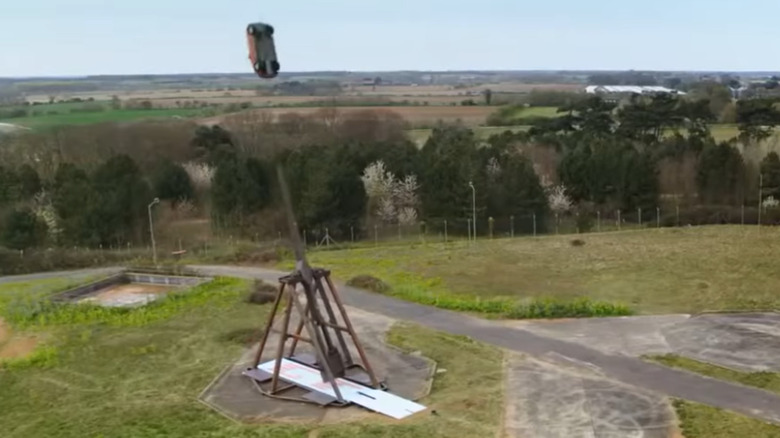
Sometimes, when the pressure's really getting to you and you feel like you're about to explode, it can be a good idea to blow off some steam in a "rage room" where you can safely destroy things to your heart's content. Of course, that isn't always the most practical solution, so we've got what may be the next best opportunity: your chance to watch other people doing the damage by flinging vehicles to their destruction with trebuchets.
Hurling cars through the air with replicas of medieval siege engines has actually become a bit of a popular hobby, with early throws dating back to at least the early 1990s. And please, don't confuse a trebuchet with a catapult. The latter, which dates back to the ancient Greeks in the West and was perhaps used as early as the 8th century B.C. in China, relies on either the sudden release of tension (in the Greek setups) or a large lever, like the so-called traction catapults of China.
The trebuchet itself is another Chinese invention and was developed in the years between about 400 and 200 B.C. While it falls under the general heading of "catapult," it uses a large counterweight that's first raised to firing height. When it's released and falls, the effects of gravity and physics take over to provide the flinging force. That can be more than enough for modern cars to take flight — and although there are still companies that insist personal flying cars are feasible, this may be the closest we come to living the dream.
Hew Kennedy heaves a Mini
The hobby of car hurling seems to have begun in 1992 under the direction of Hew Kennedy — a British military historian with a fair amount of time and money on his hands. There may have been a little family rivalry involved as well, since Kennedy's cousin had previously built a relatively small trebuchet that was mostly limited to flinging fiery toilet bowls into the sky. Not to be outdone, Kennedy and a neighbor, Richard Barr, spent a year and almost $42,000 (in today's money) to take things to the next level.
The result was a trebuchet that was 60 feet high and weighed about 30 tons, with six tons of steel as the counterweight mounted to the end of its 57-foot main beam. At the other end was a 30-foot sling holding a 1975 Austin Mini weighing about 1,400 pounds. Of course, before the Mini made its first flight, Kennedy and Barr had already successfully test fired the trebuchet with pianos, a 40-gallon drum of flaming gasoline, and assorted dead animals. Yes, that last payload sounds kind of gross, but it was a common tactic back in medieval times. A compact Hillman Imp got the treatment as well, but with such meager results that Kennedy and company were inspired to try again.
Anyway, the Mini has all the basics for a good automotive trebucheting, with the same sort of anticipation you'd get watching someone throw an RV off a cliff. In the end, it was estimated to travel approximately 90 mph on its upward trajectory before coming back to earth roughly 87 yards away.
The Grand Tour
A more cinematic experience is available from the wacky trio of Jeremy Clarkson, Richard Hammand, and James May during their Grand Tour era, specifically the special episode "Carnage a Trois" that first aired in 2021. The theme of the show was dissing French car culture — and the French in general — with the climax coming when the boys decided to trebuchet a Citroën C3 Pluriel across the English Channel and back where it came from. Well, it was actually built in Spain, but that didn't fit the show's plot.
Another hiccup? While Clarkson boasted that "our trebuchet was certainly big enough for the job," with a height north of 60 feet and a weight of 32 tons, it wasn't. A team from Leicester University did the math and discovered the Grand Tour trebuchet had a range of 1,407 to 1,614 feet, while the shortest distance across the channel between England and France is closer to 20 miles. Indeed, they're close enough that a Vespa used pontoons to sail across the English Channel in 1952.
To truly fly the Citroën across the Straits of Dover would take a counterweight weighing nearly seven tons to deliver a release velocity approaching 98.5% of the speed of light (183,488 miles per second). However, tricky editing — reminiscent of when Henry Gibson and his fellow Nazi drove their Pinto wagon off of a closed highway ramp in "The Blues Brothers" — does make for a satisfying video that ends with the Citroën seeming to crush a house in France.
A trebuchet two-fer
Now, if you're not happy seeing cars get thrown around by trebuchets on an individual basis, you can always check out the alleged 2006 Guinness World Record holder for largest trebuchet with a projectile 20 kilograms or larger. The machine itself weighed 49.6 tons and featured a 25.4-ton counterweight, and the video offers multiple successful car flings, and a few failures, along with its share of crowd-pleasing impacts.
But the real thrills came when the folks involved were able to attach a sedan with a boat trailer — boat included — to the business end of the trebuchet and then let 'er fly. The total payload weighed about 2,866 pounds, yet the trebuchet was powerful enough to throw the whole lot roughly 128 feet — after launching from a release point 75 feet above the ground. Whoever posted the video notes that poor aerodynamics probably shortened that distance, especially when the car turned in flight so its flat roof was facing the oncoming air. Maybe they should have experimented with F1's strange-looking aero rakes first.
For some context, the largest trebuchet to see actual military action might have been the Warwolf, built in 1304 to help King Edward I at the siege of Stirling Castle in Scotland. The battle-winning beast is estimated to have stood 300 to 400 feet tall and had the ability to throw 300-pound boulders at a speed of 120 mph, for an effective range of 200 yards. If you caught "Outlaw King" on Netflix, you saw a re-creation of the Warwolf in terrifying action.
Sending another Citroën into the air
As mentioned, we understand the difference between a trebuchet and a catapult — and we also know an aircraft carrier's steam catapult is different from both. On ship, steam drives a piston below deck, and that sends the bogie, or shuttle, moving along the deck and pulling the aircraft. The point is, we just can't resist mentioning that time during the wild and wacky 1980s when Citroën was somehow able to convince the French Navy to launch one of the automaker's Visa GTIs — a hot hatch unrelated to the better-than-ever 2025 Volkswagen GTI — from the flight deck of the aircraft carrier Clemenceau.
Indeed, the ad makes it look like the Citroën is racing against a fighter jet from the carrier's own stable, and if you believe what you see on X, the car launch first required the Visa GTI to be reinforced with concrete to stand up to the stress. Remember, those catapults are engineered to move a 45,000-pound airplane from 0 to take-off speed, around 165 mph, in a brisk 2 seconds. To put that into perspective, the Visa GTI's 1.6-liter four-cylinder engine only produced 104 horsepower on its own and required 9.1 seconds to get to 62 mph without the aid of a catapult.
Subtitles are necessary and included in the video, though, since it's like those French have a different word for everything. Oh, and as an added bonus, the clip includes a Visa GTI strapped to one of France's nuclear submarines.