

What Million-Mile Club Engines Have In Common (Aside From, Y'know, The Mileage)
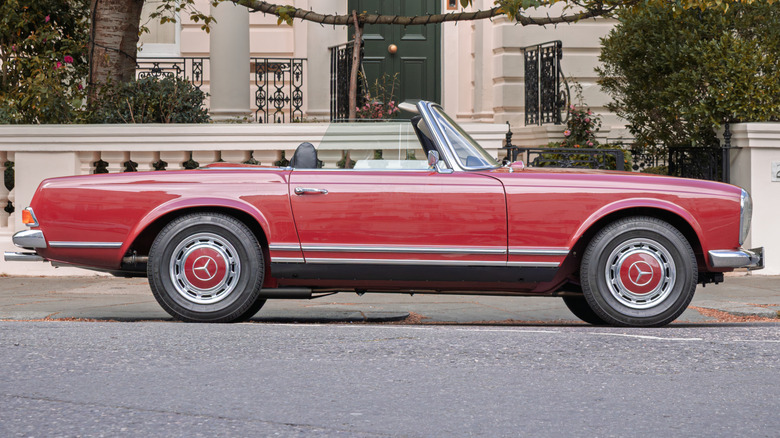
Stories of million-mile cars aren't as uncommon as one might think. The Cummins Million Mile Club was created for Cummins-powered diesel vehicles that crossed a million miles. While Cummins doesn't disclose how many members the club has, back in 2016 University Dodge reported more than 90 vehicles had registered, with the highest recorded being a 5.9-liter Cummins — one of the most reliable inline-6 diesel engines — that reached 3,016,789 miles. And SuperCar Blondie says an old Mercedes taxi, a 1976 Mercedes‑Benz 240D, crossed 2.85 million miles on its original OM616 engine.
It's not just diesels. Gas engines like the Toyota 5.7-liter iForce V8, the legendary Honda K24 four-cylinder, and Ford's 4.6-liter Modular V8 from the Crown Victoria have all crossed seven figures, often under daily driving conditions.
According to Auto Recycling World, the average mileage of a car in the U.S. before it gets junked is just 156,470 miles. So what is it about these engines that lets them outlast the average U.S. vehicle lifespan multiple times? Here's what separates million-mile engines from the rest.
Mechanical overengineering and lack of electronics
For example, the Mercedes OM617 five-cylinder is known to reach record-breaking miles, and that is, at least partly, because of its cast-iron block and cylinder heads, forged-steel crankshaft, and Bosch mechanical-injection fuel pump. Such components and materials are inherently more durable than those found in more lightweight modern engine designs. Plus, their fully mechanical operation helps eliminate electronic failure points. When selling his OM617 W126 Mercedes 300SD in 2025, Tommy Mica of TFL Classics emphasized the engine's reliability, noting: "One of the reasons these engines last such a long time is they require zero electronics to stay running. None at all."
Similarly, Autoblog noted that the Honda K24 four-cylinder had "an indestructible cast aluminum block [that] could handle boost pressures without breaking a sweat." Another notable million-mile power train is the Toyota/Lexus 4.7-liter 1UZ-FE engine — a powerful Lexus V8 engine — which is also known as staunchly overengineered thanks to a steel crankshaft, a reinforced engine block, six main bolt bearings, and belt-driven camshafts. Conversly, blocks without reinforcement tend to have lower stiffness and may be more susceptible to stress because the cross-section limits the ability to distribute load across the structure.
The Cummins 5.9 -liter 12-valve is a great example. Its overengineered architecture is tied to a cast‑iron block and head, a gear-driven design, and a Bosch CP3 injection pump which, according to MotorTrend, "has proven to be one of the most reliable and efficient fueling platforms." This means that these engines were designed to endure extreme stress. This is also obvious with the Toyota 1UZ-FE and its six cross-bolted main bearing caps, not typically found in non-racing engines.
Simple engine designs and layouts
More is not always better. EV enthusiasts often point to electric motors' reliability, saying things like "fewer moving parts" and "it's simpler." Reliability in the auto industry as a whole is also often associated with simplicity. Therefore, engines with fewer auxiliary systems and less component complexity generally have fewer potential failure points, which should make them more reliable. This design philosophy is reflected in several high-mileage power trains commonly cited in reliability studies.
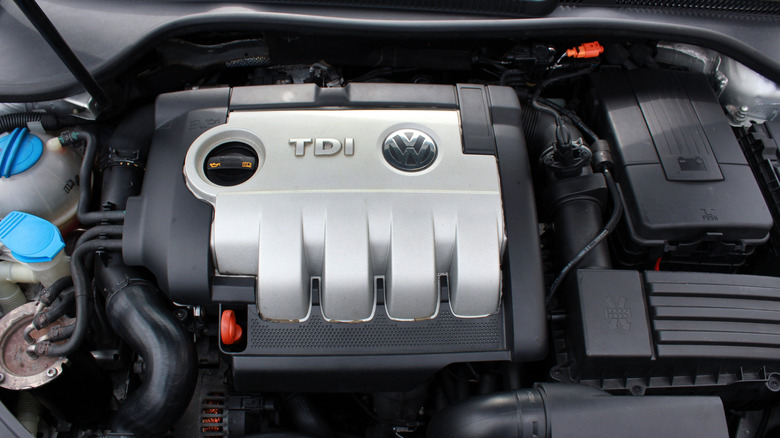
In our list of reliable engines that won't quit, we also noted how simple engineering such as sturdy cast-iron blocks, forged steel internals, and relatively few moving parts, allowed engines like the Cummins 6BT, Mercedes OM617, and VW 1.9-liter TDI to last. As mentioned, the OM617 is known for using a Bosch mechanical fueling system due to its simple, robust design that requires little maintenance. The Toyota 22R engine is also known as reliable, and that's in large part due to its simplicity and ease of maintenance.
The reasoning behind this is quite simple. With fewer complex systems, these engines have fewer potential failure points. Plus, they are easier to maintain because there are fewer expendable parts. This lets engineers focus on what could go wrong, instead of making engines carry the burden of overzealous concepts that don't prioritize reliability. In this context, emissions systems are a good example: Their main goal was to reduce emissions, not make engines more reliable.
Owners that take care of them
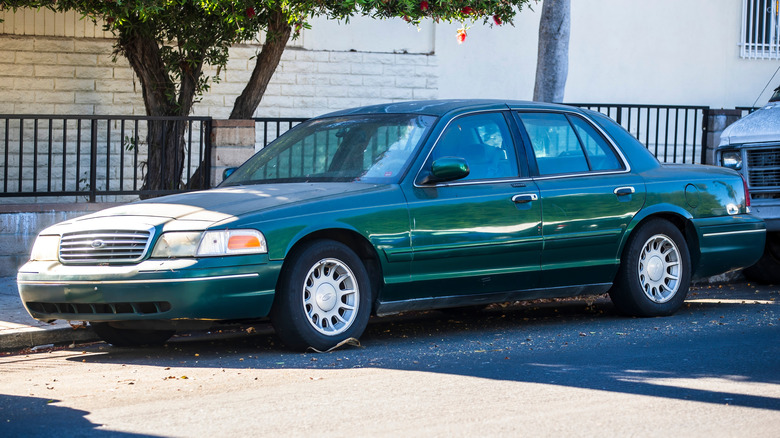
Although it may sound self-explanatory, proper maintenance is an essential aspect of keeping engines in shape. In our Crown Victoria example, the owner of the 4.6-liter Modular Ford V8 told Boostaholics, "people that know me with my cars know that I'm a bit of a nut when it comes to maintenance." He said its previous owner had changed the car's oil every 7,000 to 11,000 miles, and that all necessary repairs had been taken care of in a timely manner.
Given that the Crown Vic managed a million miles with an original engine and transmission, it paints a clear picture how proper maintenance can extend the lifespan of the engine. When MotorTrend covered a 2002 Ford F‑350 with a 7.3 -liter PowerStroke V8 diesel that reached 1 million miles, owner Gary Mueller also attributed the truck's longevity to, you guessed it, proper maintenance. Neglecting maintenance is a common mistake that destroys your engine, let alone allow it to reach a million miles.
No matter how stout the engine is, it needs some TLC to keep all moving parts properly lubricated, prevent wear, and avoid failures. Careful driving habits are also a commonly cited factor that can help an engine last. That was the case with Irv Gordon, who, Volvo Cars said, managed to drive his Volvo P1800 a Guinness-record 3.26 million miles before his death in 2018. Gordon took good care of the car, Volvo said, and even did basic maintenance himself.
Precise quality materials and evolutionary designs
Proper upkeep is a big part of why some engines are able to last, but if the object you are maintaining isn't even built with quality materials and meticulous engineering, maintenance can only go so far. Once again, most of the engines we listed illustrate this very principle. For example, both the OM617 and the Cummins 5.9-liter use cast-iron block and head designs. In many high-wear applications, these offer greater strength and wear resistance, and better long-term durability, than aluminum.
Australia's Berkeley Engineering Group says precise tolerances are what "stand between reliable performance and costly failure." This means that precise dimensional and material control ensures parts fit correctly and in mechanical harmony. It also lets them better function under heavier loads, and avoid premature wear caused by excessive play or friction. Engine durability testing also plays a role in how well engines cope with consistent stress at extremely high mileage.
Manufacturers have the opportunity to upgrade their engines over time. This lets them precisely address early production issues, and use accumulated experience and data to make continuous refinements. For example, early Ford 6.7-liter Powerstroke engines had notable turbocharger and intercooler issues. They were later solved, making the engine more reliable and capable of reaching a million miles. When talking about the worst years for the Ford Powerstroke 6.7 engine, we mentioned how Ford corrected early-generation issues, making later models much more reliable.