

11 Family Cars That Are Ridiculously Overpowered
The sports car is past its heyday. Sure, many automakers still produce fun performance cars, but the scene isn't nearly as congested as it was five decades ago. But who needs sports cars when you can have a ridiculously overpowered SUV that can also transport your whole family and cargo?
Look, we know that a large, heavy family vehicle can't replace a sports car, no matter how much power it has. We absolutely want more sports cars. But most buyers just want to be occasionally pinned to their seats and feel like they can beat any other vehicle on the road. Come on, everyone knows it — accelerating hard is addictive. Exhilarating. And, yes, fun!
Think your neck muscles are up for the challenge? They'd better be, because this piece contains 11 family cars with coma-inducing performance. Some are quicker than modern supercars and even good to drive. Each is practical, though, providing ample passenger and cargo space. So from massive three-row predators to rocket station wagons, here is your fix of overwhelmingly powerful family cars.
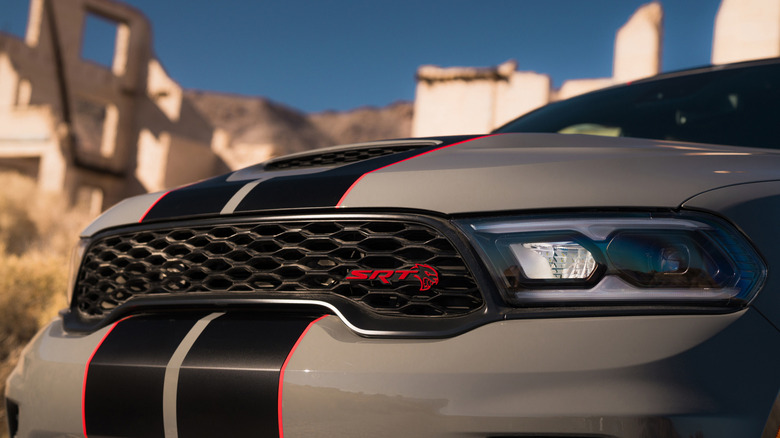
2026 Dodge Durango SRT Hellcat (710 hp; 645 lb-ft)
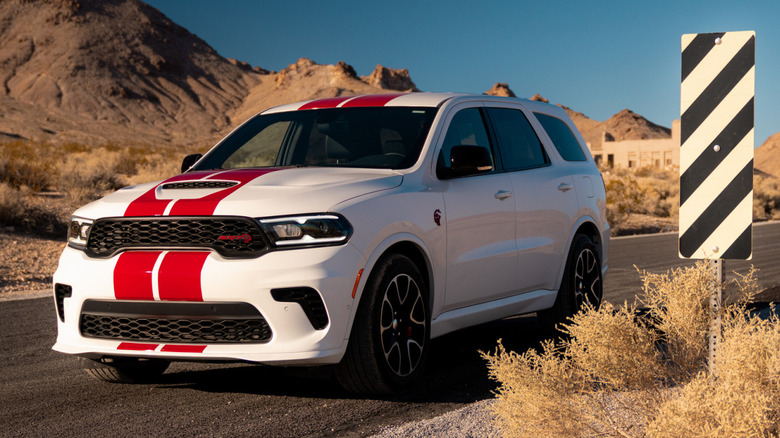
Take a traditional American muscle car. Morph it into a midsize three-row SUV. Put some additional horsepower on that engine. That pretty much sums up the Durango SRT Hellcat. Oh, but Dodge's brute is also amping up to be legendary — it's the last one to carry the Hellcat badge.
Yup, this means it has the celebrated 6.2-liter Hemi V8 plus a supercharger. 710 horsepower. 645 pound-feet of torque. All-wheel drive that makes sure you don't embarrass yourself when flooring it with an SUV full of kids. It helps with acceleration, too — 60 mph arrives in supercar-rivaling 3.5 seconds. Enough to satisfy your inner enthusiast. As for your kids? Rollercoasters: not necessary.
Let's get serious for a second. With a starting price of $79,995, plus $1,995 destination charge, the Durango SRT Hellcat is an expensive toy. But at least it's functional. The first two rows are roomy enough for adults, and you can sneak smaller kids in the third row. The class-leading 8,700-pound towing capacity allows you to carry some pretty sizable trailers. And with the second and third rows down, you could use the Durango as a van.
The Durango SRT Hellcat also holds its value surprisingly well, which takes the edge off the admittedly high price. Or you can wait for the new Durango R/T, which will employ a 6.4-liter Hemi V8 with 475 hp and 470 lb-ft. Rumors are the SRT 392 replacement will start below $50,000, which would make it a bargain compared to the SRT Hellcat. Fingers crossed!
2026 Cadillac Escalade V-Series (682 hp; 652 lb-ft)
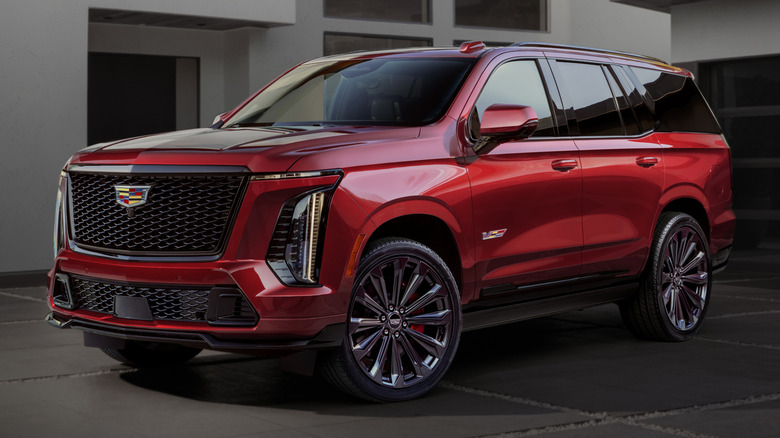
You want that muscle car spirit, but also a bit more refinement and a nicer interior? Well, you'll also need significantly more cash to pamper yourself like that, as the Escalade V-Series starts at $170,895, including $2,895 destination charge. That's two Durangos and a lot of gas. Heck, Escalade V's 6.2-liter supercharged V8 is less powerful (682 hp), too, though it produces a bit more torque at 653 lb-ft.
Step inside the cabin of the Escalade V, though, and it becomes evident where your money is going. To put it bluntly, the Durango SRT Hellcat cabin looks crude in comparison. The materials inside the Escalade V are top-notch, and the dashboard looks incredibly sophisticated. Moreover, Cadillac's latest cabin tech is leaps and bounds better than what most automakers are offering. Pillar-to-pillar 55-inch curved OLED widescreen infotainment. A bonkers optional 38-speaker AKG audio system with Dolby Atmos. GM's handy Super Cruise. And if that wasn't enough, Cadillac even implemented augmented- reality navigation.
Press the gas pedal, though, and the Escalade V uncovers its old-school roots. It barks. It bites. Challenges you to hunt three-digit speeds. Our Andy Kalmowitz rightly reminded us that the Escalade IQL shouldn't be cast aside, but damn, that supercharged V8 sounds amazing.
And it's not just the ear candy — the Escalade V accelerates like a squirrel, reaching 60 in 4.4 seconds. Unimpressed? Let us remind you that the Escalade is a large three-row SUV that's a full 10.9 inches longer than the Durango and can carry adults in all three rows.
Mercedes-AMG GLS 63 4MATIC+ (603 hp; 627 lb-ft)
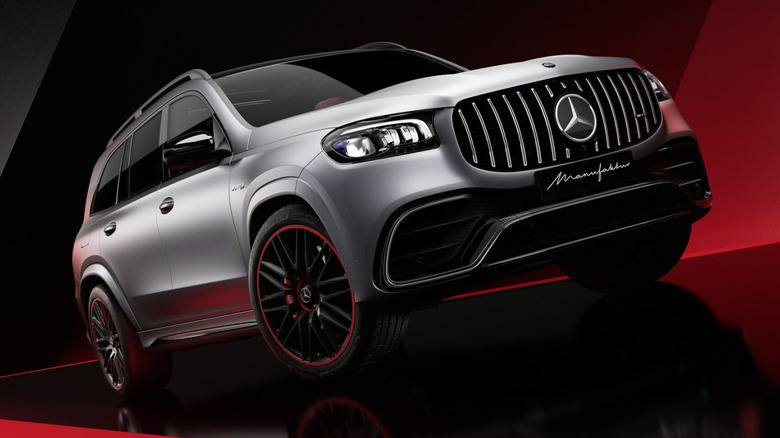
A Mercedes-AMG SUV that's cheaper than a Cadillac alternative? Admittedly, the AMG GLS 63 4Matic is smaller than the Escalade V. It also has a unibody, rather than a body-on-frame chassis. But at $151,050, plus a $1,250 destination charge, it seems like a good deal for a large three-row SUV with the AMG badge. You know, one you could bring proudly display at soccer practice.
Performance is on point, too. The 4.0-liter twin-turbo, mild-hybrid V8 produces 603 hp and 627 lb-ft. Aided by the 4MATIC+ AWD system, it propels this 5,927-pound behemoth to 60 in just 4.1 seconds with the standard 9-speed auto. The SUV's 7,700-pound towing capacity is also nothing to scoff at — it's actually higher than Escalade V's 7,200 pounds. And AMG's V8 roars properly, with a deep, satisfying rumble.
Inside, the AMG GLS 63 4MATIC+ is as luxurious as you'd expect from Mercedes-Benz. The materials look good and feel nice to the touch, and the fit-and-finish is superb. Space is also excellent, though the third row is probably best reserved for kids. Tech, while sufficient, isn't on the level of the Escalade V, though. All you get in the GLS 63 is two 12.3-inch screens with fairly large bezels. Perhaps Mercedes-Benz is saving the MBUX Superscreen for the next-gen GLS, which should arrive in three or four years.
2026 Alpina XB7 (631 hp; 590 lb-ft)
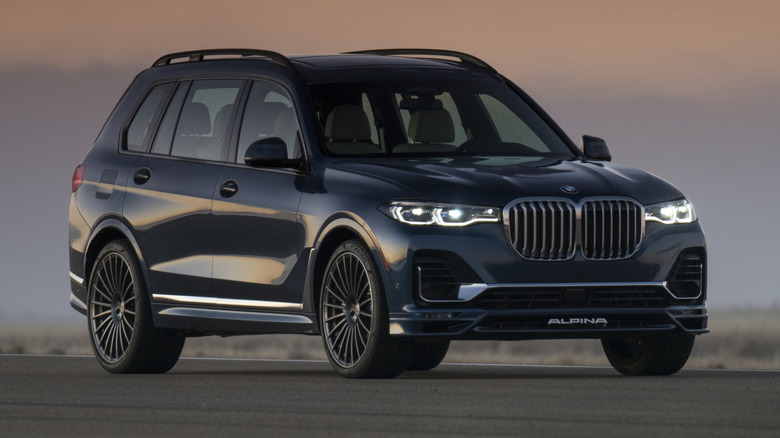
BMW recently bought its closely related aftermarket specialist, Alpina. So get ready for highly luxurious, mega-powerful machines with the Alpina badge. At least, that's what we assume would happen if we took the Alpina XB7 as an example. The $157,550 (including $1,550 destination charge) variant of BMW's three-row X7 is a true powerhouse, packing a potent 4.4-liter twin-turbo V8 with 631 hp and 590 lb-ft. Yup, BMW obviously picked the AMG GLS 63 as its direct competitor. They're close in price and power, though the XB7 is quicker to 60 (3.9 seconds). Alpina's mega SUV can also fly on the Autobahn at speeds up to 180 mph.
But that's pretty much where the similarities end. BMW readies Alpina to be a bridge between its cars and Rolls-Royce, a brand that's also owned by BMW. So while the performance is there, Alpina puts an even bigger emphasis on craftsmanship. Merino leather seats come standard on the XB7, which we reckon feel as plush as Cloud Nine. The Lavalina hand-stitched leather on the steering wheel is also known for its incredible softness. Meanwhile, the Sky Lounge LED Panoramic Roof adds some galaxy-class flair to the interior. Yes, you should get your tuxedo ready for the XB7.
Where the XB7 differs from a Rolls-Royce, however, is the driving experience. The two-axle self-leveling air suspension is designed to be plush, but Alpina implemented a Sport mode that should tighten things up at the touch of a button. The M Sport Differential further enhances handling. And XB7's staggered performance tires sit on Alpina's gorgeous multi-spoke 23-inch wheels.
2026 Audi RS6 Avant (621 hp; 627 lb-ft)
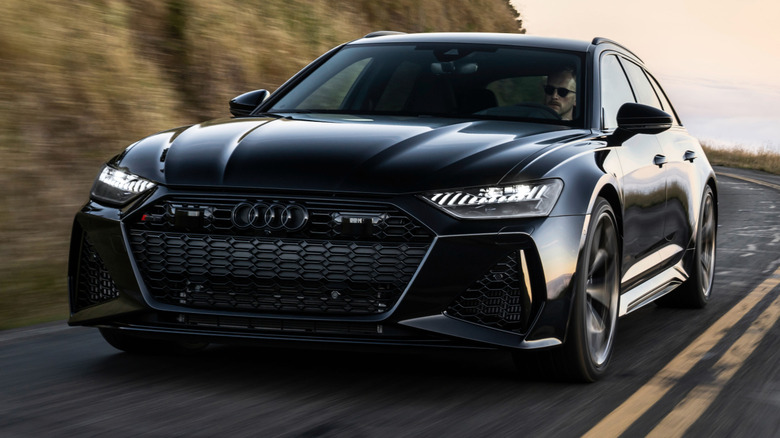
Hate the latest high-riding performance car trend? We (quietly) also do. But we won't raise our voices as long as the poster child of ridiculously overpowered family cars exists. The Audi RS6 Avant ($130,700 plus $1,295 destination charge) has only two seating rows, but they're incredibly spacious. Cargo capacity: 30 cubic feet, or enough to swallow your strollers, inflatable flamingos, and luggage for summer vacation. The rear bench backrest can also be folded by 40/20/40, so your kids can sit comfortably while you carry longer items in the middle.
Will you enjoy driving it, though? You bet! The RS6 Avant is a way, way too good performance machine. The twin-turbo 4.0-liter V8 brute packs 621 hp and 627 lb-ft and is capable of motion-blur-inducing 0-60 acceleration of 3.3 seconds. Audi's mega station wagon is sharp in the corners, too. The Quattro AWD is equipped with a light center Torsen diff to help with turn-in, and you even have the choice of Audi's Dynamic Ride Control suspension to enhance the experience even further. Or you can go with air suspension and enjoy the supple ride. Either way, be sure to check the RS Sport Exhaust, which turns up the V8's sound to hair-raising levels.
What you won't find very useful is the dual-screen (10.1-inch and 8.6-inch) infotainment layout. It's confusing and hard to use on the go. To make matters worse, Audi got rid of most buttons. Oh, the screens and piano black trim also have a thing for fingerprints. Audi, please give us your old interiors back!
2026 BMW M5 Touring (717 hp; 738 lb-ft)
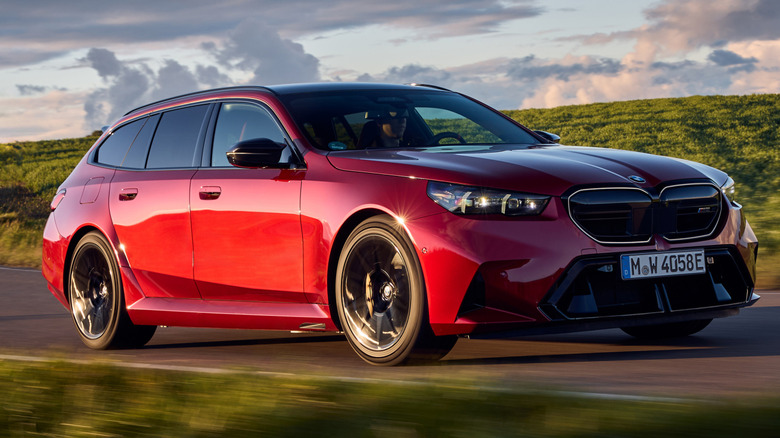
Much to the delight of enthusiasts, BMW brought the M5 Touring to the U.S. for the first time in 2024. It proved to be a great call, as the M5 station wagon outsold the sedan. But an even bigger deal is M5's brand-new PHEV savage of a power train. A 577-hp 4.4-liter twin-turbo V8 plus a 194-hp AC motor. Combined: 717 hp and 738 lb-ft. Top speed: 190 mph (M Driver's Package). 0-60: 3.5 seconds.
Whoa, whoa, whoa. How come the M5 Touring has 96 hp and 111 lb-ft more than the RS6 Avant, yet it's 0.2 seconds slower to 60? Let's say that BMW has been putting its latest M cars on a junk-food diet lately, and the M5 seems to have gobbled the most burgers of the bunch. 5,481 pounds, folks! That's 624 pounds more than the RS6 Avant. 221 pounds more than the Ford F-150 Super Cab with the 5.0-liter Coyote V8. Sheesh. True, the M5 Touring packs a relatively big 15-kWh battery that provides 25 miles of electric range. But the hybrid system also eats up useful space, so the M5 Touring's trunk has 3 cubic feet less volume than the RS6 Avant.
Look past all these foibles, though, and the M5 Touring looks like a genuine contender. At $129,350, including a $1,400 destination charge, it's cheaper than its Audi rival, despite having a PHEV drivetrain. It looks better inside, too, with better-implemented screens and nicer materials. You can even add the Alpina-derived Merino leather option!
2026 Rivian R1S Quad-Motor (1,025 hp; 1,198 lb-ft)
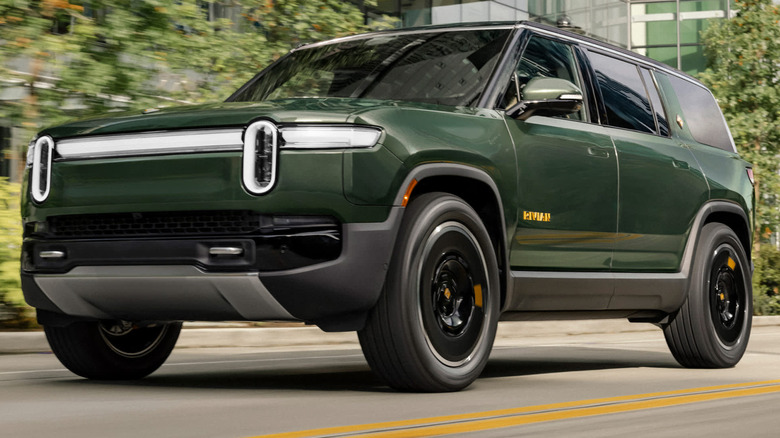
For around the same money BMW and Audi offer their high-performance station wagons, Rivian has the R1S Quad-Motor. Yes, it's an SUV. But the Rivian R1S has real off-road capabilities that can rival body-on-frame gas SUVs. It also has seven spacious seats and a cabin that can easily rival other premium family cars.
Alas, the interior is a tablet-first affair, with almost no physical buttons. It looks cool, but of course it will never be practical. Fortunately, Rivian's high-tech wizardry has been put to much better use in the power-train department. The R1S has four electric motors on each wheel, totaling an obscene 1,025 hp and 1,198 lb-ft of torque. One. Thousand. In a family SUV! 0-60 takes 2.6 seconds. That's quicker than most supercars, let alone family vehicles.
It gets better. The four electric motors at each wheel allow crazy-fast torque adjustment, meaning next-level torque vectoring. In the real world, this translates to on-rails-like handling, regardless of the weather conditions outside. On the trail, it means better traction than an SUV with locking differentials.
Oh, but R1S' boxy (and attractive) design and mega-powerful drivetrain must take a toll on the range, right? Well, thanks to the massive 140-kWh battery, the R1S Quad-Motor has a range of 374 miles. Put it into "Conserve" mode, and it goes up to 400 miles. Not bad for an astronomically powerful electric SUV that starts at $123,885, including $1,895 destination fee. And seats seven. And can go off-roading. The 825-hp Tri-Motor model is also an attractive $108,885 (including destination charge) alternative.
2026 Lucid Gravity Dream Edition (1,070 hp; 909 lb-ft)
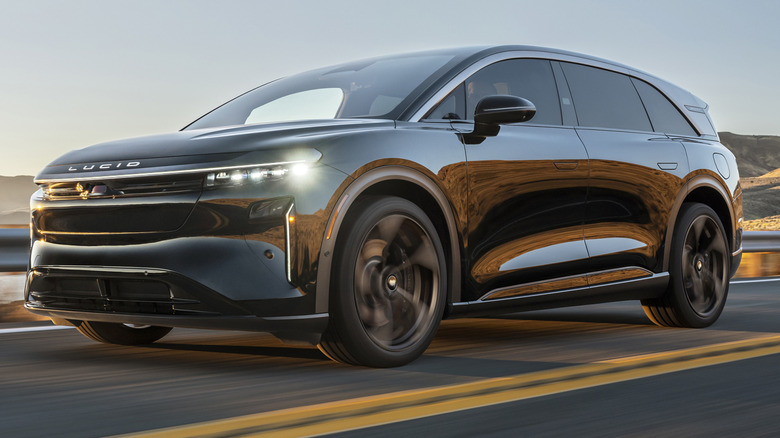
Is it an SUV? Is it a minivan? Does it really matter when you have three spacious rows and warp speed in one sleek package? The super-fast Lucid Gravity Dream Edition takes the family car game to a whole new level, packing a 1,070-hp dual-motor power train. In tests by Car and Driver, the express people mover blasted to 60 in 3.1 seconds. Quarter mile: 10.6 seconds. Range: class-leading 450 miles.
But hold on your amazement, because the Gravity Dream Edition can also drift, sports car style. It might only have two electric motors, but Lucid has again shown its ability to create great drivers' cars. Yup, we also loved the 1,234-hp Lucid Air Sapphire on track. Only the Gravity can also take two more passengers, while offering a massive 98-cubic-foot cargo area with the second and third row folded down. Even with all seats up, the trunk can swallow 15 cubic feet.
In classic modern EV fashion, Gravity's dashboard rivals CES for screen real estate. It boasts a large 34-inch curved 6K OLED display, accompanied by a 12-inch center touchscreen to control most functions. It looks stunning, especially when combined with the dynamic ambient lights. As for functionality, at least Lucid implemented physical controls for the most frequently used functions.
The Gravity Dream Edition starts at $141,550, including $1,650 destination charge. Yes, it's expensive, but it's really well built inside, with luxurious materials, aimed directly at the German hegemony.
2026 Porsche Macan Turbo (630 hp; 833 lb-ft)
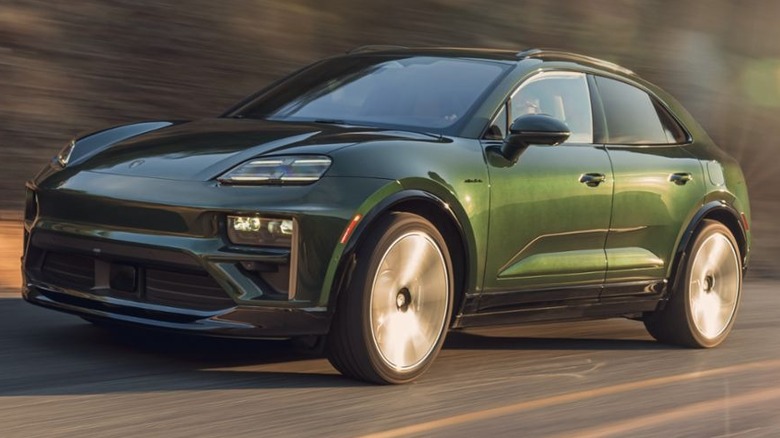
Oh, no, not another new electric SUV! We hear you — the Cayman and Boxster are waiting for an update for a decade now, and instead, Porsche is giving us battery-powered crossover? Dismiss the Macan Turbo Electric at your own peril, though, because it's one of the most impressive automobiles currently on the market.
And it's not the potent dual-motor drivetrain that gives the Macan Turbo the edge. Sure, with 630 hp and 833 lb-ft of torque on tap, it has enough power to pin you aggressively into your seat. 0-60 arrives in brisk 3.1 seconds. Top speed: 162 mph. Thanks to the advanced 800-volt architecture, the Macan Turbo can also charge from 10% to 80% in 21 minutes. Moreover, the relatively large 100-kWh battery provides a useful 288-mile range.
What truly makes the $112,700 (plus $2,350 "delivery, processing and handling fee") Porsche Macan EV a futuristic automobile is all the systems designed to maximize driving pleasure. The Porsche Active Suspension Management, for instance, can change the suspension's stiffness based on the road conditions, how aggressively you drive, etc. Then the Porche Torque Vectoring Plus system enhances cornering agility by using a variable rear differential lock. Add the optional rear-axle steering, and the Macan Turbo will feel even more agile in the corners.
Point being: the Macan Turbo is a great driver's car. Duh, the Cayman, Boxster, and 911 are better to drive. Still, the Macan Turbo can seat four adults comfortably and carry 18 cubic feet worth of cargo in the trunk and an additional 3 cubic feet in the front trunk. Not great, but still infinitely more practical than Porsche's sports cars!
2026 Kia EV6 GT (641 hp; 568 lb-ft)
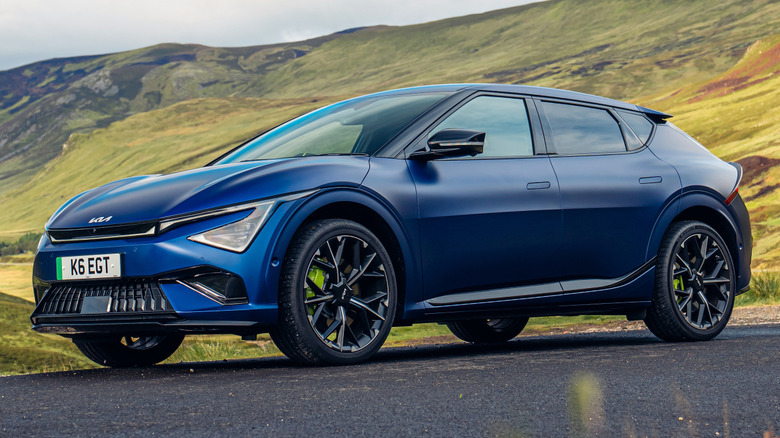
Want a blazingly fast electric crossover, but can't afford the $115,050 Macan Turbo Electric? Kia's aggressively styled EV6 GT packs even more power, yet starts at $54,200 with rear-wheel-drive, $58,900 with AWD (plus $1,545 destination fee).
The crossover's dual-motor drivetrain produces 641 hp and 568 lb-ft of torque (with overboost), enough for a supercar-like 0-60 sprint of 3.4 seconds. Top speed: 161 mph. Like the Macan Electric, the EV6 uses an 800-volt architecture, which can charge the 84-kWh battery from 10% to 80% in 20 minutes. Because the battery is smaller, though, the EV6 GT has an EPA-estimated range of only 231 miles.
What the latest EV6 GT does have is Ioniq 5's most attractive (and polarizing) feature — the faux gear shifts and engine sounds. The Virtual Gear Shift simulates gear shifts almost perfectly, though the faux engine noises sound a bit over the top.
Of course, the EV6 GT doesn't have the advanced Porsche suspension niceties. But at this price, we're more than happy with the electronic limited-slip differential and performance suspension. Really, it's only the short range that holds back the Kia EV6 GT. The car we reviewed was the less potent pre-facelift model (576 hp), but even then, it was an enjoyable car to drive. It handles corners very well and doesn't beat you with an overly stiff suspension. The cabin is decently practical, too. It offers enough space for four adults and boasts an outstanding 28-cubic-feet rear trunk.
2026 Hyundai Ioniq 5 N (641 hp; 568 lb-ft)
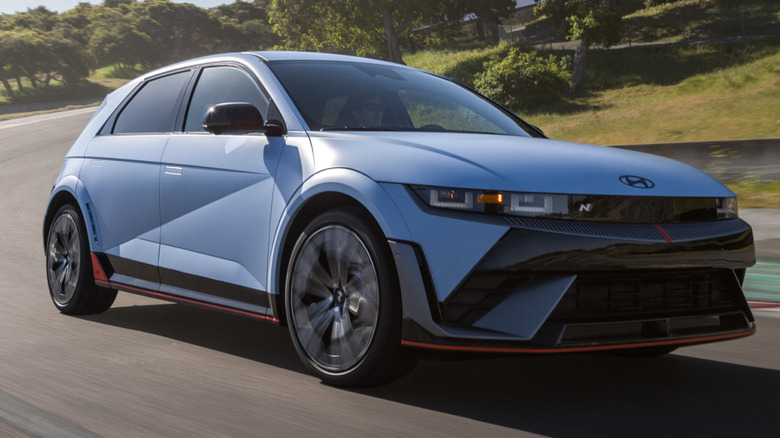
Perhaps no other family car combines retro and futuristic as well as the Ioniq 5 N. On the outside, it looks like the Lancia Delta HF Integrale, but with futuristic details. The LED headlights/taillights, in particular, look 1990s futuristic. Although electric, the Ioniq 5 N also has gear changes. Well, at least that's what your senses are telling you.
Point being, Hyundai nailed the retro hot hatch game with its hot $67,800 (including $1,600 destination charge) crossover. To do that, however, the Korean automaker needed to go the futuristic route. Notably, those fake shifts and engine noises require quite a lot of hardware and software engineering to get right. See them as a gimmick all you want, but they further spice up the fun-to-drive Ioniq 5 N.
Seriously, forget about not burning dinosaur juice for a second, and you'll be smiling ear-to-ear. Hyundai did a great job with the suspension, so the Ioniq 5 N handles beautifully, even on the track. Meanwhile, it remains comfortable over bumps. Off the line, the Ioniq 5 N jumps like a cheetah — 0-60 takes only 3.25 seconds. Top speed: 163 mph. Horsepower: 641.
Add to that all the retro fakery, and you have a real fun machine on your hands. One that can also transport your family in comfort while swallowing all your cargo (26-cubic-foot trunk). The 221-mile range still makes us wonder what a bigger battery could do to the Ioniq 5 N, though. Hey, at least you can charge the 800-volt battery at up to 350 kW, even on Tesla's Supercharger network!