

Why Old American Cars Had So Many Engine Options
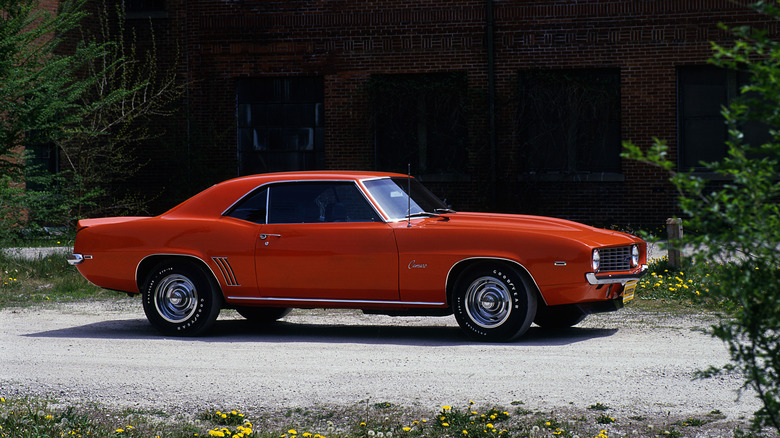
In 1965, a Pontiac Le Mans could have five different kinds of engines. In 1968, the Ford Mustang had seven engines to choose from. And in 1969, you could order 11 different engine codes for your Chevrolet Camaro. Yes, the vast majority were V8s in the Camaro's case, but when the range of performance spans across nearly 300 horsepower, who really cares?
Today, options are limited. 2026 cars such as the Cadillac CT5 and Mustang don't have more than four engine options to choose from. If you're into the true family cars, models like the Chevy Trailblazer only come with two. In fact, nowadays, many cars come with just one, and some even share the engine with another model. So, why did this change? Why is the consumer so limited in their choices nowadays?
It's hard to point to one sole catalyst of this phenomenon, because in reality, there are a multitude of factors that worked in tandem to create this automotive landscape in the mid-century era. It was truly a perfect storm of lax rules, rising competition, and plain old circumstances of the time.
A lack of emissions regulations
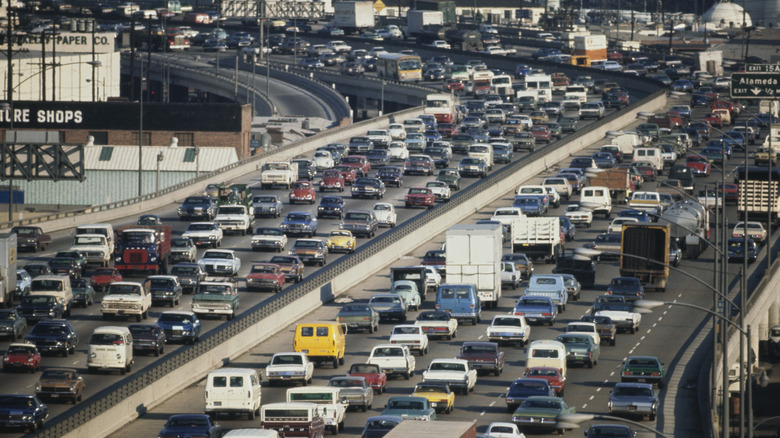
The auto industry during the 1950s and 1960s was lawless in spirit, but it wasn't entirely unregulated. There were localized laws, especially in states with larger populations; California passed legislation restricting crankcase emissions control in the mid-1960s, for example. There were even a few pieces of federal legislation regarding pollution, like the Air Pollution Control Act of 1955 and the Clean Air Act of 1963.
However, these pre-1970s anti-pollution acts weren't particularly regulatory. The primary functions of these acts were to expand the government's ability to fund and research how to combat, control, and eventually reduce emissions. It wasn't until the newly updated 1970 Clean Air Act that a framework for serious regulations was put in place. Subsequently, in 1975, the National Highway Traffic Safety Administration's Corporate Average Fuel Economy standards were implemented, which pushed for better fuel economy and led to the creation of some huge engines with surprisingly low horsepower ratings.
In other words, before 1970, engines didn't have to pass as many certifications and regulations during development. If a manufacturer saw an opportunity to fill an engine-related hole in the market, it could be filled without too much headache. This is how we got the aforementioned Camaro situation in 1969. For customers who wanted a mild engine, but didn't want the weak 250 cubic inch inline-six, they could very specifically choose the kind of grunt they desired. Chevrolet offered V8s in sizes from 302 cubic inches up to 350, delivering anywhere from 200 to 300 horsepower. For those with a hankering for performance, several more options followed, with high-output 350, 396, and 427 V8s producing as much as 430 horsepower.
Engines were simpler, making changes easier
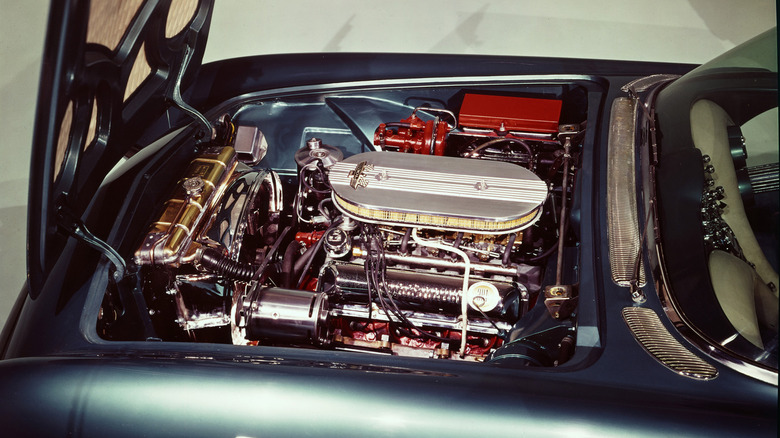
It's no secret that old engines — especially naturally aspirated, cam-in-block, pushrod V8s — are immensely less complicated than typical modern motors. Newer engines have sensors dedicated tooxygen, mass airflow, engine knock, crank position, and more. They also have a complex ECU that can computerize air/fuel mixtures, timing, and even cylinder deactivation. Then there's modern turbocharging), crash safety and crumple zones, and of course, a general increase in parts.
There's some engineering red tape to tear through, too. Modern motors have to pass numerous EPA tests to receive a certificate of conformity, and they have to pass California's CARB standards if they want to sell there. We're not saying that designing an engine back in the 1960s was easy, but compared to the standards of 2026, boring and stroking out an engine to make a new variant was far more financially and logistically feasible.
In the past, Ford had several different engine families, including FE, MEL, Windsor, 385, and more. They all shared many of the same block designs within their respective families. This made variations in designs for the bore, stroke, and cylinder head fairly simple to manufacture. In particular, Ford's 289 and 302 V8s are essentially identical from the outside, and the only main difference is the 302's slightly larger 3.00-inch stroke versus the 289's 2.87-inch stroke. The blue oval sold over six million of the 289/302 V8s in less than 10 years, and on top of those small-blocks shaping the muscle car era, we'd bet they wouldn't have sold so well if not for that tiny little change.
The horsepower wars
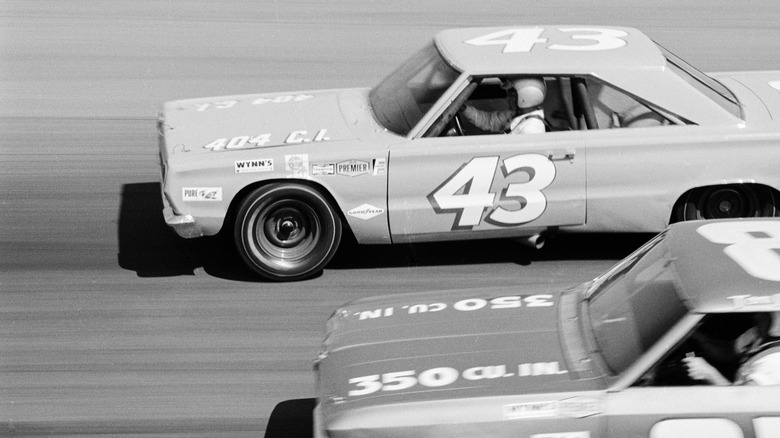
The simpler designs and lack of regulations meant that extra performance was just a few extra cubic inches away, and once the ball got rolling, the whole "no replacement for displacement" idea became key in Detroit's iconic horsepower war. But how did this 1960s automotive battle come to be? The simplest answer would be human nature. After all, what brand doesn't want its car to have the biggest, most powerful engine? Though a more specific answer leads to another old saying: "win on Sunday, sell on Monday."
The National Hot Rod Association (NHRA) had been holding official drag racing events since 1953 (and NASCAR since 1948), but it wasn't until the late 1950s and early 1960s that factory-backed efforts would begin to ramp up. One particularly important point was the 1962 introduction of the Factory Experimental (FX) class in NHRA drag racing. That class allowed manufacturers to use modified versions of their factory cars and engines to compete in officially-sanctioned events.
Though the FX category wouldn't last long, the philosophy of competing with extremely powerful factory-available engines remained the same. These racing series, including NASCAR and circuit racing, led to the development of legendary engines like the Chrysler 426 Hemi, the Pontiac 421 V8, and the Ford 427 that helped beat Ferrari at Le Mans in 1966. Race-derived power trains played a significant role in the massive list of engines available at the time, even if they were mostly the result of homologation rules or sales tactics at work.
The big three had more brands
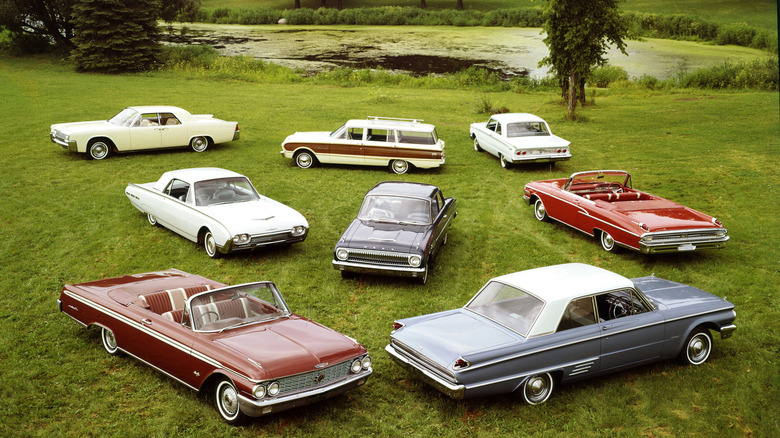
American brands were incredibly individualized during the '60s, especially when it came to bespoke engines. General Motors had four different 350 cubic inch V8s for Chevrolet, Buick, Pontiac, and Oldsmobile — and almost none of their parts are shared across the platforms. A less obvious version of this idea could be Ford's FE V8s versus the MEL. The MEL, standing for Mercury, Edsel, and Lincoln, was launched at the same time as the FE in 1958 and was primarily used in big-body applications (Mercury Marauder, Lincoln Continental, Edsel Citation) separate from the Ford brand. Meanwhile, the FE is most well-known for powering blue oval trucks.
The MEL did make an appearance in the Thunderbird at one point, but the point remains the same: Engine variety wasn't just about different sizes within one lineup. It was also about cross-brand diversity. The whole sub-division identity concept was simply handled differently back then, which becomes even more painfully obvious when we take a gander at the modern version of cross-brand variety — or the lack thereof.
The big three's American portfolio has shrunk dramatically. Pontiac, Oldsmobile, Mercury, Plymouth, Edsel, and several other brands are either long gone or slowly losing their identity. Their engine variation is also just a thing of the past. For example, Stellantis (not an American company, but it owns all of Chrysler's old brands) has recently used the 3.6-liter Pentastar V6 across all of its most popular models, such as the Jeep Wrangler, Chrysler Pacifica, and Dodge Durango, not to mention the V8s that were shared across those lineups. GM has done similar work, spreading the LT4 V8 across Chevy's Camaro and Corvette as well as Cadillac's CTS-V and Escalade V.
Natural progression and profits
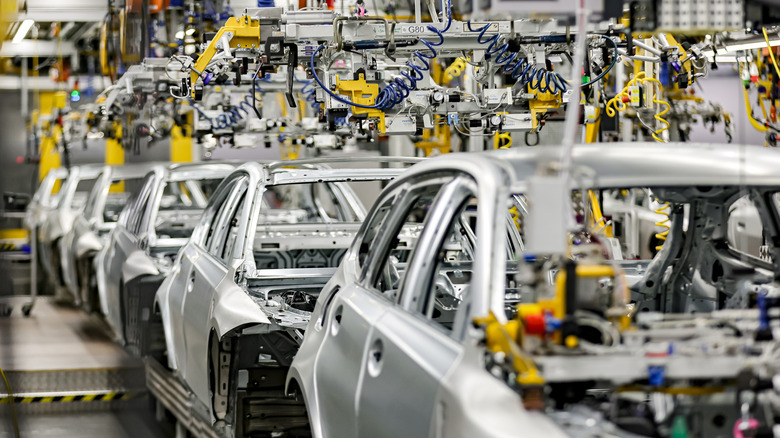
Over time, strict emission regulations were put in place and getting a new engine past the approval stage became harder. Thus, manufacturers realized that the standardization of engines across dozens of models across their lineup reduces cost and won't drive the average buyer away. How many non-enthusiasts in 2026 would really care if their Buick Envista has the same power plant as a Chevrolet Trax?
Plus, engines are far more advanced nowadays, so manufacturers can develop motors that make more power from smaller displacements. Instead of making three engines for entry-level, mid-tier, and performance variants of the same model, engineers can use just one or two. Then they can just add a turbocharger or a performance exhaust to provide different levels of power without needing to redesign expensive major components. Something like the MQB Volkswagen platform is a great example of this, as it designs modular chassis and engine compartments across all its brands so it can use the same parts and motors. The Atlas, Tiguan, and Golf all use a version of the 2.0-liter turbo TSI engine, as do several Audis and other VW-owned products.
Then there are hybrid and electric vehicles. The industry is more concerned with emissions than it ever was in the early 1970s. As electrified options take a greater hold of the market, power trains, by default, are losing individual identity and characteristics beyond making 1,000 horsepower that they don't need. All of the factors we covered today deserve their own focused discussion, so we're curious how you feel about this concept. Are you sad we've lost this much power train diversity over the last 50 years, or do you think the benefits outweigh the lack of variety?