

Ferrari's First EV Officially Has A Name And A Lovely Tactile Interior Created By Apple's Former Design Boss
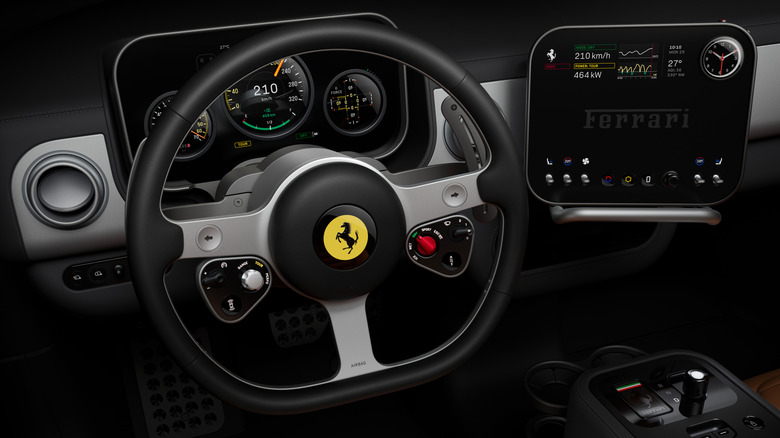
After years of waiting, we finally know what Ferrari's first EV will be called, and we know it's going to be blessed with one of the sickest interiors we've seen in a very long time. The Ferrari Luce, which is Italian for "light" — luminance, not weight — has a retro-futuristic interior created by LoveFrom, an agency founded by former Apple designers Jony Ive and Marc Newson. (I've actually got one of his watches. Hell yeah.).I know it won't be for everybody, and some will bemoan the "iPad" on the dash, but it feels very fresh in my mind.
We haven't been given a full glimpse of the interior just yet. Hell, we don't even know what its exterior looks like, but we do know what the steering wheel, gauge cluster, center console, infotainment screen, roof-mounted controls and front seats of the 1,000-plus horsepower Luce are going to look like. Anyone who is familiar with Ive's and Newson's work will immediately recognize some of the telltale signs of their influence, like clean lines, brushed aluminum, muted tones and minimalism without becoming useless.
The gauge cluster
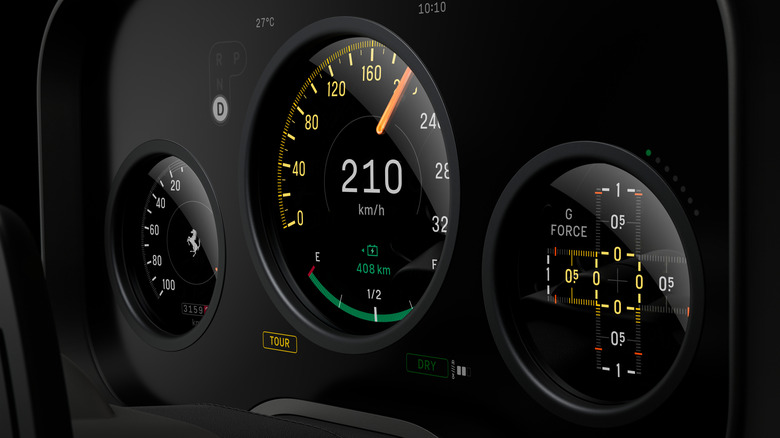
To me, the coolest element of the interior thus far is the gauge cluster. It's been a long time since we've seen such an analog-looking cluster from Ferrari. Mounted to the steering wheel (a first for Ferrari), it features two overlapping OLED displays that combine both digital and analog elements.
Ferrari and LoveFrom worked with Samsung Display engineers to create an ultra-light and ultra-thin OLED panel that gives it a floating look, and by cutting holes in the upper OLED layers, engineers were able to create digital displays directly next to physical elements. For example, a digital speed readout is nestled directly inside of an analog, gear-driven speedometer. It's really fascinating stuff.
The graphics Ferrari used take their inspiration directly from aviation and are meant to look analog, even when they're not. Other cues were taken from iconic instrument clusters of days gone by from companies like Veglia and Jaeger, and that's incredibly welcome in a world of 12-point-whatever-inch display screens acting as gauge clusters. Those have their places, sure, but a break is always welcome.
The wheel
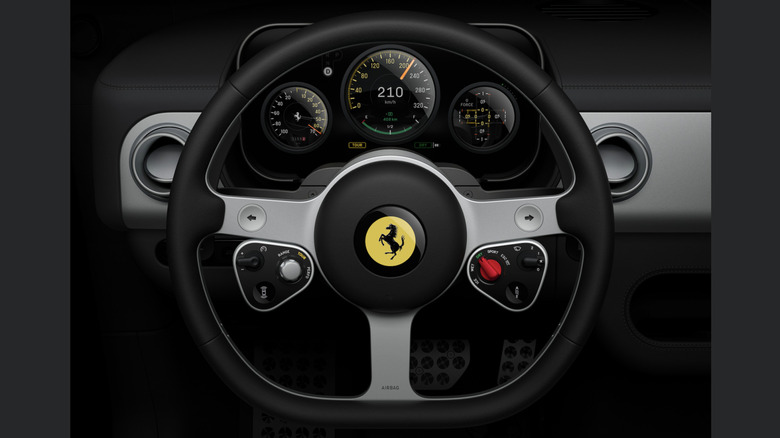
While some may not like the digital-ish gauge cluster, I'd imagine it'll be hard for anyone to find fault with the steering wheel. I mean, just look at it. Gone are the tech-heavy, button-filled steering wheels we've become accustomed to from Ferrari over the past decade. In their place is a more delicate, brushed aluminum three-spoke design with buttons relegated to small control pods below the 9 o'clock and 3 o'clock spokes. Ferrari says, like the cluster, the leather-wrapped unit is supposed to harken back to designs from the '50s and '60s. Specifically, it's supposed to look like wooden three-spoke Nardi wheels you'd find back then.
 Ferrari
Of course, those who were hoping Ferrari would ditch steering wheel buttons altogether are SOL. It still has plenty of those, including the turn signal buttons it's been using for almost two decades now. The left-side pod houses cruise control, EV power modes and exterior lighting controls, and the right-side pod takes care of your Manettino drive modes, windshield wipers and suspension settings. Behind all of this is a set of lovely looking aluminum paddle shifters that will let the driver fake shift up and down a simulated gearbox à la the Hyundai Ioniq 5 N.
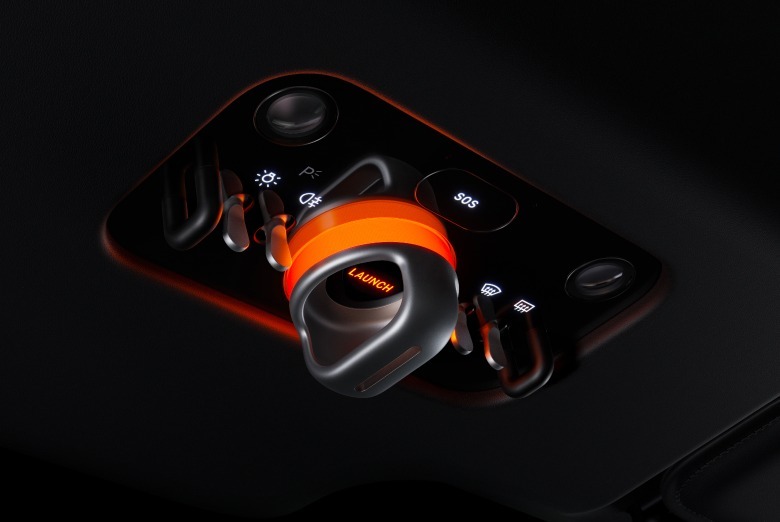
As you can see in the above photo, there's a small group of controls mounted in the roof includes switches for things like headlights, windshield defrosters, hazard lights and the launch control function. That last button is behind some sort of brushed aluminum and orange housing. It's very neat looking.
The infotainment
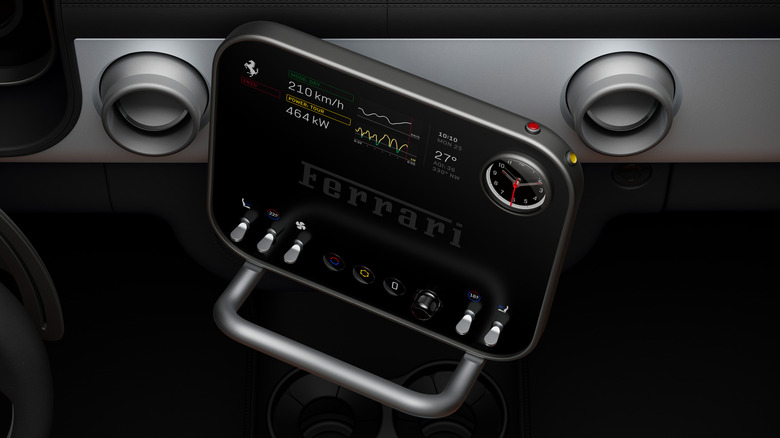
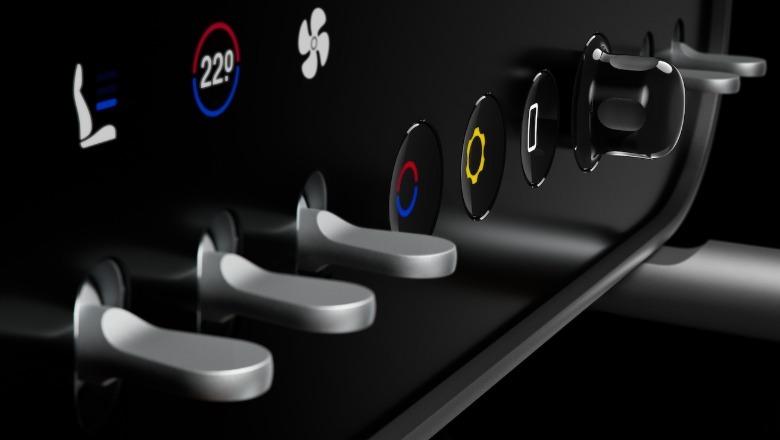
This whole area of the Luce is going to be the most controversial. I know folks like to complain about the entire "iPad glued to a dashboard" thing, but this really seems to be a lot more than that. While there is a large, iPad-looking tablet in the middle of the dashboard, it's fitted with a handful of aircraft-style toggle switches that'll take care of your climate controls. On top of that, it's even got a physical volume knob, so it really looks like Ferrari has learned its lesson about capacitive touch buttons and how much everybody on Earth hates them.
The top-right of the screen area is taken up by a clock, above which are two buttons on the outside bezel. It can switch between a typical watch, a chronograph, a compass and a launch control display. The inclusion of this little clock does mean that the center screen loses out on some size, but I think that's okay. I love style and a gimmick, and this is both. Similar to the gauge cluster, the clock mixes analog and digital. The faces appear to be screens, but the hands are analog and use a proprietary movement with three independent motors, according to Ferrari.
 Ferrari
Another fun gimmick, which is actually quite useful, is the fact that this screen can rotate since it's mounted on a ball-and-socket joint. That means it can be pointed toward either the driver or the passenger, depending on who is using it.
Ferrari goes back to the future
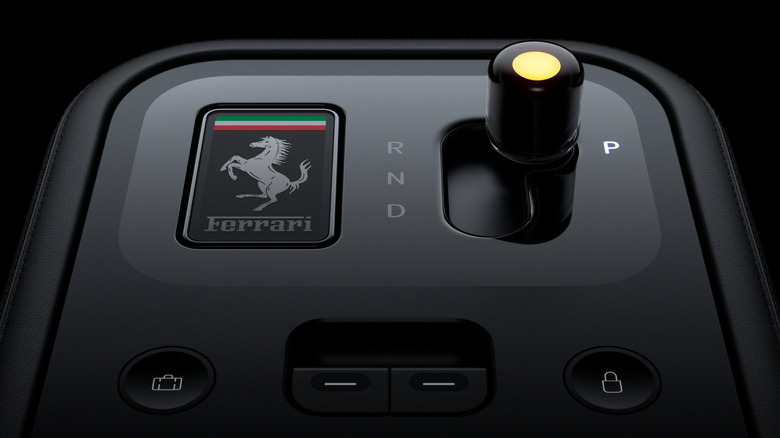
Debuting with the Luce is a new shifter, which takes on an upside-down "L" shape and is surrounded by Corning glass. Ferrari says it used lasers to make tiny holes in the glass to deposit the ink used for its graphics, which feels extreme, but neat.
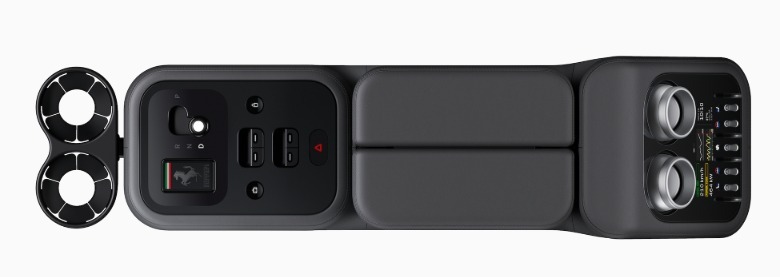
To its left is a small dock where you're meant to place your keyfob, and behind that is a trunk popper, central locking button and your window controls. Following the console backwards, you'll find a split-opening storage area with rear climate control vents and a small screen behind it. At the very front of the console are two cupholders side-by-side.
 Ferrari
Surely, the Luce will have plenty of seat options, but the ones we have been shown are a warm brownish leather with a fixed headrest and a ribbed center insert. Obviously, I haven't sat in them, but they do look pretty comfortable.
 Ferrari
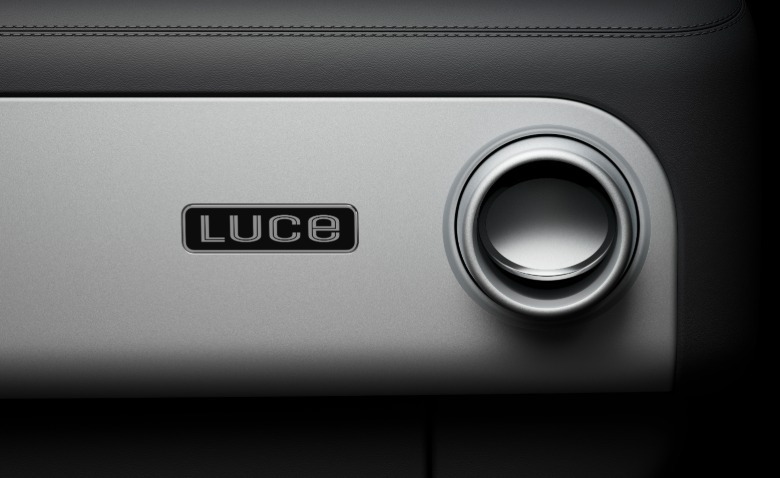
We've also gotten a small glimpse of the passenger portion of the dashboard, which shows a "Luce" logo and air vent, both of which look like real throwbacks to the 1960s. Obviously, that's a recurring theme with this car, which is fascinating since it's almost certainly the most advanced Ferrari to date.
I know that this might not end up being everybody's cup of tea, but if this is where the future of interior design is heading, sign me the hell up.