

11 Of The Biggest V8 Engines Ever Put In Production Cars
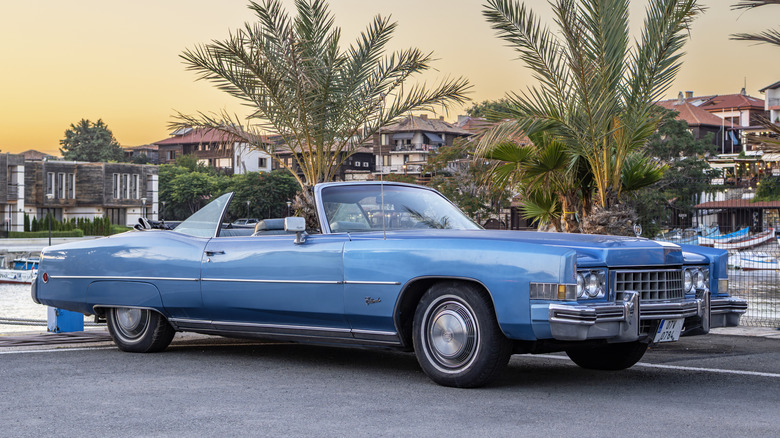
There was a time in automotive history when 'replacement for displacement' hadn't been invented yet. Sure, you could extract more horsepower with performance camshafts, better (and more) carburetors, and long tube headers, but you could also put them in a higher-displacement engine and make some stupendous horsepower figures.
For a long time, at least in America, the 'replacement for displacement' saying was mostly associated with the V8 engine. During the heyday of muscle cars, automakers installed some massive, big-block V8s into relatively small cars. Today, engines like this are generally reserved for heavy-duty pickup trucks. But in the 1960s, they powered everything from Mustangs to Eldorados.
Fact is, with modern muscle cars, like the 2026 Dodge Charger Sixpack, receiving twin-turbo inline-six power, people feel even more nostalgic for the high-capacity greats from the past. The low-frequency thump. The vroom. The tire shredding. Those were some good times! Not that I was alive then, but that makes big V8s more attractive.
Let's celebrate the golden era with the biggest V8 engines ever put in production cars. We'll focus only on cars, not pickup trucks or large body-on-frame SUVs. Let's crack open the history of massive V8s!
Ford 7.03L Boss 429 (1969 to 1970)
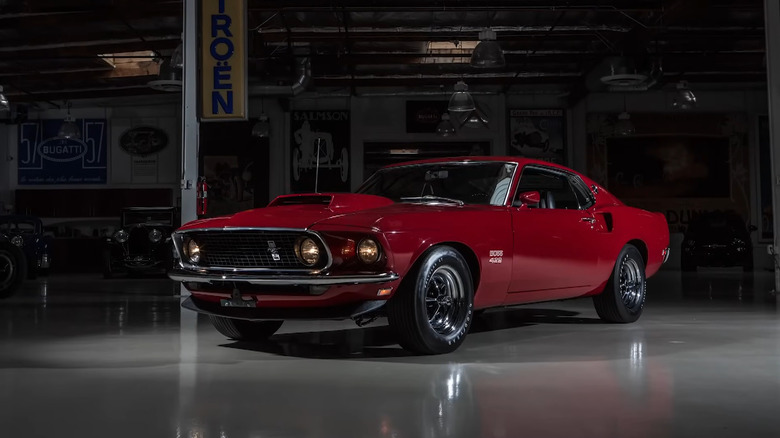
A NASCAR-bound 429-cubic-inch V8 in a pony car? Yes, it's absurd. But that's why we love the Mustang Boss 429 so much. Ford could've installed this homologation-special engine in its larger vehicles, but no one complained about the 7.03-liter V8 turning the Mustang into a supercar-eating beast. 375 hp at 5,200 rpm. Meaty 450 lb-ft (610 Nm) of torque at 3,400 rpm. 0-60: 5.1 seconds. Quarter mile: 13.6 seconds. Top speed: 114 mph (183 km/h). Few cars could outcompete these figures in 1969. For comparison, the V12-powered Lamborghini Miura needed 6.3 seconds to reach 60. Oh, and thanks to the engine's massive displacement, Boss 429 owners could extract over 500 hp with small modifications — no turbocharging/supercharging required.
Even more impressively, Ford didn't just put a larger engine in the Boss 429 and call it a day. The company wanted to win at NASCAR with this beast, so it overengineered the heck out of it. Forged steel crankshaft. Four-bolt main caps. Hemi-like crescent-shaped combustion chambers and big ports. Furthermore, Ford equipped the engine with a 735-cfm Holley four-barrel, ram-air carburetor, an oil cooler, and a header-type exhaust manifold.
Installing the engine into the Mustang's engine bay was also challenging. Ford had to modify the shock towers, give the Mustang a wider track, and even put the battery in the trunk. As a result, despite carrying a much larger engine, the Boss 429 handled better than the regular version. Unsurprisingly, the 1969 Ford Mustang Boss 429 is sought after today, with prices reaching over $500k for mint examples.
Cadillac 7.03L 429 (1964 to 1967)
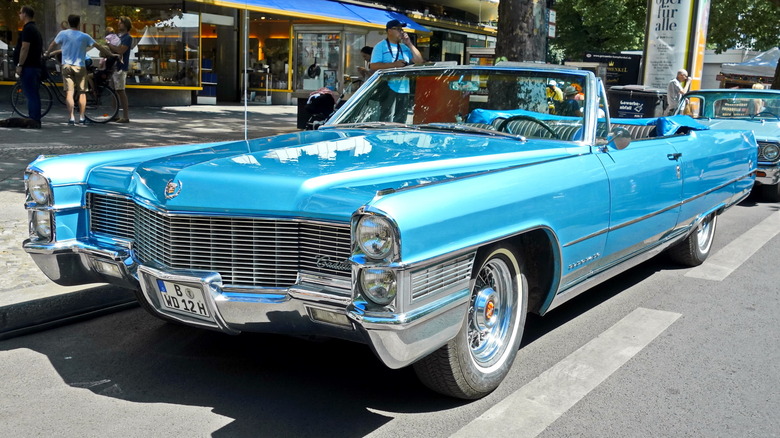
Ford wasn't the first to market with a 429-cubic-inch V8. Cadillac offered such an engine back in 1964 to power its massive luxury cars. Caddy's focus wasn't on delivering the best performance, but providing enough power to move its heavy vehicles. Still, with 340 hp and massive 480 lb-ft (651 Nm) of torque, Cadillac's 429 was more than powerful enough to burn the rear tires.
Although it arrived earlier than Ford's 429 engine, Caddy's unit wasn't as influential. No motorsports success. No performance vehicles to make use of its power. Instead, it was used in luxury barges like the Sixty Special, Eldorado, and DeVille.
Cadillac paired the 429 with the Turbo Hydra-Matic 400 automatic transmission with three speeds and a torque converter. This combo propelled the DeVille sedan to 60 in 8.5 seconds and the quarter mile in 16.8 seconds. The Cadillac 429 was an OHV engine with 16 valves, and a cast-iron head and block. It was fed fuel and air via a Carter AFB 3903S four-barrel downdraft carburetor.
The Cadillac 429 was discontinued only three years after its introduction, simply because Cadillac had even larger V8 engines on the horizon. Oh, yes, you'll definitely meet them in the list — one holds the title for the largest-ever V8 in a production car!
Ford 7.05L MEL 430 (1958 to 1965)
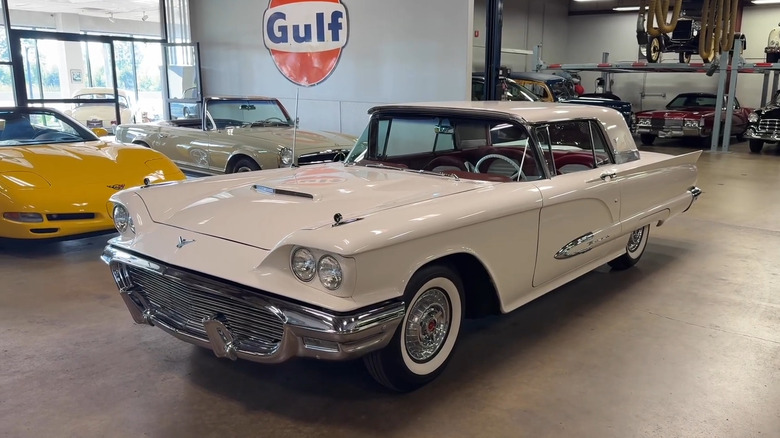
Ever heard about the MEL (Mercury-Edsel-Lincoln) V8? It was Ford's answer to the big-block V8s from its American competitors, featuring a rather unusual combustion chamber design. Unlike modern engines, the MEL engine family had flat heads with no combustion chambers. Instead, the block was machined at a 10-degree angle, creating a weird wedge shape where combustion occurred. Yes, that's far from the perfect shape for efficient combustion, but Ford was more worried about cutting manufacturing costs. Oh, and the Blue Oval wasn't alone — Chevy's 348 and 409 W-block engines had a similar design.
The MEL family consisted of four engines. The 383 cubic-inch (6.27-liter) engine was used exclusively in Mercury vehicles, while the larger 410 cubic-inch (6.72-liter) unit found its way in Edsel vehicles. The 430 cubic-inch (7.05-liter) MEL was used in Mercury and Lincoln vehicles, but also Ford's Thunderbird. We'll expand more on the largest 462 cubic-inch (7.57-liter) MEL below.
The MEL 430 is the most interesting of the bunch, at least for enthusiasts. The regular version produced solid 360 hp, an excellent figure in 1958. Still, for the 1958 Super Marauder, Mercury improved the engine with three Holley 2300 two-barrel carbs and a dual-plane aluminum intake manifold. As a result, the MEL 430 produced 400 hp, making it the most powerful American V8 at the time. A year later, Johnny Beauchamp almost won the Daytona 500 with a Ford Thunderbird that featured the same engine. So, yeah, the MEL 430 even has some racing heritage.
Buick 7.05L 430 V8 (1967 to 1969)
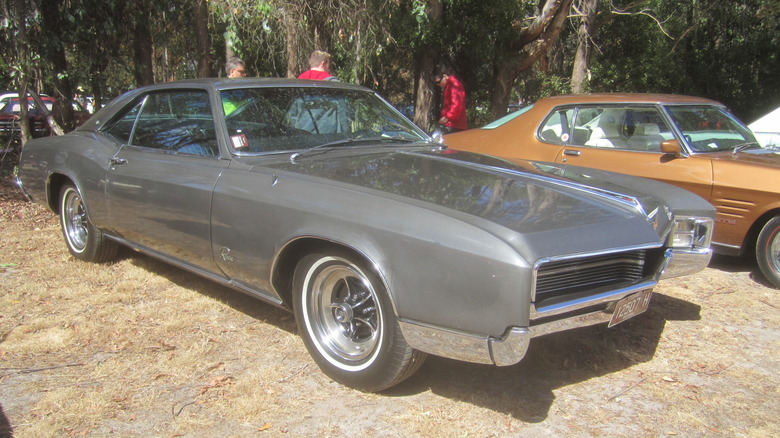
Buick today is all about boring crossovers and SUVs. Back in the day, though, Buick was producing some of the finest V8-powered muscle cars around. The automaker started its V8 journey with the Nailhead family in 1953, replacing it with the vastly improved 400 and 430 big-block motors in 1967.
The new engines had larger 3.25-inch main bolts to improve crankshaft rigidity, alongside forged steel connecting rods and cast aluminum pistons. Although an oversquare design, these new engines had a much longer stroke than the Nailhead V8s, meaning the focus was to improve torque, rather than power. Indeed, producing 475 lb-ft (644 Nm) at 3,200 rpm, the larger 430-cubic-inch engine was a torque monster. With 360 hp at 5,000 rpm, it was peppy at the top end, too.
The 430-powered Buick's massive coupes — the Riviera, Electra 225 Sport Coupe, and Wildcat. This engine was the epitome of solving power problems with combustion space. The engine's torque was more than sufficient to produce massive burnouts!
Shame Buick isn't doing much to honor its past big-block monsters. Oh, wait, we totally forgot about the Buick Electra GS Concept and the Buick Wildcat EV Concept! Sorry, false alarm — both these are EVs. Heck, Buick is poised to become an all-electric brand by 2030. At least the Electra name suits an EV more than the 1967 model.
Chrysler 7.2L 440 Big Block (1966 to 1979)
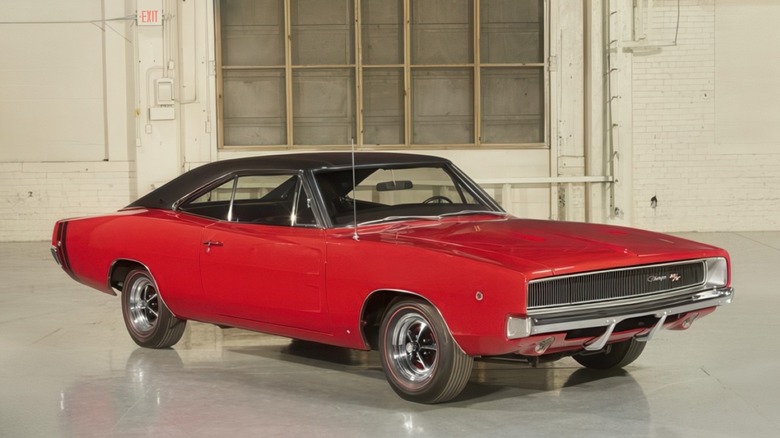
The Chrysler 426 HEMI engine is the stuff of legends, providing drivers with a racecar feel in Dodge's and Plymouth's run-of-the-mill vehicles. But there was another Chrysler V8 that deserves a special mention, and it was offered concurrently with the 426 HEMI. The 440 Magnum had a larger capacity (7.2 liters), though it was less powerful because the 426 was simply a more advanced engine.
But, in this case, down in power doesn't mean weak. Equipped with the Six-Pack induction system with three Holley two-barrel carburetors and an Edelbrock aluminum manifold, the Magnum was good for 390 hp and brawny 490 lb-ft (664 Nm) of torque. Thus, it matched the 426 HEMI's torque figure and was only 35 hp short of the legendary engine. Dodge deemed that it was good enough for the 1969 Charger Daytona homologation special. Crucially, the 440 Magnum was cheaper than the 426 HEMI, making it a more desirable option for most people.
Unfortunately, Chrysler had to detune the 440 Magnum to meet the more stringent EPA emissions regulations. Furthermore, in 1972, automakers needed to show net, rather than gross, horsepower figures. As a result, Chrysler's big-block was rated at 330 hp and 410 lb-ft (556 Nm) of torque with the Six-Pack upgrade. This has somewhat diminished 440's usefulness in performance cars.
Still, thanks to its high torque figure, it continued to be used in full-size cars and SUVs. Most notably, the Chrysler 440 was popular in late 1970s police cars. According to Dodge Garage, the engine allowed officers to maintain 120 mph (193 km/h) for extended periods thanks to its heavy-duty cooling.
Chevrolet 7.44L 454 (1970 to 1993)
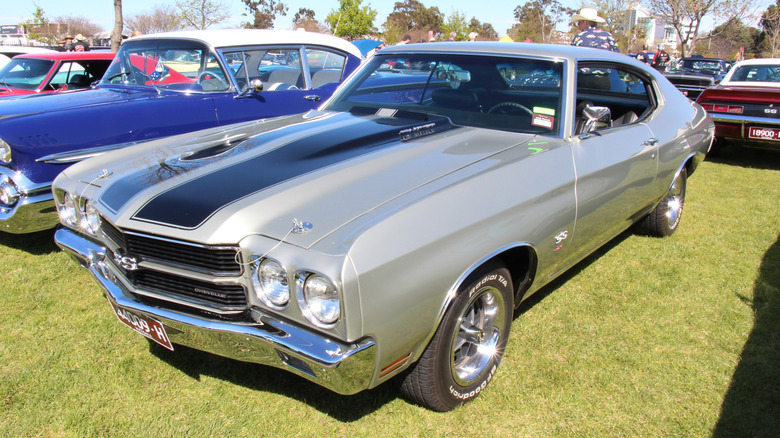
The year is 1970. Ford is still stealing headlines with the Mustang Boss 429, while Chrysler is betting on racing heritage with the 426 HEMI. Chevy's answer? A 454-cubic-inch (7.44 liter) brute of an engine designed to demolish the horsepower figures of its competitors. The 454 was the biggest engine in Chevy's Mark IV family, also known as the porcupine. Why? Some media people at the time thought that the valves set at compound angles were pointing in different directions, like the quills of a porcupine, so the name stayed.
In the 1970 Chevelle SS, the LS6 454 produced an astonishing 450 hp at 5,600 rpm and 500 lb-ft (678 Nm)of torque at 3,600 rpm, making it the most powerful car at the time. Chevrolet achieved these crazy figures using an aggressive compression ratio of 11.25:1, a four-barrel 800 cfm Holley carburetor on an aluminum manifold, forged steel crankshaft and connecting rods, and forged aluminum pistons. Interestingly, the 1970 Corvette was also slated to receive an even more powerful LS7 variant with 460 hp, but it never materialized.
Instead, after the more stringent emission regulations, the 454 was repurposed for use in Chevy and GMC trucks and SUVs. It became so popular as a truck engine that Chevy continued using it in that capacity. Of course, the 454 was modernized over the years, but it never reached the figures of its glory days.
GM 7.45L 455 (1968 to 1976)
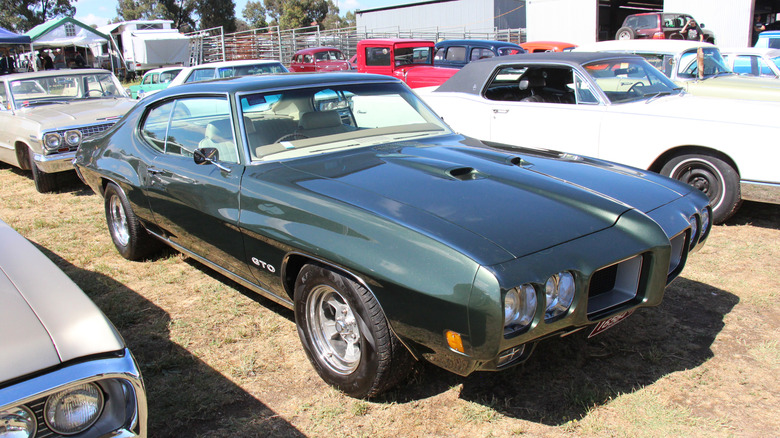
In the 1960s, GM let its brands do something unthinkable — produce three engines with the same capacity, but different designs. Today, that's next to impossible. But back in the day, Oldsmobile, Pontiac, and Buick all developed 455-cubic-inch V8s that were similar only in displacement.
Let's start with the thin-wall masterpiece — the Buick 455 big block. Thanks to the thin-walled casting, Buick's big block was the lightest of the bunch. Don't mistake that for incapable, though. In fact, the Buick 455 was somewhat of a torque beast, producing 510 lb-ft (691 Nm). It also had 350 hp on tap, or 360 hp with the Stage 1 package, with larger valves and a higher compression ratio. In the 1970 Riviera, the Buick 455 even produced 370 hp! Other cars that carried this engine were the Electra, LeSabre, Centurion, and Regal.
Meanwhile, Oldsmobile's 455, nickname 'Rocket', was designed with front-wheel-drive configuration in mind. No joke. It powered the Oldsmobile Toronado, an FWD luxury car. Don't worry, you can also find it in the rare 1968 Hurst Olds muscle car, where it produced a whopping 390 hp and 500 lb-ft (678 Nm) of torque.
Finally, the Pontiac 455 was the heart and soul of the Firebird Trans Am, GTO, and Grand Prix. It was essentially a bored-and-stroked version of the Pontiac 428. The Pontiac 455 produced up to 370 hp and 500 lb-ft of torque in the Super Duty version, featuring a strengthened block and internals to cope with the added power.
Ford 7.5L 460 Lima (1968 to 1997)
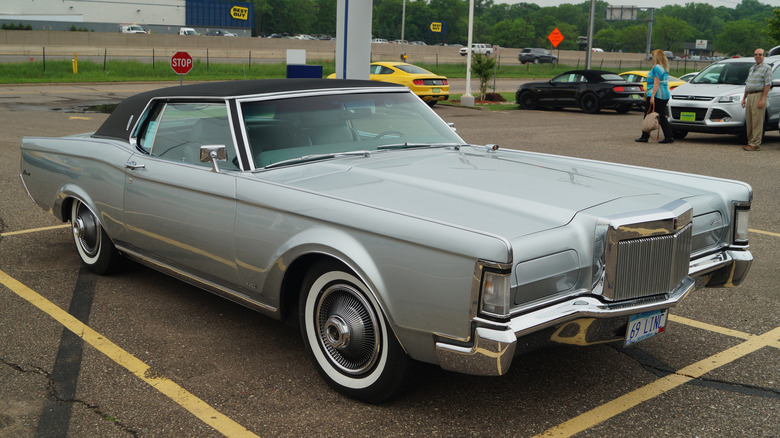
In 1968, Ford launched a brand-new 385 series of big-block V8 engines, including 429- and 460-cubic-inch versions. Since they were produced in Lima, Ohio, the automotive community today refers to them as the 'Lima V8' engines. Both engines shared the same bore, but the larger 7.5-liter version had a longer stroke. The 460 was also more robust, weighing 720 pounds (327 kg). That's heavy, yes, but still lighter than the MEL engine it replaced.
Somewhat unsurprisingly, the 460 wasn't a drag-strip engine. Instead, it had a blue-blooded debut in the Lincoln Continental Mark III. With 365 hp and hefty 485 lb-ft (658 Nm) of torque on tap, it moved Continental's heavy luxury coupe with poise up to a top speed of 120 mph. In 1972, Ford introduced the brand-new Thunderbird, which also carried the 460 Lima V8. Due to the new regulations, it only produced 219 hp and 338 lb-ft (458 Nm) of torque and came exclusively with a three-speed automatic. As a result, 0-60 took a leisurely 9 seconds.
Although the 460 Lima V8 was never utilized in a Mustang Boss or any other performance application, it did find its way into many Ford trucks and vans. In 1978, the Blue Oval removed the engine from its luxury barges and repurposed it for truck use. Using modern technology, such as fuel injection, it was even upgraded to 245 hp and 400 lb-ft of torque. The 460 V8 Lima remained in use until 1997, making it one of the longest-running V8 engines in the U.S.
Ford 7.57L MEL 462 (1966 to 1968)
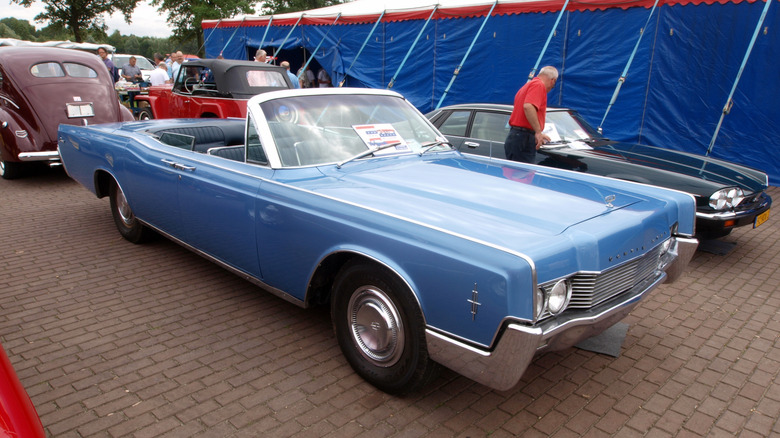
Back to the weird MEL family with irregular, wedge-shaped combustion chambers. The 462 cubic-inch (7.57 liter) was the largest engine with this design, but also the latest. It arrived in 1966 as Ford's largest-ever engine in a passenger car, a title it still holds today. Unlike its MEL cousins, the 462 featured a Carter four-barrel carburetor. Other improvements over the 430 MEL included a new head/camshaft and better cooling.
Not that it mattered much; the MEL 462 produced only 340 hp, so it was never installed in a performance vehicle. Still, the brawny 485 lb-ft (658 Nm) of torque, available at diesel-like 2,800 rpm, made it useful in the heavy Lincoln Continental from 1966 to 1968. This included the unique four-door convertible model — a 220.9-inch (5.6 meters) colossus that weighed around 5,700 pounds (2,590 kg).
Of course, the MEL 462 was only paired with an automatic transmission. It was also very thirsty for fuel and was overpowered by its big-block rivals by a significant margin. So, in mid-1968, Ford replaced it with the much-improved 460 Lima.
Cadillac 7.73L 472 (1968 to 1975)
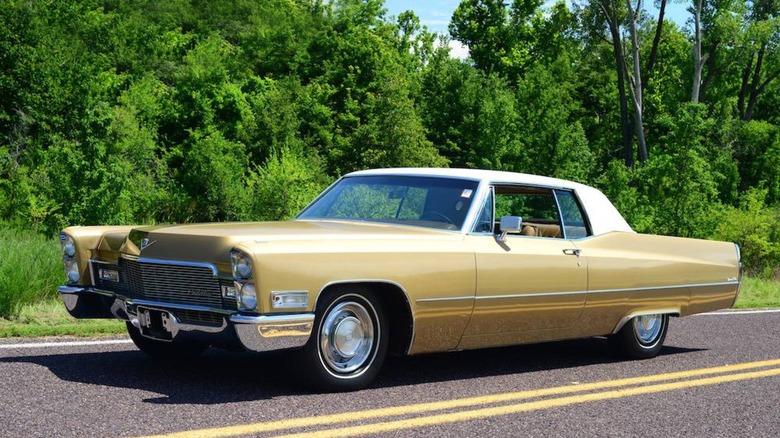
By the mid-1960s, Cadillac's 429 V8 engine was nearing the end of its lifecycle. Rivals already introduced larger, more powerful engines, so Caddy needed to react — fast. So, in 1968, the company introduced the 472 cubic-inch (7.73-liter) behemoth — the largest V8 in a production car at that time.
Unsurprisingly, the new engine wasn't designed for performance, but rather for buttery smooth power delivery. Furthermore, the 472 was developed with accessories in mind, with its engine block featuring unique mounting points. The idea was to create ever-more advanced luxury vehicles. Oh, and the engine also had very thick cylinder walls, meaning Cadillac wanted to expand its capacity down the line. Little did they know of the oncoming regulations, which all but killed these leviathans. That said, the thicker walls made the 472 a stout, durable engine. Not only that, but the block was made from a high-nickel alloy, which further improved strength without adding weight.
With a fairly high 10.5:1 compression ratio, the 472 produced 375 hp and an Earth-moving 525 lb-ft (711 Nm) of torque. It found its way to the 1968 DeVille III, paired with a three-speed Hydra-matic transmission. By 1971, though, Cadillac lowered the compression ratio to 8.8:1 to meet the more stringent smog regulations. In the 1971 DeVille, the engine produced 345 hp — pretty low for its massive size. The 500 lb-ft (678 Nm) torque figure remained impressive, however, and was available at a very low 2,800 rpm.
Cadillac 8.2L 500 (1970 to 1976)
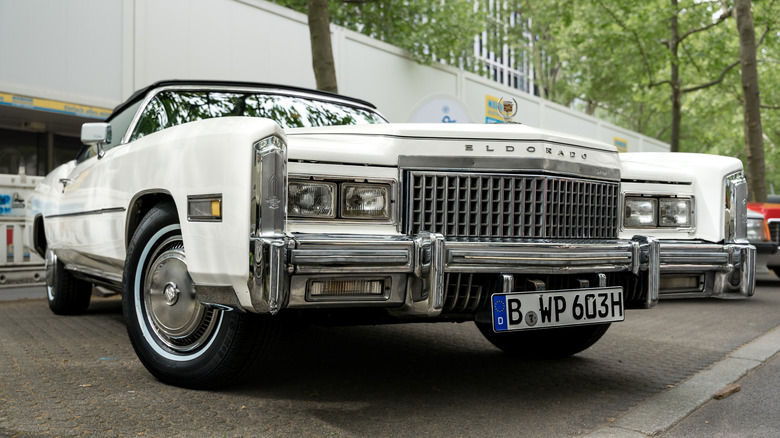
Not that you expected any other brand to hold the title for the largest-ever V8 in a production car. The 500 cubic-inch (8.2 liter) engine was based on the 472 and featured the same bore, but a longer stroke. With a high 10:1 compression ratio, the 500 initially produced 400 hp at 4,400 rpm and best-in-class 550 lb-ft (745 Nm) of torque at just 3,000 rpm. Unsurprisingly, it was only offered with the Turbo Hydra-Matic automatic transmission.
Once the new emission regulations were set, Cadillac had to significantly reduce its output. So, in 1971, the 500 was rated at 365 hp and 535 lb-ft (725 Nm) of torque. And that was generous — the 500 was further stifled down the line. So much so that, in 1975, it only produced 190 hp and just 360 lb-ft (488 Nm) of torque. The move from gross to net horsepower figures played its role, but 190 hp from an 8.2-liter capacity seems a bit low, you'd agree. Heck, the 2025 Honda Civic Si produces 200 hp from a 1.5-liter engine. It's turbocharged, yes, but still!
What made the Cadillac 500 V8 so interesting is the fact that it was initially installed in the front-wheel-drive Eldorado — just like the Civic Si! Yup, that's not an error — America's largest passenger-car V8 was used in an FWD configuration. And those were the high-output 400-hp and 365-hp versions — not the choked 500 introduced later. In fact, the least powerful 190-hp Cadillac 500 was paired with rear-wheel drive in Caddy's 1975-1976 class full-size vehicles. These included the DeVille V, Fleetwood Seventy-Five, and Calais.