

Federal Government Sued By 16 States Over Trump's Decision To Pull EV Charger Programs
Good morning! It's Wednesday, December 17, 2025, and this is The Morning Shift, your daily roundup of the top automotive headlines from around the world, in one place. This is where you'll find the most important stories that are shaping the way Americans drive and get around.
In this morning's edition, a fairly sizable chunk of U.S. states are suing the federal government over President Trump's decision to suspend two EV charging programs that would have helped with infrastructure, the European Union has officially proposed killing off its 2035 combustion-engine ban, Scout Motors will be allowed to sell directly to customers in Colorado and Jeep is asking for forgiveness following 4xe recalls.
1st Gear: Federal government sued over EV charger program cuts
Sixteen states and the District of Columbia are suing the federal government in response to President Trump's decision to suspend two grant programs for electric vehicle charging infrastructure. California Attorney General Rob Bonta said the President's Department of Transportation has refused to approve any new funding under two EV charging infrastructure programs created by Congress. They were part of the $1 trillion infrastructure law signed by former-President Biden in 2022.
This latest lawsuit is being led by the attorneys general of California and Colorado, but it has been joined by AGs from Arizona, Delaware, Illinois, Maryland, Massachusetts, Michigan, New Jersey, New York, Oregon, Rhode Island, Vermont, Washington, Wisconsin and the District of Columbia, as well as the governor of Pennsylvania.
Back in June, a U.S. judge actually blocked Trump's plan to withhold funding awarded to 14 states from a seperate $5 billion electric vehicle charger infrastructure fund that was approved in 2022, so there's some precedent here. From Reuters:
"This is just another reckless attempt that will stall the fight against air pollution and climate change, slow innovation, thwart green job creation, and leave communities without access to clean, affordable transportation," Bonta said.
One of the programs directs $2.5 billion in funding to states and cities for EV charging and hydrogen fueling infrastructure. The suit, led by California, Washington and Colorado, said Trump's action "has placed $1.8 billion in federal awards to dozens of state and local governments in jeopardy and made the vast majority of these funds unavailable."
[...]
Trump has taken aim at electric vehicles on a number of fronts. In June, the Republican president signed a resolution of disapproval under the Congressional Review Act to bar California's landmark plan to end sale of gasoline-only vehicles by 2035 and two other vehicle rules.
Trump has also —rather infamously — signed legislation that killed the $7,500 EV tax credit, and earlier this month, he proposed slashing fuel economy standards the Biden Administration finalized last year. It's all part of an effort to make it easier for American automakers to sell gas-powered cars.
Let's hope this money can get flowing again so our EV infrastructure can be built up to where it needs to be. And, before you all start complaining about subsidies for the EV industry, ask yourself what sort of subsidies the oil and gas industry is getting.
2nd Gear: Say goodbye to the EU's 2035 combustion engine ban
The European Union is trashing its 2035 combustion engine ban after receiving a hell of a lot of pressure from the automotive industry, which has struggled to really make EVs catch on as quickly as it had hoped. Now, rather than requiring automakers to completely eliminate carbon-dioxide tailpipe emissions for new cars starting in 2035, the EU's new proposal calls for a 90% reduction from a baseline level. That remaining 10% would need to be made up through the use of low-carbon steel or from e-fuels and bio-diesel.
The European Commission said its plan maintains a strong market signal in favor of zero-emission vehicles while also giving automakers a bit more flexibility. It basically means that, along with full EVs and hydrogen vehicles, car companies can also sell plug-in hybrids, extended range electric vehicles and even some internal combustion-powered cars past the 2035 deadline.
At the moment, it's still just a proposal. It'll need to gain approval from the EU's member states and the European Parliament before it can become law. From The Wall Street Journal:
Industry groups said the proposal was a positive first step but raised questions about the details. The measures "are too complex" and won't be enough to protect production and jobs, the European Association of Automotive Suppliers said.
Carmakers had argued that the original 2035 target for zero emissions was unachievable because of a slower-than-expected uptake of EVs among consumers.
[...]
In Europe, automakers have had to price their EVs aggressively to hit regulatory targets this year, resulting in a surge in sales but weaker profits.
Volkswagen, for example, reported a loss for the third quarter. The region's largest carmaker said it sold more lower-margin EVs while its Porsche brand was hit by write-downs related to EV investments that hadn't yielded the expected returns.
Europe's vast complex of automotive suppliers is being particularly hard hit by the transition. EVs contain fewer of the mechanical parts the companies specialize in and more electronics, where Asian supply chains are dominant.
Bosch and ZF Friedrichshafen—two of Europe's largest automotive suppliers—announced thousands of job cuts in recent months. A study by consulting company Roland Berger for the European Association of Automotive Suppliers found that as many as 350,000 jobs could be lost by 2030 if the current trend continues.
Obviously, I cannot see the future, but I've got a terrible feeling that in a few years, we're going to look back at these decisions being made by governments in the U.S. and Europe and be able to point to exactly where it all went wrong. We're going to be able to see exactly where tailpipe emissions got out of control, once and for all. Hopefully I'm wrong.
3rd Gear: Scouts gets a major sales win in Colorado
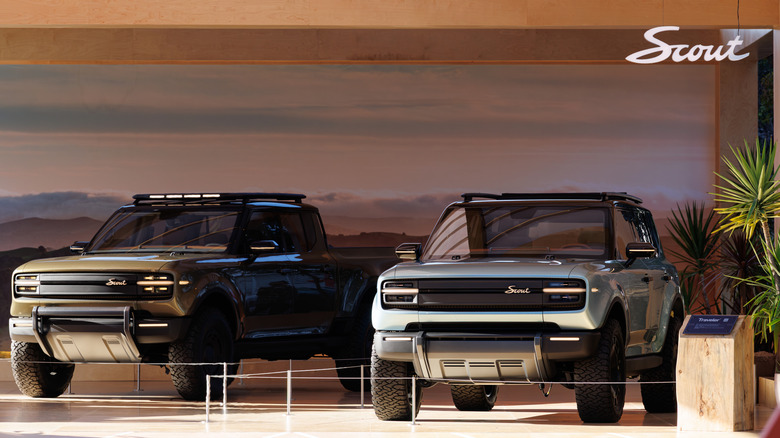
Scout Motors has wanted to do direct-to-customer sales from the get-go, and that hasn't really gone over so well with dealers. Still, it hasn't stopped the Volkswagen-owned SUV-maker from getting its dealer license in Colorado, which means it can indeed sell cars directly to buyers in the U.S.
Colorado's Motor Vehicle Dealer Board voted 6-2 to approve Scount's application to become a dealer in the state. As you may have imagined, dealers aren't thrilled about this development, and I'll tell you what: I don't give a rat's ass. From Automotive News:
"We're disappointed," Colorado Auto Dealers Association CEO Matthew Groves told Automotive News. "We have a law that specifically prohibits manufacturers from having control of the dealership and now the state's just granted a manufacturer control of the dealership."
Scout's detailed roadmap to sell an electric SUV and pickup to American consumers includes experience centers, speedy purchase transactions, stores in key U.S. markets and a flexible nationwide service footprint at launch.
Denver was one of the first 25 markets Scout identified for brand-owned rooftops in October 2024.
Groves acknowledged that there is a loophole for Tesla, Rivian and Lucid to sell vehicles in Colorado because those are all-EV brands and do not have franchise agreements with legacy automakers.
Groves said Scout is financially backed by VW Group and plans to offer an extended-range EV energy system which will utilize a gasoline engine as a generator.
[...]
VW Group, VW Group of America and Scout maintain the startup is and will remain independent.
Right now, it's not clear how many locations Scout is planning to set up in Colorado or if it was granted licenses in other states as well, but we do know that its Colorado license is valid from December 16, 2025, through October 31, 2026. It'll allow the automaker to sell new, used and wholesale vehicles.
4th Gear: Jeep says sorry:(
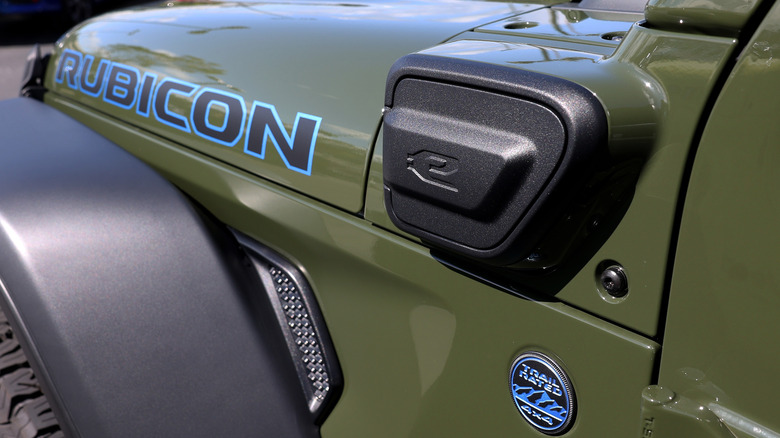
In a rare (and slightly strange) move, Jeep's CEO apologized and promised a $100 gift card in a note to 4xe plug-in hybrid owners who have been dealing with a slew of issues related to three separate battery fire recalls in the past two years.
CEO Bob Broderdorf said most Wrangler and Grand Cherokee 4xe hybrids haven't been impacted by the battery problems, but he acknowledged recalls could be "unsettling." He asked owners of these troubled cars to "Please accept our sincerest apologies." Most recently, 320,065 owners were told to stop charging their 4xes and park them away from structures. From The Detroit News:
"As a valued member of the Jeep family, you deserve a reassuring ownership experience, and we are truly sorry if this situation caused any disappointment or concern," the email said. The brand is offering $100 Mastercard gift cards to "cover unexpected fuel costs since you are being asked to not travel in EV mode," the CEO confirmed, while also providing loaner vehicles and extended warranties for the Samsung SDI-made high-voltage batteries.
The apology came as the Stellantis NV brand also released details to dealers for how to fix the Wrangler plug-in hybrids, though not yet the Grand Cherokee versions, after the battery recall was issued in late October. Owners began to book repairs on Tuesday.
The fix, as with the prior two Jeep battery recalls, doesn't involve immediately replacing the battery. Instead, it involves a software update that is supposed to be able to detect if there is damage in a battery component called a separator. If an issue is detected, battery charging will be disabled, the company said, at which point the battery will be replaced.
The company in a recent statement said it now has a "deeper understanding of the factors involved" and has found a "more comprehensive remedy" to fix it.
Aside from the latest "park away from structures" recall, the others involved a software update causing some 4xe drivers to suddenly lose power, as well as a really bizarre one that we told you about: sand in the engine that could cause a fire.
This is nothing a $100 gift card can't fix.
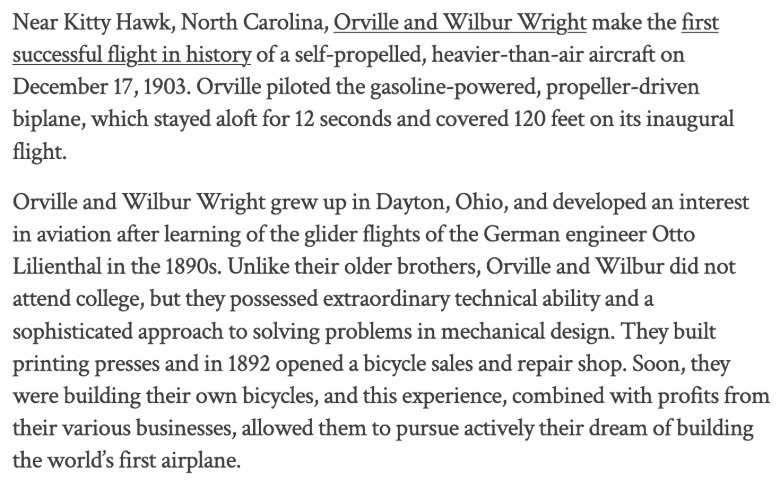
Reverse: I know thats Wright
 History.com
It is truly wild to think how far aviation has come in such a short amount of time. I mean, just 66 years after the Wright Brothers' plane flew for 12 seconds, we landed on the goddamn moon. Can you imagine what these guys would think if they saw a United Polaris seat? They'd probably lose their minds. In any case, if you want to learn more about the Wright Brothers and their flight at Kitty Hawk, head over to History.com.
On the radio: The Ronettes - Sleigh Ride
Folks, we're now just eight days away from Christmas. And, for my Jewish friends (me included), tonight is the fourth night of Hanukkah. This means we're really getting down to crunch time for buying gifts. I hope you're prepared.