

What's The Difference Between Ruthenium And Iridium Spark Plugs?

The many spark plug types are typically named after precious metals used in their center electrode, ground electrode, or both. Copper plugs are the most affordable and the most basic while iridium plugs have a longer lifespan and are capable of improving combustion, emissions, and fuel economy. In between are platinum spark plugs, which strike a nice balance of cost, durability, service life, and performance. However, iridium beats copper and platinum in corrosion resistance, making it extremely hardy and well-suited for vehicular applications.
The latest innovation in spark plug metals is ruthenium, a rare silver metal belonging to the platinum family and related closely to rhodium, palladium, platinum, osmium, and iridium, too. If any of those rare earth metals sound familiar, it's because some of them are vital elements of your car engine's catalytic converter, namely platinum, rhodium, and palladium.
Like iridium, ruthenium is an extremely sturdy metal and is highly resistant to corrosion. Speaking of which, ruthenium can last even longer than iridium. The latter can keep sparking efficiently for 100,000 miles or more, but ruthenium has a minor advantage in wear resistance and can last up to 120,000 miles.
Niterra North America (NGK) was among the first to commercially debut ruthenium spark plugs in response to the needs of modern engines. But instead of bragging about ruthenium's ultra-long lifespan, NGK's marketing focuses more on ruthenium's high ignitability, a feature that enables it to burn the air/fuel mixture more completely. This results in faster cold starts, smoother and more stable idling, and better throttle response.
NGK ruthenium plugs come in two types
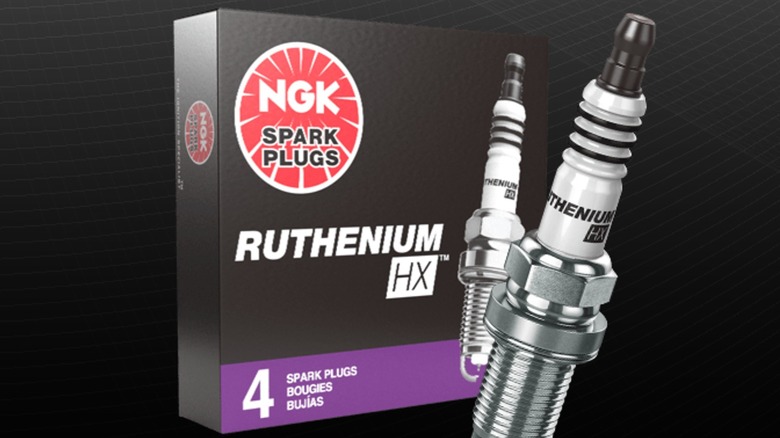
NGK iridium spark plugs come in Laser Iridium and Iridium IX variants. The former is an OEM plug with an iridium center electrode and a platinum ground electrode, while the latter only has iridium and is made for aftermarket applications. NGK's ruthenium plugs also come in two flavors, and their difference is found in the design of the ground electrode.
The NGK Ruthenium HX DFE (double fine electrode) has a ruthenium center electrode and a platinum ground electrode for low-heat engines. In other words, ruthenium DFE is a hot spark plug for low-speed, low-compression, or non-turbo motors. The NGK Ruthenium HX PSPE (projected square platinum electrode) has the same materials, but the design and orientation of the ground electrode is different, making it ideal for high-compression and high-heat engines. It also makes the ruthenium PSPE a cold spark plug.
Ruthenium offers more benefits other than having a more exotic-sounding name and better wear resistance. It's more durable than iridium at high temperatures, and it provides more stable performance in high-stress driving conditions. Engines that run on iridium plugs can be upgraded to ruthenium plugs, but you'll need to find the right part number and know whether your car requires hot or cold plugs. Ruthenium spark plugs also have a slight price premium over iridium owing to their advanced construction, although the benefits should outweigh the added cost.