

Lamborghini Temerario Spyder Has Lambo's First Retractable Hardtop (And Its First Neck Warmers)
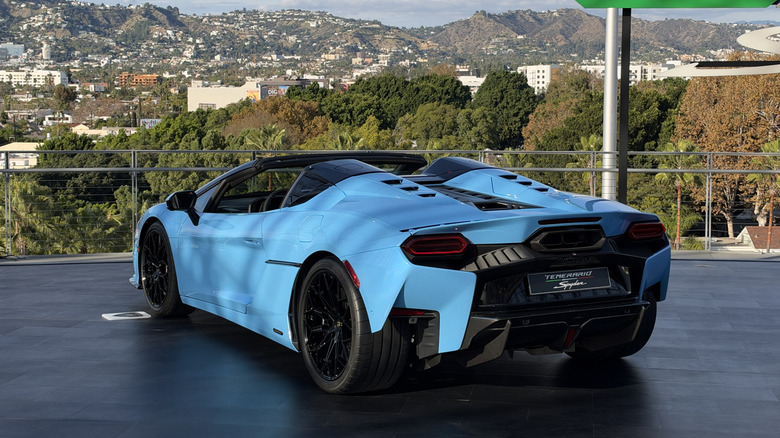
The Lamborghini Temerario has only been in the hands of customers for about a year, but the Italian automaker is already introducing a new version that will have a lot of owners rushing to their dealers to get the ball rolling on a trade-in. Say hello to the Lamborghini Temerario Spyder, which just made its world debut at the Academy Museum of Motion Pictures. Lamborghini has been making droptop supercars since the Silhouette in 1976, but in this case it's actually quite behind the times — the Temerario Spyder is Lambo's first convertible with a powered retractable hardtop, a setup that has already seen its peak in popularity.
Still, this new model is quite exciting, and it definitely doesn't seem outdated. Lamborghini says the hardtop setup was chosen "to combine comfort, driving precision and aerodynamic efficiency," and its folding mechanism is unique to the industry. The best Lamborghinis are all about exuberance, and the Temerario Spyder seems to deliver that in spades.
Look at that roof!
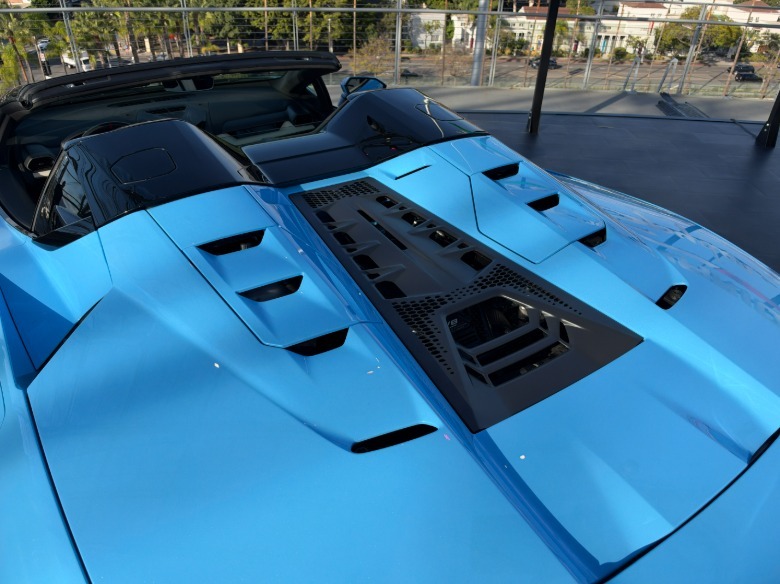
There's not a ton to talk about from a styling standpoint, which is no bad thing. I already thought the Temerario looked awesome, and the Spyder looks even better. Its profile and roofline are largely the same, especially with the roof in place. There are two prominent cowls on the decklid just behind the seats, with a great set of trio of vents on each one, and in place of the coupe's smaller side quarter window is a new intake element. The engine cover does a nice job of showing off the V8 engine, and there are a bunch of other intakes, vents and aero elements adding visual interest. You can get a new livery option that adds a bunch of black accents to the interior, like sharp eyeliner around the headlights, and there are even more personalization options than what we've seen on the coupe.
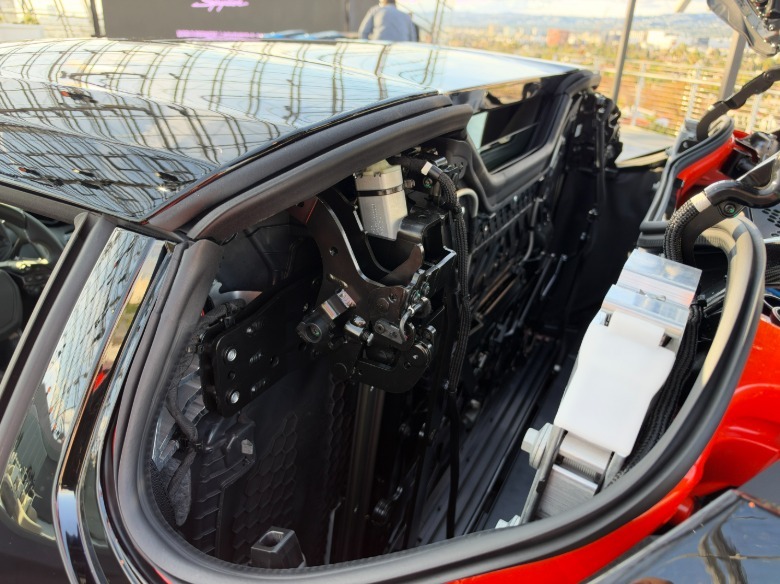 Daniel Golson/Jalopnik
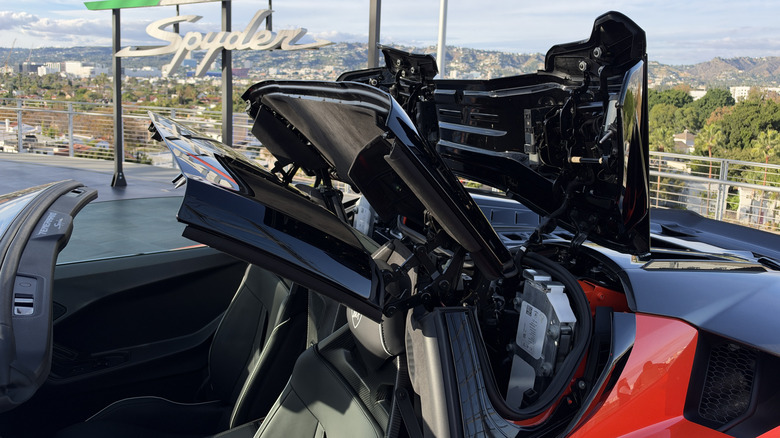
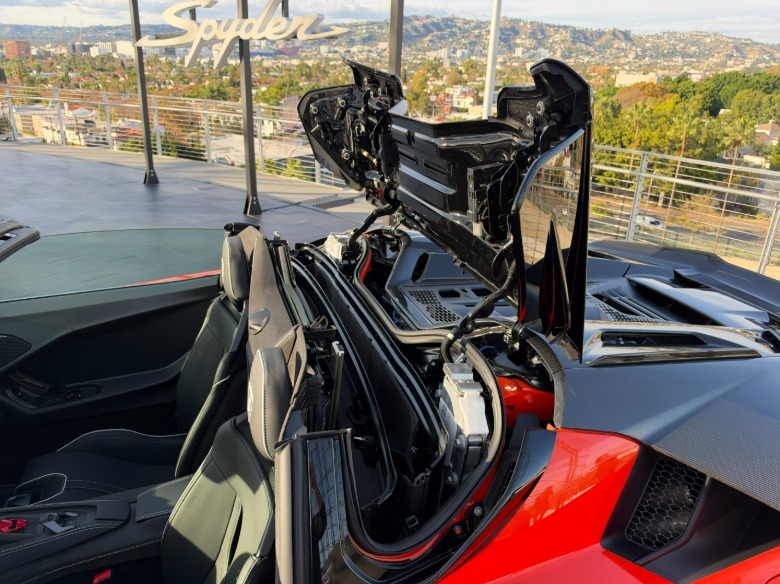
Obviously the real star of the show is the roof, and its patented operating mechanism is unlike any retractable hardtop we've seen before. Instead of the roof sitting flat on top of the rear deck, it's split into two panels that stow vertically behind the seats, ahead of the engine. It uses ten electric actuators instead of needing the traditional electro-hydraulic circuitry, which makes it smoother to operate, quieter and more compact. It's fascinating to watch, especially when you look inside at all of the various components.
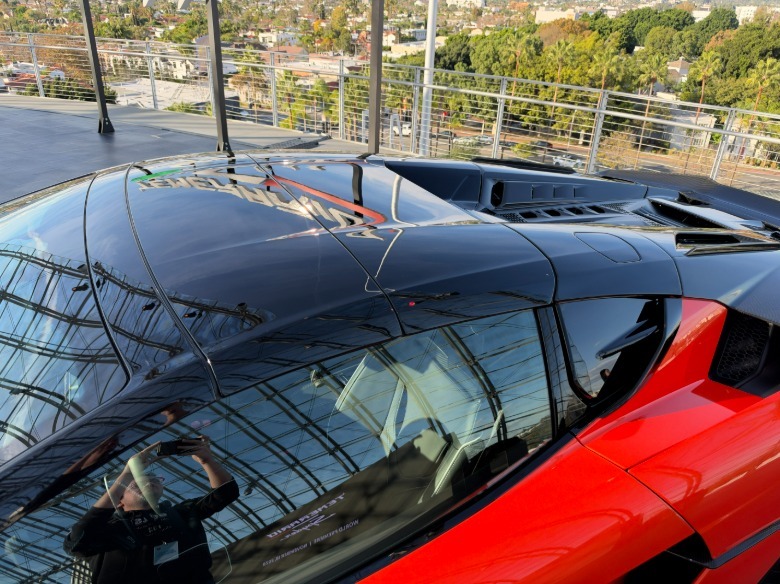 Daniel Golson/Jalopnik
If the Spyder had a normal roof setup, the car's center of gravity would be 0.3 inches taller and 0.4 inches further towards the rear axle when the roof is down, but this vertical configuration means the center of gravity actually drops by a couple tenths of an inch when you open the roof, and weight distribution is unaltered. Lamborghini says it takes about 17 seconds to open the roof and 18 seconds to close it, and it can be done at up to 31 mph. If the roof is up, you can lower the rear window to be able to hear the engine roar without letting all of the elements in.
It's only slightly slower
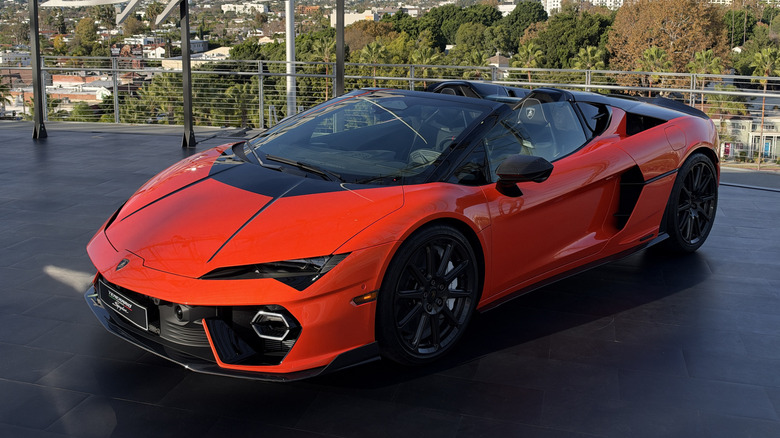
Lamborghini did a lot of work on developing the Spyder's chassis to preserve "the highest levels of structural rigidity and dynamic precision," and the Temerario was designed from the start with the Spyder in mind, so the company didn't have to make too many drastic changes. Compared to the Huracán Spyder, the Temerario has 6% more static torsional rigidity, 6% more dynamic torsional rigidity, and 9% more dynamic bending stiffness of the body shell. Spyder-specific suspension tuning is said to reduce secondary vibrations on uneven surfaces by 20%, as well.
 Daniel Golson/Jalopnik
Powering the Spyder is the same plug-in-hybrid setup as the Temerario coupe. It's got a twin-turbo 4.0-liter V8 engine that revs to 10,000 rpm (or 10,250 when using launch control), with the engine making 789 horsepower on its own. There are two axial-flux electric motors on the front axle and a third motor located between the engine and 8-speed dual-clutch transmission. Total output is 907 hp, just like the coupe, and it has 13 different configurations for the drive modes and hybrid system.
The automaker says the Temerario Spyder is about 220 pounds heavier than the coupe, and there's only a tiny decrease in acceleration performance to go along with it. The Spyder will sprint from 0 to 62 mph in 2.8 seconds according to Lamborghini, just a tenth slower than the coupe, and it's two tenths slower to 124 mph, needing 7.3 seconds to hit that mark. Not bad at all. It'll also reach a top speed of 213 mph, the same as the coupe.
 Daniel Golson/Jalopnik
Spec the Alleggerita package and a bunch of components will be made from carbon-fiber-reinforced polymer, like the front splitter, rear decklid and underbody panels. The door cards are also made from carbon, and if you choose the optional carbon-fiber wheels, total weight savings adds up to 49 pounds.
It'll even warm your neck
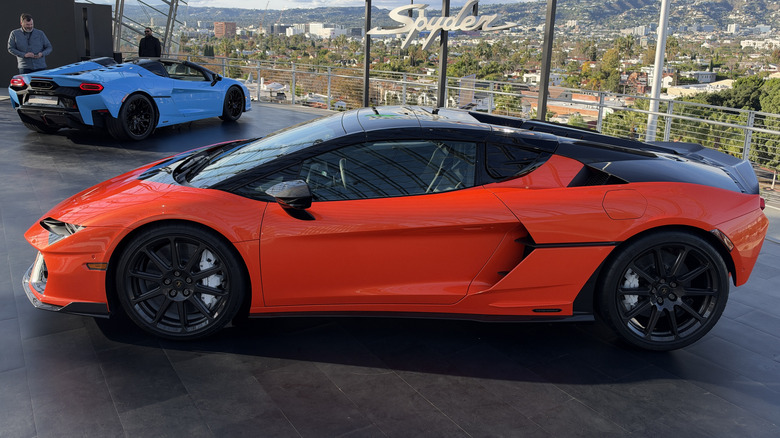
Lamborghini recently announced a new titanium Akrapovič exhaust for the Temerario coupe, which will of course be offered on the Spyder as well. Regarding the Spyder's sound in general, here's what Lamborghini has to say:
With the roof open, the sound of the V8 blends directly with the surrounding environment, while the adjustable rear window makes it possible to modulate the level of aerodynamic protection and the presence of the sound inside the cabin. The result is a more immediate and engaging experience, in which the progression of the engine is perceived by the driver seamlessly, while the sonic pulsations that accompany lift-off phases spread into the surrounding environment, amplifying the emotional character of open-air driving.
The Città, Strada, Sport and Corsa modes each retain a specific acoustic character. In Città and Strada, comfort and consistency of the sound response prevail; in Sport and Corsa, the V8's characteristic orders and the harmonics of the intake system are accentuated, accompanying rising engine speed with an increasingly intense sonic signature. With the roof open, this evolution becomes even more perceptible, turning the sound of the V8 into one of the most authentic expressions of Temerario Spyder's character.
 Daniel Golson/Jalopnik
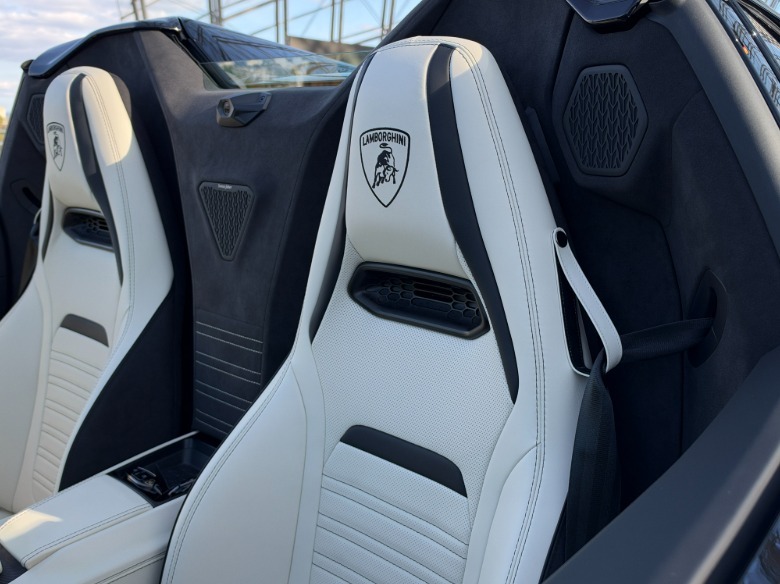
As you're enjoying the wonderful sound, you can also enjoy a new neck warmer integrated into the seats, which has three settings and can reach up to 113 degrees Fahrenheit. The Temerario coupe is already much roomier inside than the Huracán was, and the same is true for the Spyder as well — Lamborghini says people who are 6-foot-7 can comfortably fit in the car, including when the roof is being opened or closed.
We don't know how much the Temerario Spyder will cost when it goes on sale in 2027, but expect to pay a premium of around $50,000 on top of the coupe's $382,000-ish starting price.