

What Are Drivers Supposed To Do When Encountering A 'Narrows' Road Sign?
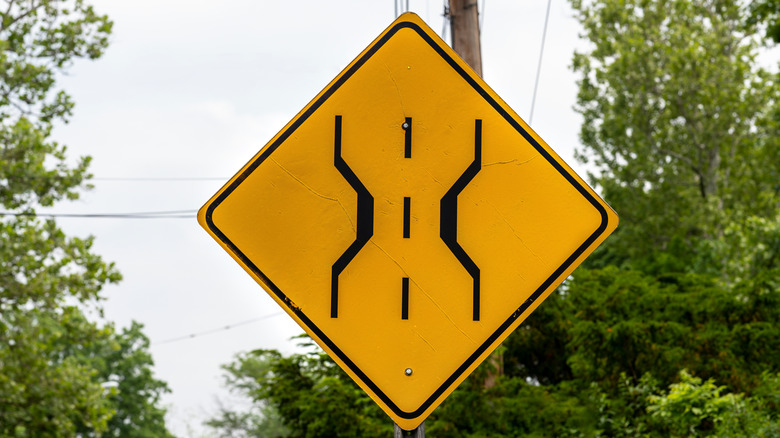
Road signs are short, sweet, and sometimes downright goofy. However, they're not always easy to understand. When a picture is worth a thousand words, deciphering signage with diagonal black-and-yellow stripes or arrows pointing in opposite directions is akin to playing Pictionary with toddlers: what is that shape supposed to mean?! Adding a few words can create even more ambiguity, like Pennsylvania's contribution to the worst road signs list. Which brings us to the narrows.
Various warning signs are used for narrowing roadways. The self-explanatory ones are emblazoned with the phrases "road narrows" and "narrow bridge." Less informative is the pictorial variation featuring an hourglass-like outline that may or may not be accompanied by vertical dashes down the middle — the figure's "hips" reference the road narrowing. Regardless of which version you see, the rules of engagement remain the same: proceed with caution.
The Manual on Uniform Traffic Control Devices (MUTCD), which is managed by the U.S. DOT's Federal Highway Administration (FHWA), sets the standards for all traffic-flow-related communications, including road markings, signs, and signals. Per the MUTCD, Road Narrows signs are part of the W5 series, which includes cautions for underpasses. Standardized to be yellow, warning signs will vary in shape. For the W5s, the MUTCD settled on a diamond.
You'll also find them only in specific places. Plenty of driving lanes narrow and widen, but only when the path is shrunk to a certain width will you come across a W5 sign. The exception is low-volume local streets with speed limits of 30 mph or less. At those speeds, you're likely able to see oncoming traffic.
Squeeze on through, but slowly

According to the MUTCD, a road's width must diminish so abruptly and sharply that opposing traffic cannot simultaneously pass at posted speed limits. For bridges, culverts, and underpasses, warnings are issued following the surface-street rules, as well as when the two-way road's clearance is 16 to 18 feet across. This measurement includes the shoulder, if there is one.
The guidance suggests warnings be posted roughly 155 to 325 feet ahead of narrowings in 25 mph sections and up to 990 feet in 55 mph sectors. If visibility is impaired due to curves or grades, those distances can be adjusted. In construction zones, especially dangerous highway work, the W5s switch to work-zone orange and should appear prior to lane tapers, while a second reminder can be placed closer to the work area.
So, what should you do when you see a narrows sign? Because it's not a road closure and the number of lanes can be unchanged, you simply continue on. Just keep your vehicle centered and take things slow and easy, especially if there's oncoming traffic. If a large vehicle approaches, like a bus or truck, consider yielding and letting it through. Room to pass will be limited, even if there is a shoulder.
On bridges, stick to your side of the road, reduce your speed, and definitely watch out for outside mirrors. If the bridge is too narrow for two vehicles, the rule of thumb is whoever arrives first gets dibs. If there's no room, there's no point in forcing your way through. Although these signs don't say how long the road narrows, the early heads-up gives you time to prepare.